5 pounds 1961 specimen
Market Prices
About This Note
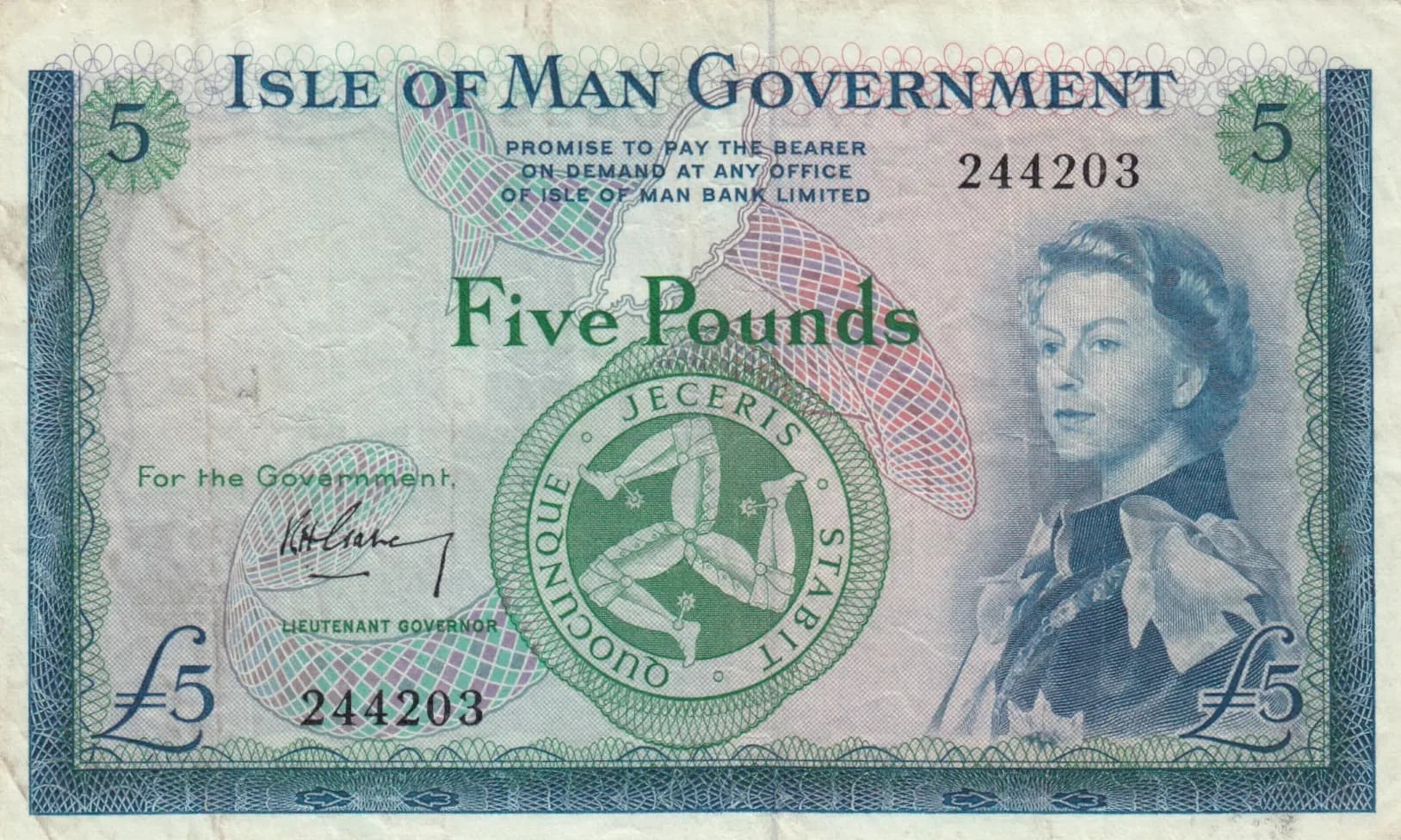
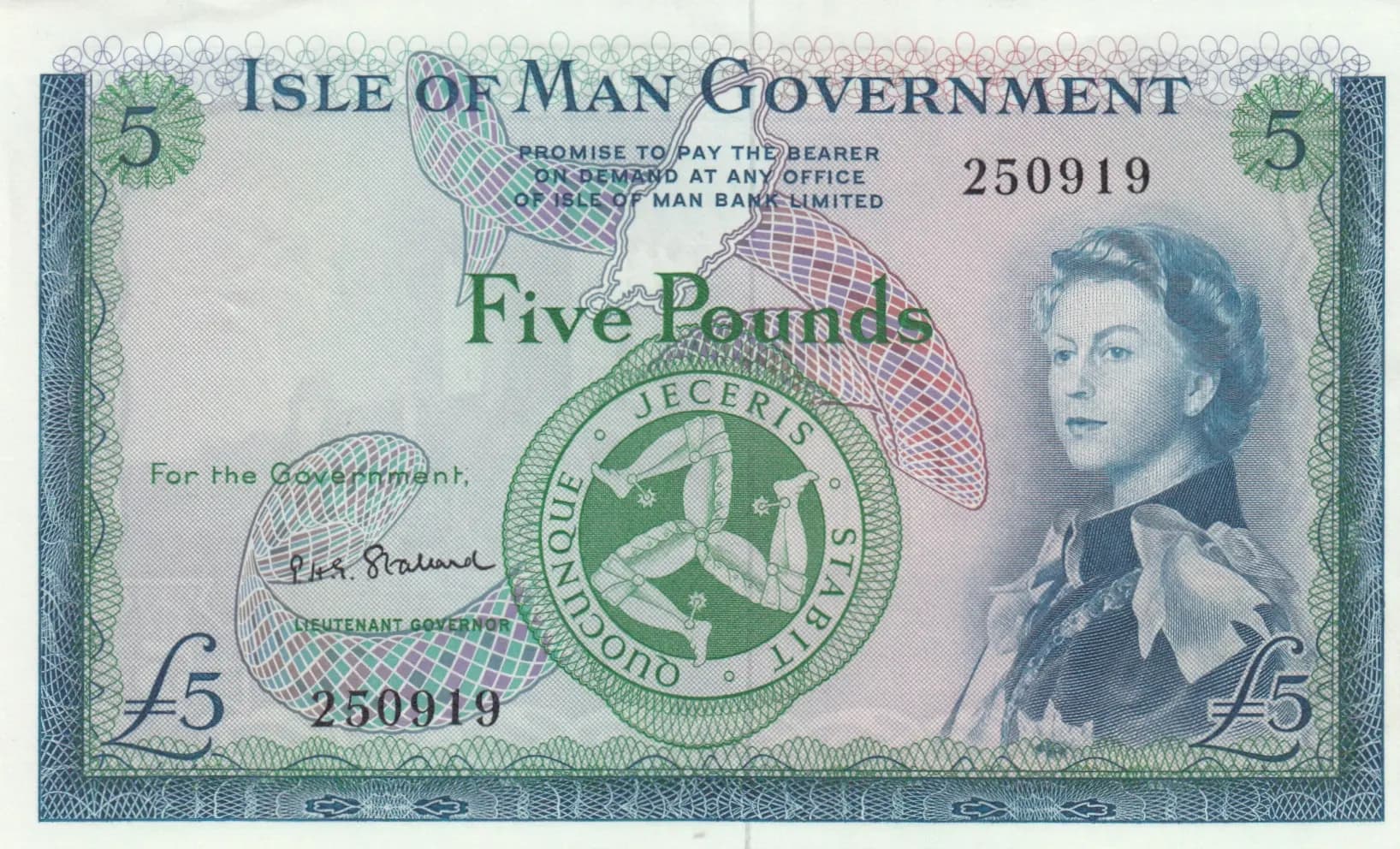
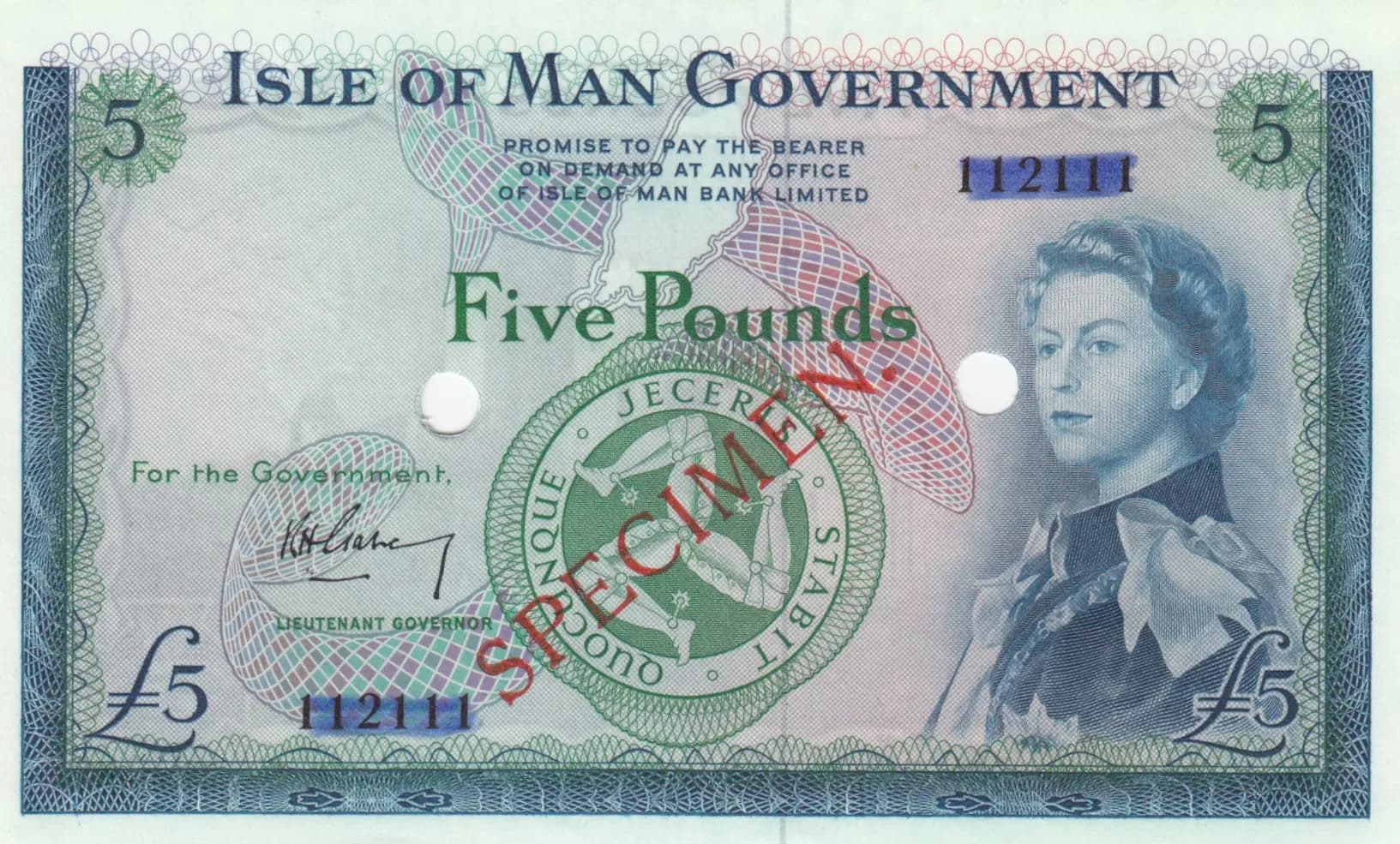
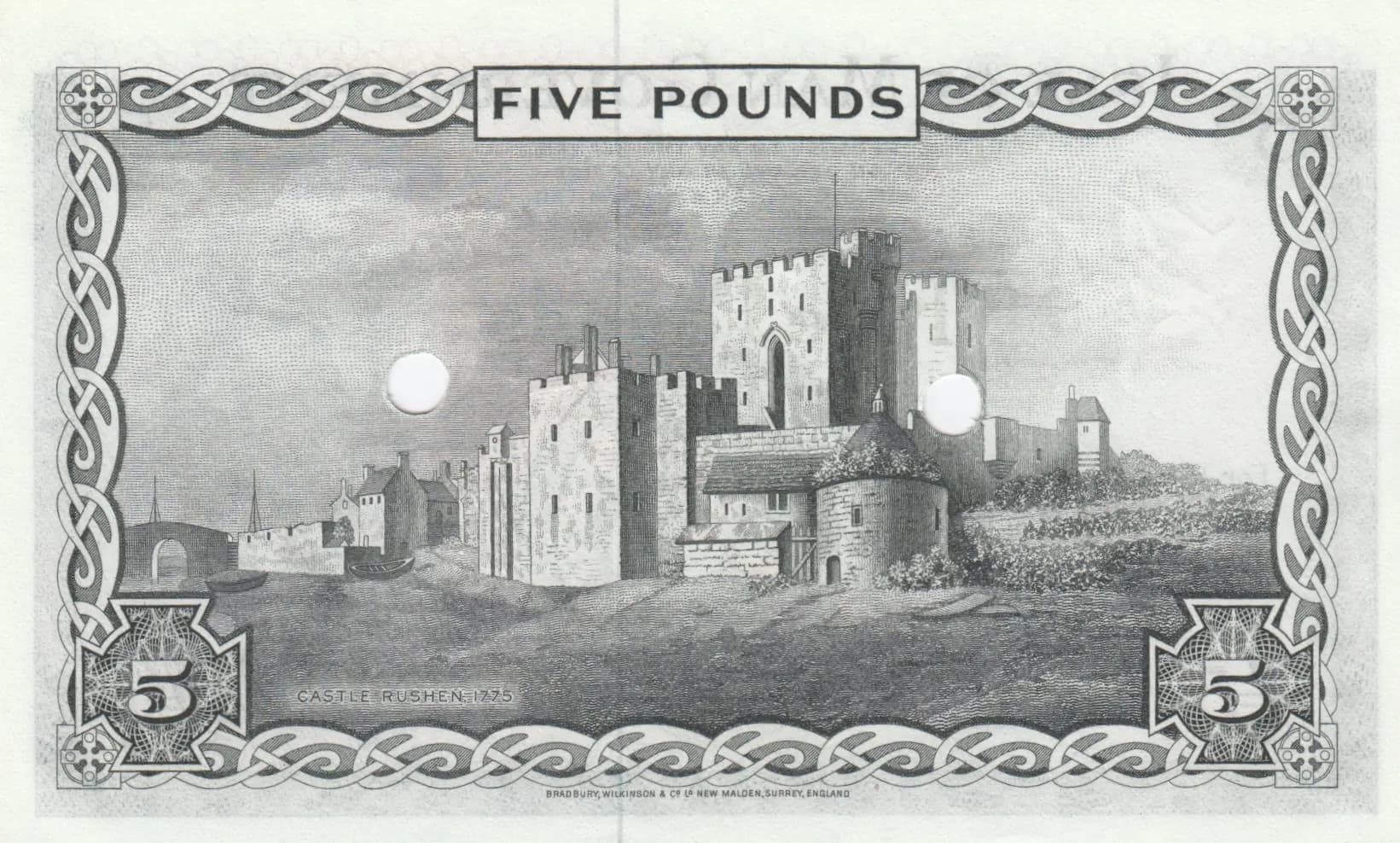
This is a 1961 Isle of Man Government 5 Pounds specimen note (Pick P-26as) in uncirculated condition, featuring a young portrait of Queen Elizabeth II on the obverse and a detailed engraved depiction of Castle Rushen dated 1775 on the reverse. The specimen is marked with the characteristic red "SPECIMEN" overprint and two circular punch holes typical of specimen currency handling, yet remains in pristine condition with crisp, clear printing throughout. This early example of Isle of Man currency represents an important piece of the island's monetary history and is notable for its fine intaglio work by Bradbury Wilkinson.
Common. While this is a specimen note from 1961, the catalog price data and eBay market listings indicate these notes are not particularly scarce. eBay listings show UNC specimens trading in the range of $17.99 to $350.00 USD, with most examples in the $18–$45 range, and even the 2019 catalog value for UNC is $1,650—a figure that reflects the specimen designation rather than extreme rarity. The fact that multiple UNC examples are regularly available on eBay at modest prices indicates healthy supply. Specimen notes were produced in reasonable quantities for distribution to banks and collectors, and the Isle of Man's government banknotes, while historically interesting, were not produced in limited quantities that would justify a 'rare' classification.
Issued in 1961 by the Isle of Man Government through Isle of Man Bank Limited, this note reflects the island's assertion of monetary independence and cultural identity during the post-war period. The obverse features a young Queen Elizabeth II, acknowledging the Crown's role in Isle of Man governance, while the reverse's prominent depiction of Castle Rushen—a 13th-century medieval fortress and the seat of the island's House of Keys—emphasizes Manx historical heritage and sovereignty. The 1775 date on the castle engraving places emphasis on the Enlightenment era, a period of significant development in Isle of Man's self-governance.
The obverse features a formal portrait of Queen Elizabeth II in her youth, rendered in blue and grey tones and positioned toward the right side of the note. The central composition includes an Isle of Man map outline in the upper center, with a circular seal bearing 'ISLE OF MAN' text around its perimeter. The design employs green and red coloring with ornamental corner designs featuring curved patterns and fine line work. The reverse presents a detailed black and white intaglio engraving of Castle Rushen as it appeared in 1775, depicted from a landscape perspective showing the medieval fortification's multiple towers, crenellations, stone walls, internal buildings, surrounding landscape, and water features (moat or harbor) on the left. Celtic knot-pattern borders frame all sides of the reverse, with decorative shields containing the numeral '5' in the lower corners, emphasizing the Manx cultural identity through traditional Celtic ornamentation.
FRONT SIDE: 'ISLE OF MAN GOVERNMENT' — Isle of Man Government; 'PROMISE TO PAY THE BEARER ON DEMAND AT ANY OFFICE OF ISLE OF MAN BANK LIMITED' — Promise to pay the bearer on demand at any office of Isle of Man Bank Limited; 'Five Pounds' and '£5' — denominations in words and symbols; 'For the Government,' and 'LIEUTENANT GOVERNOR' — issuing authority signature line; 'SPECIMEN' — specimen designation overprint. REVERSE SIDE: 'FIVE POUNDS' — denomination; 'CASTLE RUSHEN, 1775' — identification of the depicted landmark and historical date; 'BRADBURY, WILKINSON & CO LTD NEW MALDEN, SURREY, ENGLAND' — printer attribution; '5' — corner denomination numerals.
Intaglio (recess) printing, the primary security printing method used for banknotes of this era. Bradbury Wilkinson & Co Ltd, a renowned British security printer located in New Malden, Surrey, executed the work. The visual analysis confirms the characteristic features of intaglio printing: intricate fine line patterns, cross-hatching for tonal variation and depth, precise multi-color registration on the obverse (green, blue, red, grey), and exceptionally detailed landscape engraving on the reverse. The crispness of the printing and the fine detail visible in both the portrait and castle engraving are consistent with the highest standards of mid-20th-century intaglio security printing.
This note is cataloged as Pick P-26as, where the 's' suffix denotes it as a specimen note. The visual analysis confirms the specimen designation through the red 'SPECIMEN' overprint and the two circular punch holes, which are standard specimen handling marks. The PMG population report indicates at least six known variants for this base Pick number (P-26a, P-26b, P-26cts, P-26s1, P-26s2, P-26s3), all printed by Bradbury Wilkinson (BWC). This specific example appears to fall within the standard specimen variant category. The serial number visible in the upper right corner (described as '112111' in the analysis) follows the format consistent with other notes of this issue. No overprints, dates, or other distinguishing features suggest a further sub-variety beyond the standard P-26as specimen classification.