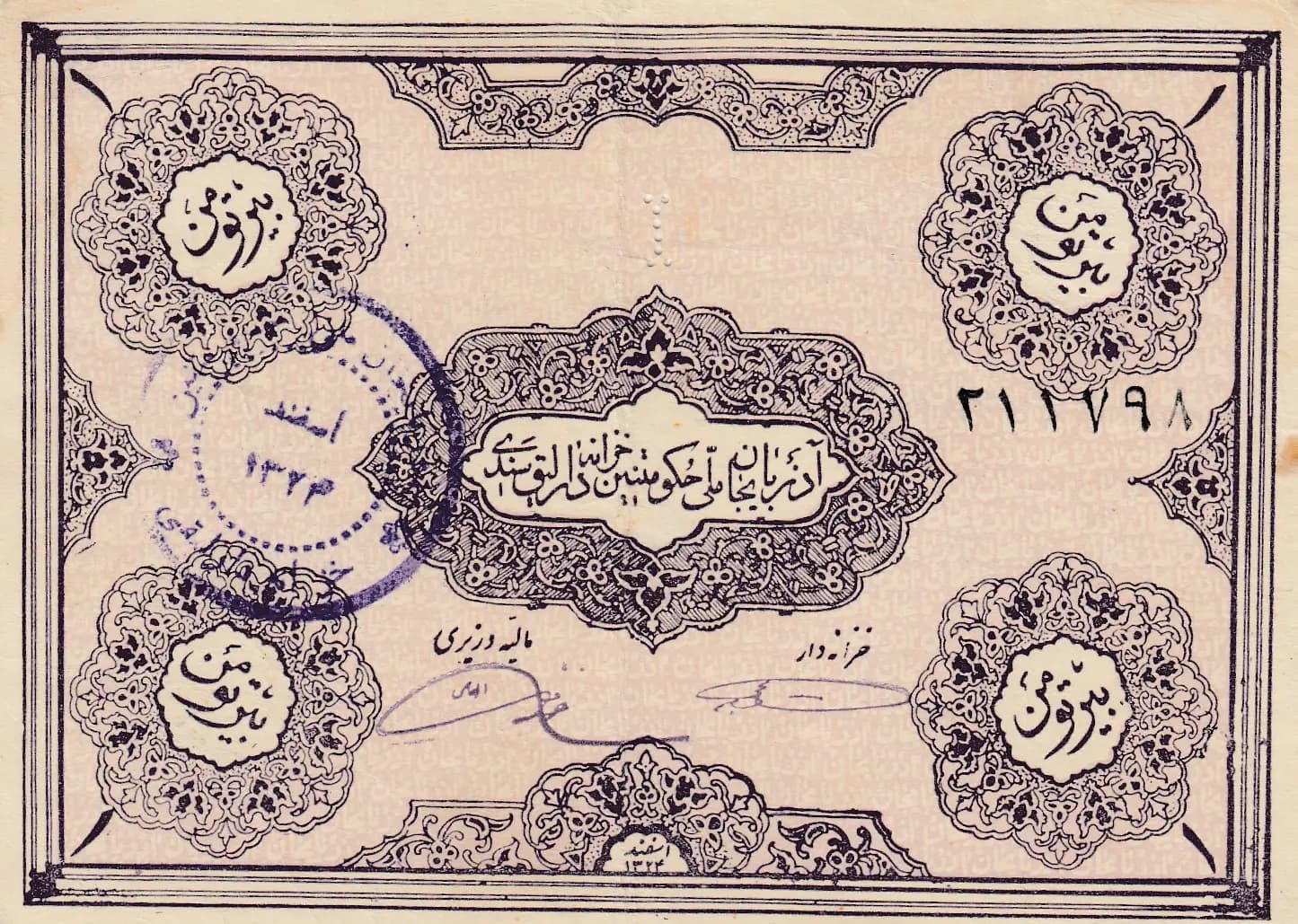
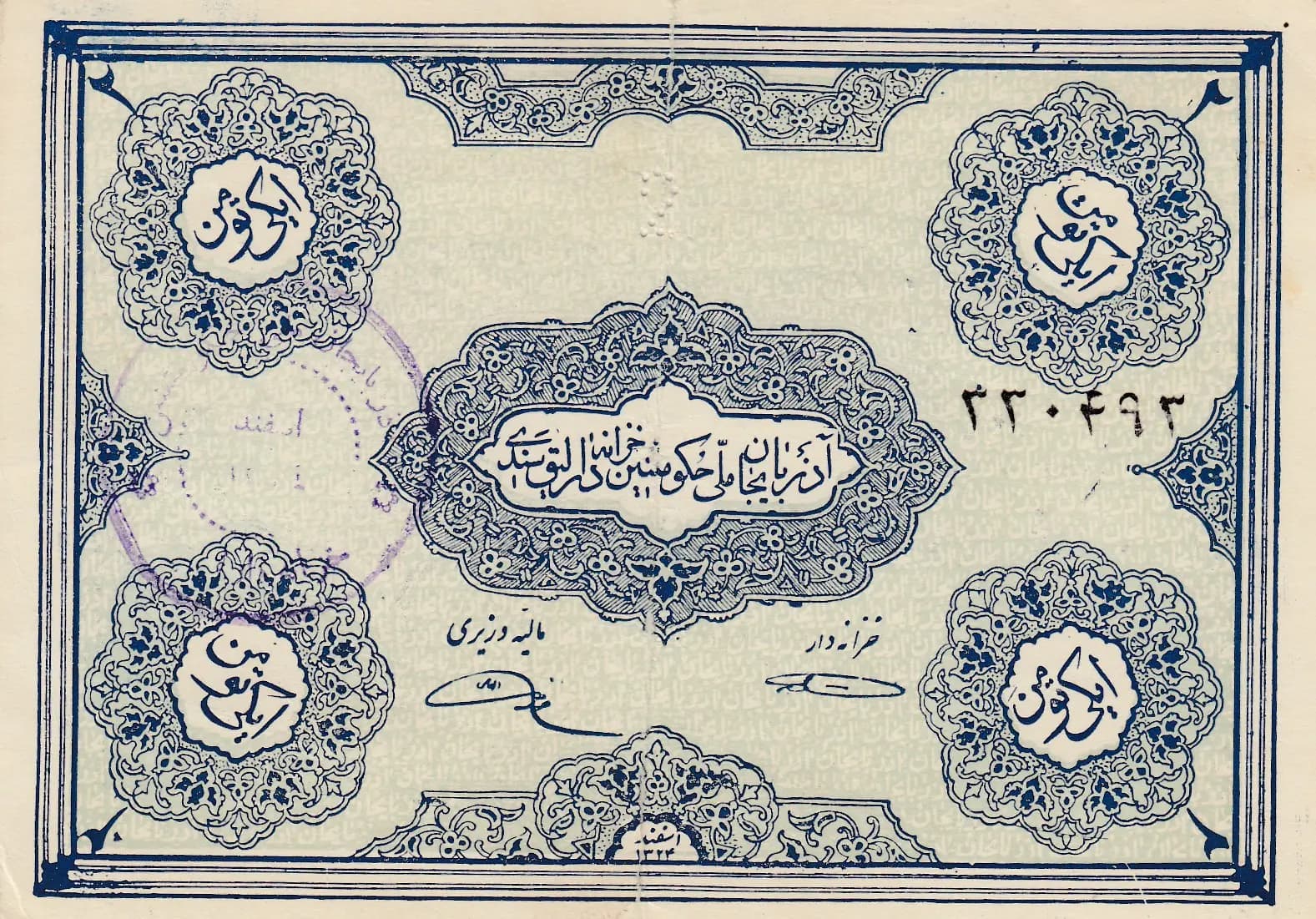
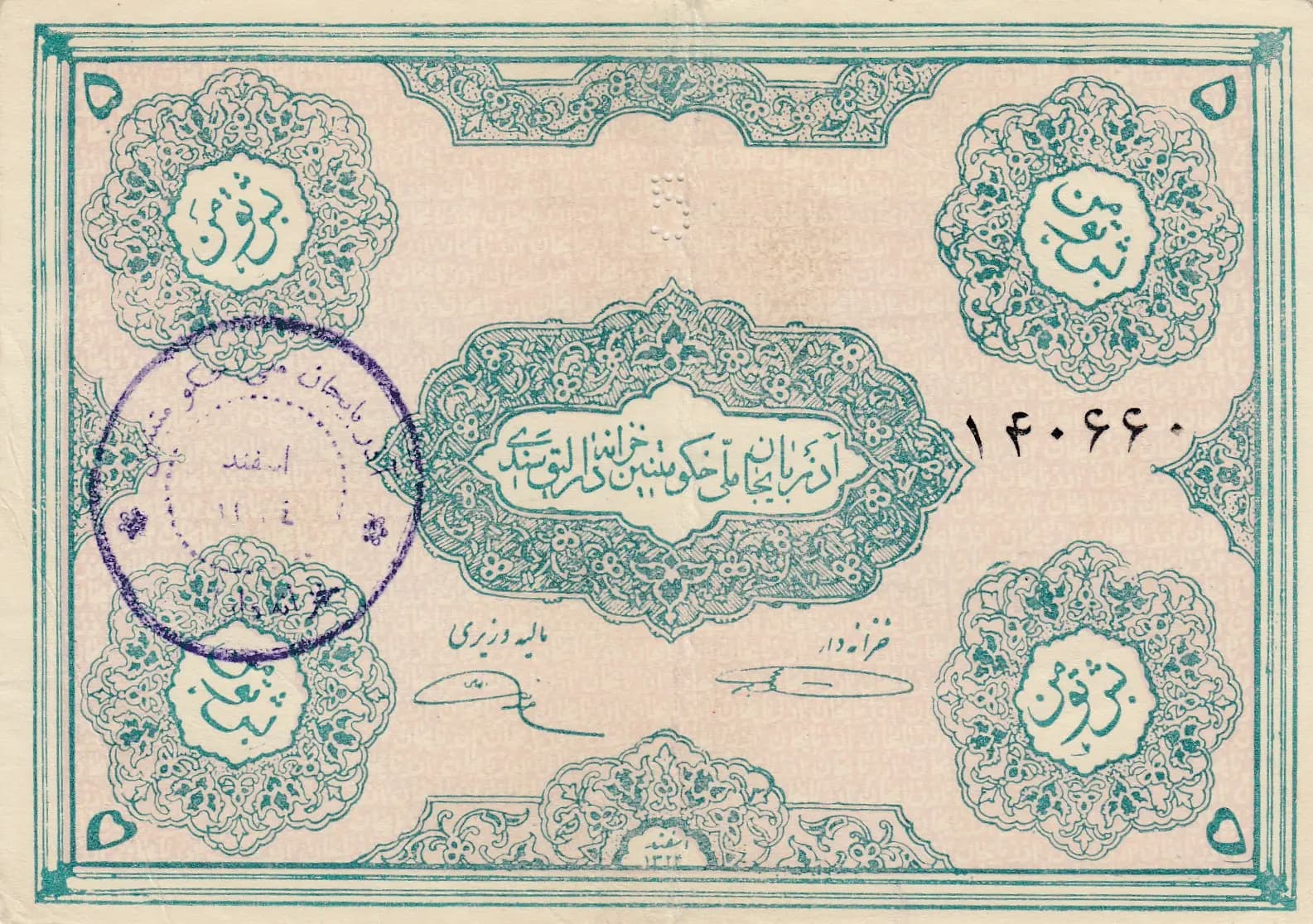
50 toman 1946
About This Note
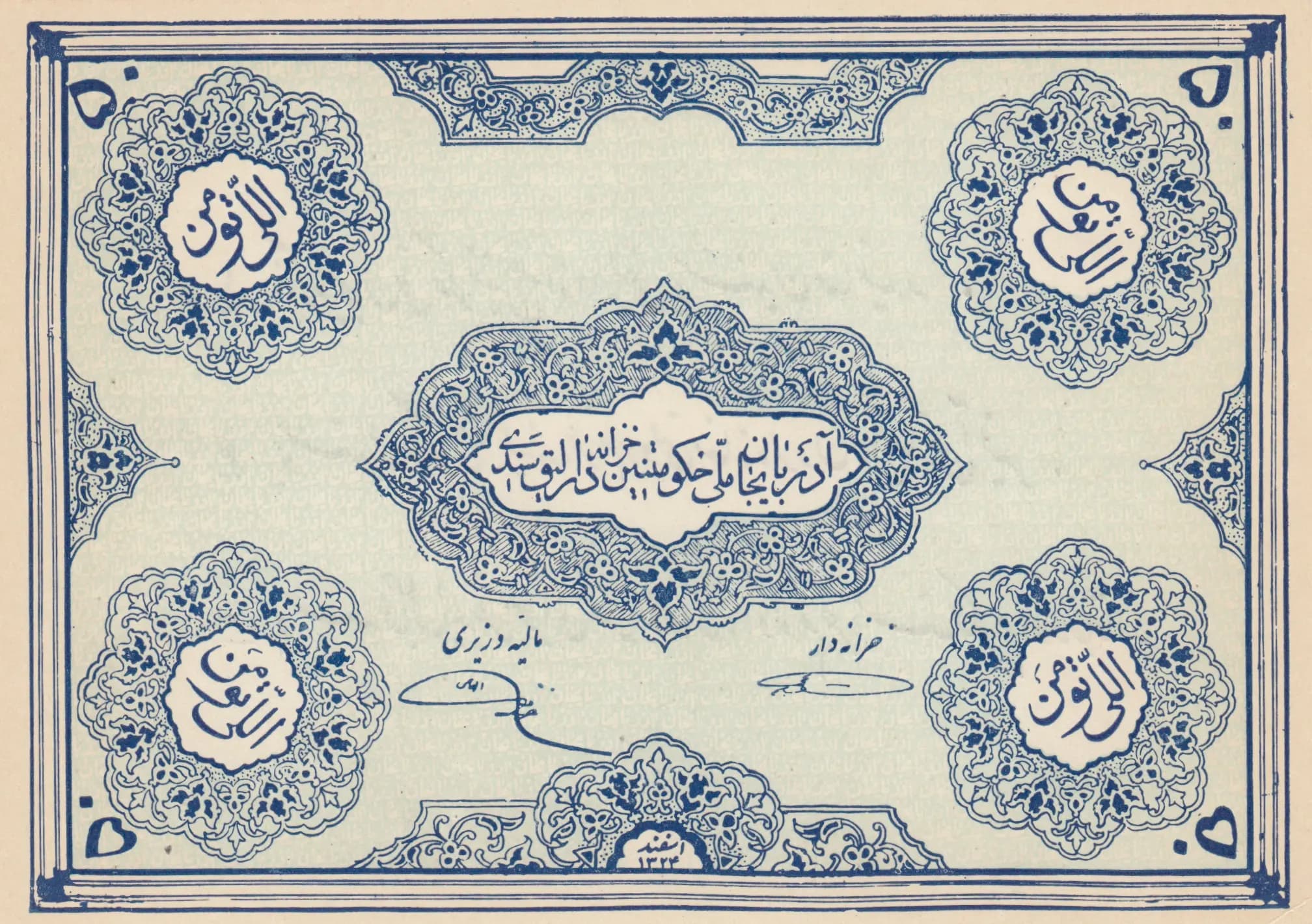
This is a striking 50 Toman banknote issued by the short-lived Iranian Azerbaijan Autonomous Government in 1946, presented in uncirculated condition with excellent preservation. The note showcases an elegant design dominated by ornate Persian calligraphy within decorative medallions and cartouches rendered in navy blue ink on a cream background, with visible watermark elements and fine engraving throughout. This historically significant piece represents one of the most visually distinctive regional currency issues of the immediate post-WWII period in the Middle East.
This note is classified as UNCOMMON to SCARCE in uncirculated condition. While the Iranian Azerbaijan Autonomous Government's currency issues are not extremely rare, the Pick P-S106r in UNC grade represents a relatively limited survival pool. The brief 1946 lifespan of this issuing authority, combined with the political instability of the period and subsequent currency recall and replacement, means that pristine examples like this one have seen limited circulation among collectors. Most surviving examples exhibit handling wear from the short period of actual use before the government's dissolution. UNC specimens represent perhaps 5-10% of remaining examples, making this grade notably more challenging to acquire than circulated or heavily used examples.
The Iranian Azerbaijan Autonomous Government existed briefly from 1945-1946, a Soviet-backed separatist entity during the Azerbaijan Crisis following World War II. The note's inscriptions reference 'Eastern and Western Azerbaijan Islamic State,' reflecting the territorial claims of this short-lived political entity that ultimately collapsed when Soviet forces withdrew and Iranian central authority was reasserted. The use of Persian calligraphy and references to Islamic governance on the reverse text underscore the complex interplay between regional autonomy movements and Persian cultural identity during this turbulent Cold War emergence period.
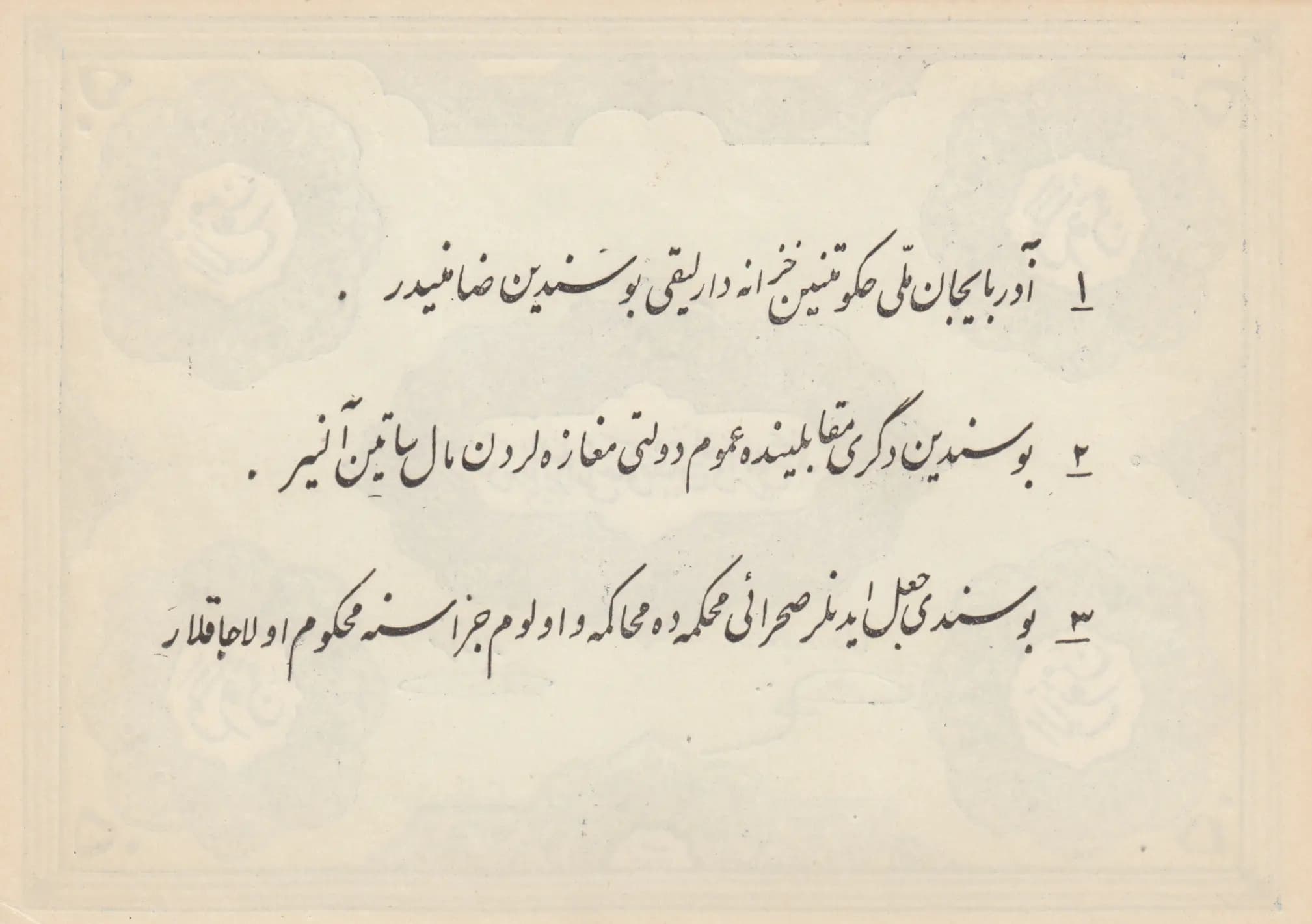
The obverse presents a masterwork of Persian decorative arts applied to currency design. Five identical ornamental medallions—positioned in each corner and at the bottom center—each contain Persian script within intricate circular floral borders executed with fine guilloché patterns. The central element features a large decorative cartouche with scalloped edges displaying the primary denomination text. The entire composition is framed by double-line borders with elaborate corner flourishes in the classical Persian architectural tradition. No portraits appear on this note; instead, the design relies entirely on geometric and floral ornamentation typical of Islamic artistic conventions. The reverse is a text page presenting legal/constitutional information in traditional Persian typography. The cream/beige stock and navy blue ink create a sophisticated, formal appearance befitting an official state currency.
FRONT SIDE: Central inscription reads 'آذربایجان شرقی و غربی دولت اسلامی' (Eastern and Western Azerbaijan Islamic State). Denomination inscribed as 'پنجاه' (Fifty). Additional inscriptions include references to 'خراسان' (Khurasan) and 'والی درزی' (enduring/lasting). BACK SIDE: Contains three lines of Persian legal/constitutional text appearing to describe the authority and regulations governing the note's issuance by the Islamic Government of Eastern and Western Azerbaijan, with references to governmental council approval and legal standing. The exact transliteration of the reverse text is challenging due to historical typesetting conventions, but the content appears to be boilerplate legal language regarding the note's official status and authorization.
This note was produced using fine line engraving with guilloché (engine-turned) pattern techniques, evidenced by the intricate geometric backgrounds visible in the medallions and borders. The consistent line weight and precision of the ornamental elements indicate classical intaglio printing, likely combined with letterpress for the reverse text. The watermark visible as lighter circular patterns in the background suggests paper manufactured specifically for currency use. While the specific security printer is not definitively documented in readily available sources, the high quality of execution suggests a capable European or international security printer, possibly contracted by the Soviet-backed Azerbaijani government or sourced from existing press facilities.
The Pick P-S106r designation with the 'r' suffix indicates this is a recorded variety or reverse design variant. As the note displays the legal text reverse as described, this appears to be the standard cataloged version for this denomination and issuer. No visible signature varieties, overprints, or serial number prefixes are evident from the provided visual analysis that would indicate additional sub-varieties. The absence of clearly visible serial numbers in the images prevents determination of any serial number prefix variants that might exist for this issue. Researchers should consult specialized Azerbaijan currency catalogs or the Pick catalog's detailed notes for information regarding any known printing variations, watermark differences, or signature variants within the P-S106 series.