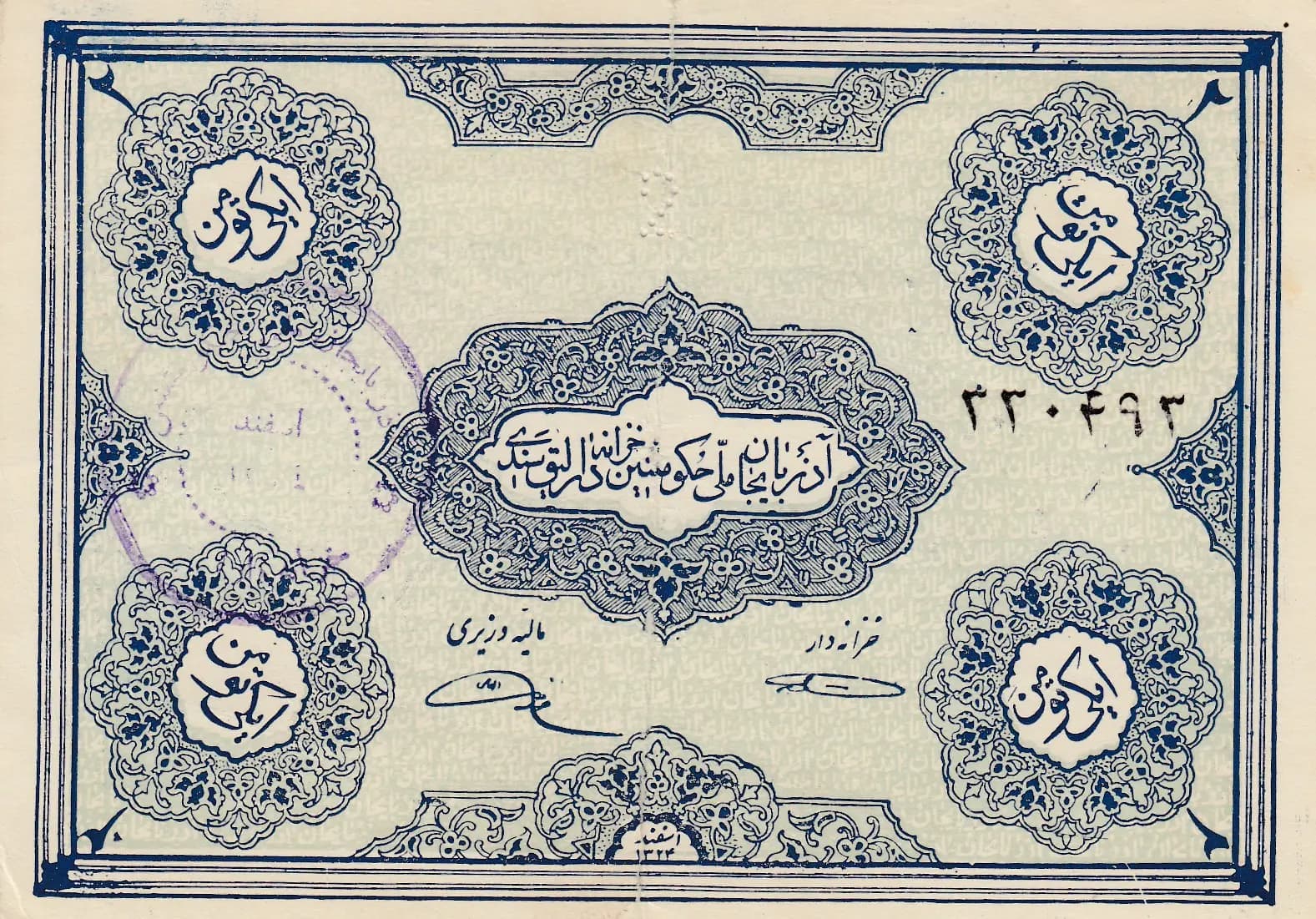
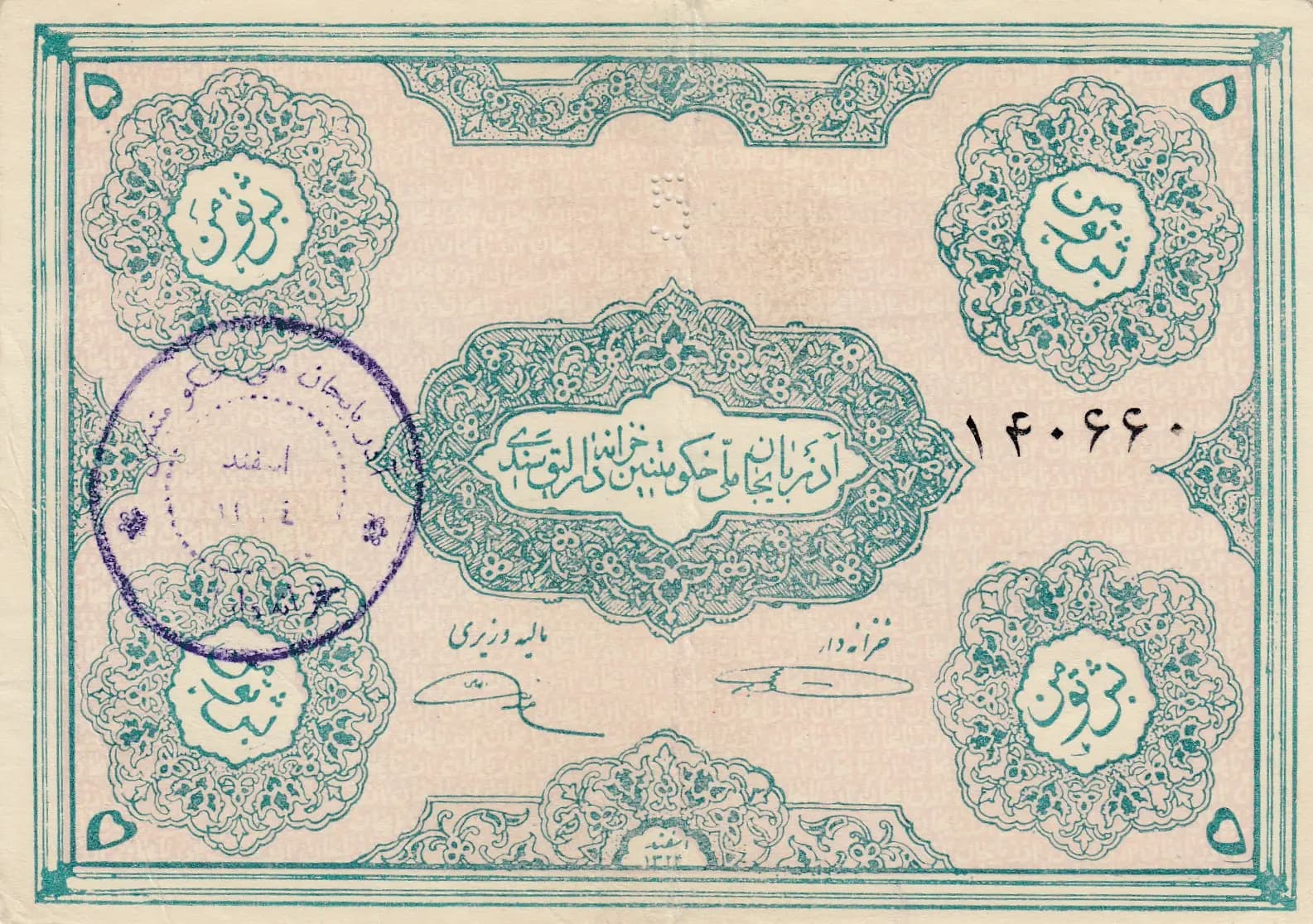
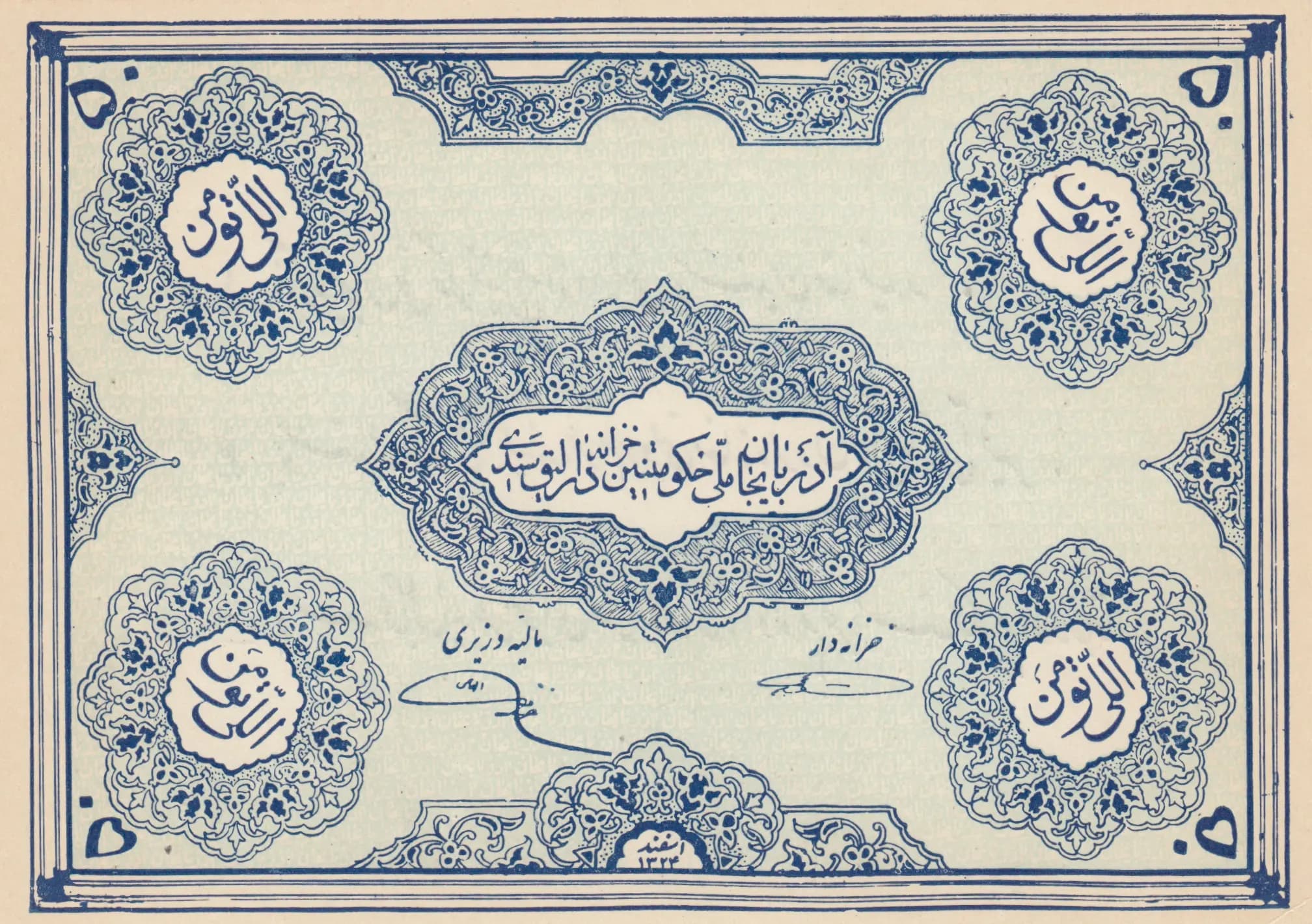
1 toman 1946
About This Note
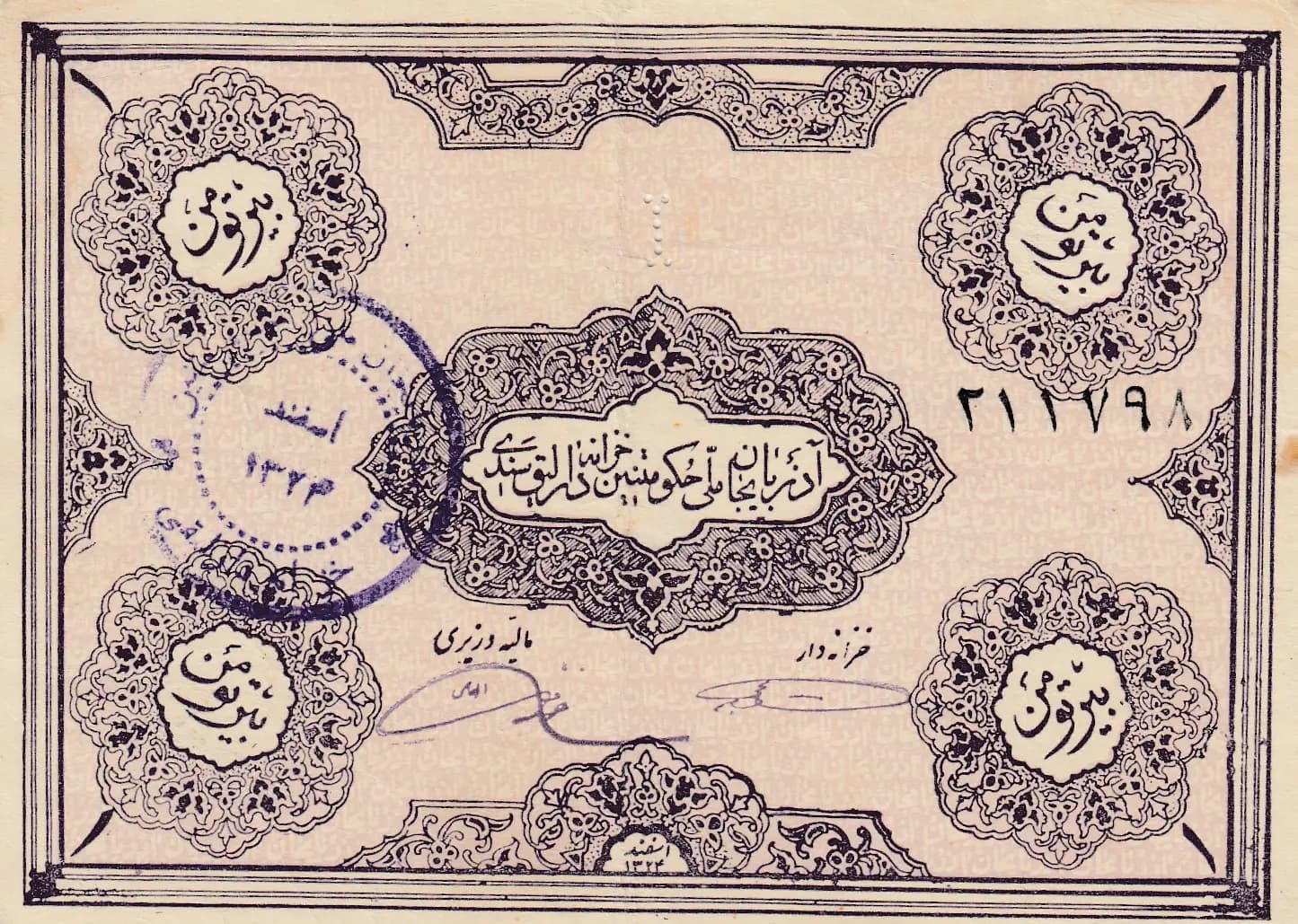
This is a 1 Toman note from the short-lived Iranian Azerbaijan Autonomous Government, issued in 1946 during a brief period of regional autonomy. The note features an elegant ornate design with Persian/Islamic decorative elements including corner medallions and a central cartouche, rendered in black ink on aged cream-colored paper. The VF condition grade is appropriate given visible aging, foxing, and historical handling marks, though the note retains strong structural integrity and legibility.
Uncommon. The Iranian Azerbaijan Autonomous Government existed for only approximately 12 months (1945-1946) before political collapse and Soviet withdrawal, resulting in a limited window for currency production and circulation. This specific 1 Toman denomination likely saw modest print runs compared to standard national currencies. However, the note is not extremely rare, as some examples have survived and appear in numismatic collections. The Pick catalog S102a designation indicates this is a recognized type, suggesting multiple examples are known to exist. Surviving examples in VF condition command moderate collector interest due to the note's historical significance as a short-lived autonomous government's currency, but supply appears sufficient that the note cannot be classified as rare or very rare.
This note was issued during the Iranian Azerbaijan Autonomous Government's brief existence (1945-1946), a period of Soviet-backed autonomy that ultimately failed when Soviet forces withdrew. The ornate Persian calligraphic design and formal governmental styling reflect the administrative legitimacy the autonomous government attempted to project through currency. The use of Persian language and Islamic geometric patterns throughout the design emphasizes cultural continuity despite the political circumstances of issuance.
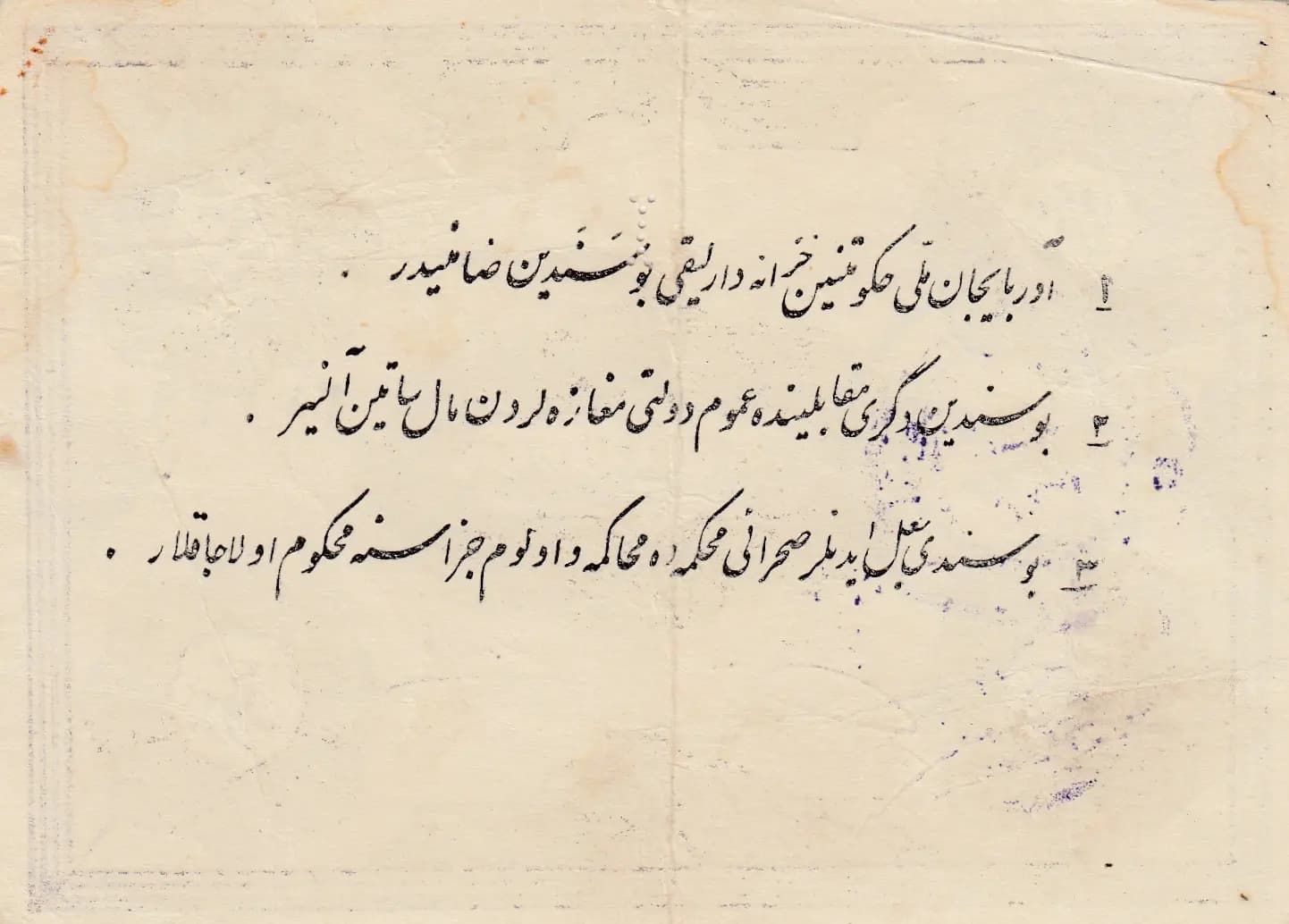
The note employs a highly symmetrical, ornate design characteristic of Persian/Islamic artistic traditions. The front features four large scalloped circular medallions positioned at the corners, each containing Persian script within decorative floral borders. A fifth circular medallion is centered at the bottom. The dominant feature is a large rectangular central cartouche with elaborate scrollwork and floral elements, surrounded by a double-line border framing the entire composition. The back presents three lines of formal calligraphic Persian text, likely containing constitutional or authorization language. No portraits of individuals are depicted; instead, the design relies on ornamental complexity and administrative text as its security and identity features. The geometric and floral patterns follow classical Islamic design principles common to Persian governmental documents of the period.
Front side: The central cartouche and corner medallions contain Persian administrative text, including references to 'Khazandar' (Treasurer) and 'Vizier' (Ministry), suggesting this note carries official governmental authorization marks. A serial or reference number '21198' appears in Persian numerals. The precise transcription and complete translation of the calligraphic inscriptions in the corner medallions would require expert paleographic analysis of the historical Persian script employed. Back side: The reverse contains three lines of formal Persian calligraphic text in classical administrative style. The exact content requires specialized expertise in mid-20th century Persian paleography, but the formal structure and length suggest this contains legal or authorization text typical of governmental banknote issuances.
This note was produced using traditional letterpress or intaglio printing methods typical of mid-1940s banknote production. The fine detail work visible in the ornate borders, scalloped medallion frames, and decorative cartouche elements, combined with the sharp ink definition observed in the visual analysis, indicates professional security printing. The printer is not definitively identified in the catalog data, but such governmental currency for regional authorities was typically produced by established security printers, possibly including international firms or Soviet-backed printers given the geopolitical context. The consistent black ink application and clean line work suggest a single-color intaglio or enhanced letterpress production.
The Pick number P-S102a indicates this is variety 'a' of the 1 Toman Iranian Azerbaijan note. Specific variety differentiation within Pick S102 would be based on signature combinations, overprint differences, or serial number prefixes. The observed serial number '21198' and the manuscript annotations visible in the upper left area (appearing as blue/purple marks) may indicate later cataloging or collection marks rather than original printing varieties. Without comparison to other known examples of P-S102a, b, c, etc., precise variety identification cannot be definitively established from this single specimen, but the formal characteristics (design, calligraphy, paper stock) appear consistent with the established P-S102a type.