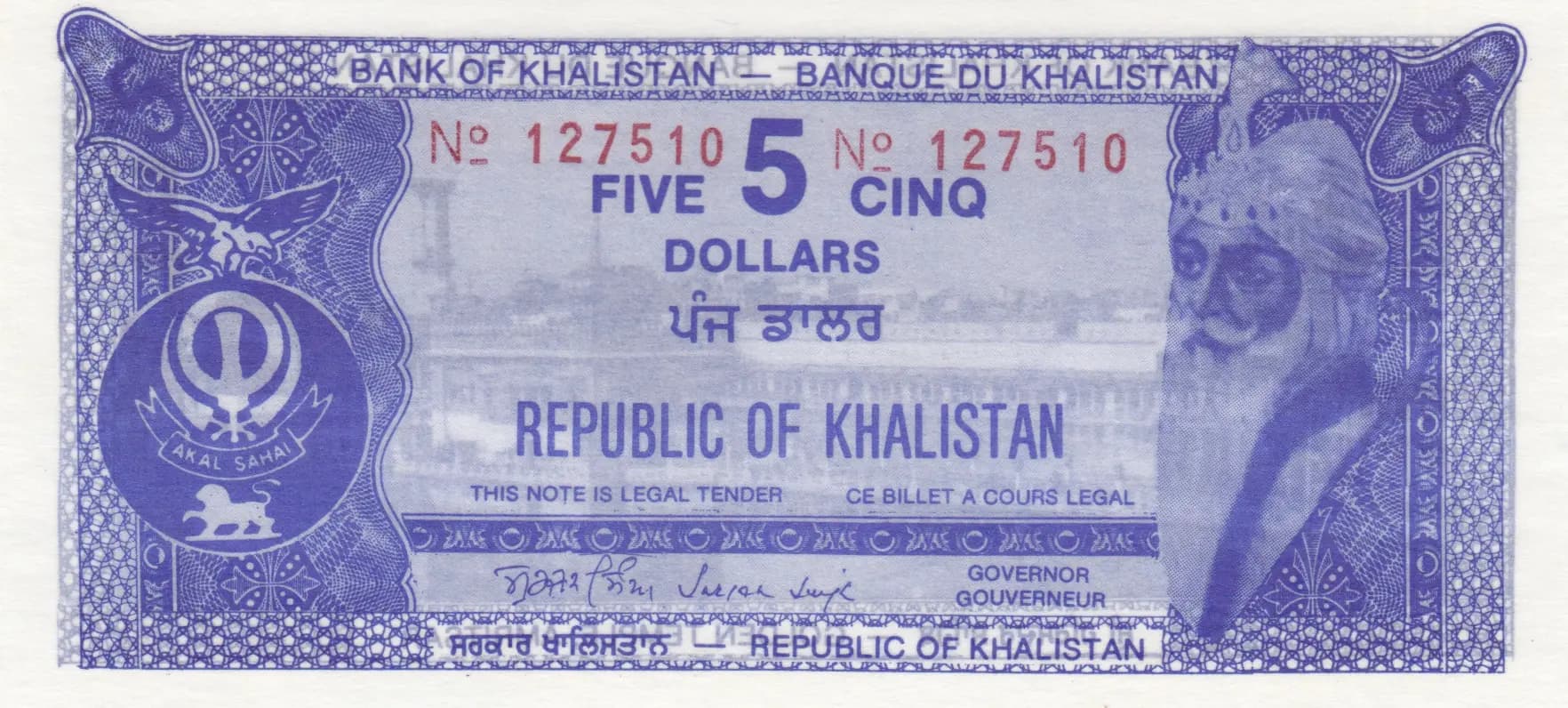
5 dollars 1980's
About This Note
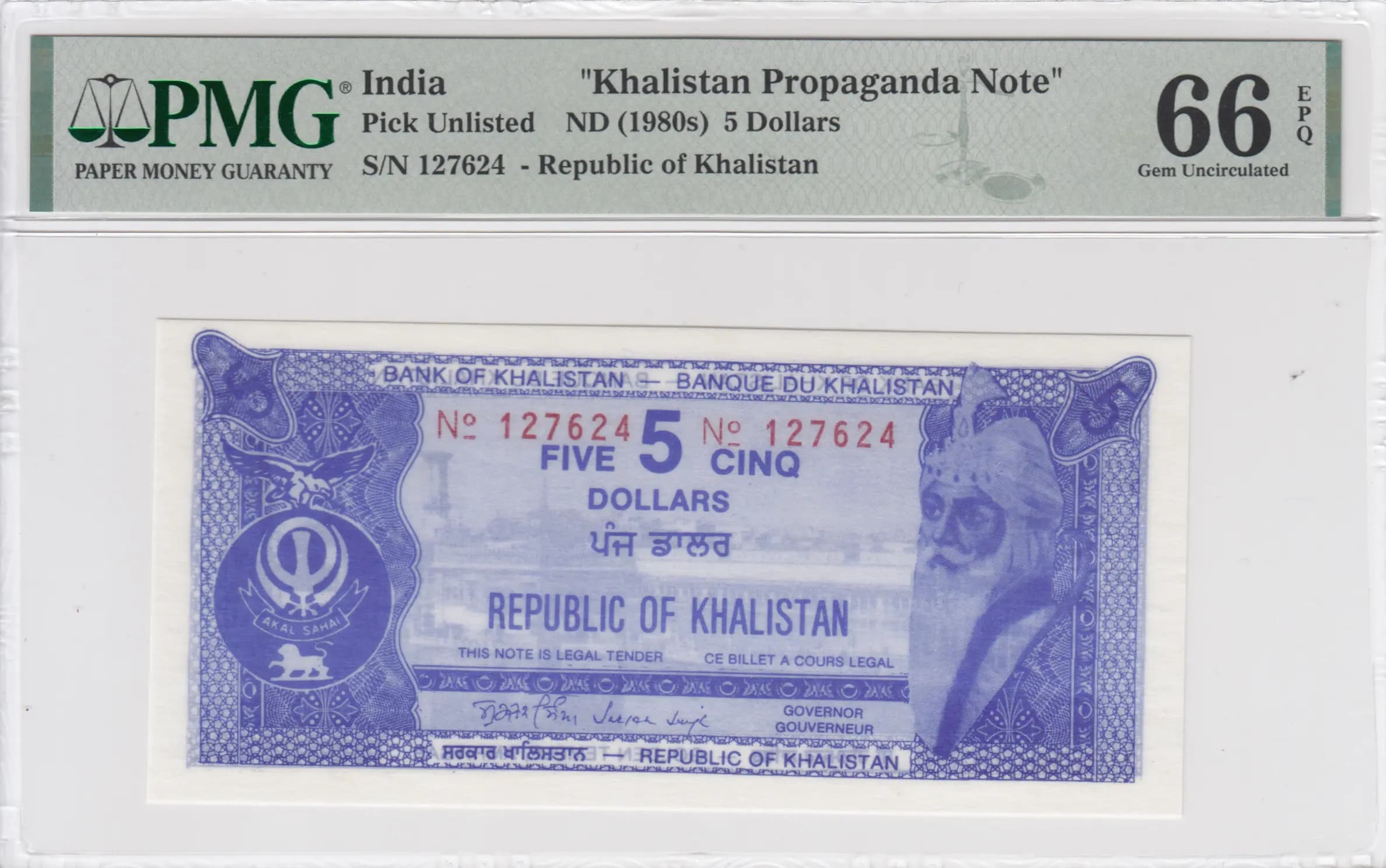
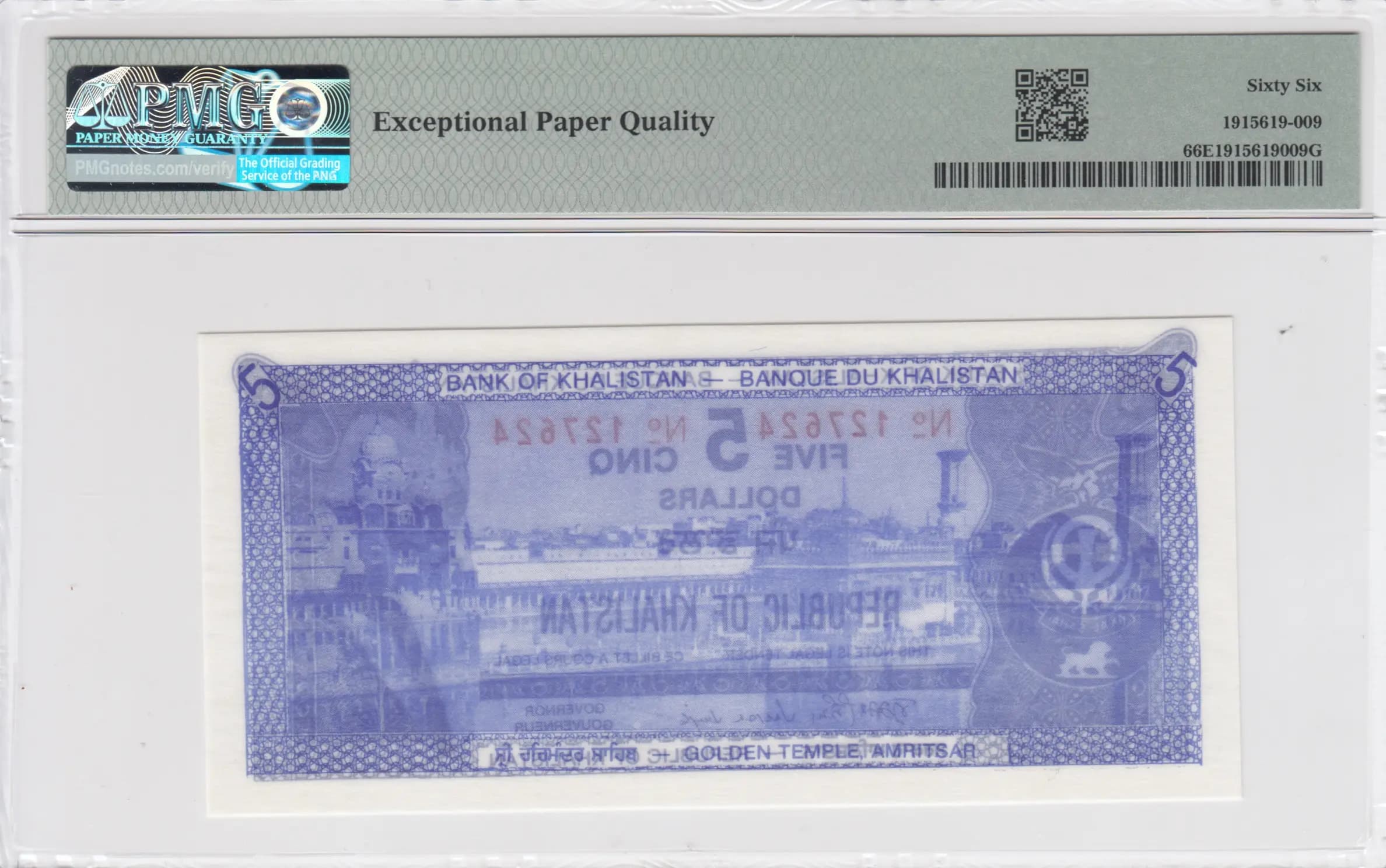
This is a scarce Bank of Khalistan 5 Dollar note from 1980, graded PMG 66 EPQ and representing an unlisted Pick catalog entry. The note features striking blue-purple coloring with the Khanda symbol and a bearded historical figure in profile on the obverse, while the reverse depicts the Golden Temple of Amritsar—making it a significant piece of Sikh cultural and political history. In this near-gem uncirculated condition with sharp printing and vibrant colors, this note represents a notable example from a short-lived separatist currency experiment.
Rare. The Bank of Khalistan notes were produced in limited quantities during a brief period in the 1980s by an unrecognized political entity. These notes were never legal tender and had no actual circulation, resulting in very limited print runs. The fact that this Pick number is unlisted in standard catalogs combined with the ephemeral nature of the Khalistan movement and its currency issuance indicates this note was produced in small quantities. The PMG 66 EPQ grade further elevates its desirability as most surviving examples would show age or handling.
The Bank of Khalistan notes were issued during the 1980s when the Khalistan movement sought an independent Sikh state in Punjab, India. The front features a portrait of what is likely a significant Khalistan movement figure, while the reverse prominently displays the Harmandir Sahib (Golden Temple) in Amritsar, the holiest shrine in Sikhism—symbolizing the religious and political aspirations of the movement. These notes were never accepted as legal tender by any recognized government and represent a historical artifact of a geopolitical movement that peaked during this era.
The obverse features a predominantly blue field with ornamental geometric borders. On the left side is a circular emblem containing the Khanda symbol (the central religious emblem of Sikhism consisting of a double-edged sword with a circle and two curved sabers), beneath which is a lion emblem. The right side displays a portrait in profile of a bearded man facing left, representing a significant figure associated with the Khalistan movement. The center contains denomination text in three languages (English, French, and Punjabi in Gurmukhi script), with 'REPUBLIC OF KHALISTAN' prominently displayed. The reverse showcases the Golden Temple of Amritsar (Harmandir Sahib) rendered as a detailed architectural vignette with its characteristic dome and sacred structure. Decorative patterns and repeated ornamental designs frame both sides, with security overprinting visible on the reverse in a lighter shade.
FRONT SIDE: 'Bank of Khalistan' / 'Banque du Khalistan' (French: Bank of Khalistan) | Serial Number: '№ 127624' | Denomination: 'FIVE DOLLARS' / 'CINQ' (French: Five) / 'पंज डालर' (Punjabi: Five Dollars) | 'REPUBLIC OF KHALISTAN' | 'THIS NOTE IS LEGAL TENDER' / 'CE BILLET A COURS LEGAL' (French: This Note is Legal Tender) | 'GOVERNOR' / 'GOUVERNEUR' (French: Governor) | 'खलिस्तान' (Khalistan). REVERSE SIDE: 'BANK OF KHALISTAN' / 'BANQUE DU KHALISTAN' (French: Bank of Khalistan) | 'GOLDEN TEMPLE AMRITSAR' | 'हरमंदिर साहिब' (Punjabi/Gurmukhi: Harmandir Sahib/Golden Temple) | 'REPUBLIC OF KHALISTAN'
The note exhibits characteristics of intaglio (engraved) printing combined with multicolor lithography, evidenced by the sharp, detailed rendition of the portrait and architectural elements, crisp ornamental borders, and vibrant color registration visible in the blue and purple tones. The security overprinting on the reverse suggests additional security printing layers. Specific printer attribution for unlisted Khalistan bank notes of this period is not definitively documented, though these were typically produced by private security printers supporting nationalist movements.
Serial number 127624 is noted on this example. The trilingual inscription format (English, French, and Punjabi/Gurmukhi) appears standard for Bank of Khalistan issues, suggesting a deliberate design to appeal to international audiences and the Punjabi-speaking diaspora. No signature or date varieties are apparent on this note beyond the serial number. This specific example may represent one of a limited number of notes produced from a particular printing run, with the uncirculated condition suggesting it was preserved rather than distributed.