10 rupees 1939
About This Note
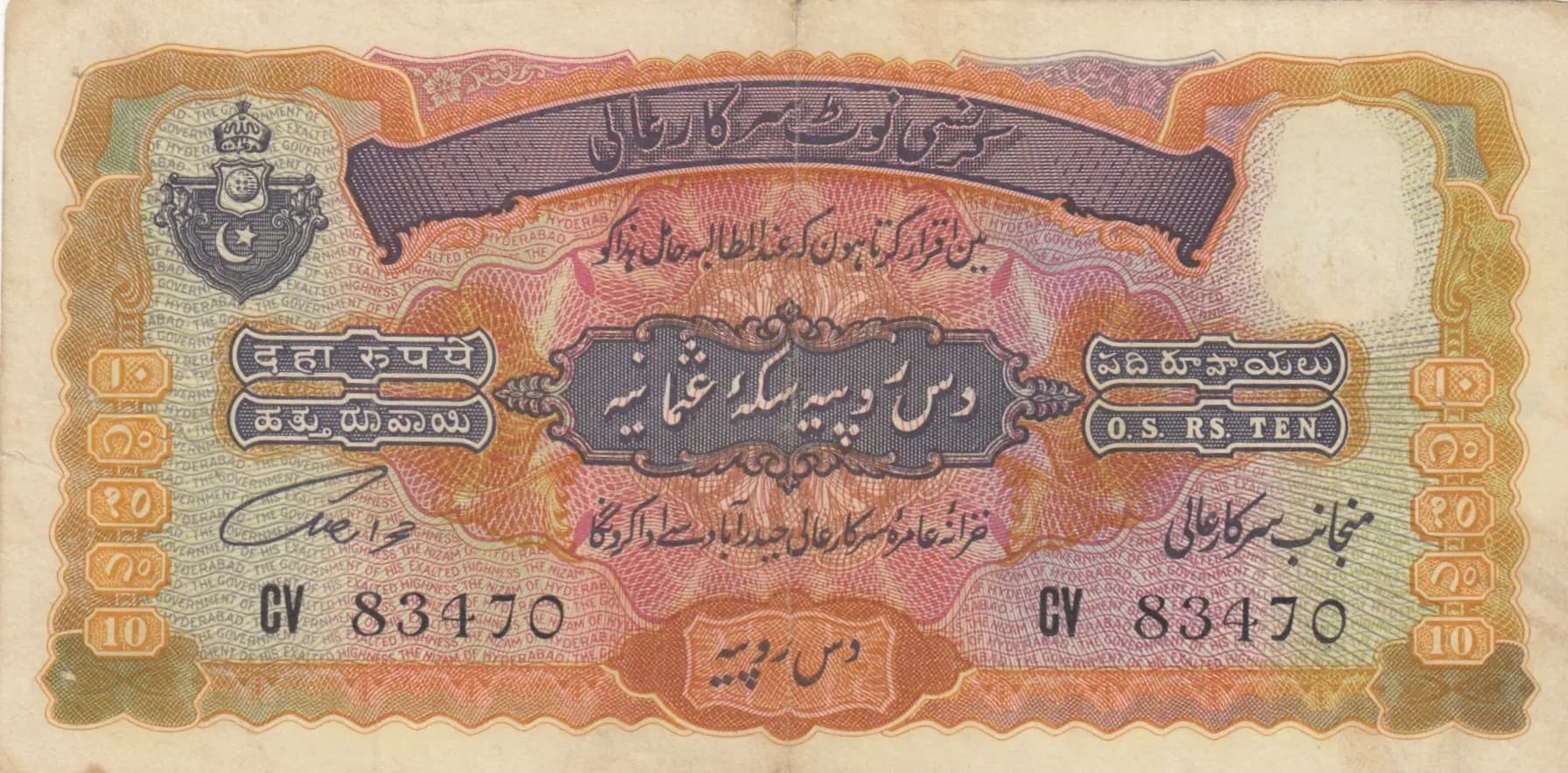
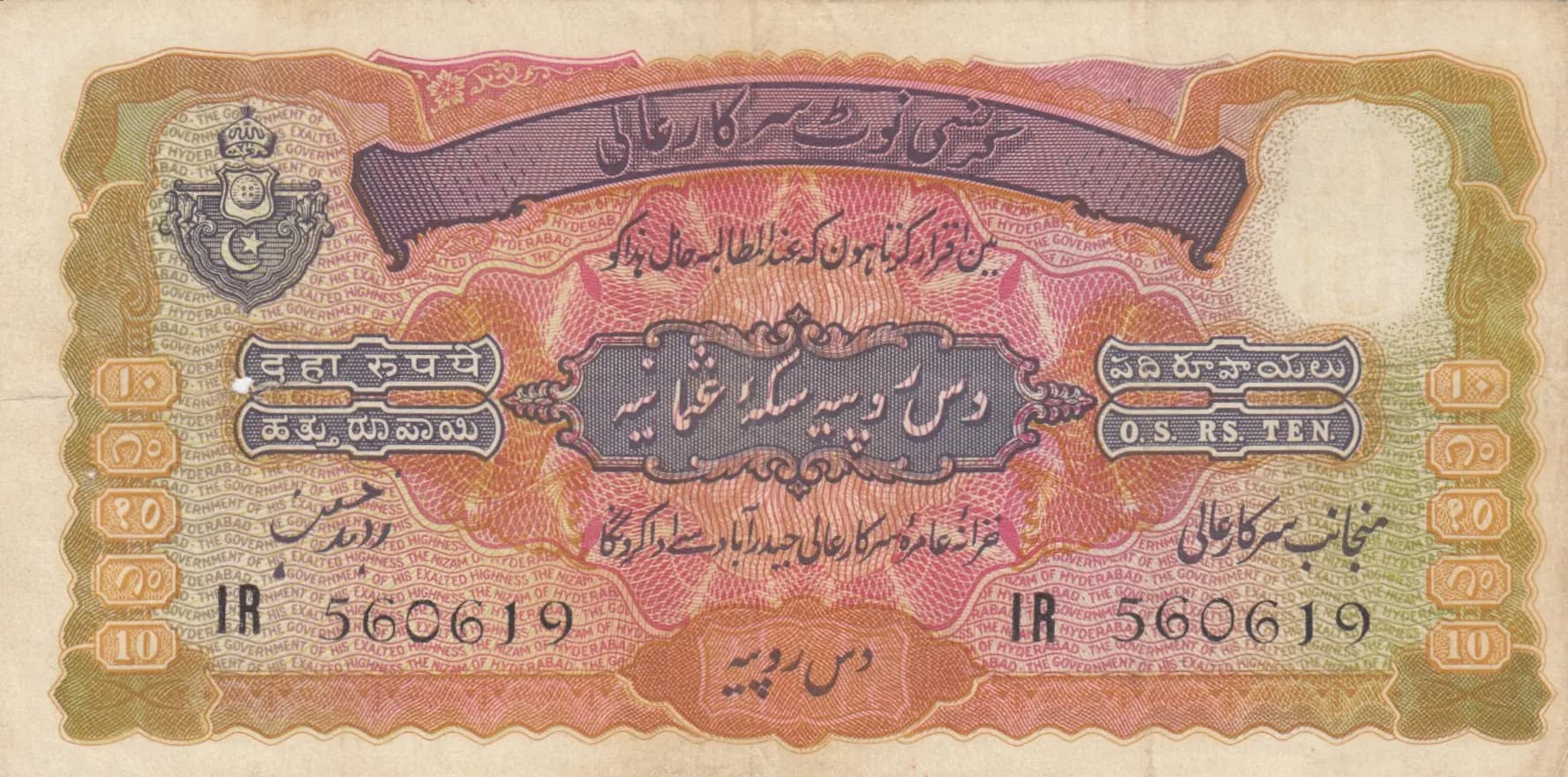
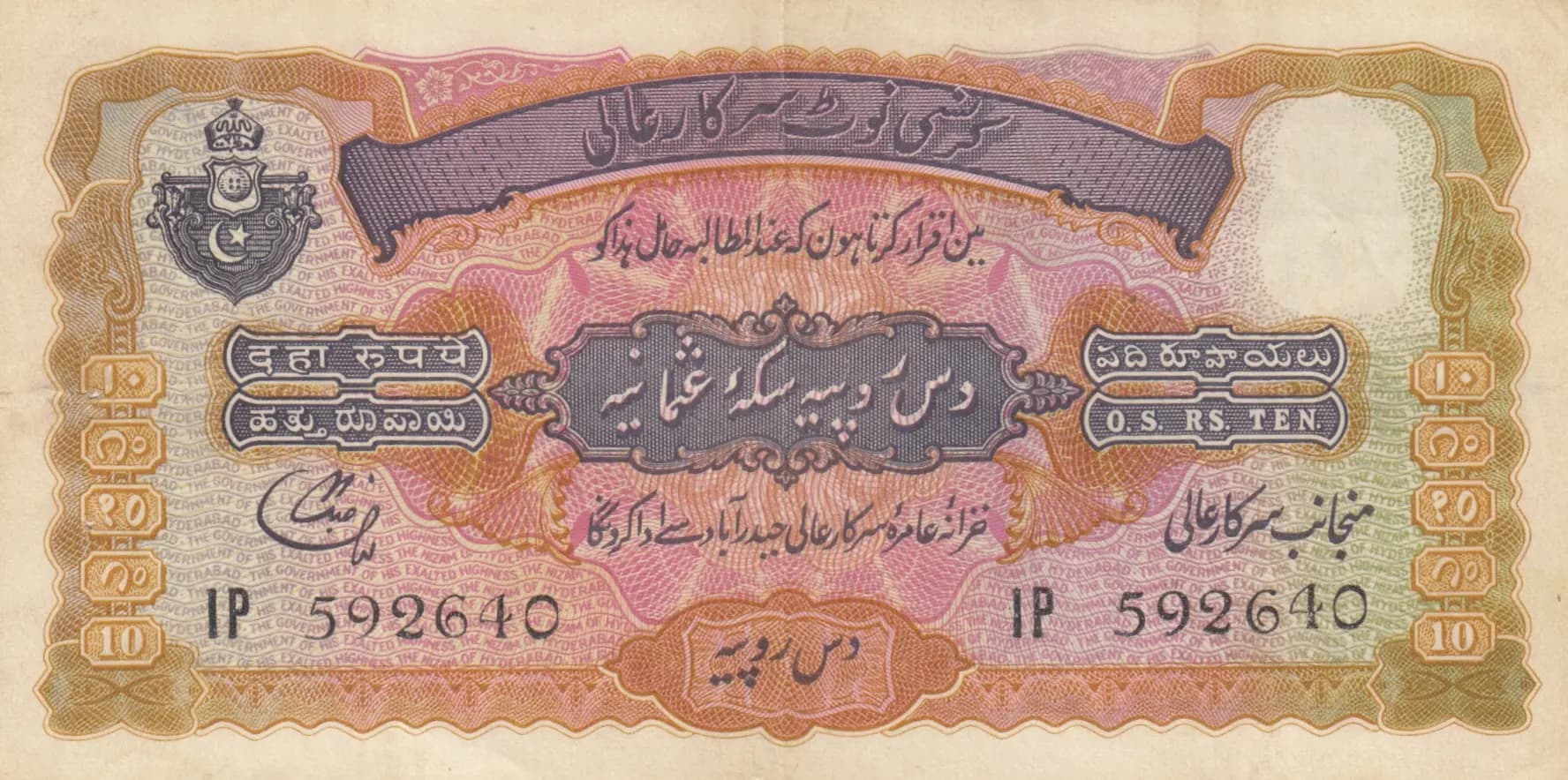
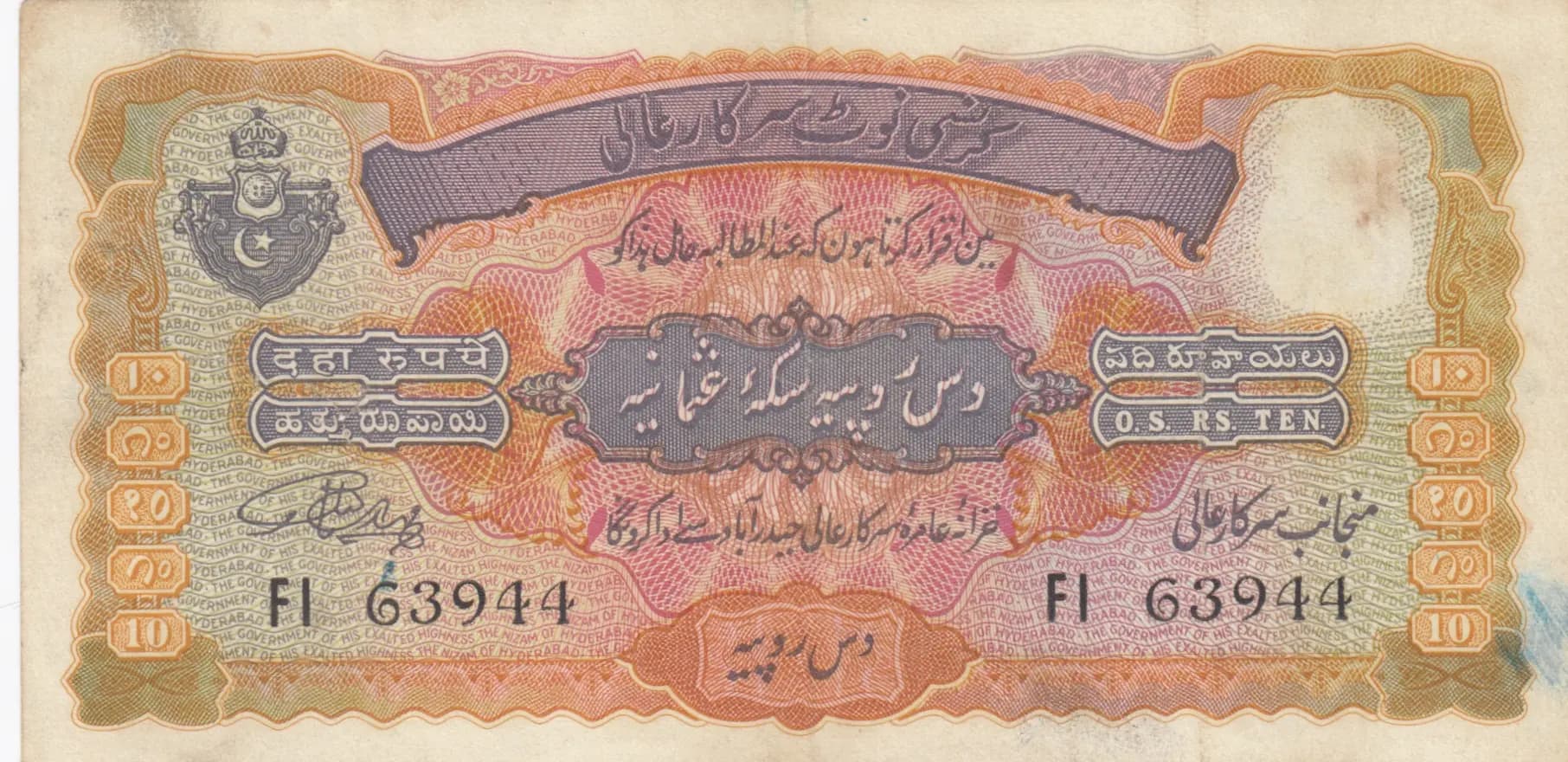
A 1939 10 Rupee Sicca Osmania banknote from Hyderabad in Very Fine condition, featuring the distinctive ornate design characteristic of princely state currency. The note displays the State Coat of Arms with crescent moon symbol, intricate geometric and floral patterns in orange, pink, and green tones, and multilingual inscriptions in English, Urdu, and Kannada. Despite visible aging with foxing and light staining consistent with circulation, the fine line engraving details remain well-preserved, making this an excellent example of pre-independence Indian princely state currency.
Common. The Rupee Sicca Osmania System was in active circulation throughout Hyderabad State until 1948, and 10 Rupee denominations were standard circulating notes with substantial print runs. While pre-independence Indian princely state notes have collector interest, this denomination and type remain widely available in the secondary market. The VF condition and visible circulation marks indicate this was part of a large issued quantity typical of common denominational values.
This note was issued under the authority of the Nizam of Hyderabad during the final years of the princely state's independence, before Hyderabad's integration into India in 1948. The inscription 'Government of His Exalted Highness the Nizam of Hyderabad' reflects the state's sovereignty and status as one of India's largest princely states. The multilingual design incorporating Urdu, Kannada, and English demonstrates the cosmopolitan character of Hyderabad's administration and the diverse populations within its territory during this period.
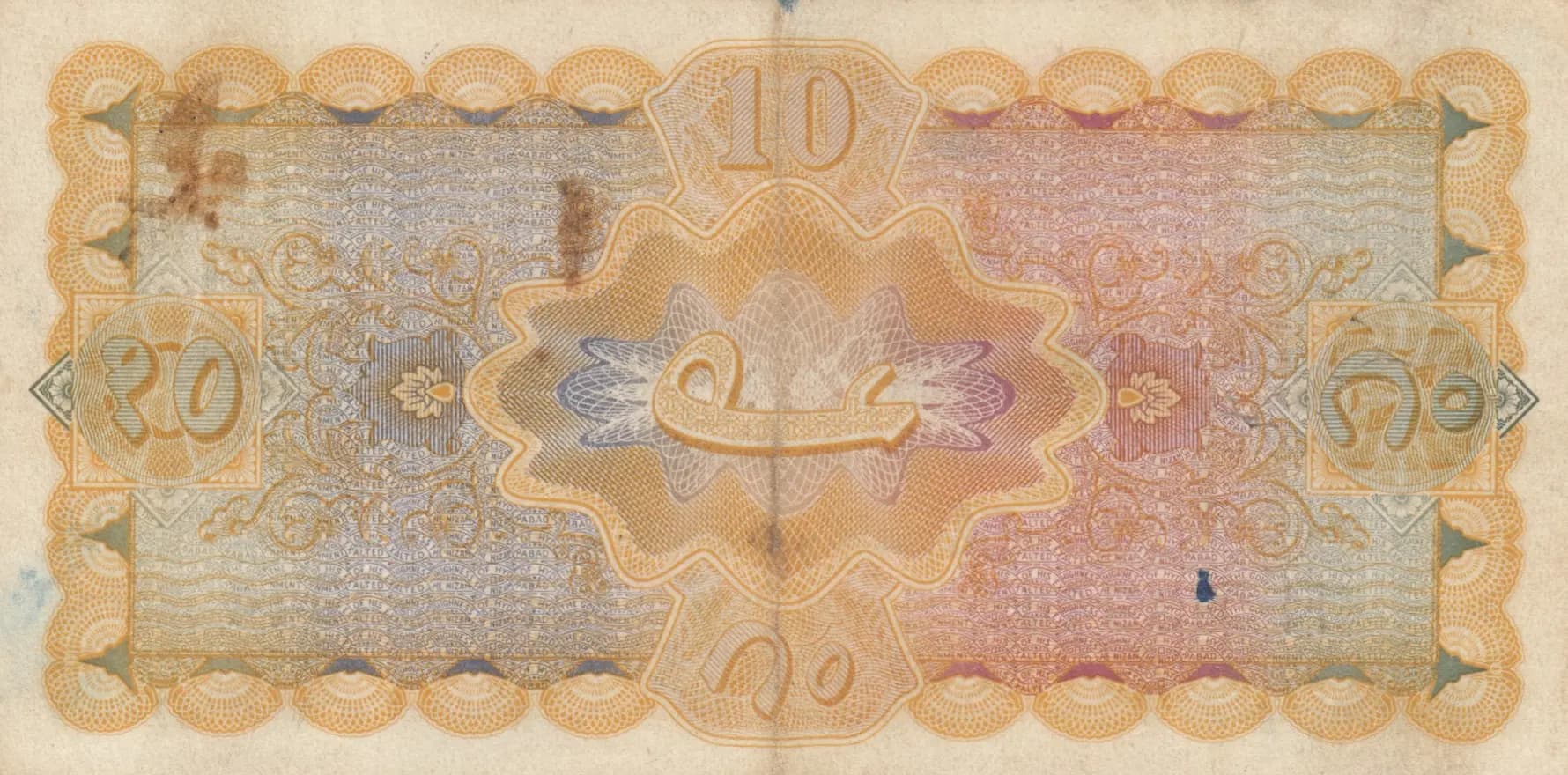
The front features a formal heraldic design centered on the State Coat of Arms of Hyderabad, depicted as a decorative shield on the left side incorporating the crescent moon symbol representing Islamic sovereignty. The central area contains layered rectangular frames with the denomination in multiple languages and scripts, reflecting the multilingual administration of the princely state. The back displays a stylized fish motif as the dominant central element, framed within ornamental scalloped borders - a design element common to Osmania currency. Denomination values appear in cartouches on both sides of the reverse. The entire note is surrounded by fine geometric and floral decorative patterns in the characteristic orange, pink, green, and cream palette of Osmania currency.
Front Side: 'دس روپے' (Urdu: 'Das Rupaye' - Ten Rupees); Kannada script denomination marking (Ten Rupees); 'O.S. TEN' (Osmania System Ten); 'GOVERNMENT OF HIS EXALTED HIGHNESS THE NIZAM OF HYDERABAD' (English); Serial number: F1 63944 (appears twice). Back Side: Denomination numerals '10' and '20' (left and right cartouches). All inscriptions are integrated within ornamental frames and borders typical of Osmania banknote design.
Intaglio engraving (line engraving and copperplate printing), evidenced by the fine line work, complex geometric cross-hatching, stippling patterns, and intricate detail visible throughout both sides. The consistent depth of impression and crisp detail of the ornamental borders and heraldic elements are characteristic of high-quality security printing used for Osmania banknotes. This printing method was standard for Indian princely state currency of this era, providing security against counterfeiting through the complexity of the engraved plates.
Serial number F1 63944 indicates this note is from the F1 series of the Osmania System. The specific prefix and serial number help date and identify the production batch. Pick catalog P-S274b designation indicates this is the 'b' variety of the 10 Rupee Osmania note, though without comparison to the 'a' variety in the images provided, the specific distinguishing characteristics between varieties cannot be detailed. The multilingual inscription set (English, Urdu, Kannada) is consistent with the standard design for this Pick number during the 1939 period.