5 rupees 1969
Market Prices
7 salesAbout This Note
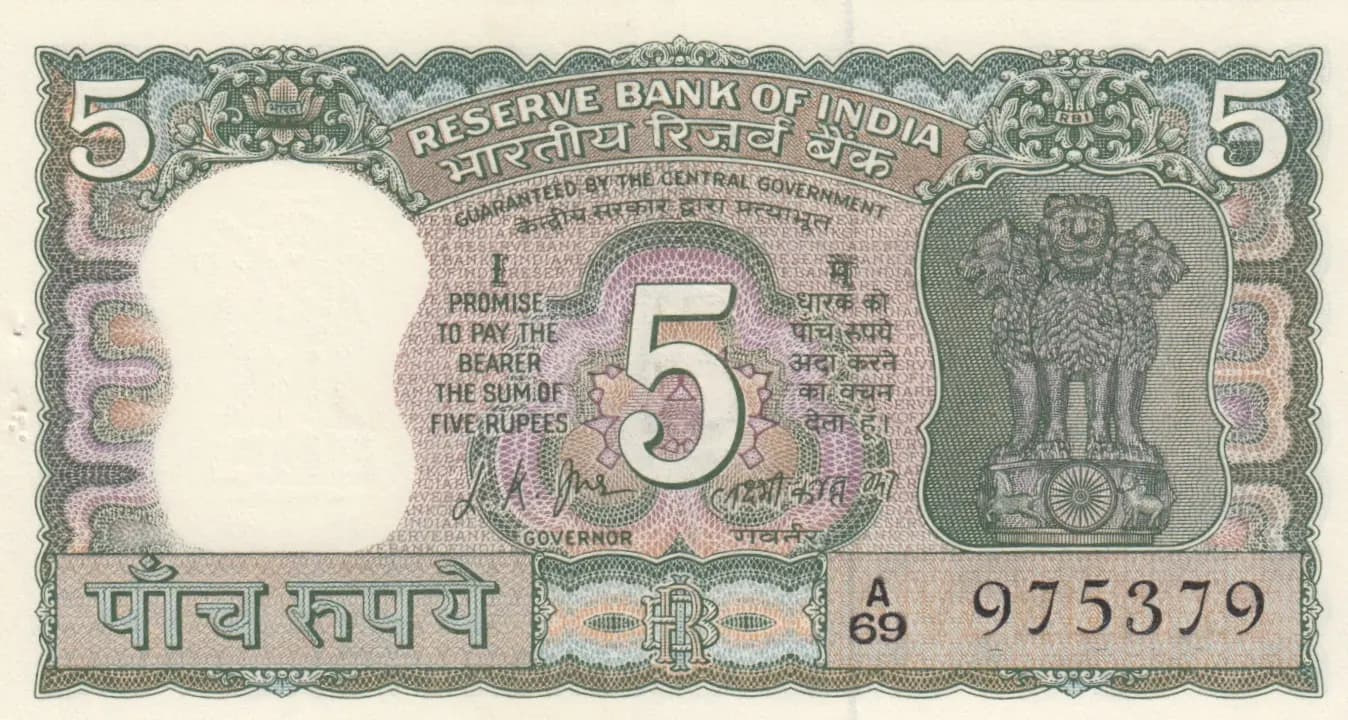
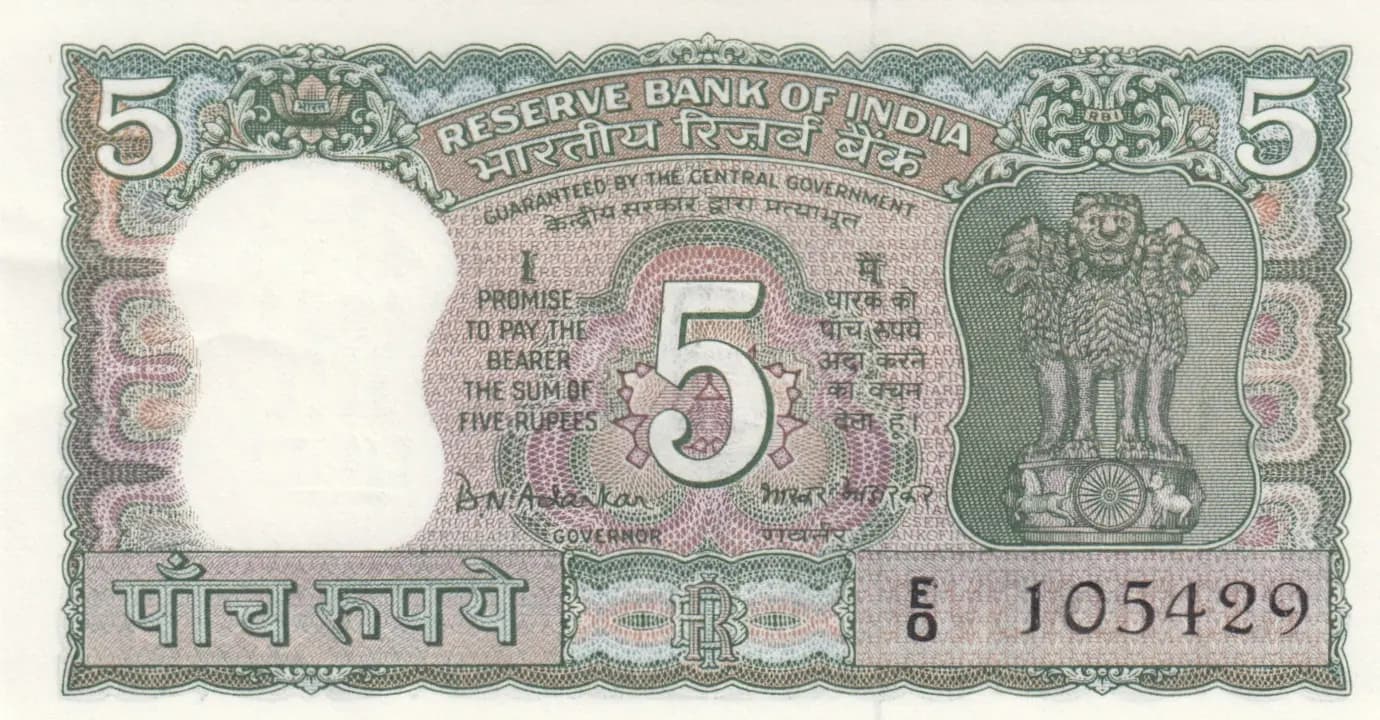
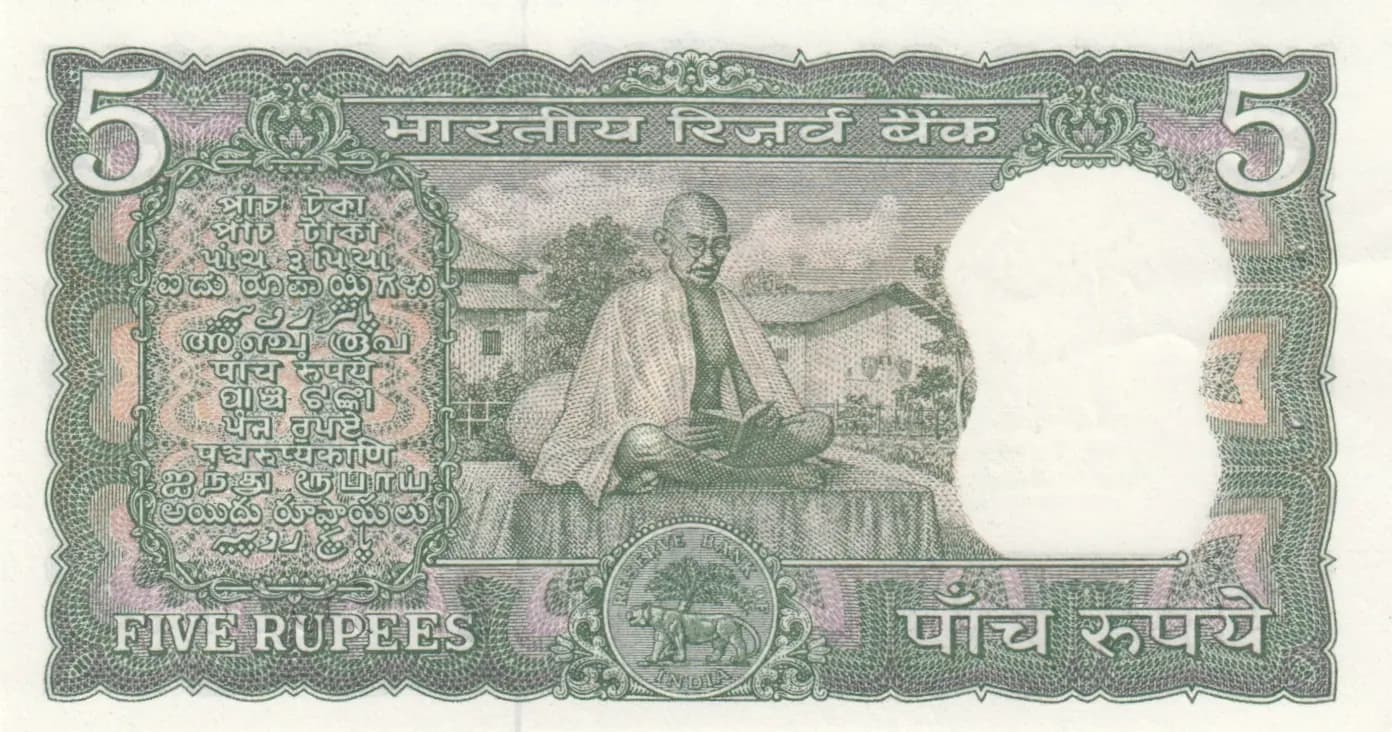
This is a 1969 India 5 Rupees banknote (Pick 68b) issued by the Reserve Bank of India to commemorate the centennial of Mahatma Gandhi's birth. The note displays exceptional condition consistent with UNC grading, featuring the iconic Lion Capital of Ashoka on the obverse and a seated female figure in traditional dress on the reverse, both rendered in fine engraved detail. The bi-lingual design in English and Hindi, combined with its historical commemorative significance, makes this a desirable note for both Indian currency collectors and Gandhi memorabilia enthusiasts.
Common. This is a regular issue of the 1969 5 Rupees note with a substantial print run typical of currency denominations in regular circulation. The eBay market data provided shows consistent sales in the $5-$34 range depending on condition and grading service, with 2019 catalog values listing UNC examples at $20. The recent 2025 AUNC sale at $17.50 confirms ongoing collector demand but at price points typical of common notes. No evidence of scarcity, recall, or restricted distribution exists for Pick 68b. The note remains readily obtainable in most condition grades.
This note was issued in 1969-1970 to commemorate the 100th anniversary of Mahatma Gandhi's birth (1869-1969), a significant milestone in Indian history. The obverse features the Lion Capital of Ashoka, India's national emblem symbolizing Buddhist heritage and modern India's commitment to dharma, while the reverse depicts an idealized representation of Indian womanhood or Mother India in a rural setting, reflecting the agrarian values central to Gandhi's vision of India. This commemorative issue represents a pivotal moment in post-independence India's cultural identity, linking ancient Mauryan symbols with Gandhian philosophy.
The obverse features the Lion Capital of Ashoka (Sarnath Museum original), depicted with multiple lions in heraldic style within a decorative rectangular frame on the right side, with the Ashoka Chakra (dharma wheel) visible at the base. A large ornamental numeral '5' dominates the center. The reverse depicts a woman in traditional Indian dress and head covering, seated in a rural landscape with fields and traditional architecture in the background, representing the idealized vision of rural India and feminine Indian identity. Both sides feature intricate border designs with repeating ornamental patterns in the classical engraved style characteristic of Indian currency of this era. The color scheme of dark green on multicolored underprint (pink/mauve tones) creates strong visual contrast and aids in authentication.
FRONT SIDE: 'Reserve Bank of India' (English and Hindi/भारतीय रिज़र्व बैंक); 'Guaranteed by the Central Government'; 'I Promise to Pay the Bearer the Sum of Five Rupees'; Denomination: 'Five Rupees' / 'पाँच रुपये'; 'Governor'; Series letter 'E'; Serial number 'J054299'. BACK SIDE: 'Reserve Bank of India' (Hindi/भारतीय रिज़र्व बैंक); 'Five Rupees' / 'पाँच रुपये'; Denomination numeral '5'. The note employs both English and Devanagari script throughout, reflecting India's multi-lingual currency policy established post-independence.
This note was produced using traditional intaglio engraving and letterpress printing, as evidenced by the fine line work, depth of detail in the portraiture and architectural elements, and the crisp definition of text and numerals visible in the uncirculated condition. The multi-color printing technique combining green and pink/mauve underprint with black overprinting is consistent with the security printing methods employed by the Reserve Bank of India's contracted security printers during the 1960s-1970s period. The precision of the ornamental borders and fineness of the engraved landscapes indicate high-quality intaglio plate production.
This specimen displays series letter 'E' with serial number J054299, consistent with the standard production run of the 1969 issue. The Pick 68b designation distinguishes this from the Pick 68a (1957 design variant). Notable varieties for this type include different series letters (A through H documented) and corresponding serial number ranges. The white oval spaces visible in both images suggest this may be presented as a specimen or security-printer's proof, though the full design completion indicates it is a production note. No overprints, date variants, or signature variations are evident in this example.