1 rupee 1963
Market Prices
11 salesAbout This Note
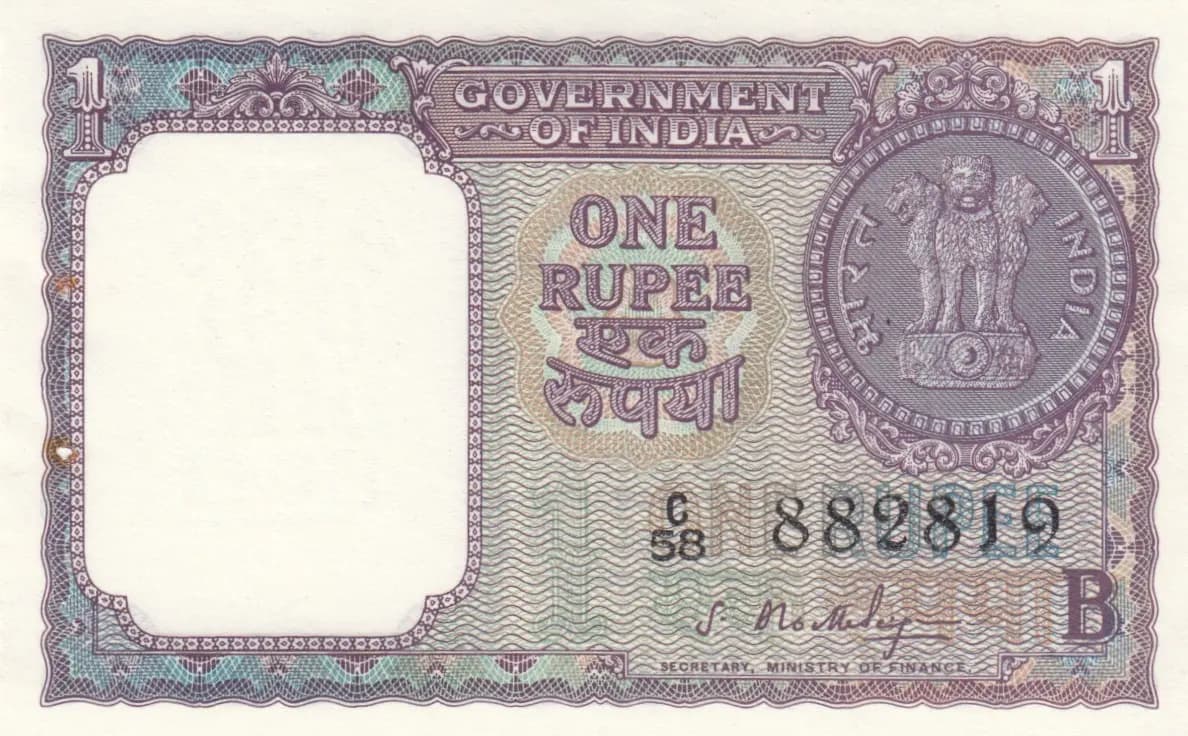
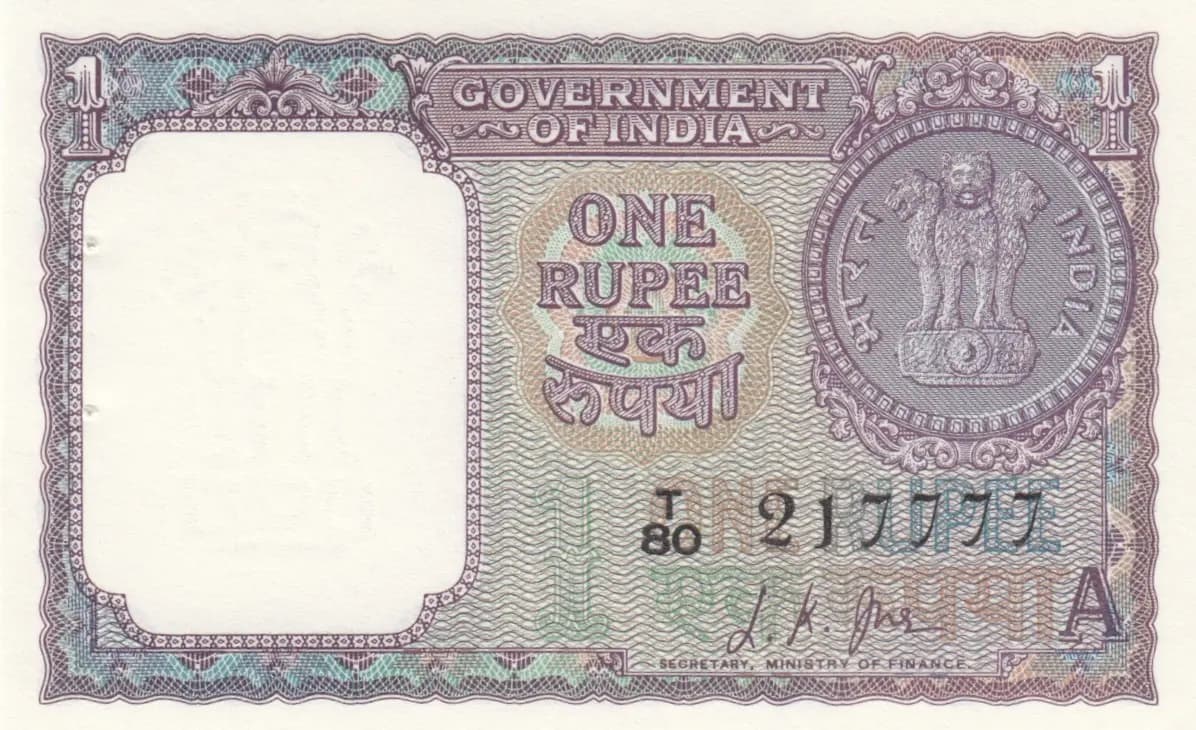
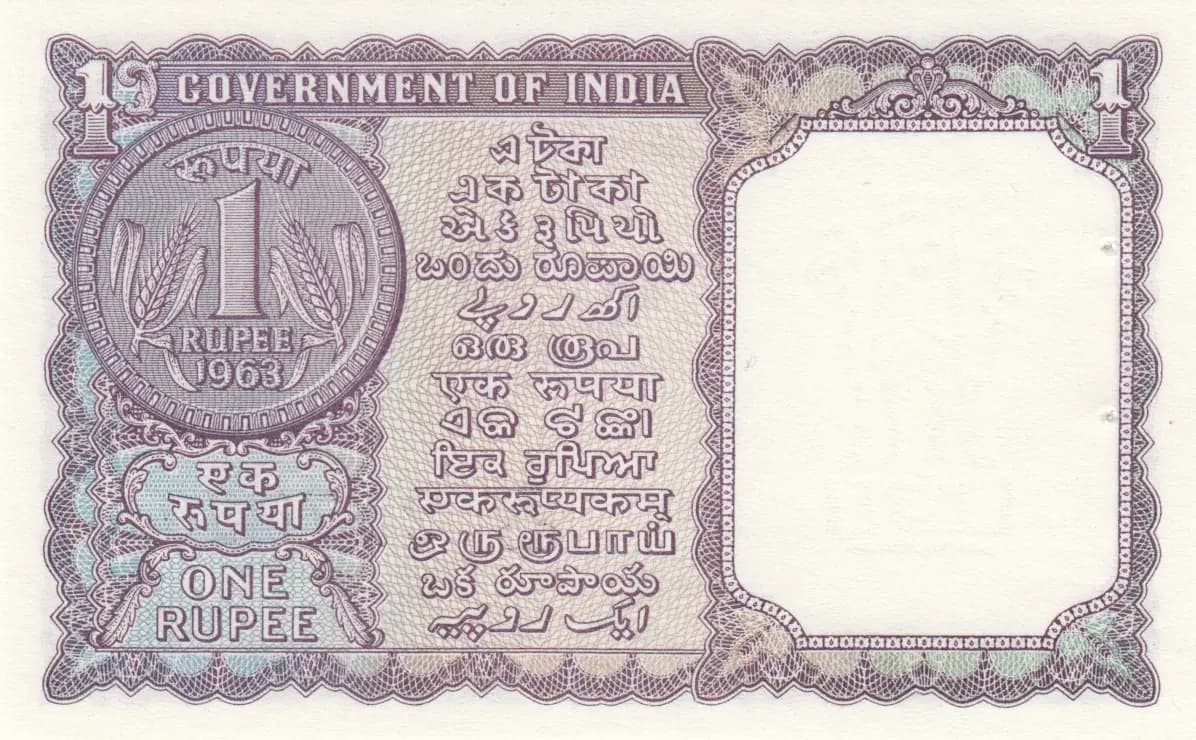
This 1963 India 1 Rupee note (Pick 76a) is presented in uncirculated condition with crisp, clean surfaces and vibrant purple-mauve coloring throughout. The obverse features an ornamental circular medallion displaying the numeral '1' with 'RUPEE' inscription and the issue date, surrounded by intricate decorative borders and multilingual denomination text in six Indian scripts. The reverse showcases the iconic Lion Capital of Ashoka emblem in a circular frame, with 'ONE RUPEE' text in both English and Devanagari script, representing a significant piece of early post-independence Indian currency design.
Common. This note had a substantial print run during 1963-1965 and circulated widely throughout India. Secondary market data confirms common status: eBay auction records show consistent sales in the $1-21.50 range across various grades (VF, AUNC, UNC) over the past several years, with UNC examples catalogued at approximately $9 (2019 valuation). The note is readily available to collectors and does not command premium prices characteristic of scarce or rare issues. Population data from PMG indicates standard production volumes with catalogued variants (76a/76b), consistent with routine currency issuance.
This note was issued during the early period of the Republic of India's currency evolution, approximately 18 years after independence in 1947. The deliberate choice to feature the Lion Capital of Ashoka—sourced from the Sarnath Museum and adopted as India's national emblem—reflects the newly formed nation's connection to ancient Buddhist heritage and its commitment to secular democratic values. The multilingual inscriptions in Devanagari, Tamil, Telugu, Kannada, Gujarati, and Urdu underscore India's constitutional recognition of its linguistic and cultural diversity during this formative post-colonial period.
The obverse (front) presents a formal, symmetrical design centered on a large ornamental circular medallion containing the Arabic numeral '1' with 'RUPEE' lettered below and flanked by the issue year '1963'. The medallion is rendered in intaglio with decorative circular border frames, conveying official authority. The reverse (back) features the Lion Capital of Ashoka—depicting four lions back-to-back representing courage and sovereignty—positioned within a circular medallion on the right side. The denomination 'ONE RUPEE' appears prominently in both English and Devanagari script in the center. Both sides employ ornate decorative borders with geometric flourishes and a subtle wave pattern background. The multicolored underprint consists of light blue and green tints supporting the dominant purple-mauve printing, while the field is primarily cream to beige. Large blank rectangular spaces on both sides suggest a design framework allowing for future portrait incorporation, though this variant (76a) does not include a portrait figure.
OBVERSE: 'GOVERNMENT OF INDIA' (English header); '1 RUPEE 1963' (English denomination and date); 'एक रुपया' (Devanagari: One Rupee); 'ஒரு ரூபாய்' (Tamil: One Rupee); 'ఒక రూపాయి' (Telugu: One Rupee); 'ಒಂದು ರೂಪಾಯಿ' (Kannada: One Rupee); 'એક રુપિયા' (Gujarati: One Rupee); 'ایک روپیہ' (Urdu: One Rupee). REVERSE: 'GOVERNMENT OF INDIA' (English header); 'ONE RUPEE' (English); 'एक रुपया' (Devanagari: One Rupee); 'SECRETARY, MINISTRY OF FINANCE' (signature authority line); Serial number '2117777'; Reference number '80'.
Intaglio (recess printing), the standard technique for Indian rupee notes of this period. The crisp, sharp definition of the decorative medallion borders, the ornamental flourishes, and the precise line work of the circular frames are characteristic of steel engraving. The subtle multicolored underprint (light blue and green tints beneath the primary purple printing) indicates the use of multi-plate intaglio process. Security printers for Indian currency during this era typically included the Government of India Security Printing Press and private contractors such as Bradbury, Wilkinson & Co.; specific attribution for this pick number would require additional documentation.
This specimen is catalogued as Pick 76a. PMG records indicate a variant 76b exists for the base pick number. Distinguishing characteristics between variants typically include signature differences, minor design elements, or print run identifiers. The observed serial number '2117777' and reference number '80' are specific to this individual note and do not define the variety classification. The lack of portrait on this variant (76a) versus the 76b may represent the key distinguishing feature between the two catalogued variants, though this would require direct comparison with documented examples to confirm.