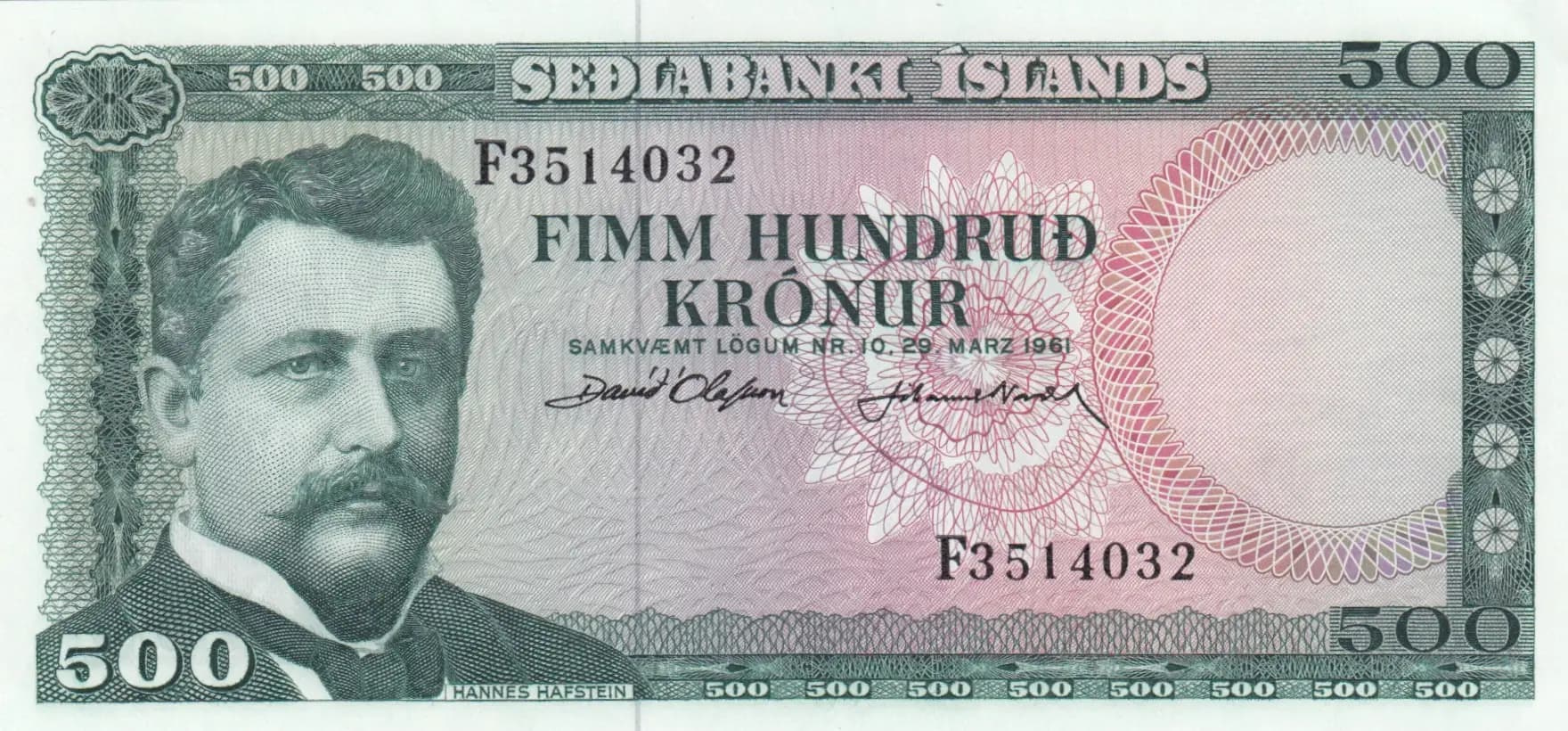
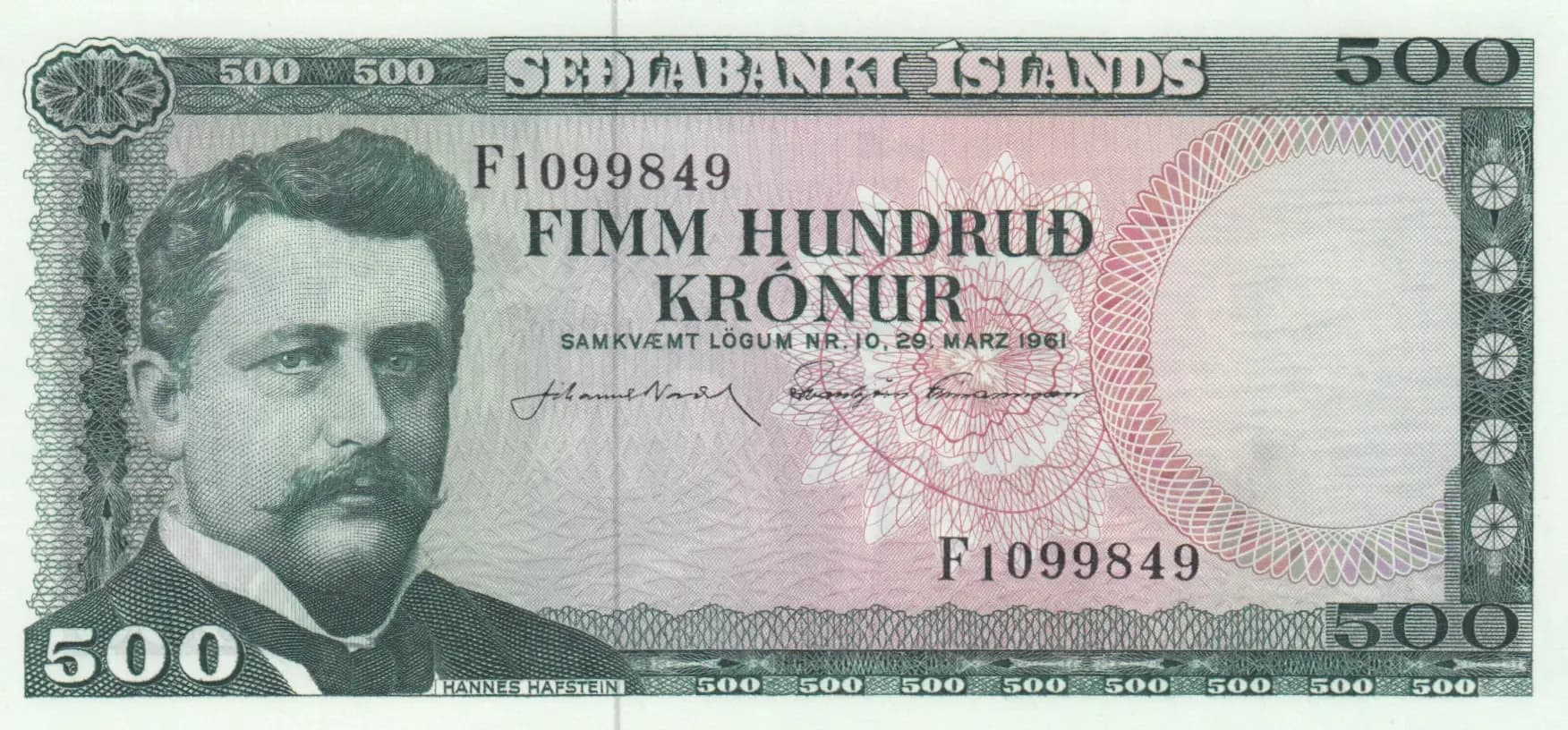
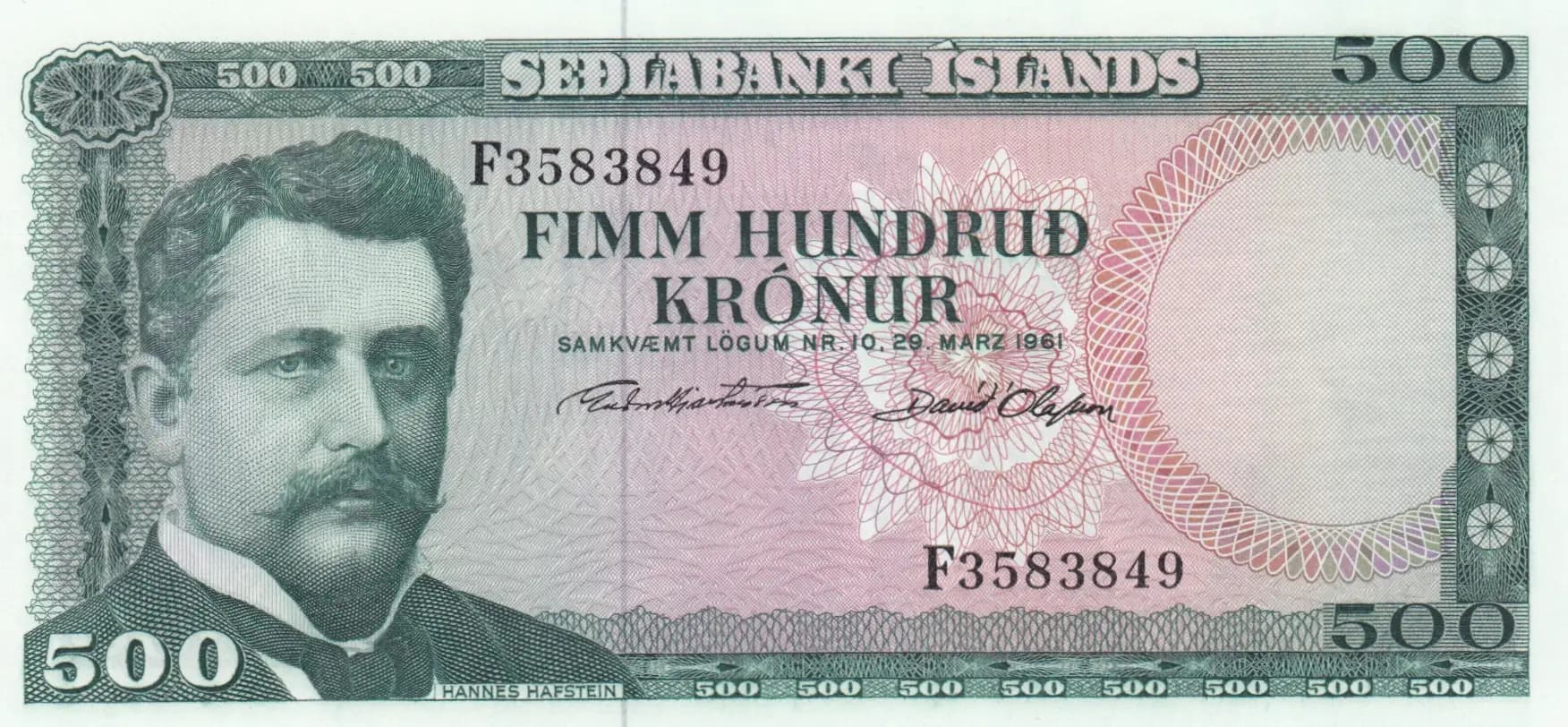
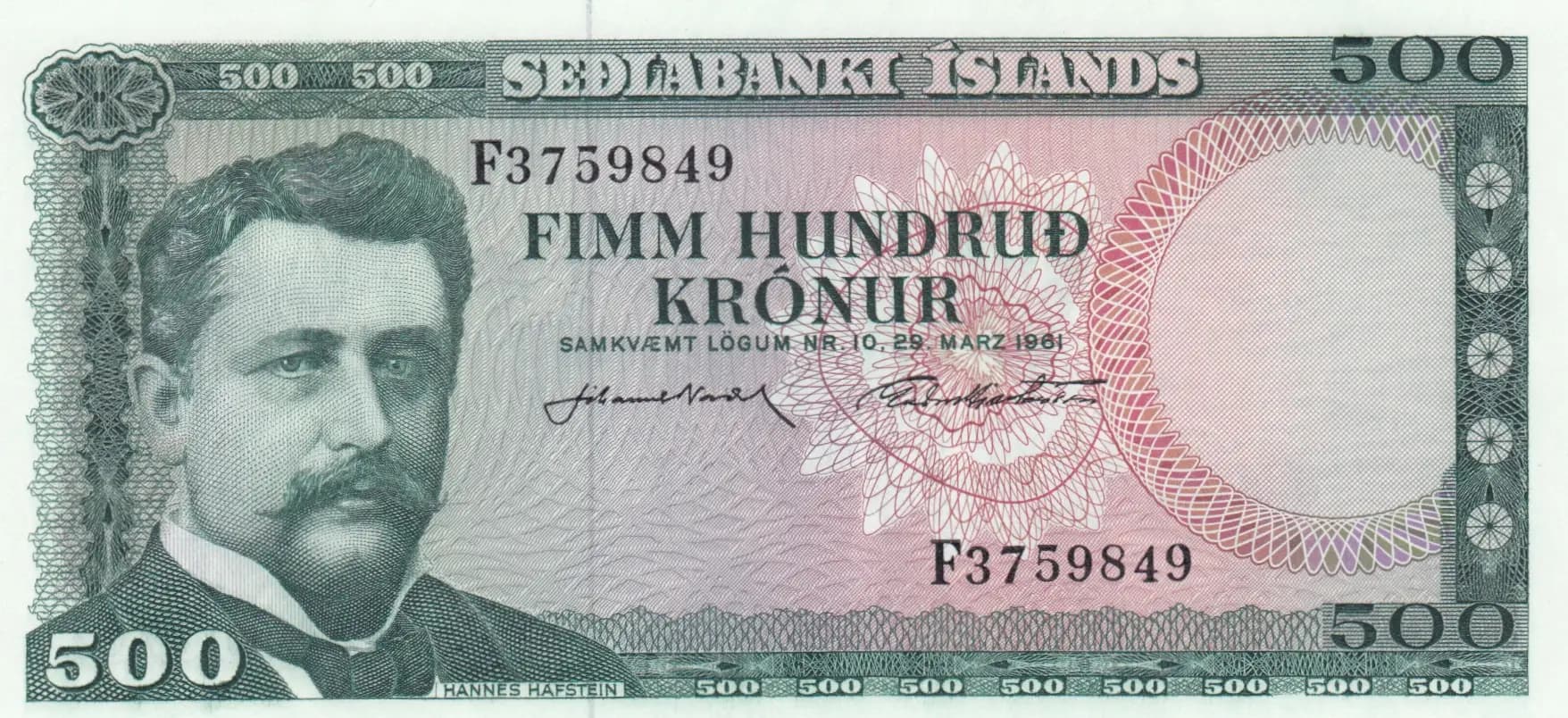
500 kronur 1961 specimen
Market Prices
About This Note
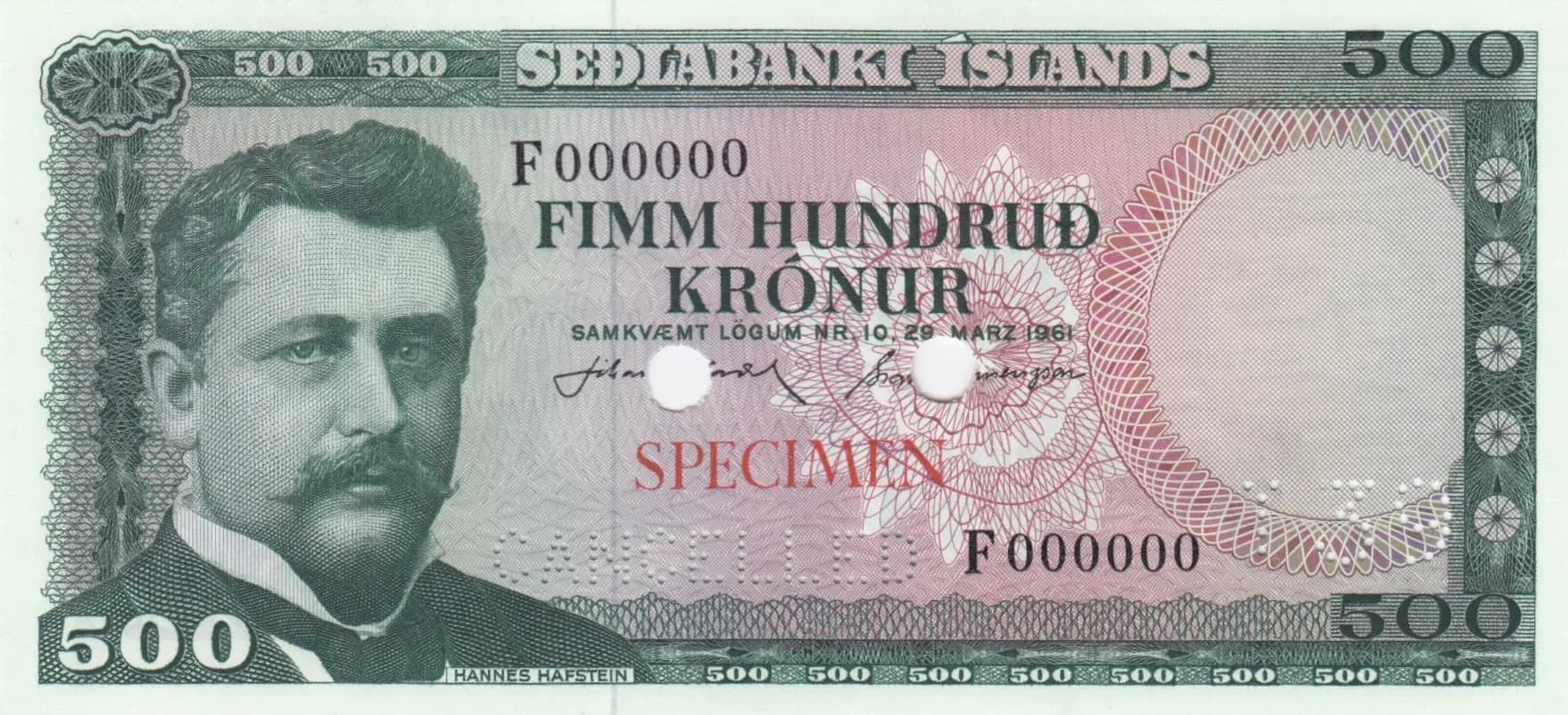
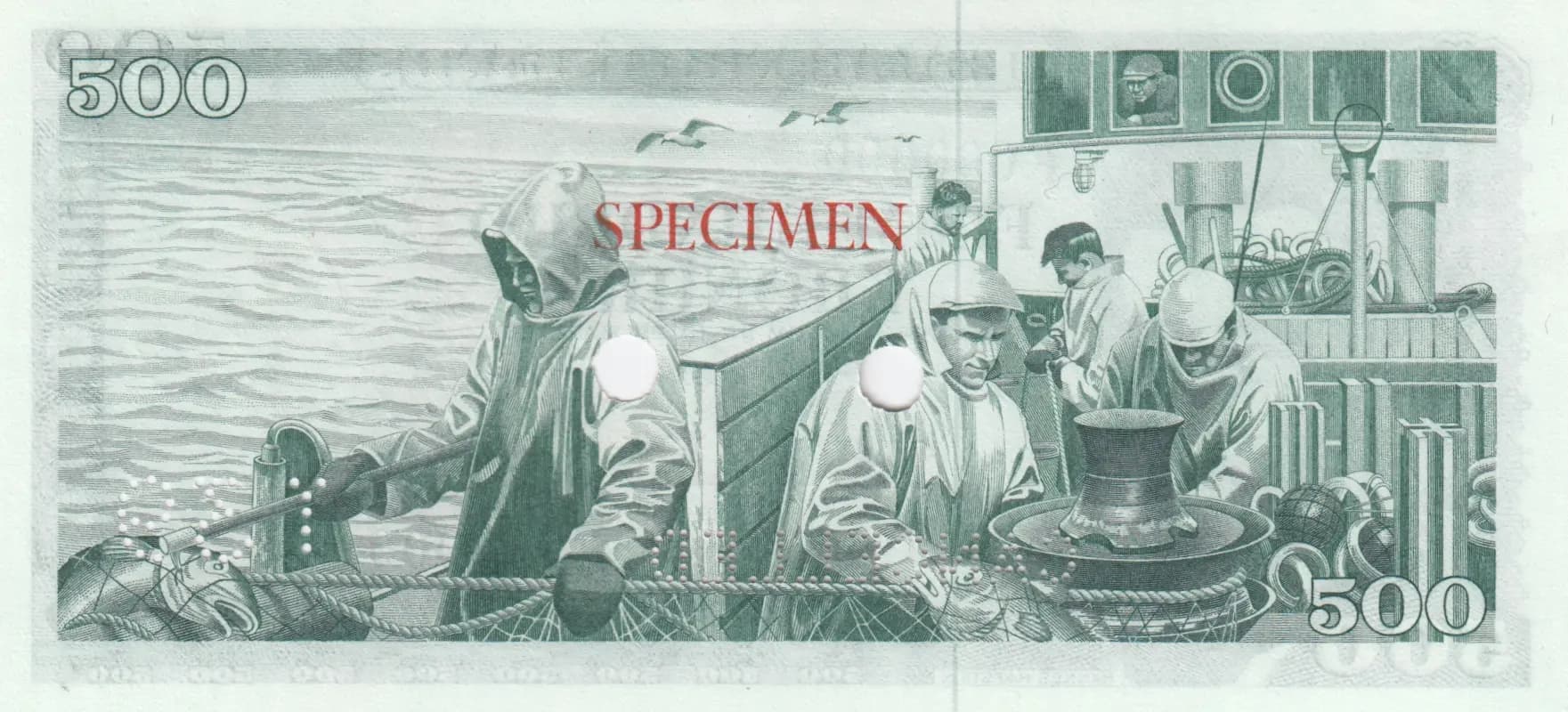
This is a 1961 Icelandic 500 Krónur specimen note in uncirculated condition, featuring a striking portrait of Hannes Hafstein on the obverse and a detailed maritime fishing scene on the reverse. The note displays the characteristic green and pink color scheme with fine engraving work throughout, and bears the typical specimen markings (punch holes and 'SPECIMEN' overprint) that identify it as a non-circulating example issued by Sedlabanki Islands. As a specimen note from Iceland's early post-independence currency period, it represents an important artifact of Icelandic numismatic history.
Common. Specimen notes of this denomination from 1961 appear regularly in the secondary market with eBay prices ranging from $3.49 to $79.95 USD, with most sales clustering in the $5–$20 range, and the 2019 catalog value of $325 USD appearing to be aspirational rather than realized market value. The frequency of sales and wide availability indicate substantial production quantities. While specimen notes have some numismatic interest beyond circulating examples, this particular note does not show characteristics of scarcity.
Issued under Law No. 10 dated 28 March 1961, this banknote commemorates a pivotal period in Icelandic history when the nation was establishing its modern monetary system. Hannes Hafstein, depicted on the obverse, was a significant Icelandic historical figure, while the reverse's fishing scene reflects Iceland's fundamental economic dependence on maritime industries and the fishing trade that defined the nation's prosperity and identity throughout the 20th century.
The obverse features a formal portrait of Hannes Hafstein, an important Icelandic statesman and historical figure, positioned on the left side wearing formal attire with distinctive facial hair. The design incorporates ornamental rosette/flower patterns in pink and red on the right side, along with decorative circular seals and geometric border patterns serving both aesthetic and security purposes. The reverse depicts a detailed maritime scene showing multiple fishermen and sailors actively engaged in fishing operations aboard a vessel, with ocean waves visible to the left and various nautical equipment and rigging throughout the composition. Both sides feature fine line engraving work with intricate cross-hatching and geometric security patterns, particularly visible in the upper right corner of the reverse. The dominant color scheme is green with pink/rose accents and cream backgrounds, creating a visually distinctive and historically significant design that emphasizes Iceland's maritime heritage.
Front Side: '500' (denomination), 'SEDLABANKI ISLANDS' (Central Bank of Iceland), 'FIMM HUNDRUÐ KRÓNUR' (Five Hundred Kronur in Icelandic), 'SAMKVÆMT LÖGUM NR. 10, 28 MARZ 1961' (According to Law No. 10, 28 March 1961), 'HANNES HAFSTEIN' (name of the depicted historical figure), 'SPECIMEN' (English designation indicating non-circulating status), and serial number 'F000000'. Back Side: '500' (denomination reiteration), 'SPECIMEN' (confirming specimen status).
Intaglio engraving (line engraving) executed by BWC (Bradbury, Wilkinson & Company), a renowned British security printer. The fine line work, intricate cross-hatching patterns, detailed portraiture, and geometric security elements visible throughout both sides are characteristic of high-quality intaglio printing techniques employed by this prestigious printer for banknote production.
This is the P-45s variety (specimen note variant) as indicated by the Pick catalog designation. The PMG population report identifies three variants for the base Pick number P-45: P-45a, P-45r, and P-45s, all printed by BWC. This specimen (P-45s) is distinguished by the 'SPECIMEN' overprint, punch holes through the design, and serial number format (F000000) that identifies it as a non-circulating issue. The specimen designation and marking style are consistent with 1961 Central Bank of Iceland specimen production practices.