100 kronur 1957
Market Prices
13 salesAbout This Note
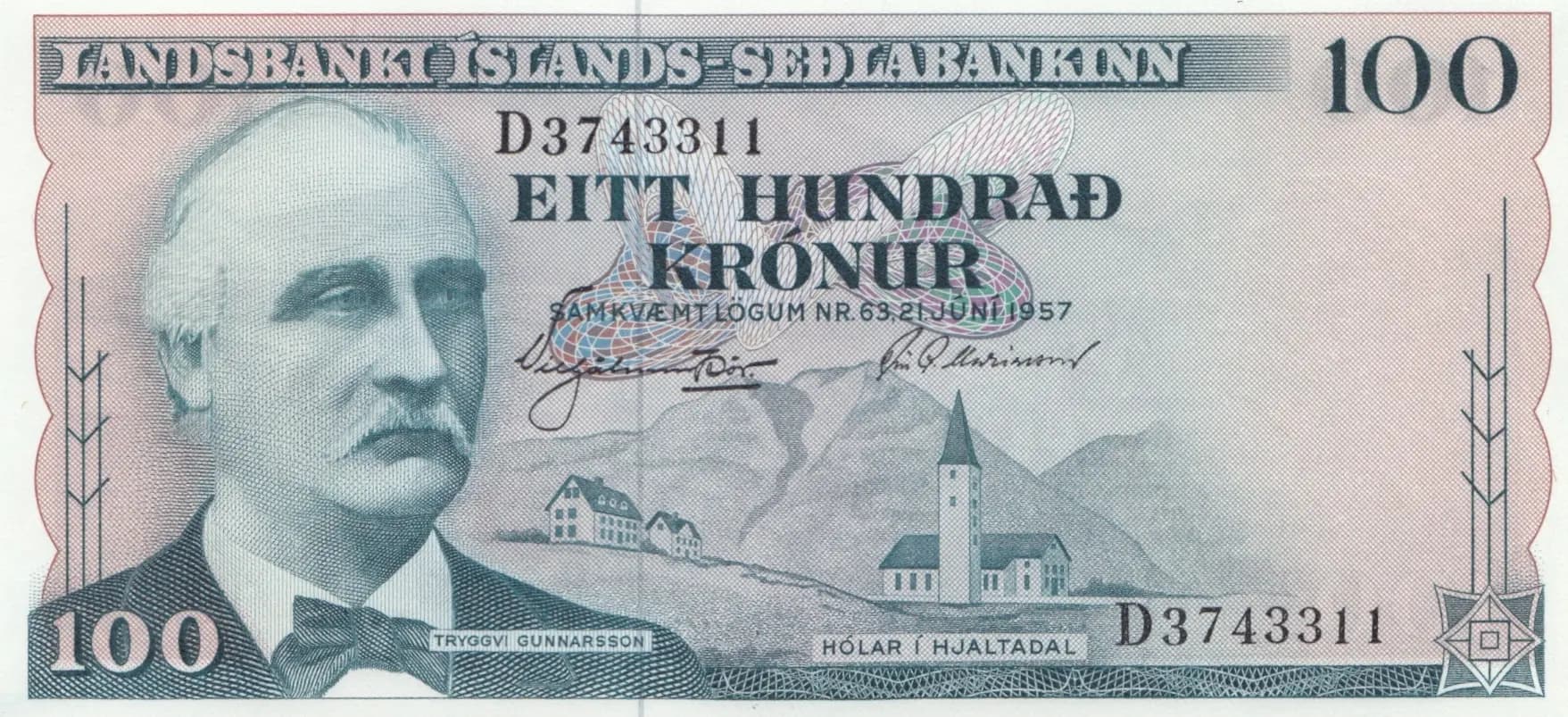
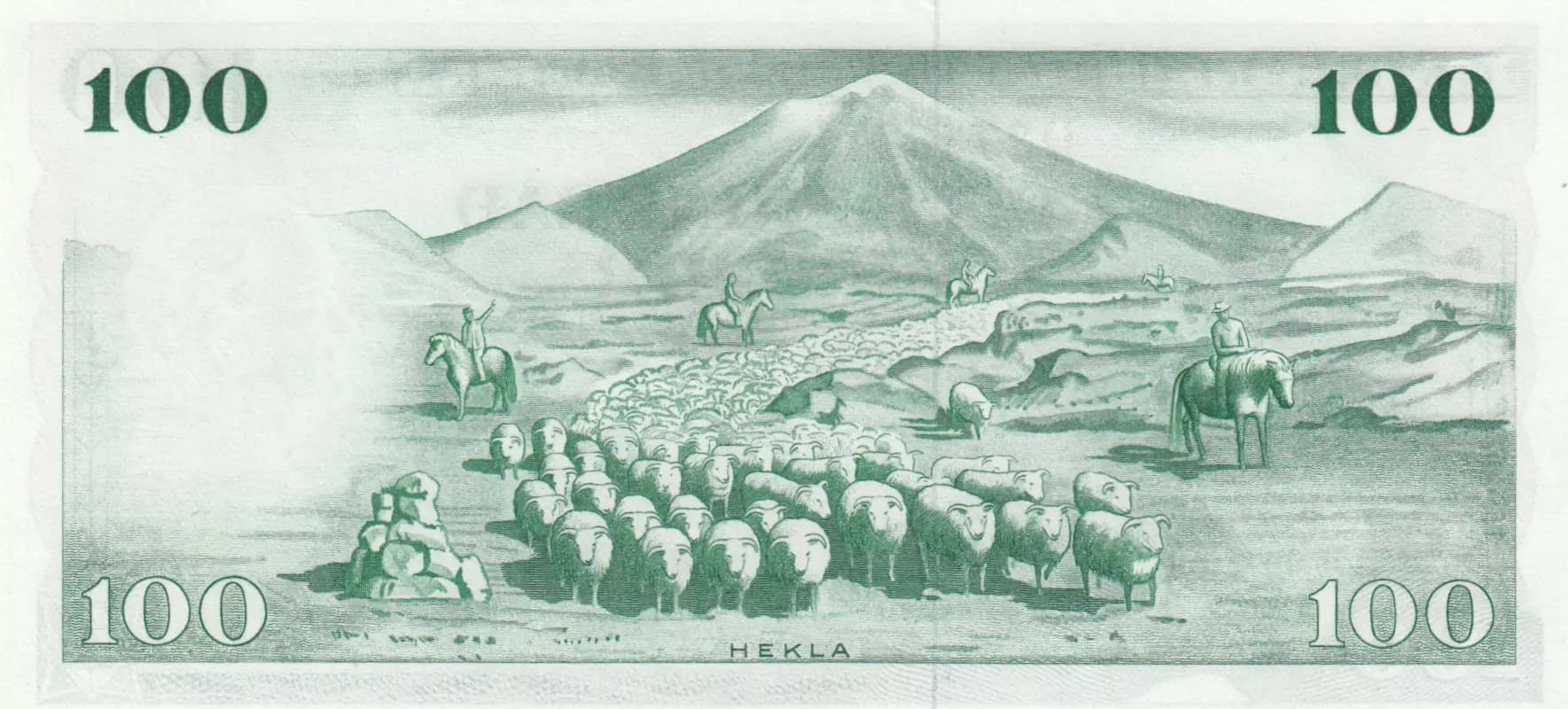
This is an exceptional example of Iceland's 100 Krónur note from 1957, presented in uncirculated condition with crisp, well-preserved surfaces on both sides. The obverse features a striking portrait of Tryggvi Gunnarsson in formal 19th-century attire set against a pink/reddish background, accompanied by a detailed engraving of Hólar church in Hjaltadal Valley. The reverse depicts a pastoral Icelandic scene with shepherds on horseback managing a flock of sheep beneath the snow-capped Hekla volcano, rendered in rich green tones. This note represents an important transitional period in Iceland's monetary history and demonstrates the high-quality intaglio printing techniques employed by Landsbanki Íslands.
Common. This note exhibits substantial eBay market activity with numerous sales ranging from $3.25 to $60 depending on condition and grading certification, with UNC examples typically realizing $10-20. The 2016 catalogue value for UNC is $18, consistent with recent market data. No evidence suggests restricted print runs, early recall, or short-lived issuing authority complications. The availability of multiple graded examples in PMG records (P-40a and P-40s variants) further confirms adequate supply in the collector market.
Issued on June 21, 1957, this banknote commemorates key figures and landscapes central to Icelandic national identity during the post-independence era. Tryggvi Gunnarsson (1816-1889) was a notable 19th-century Icelandic figure, while the depicted landmarks—Hólar church and Mount Hekla—represent Iceland's cultural and natural heritage. The note's design reflects Iceland's commitment to celebrating its rural traditions and volcanic landscape during a period of economic modernization and nation-building.
The obverse features a left-facing portrait of Tryggvi Gunnarsson, a 19th-century Icelandic dignitary, rendered in formal period attire with distinctive facial hair. The portrait is positioned on the left side with a complex guilloche pattern background in pink and teal tones. Dominating the center-right is an engraved vignette of Hólar Church, identifiable by its characteristic tall spire and attached residential buildings, situated on a hillside in Hjaltadal Valley. A geometric seal or emblem appears in the bottom right corner. The reverse depicts a romanticized pastoral scene of traditional Icelandic sheep herding, with mounted shepherds in silhouette managing a flock against a mountainous backdrop crowned by Mount Hekla, Iceland's most famous active volcano. The entire composition employs fine intaglio line work creating intricate tonal variations across both surfaces.
FRONT SIDE: 'LANDSBANKI ÍSLANDS - SEÐLABANKI ÍSLANDS' (Landsbanki Iceland - Central Bank of Iceland); '100' and 'EITT HUNDRAÐ KRÓNUR' (One Hundred Kronur); 'SAMKVÆMT LOGUM NR. 63-21. JÚNÍ 1957' (According to Law No. 63 of June 21, 1957); 'TRYGGVI GUNNARSSON' (name of portrayed historical figure); 'HÓLAR Í HJALTADAL' (Hólar in Hjaltadal Valley - church location); Serial number: 'D3743311'. BACK SIDE: '100' (denomination, repeated twice); 'HEKLA' (Mount Hekla volcano).
Intaglio (steel engraving) process, executed by Banknote World Currency (BWC) as the printer, with no imprinted mark visible on the note itself. The detailed guilloche patterns, fine parallel line work, and deeply engraved pastoral scene are characteristic of classical high-security banknote production. The multicolor printing on both sides demonstrates BWC's capability to produce sophisticated currency designs during the 1950s.
The observed note corresponds to Pick-40a, the standard variety with BWC printing and no imprint mark. PMG population records identify two variants for this base Pick number: P-40a (standard BWC) and P-40s (likely specimen/special marking variant). The serial number format (letter prefix 'D' followed by seven digits, 'D3743311') is consistent with the 1957 issuance standard. No signature varieties, date variations, or overprints are evident on this particular specimen, indicating it represents the common circulation printing variant from the 1957 issue authorized under Law No. 63 of June 21, 1957.