5 kronur 1957
Market Prices
17 salesAbout This Note
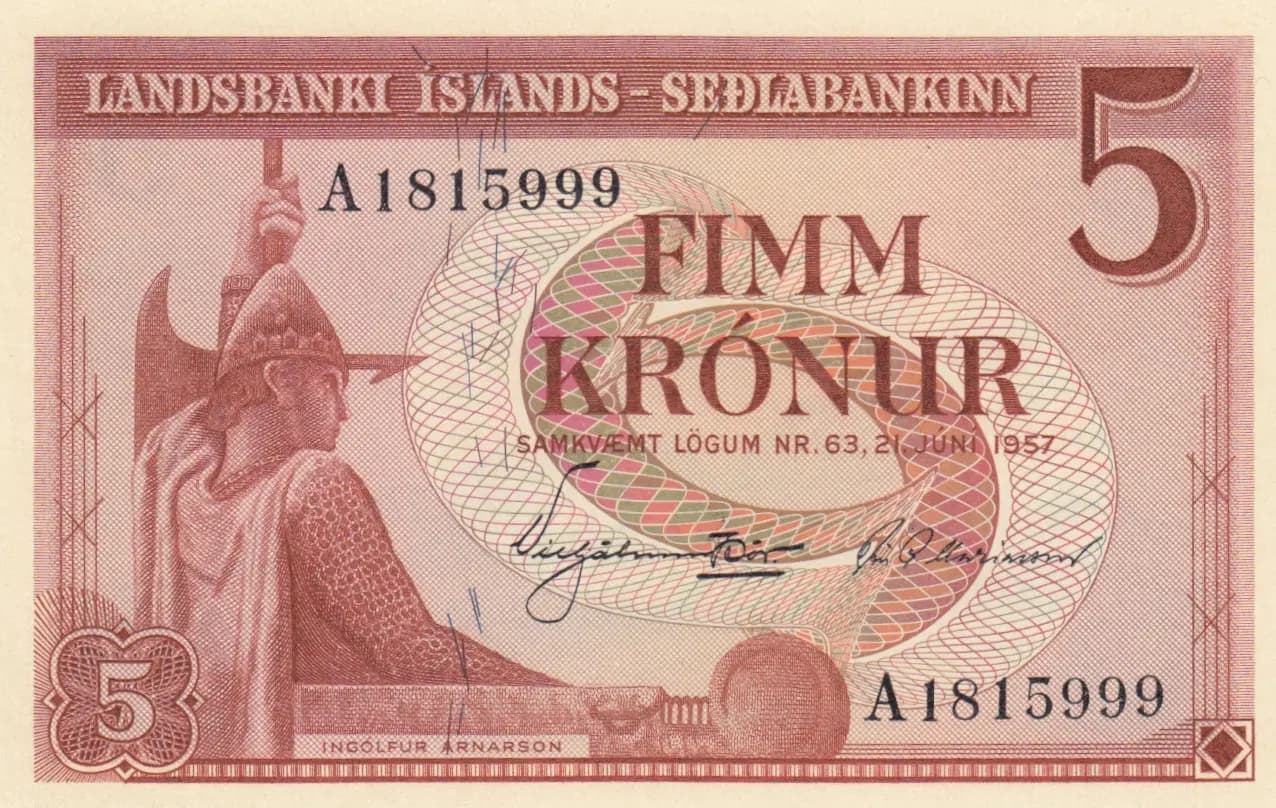
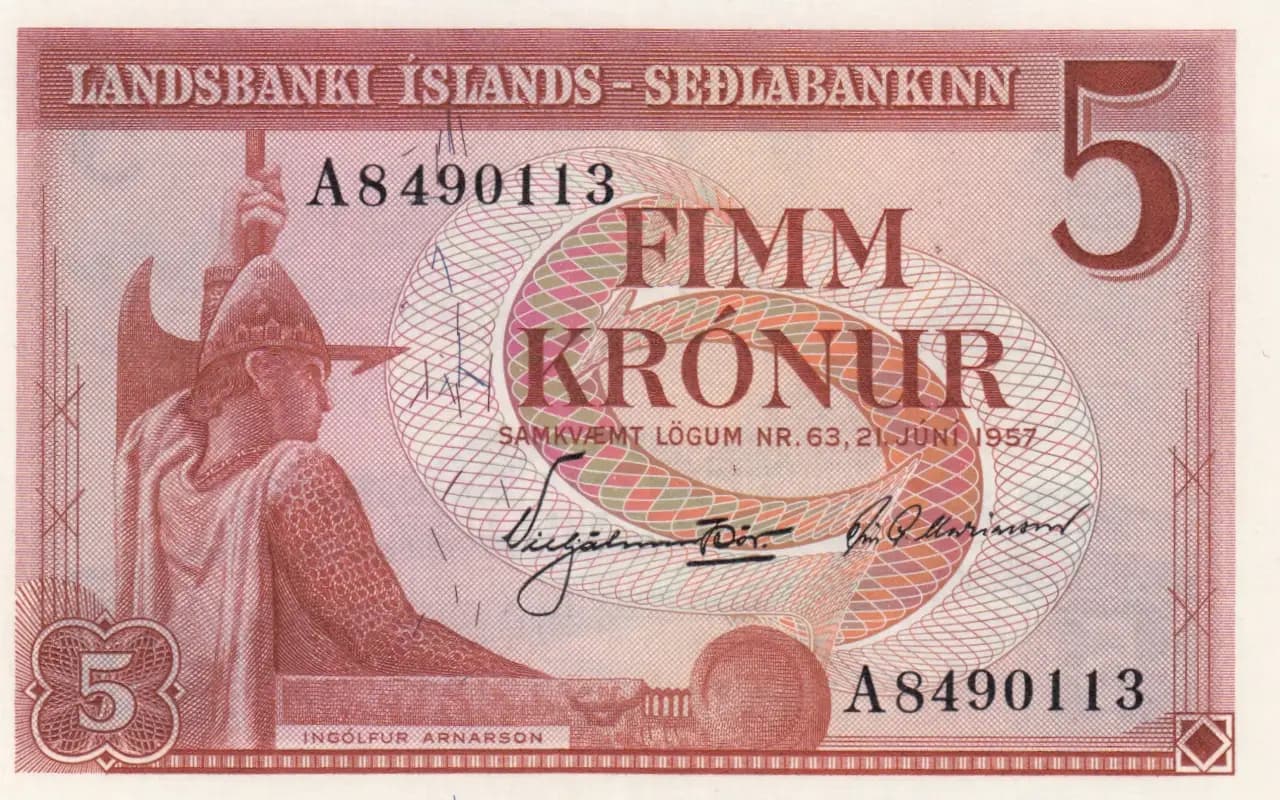
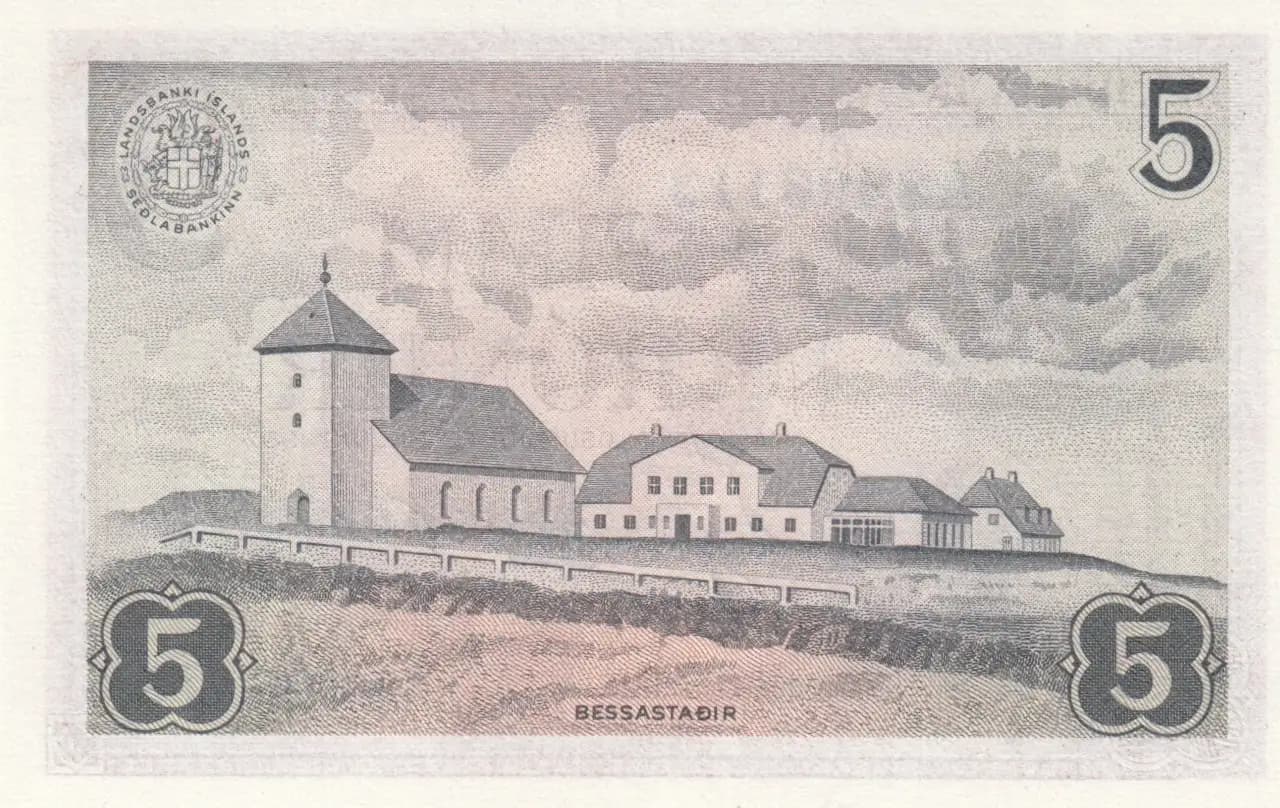
This 1957 Iceland 5 Krónur (Pick-37b) presents an exceptional example of mid-20th century Icelandic currency design, featuring the distinctive rose-pink color scheme and central oval security feature characteristic of this issue. The note depicts Ingólfur Arnarson, Iceland's first Viking settler, on the obverse and Bessastaðir (the presidential residence) on the reverse, connecting the currency to Iceland's medieval heritage. In UNC condition, this note represents a well-preserved specimen of this relatively common but historically significant denomination from the post-war period.
Common. The eBay price tracking data shows consistent sales activity across multiple condition grades, with UNC examples regularly selling in the $10-$29 range and averaging approximately $15-20 for uncirculated specimens. The 2016 catalogue value of $10 for UNC condition further confirms this note's common status. The regular auction activity and moderate pricing indicate a healthy supply in the collector market, typical of post-war banknotes from a stable issuing authority with substantial print runs.
Issued under Law No. 63 of June 21, 1957, this note represents Iceland's currency during the early years of the modern Icelandic Republic, established in 1944. The choice to feature Ingólfur Arnarson, the Viking settler who founded the first permanent settlement in Iceland around 874 AD, reflects the nation's cultural emphasis on medieval heritage and national identity during the Cold War era. Bessastaðir, depicted on the reverse, served as the official residence of Iceland's head of state, symbolizing institutional stability and governmental continuity in the newly independent nation.
The obverse features a left-facing engraved portrait of Ingólfur Arnarson, Iceland's first Viking settler, depicted wearing ornate medieval-style helmet and armor with detailed ornamentation, symbolizing Iceland's Norse heritage. A large oval security feature with dense mesh and grid pattern in pink and orange tones dominates the center of the note, serving both as a security measure and design element. Decorative denomination numerals '5' appear in ornamental frames in the top right and bottom left corners. The reverse depicts Bessastaðir in grayscale, showing a church with a distinctive tall pointed spire, accompanied by period farm buildings and structures on elevated terrain, representing Iceland's governmental and architectural heritage. The circular seal of the Central Bank appears in the top left corner of the reverse.
FRONT: 'Landsbanki Íslands—Seðlabankinn' (Central Bank of Iceland); 'Fimm Krónur' (Five Kronur); 'Samkvæmt lögum nr. 63. 21. júní 1957' (According to Law No. 63, June 21, 1957); 'Ingólfur Arnarson' (name of depicted historical figure); Serial number A8490113 (appears twice). BACK: 'Landsbanki Íslands' (within circular seal, top left); 'Bessastaðir' (name of the depicted residence/location).
Intaglio engraving on white paper, printed by Bradbury Wilkinson and Company (BWC) without imprint, as indicated by catalog notation. The fine line work, cross-hatching patterns, and detailed engraving throughout both sides are characteristic of BWC's high-security banknote production methods. The dense mesh pattern of the central security oval and the intricate portraiture demonstrate the precision and depth achievable through traditional intaglio printing techniques used for currency production in the mid-20th century.
This note is identified as Pick-37b, distinguishing it from the P-37a variant. Both variants were printed by BWC, but the P-37b is noted in catalog records as the second printing on white paper. The visual analysis confirms white paper stock consistent with this second printing designation. The serial number prefix 'A' and the lack of visible printer's imprint are consistent with the P-37b variety characteristics. No overprints or unusual markings are visible that would indicate a specialized sub-variety.