5 dollars 1954
Market Prices
26 salesAbout This Note
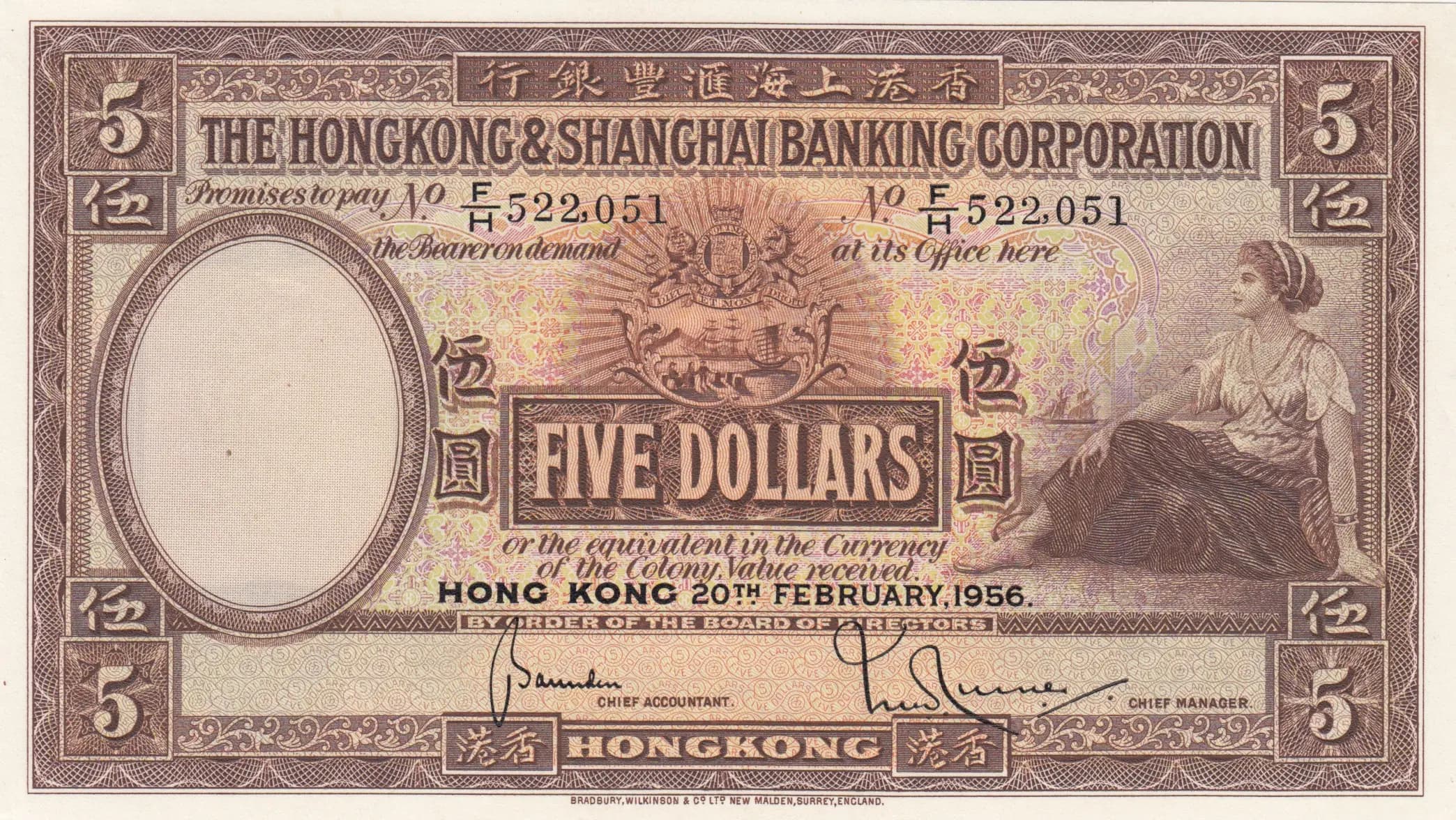
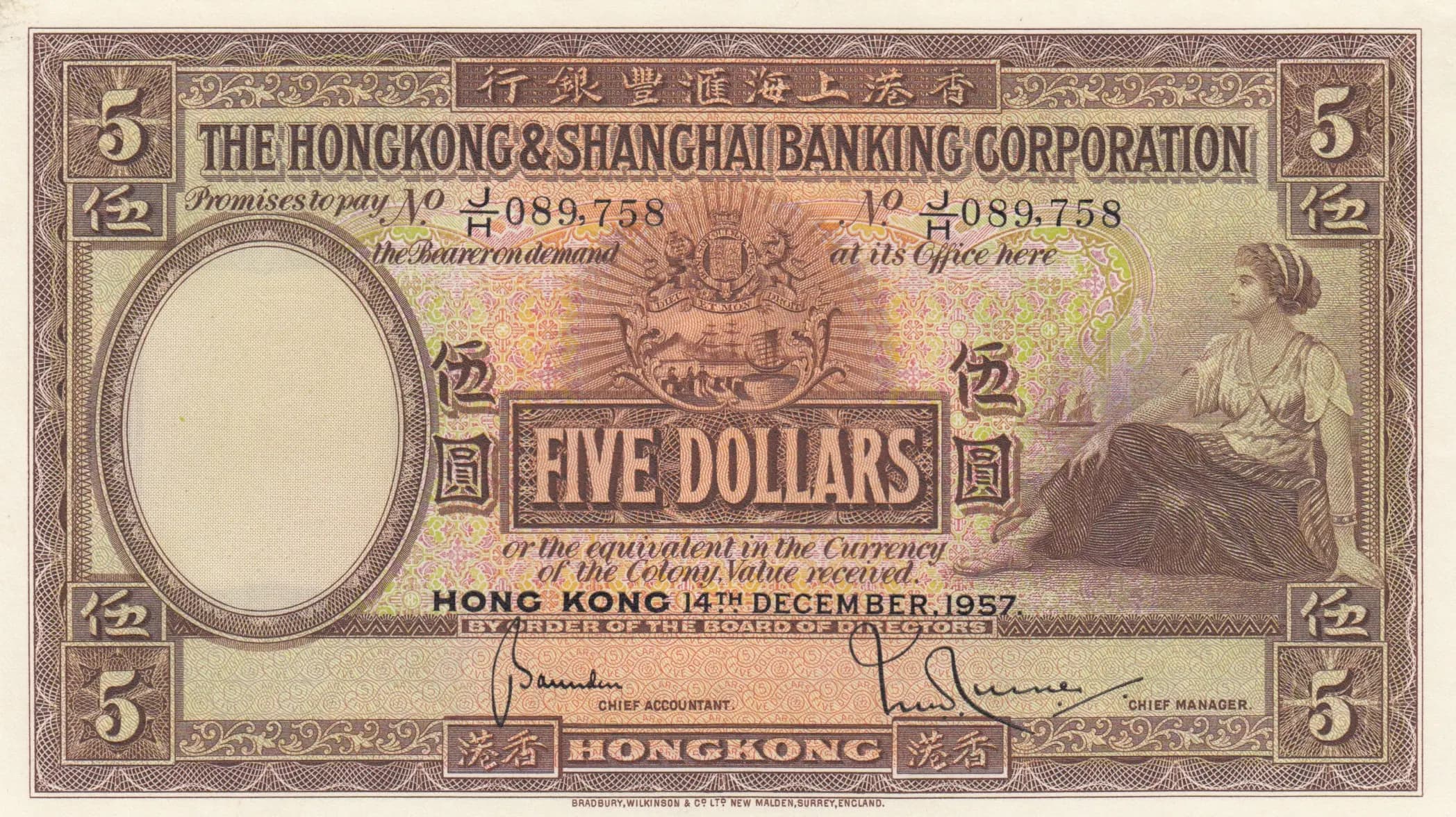
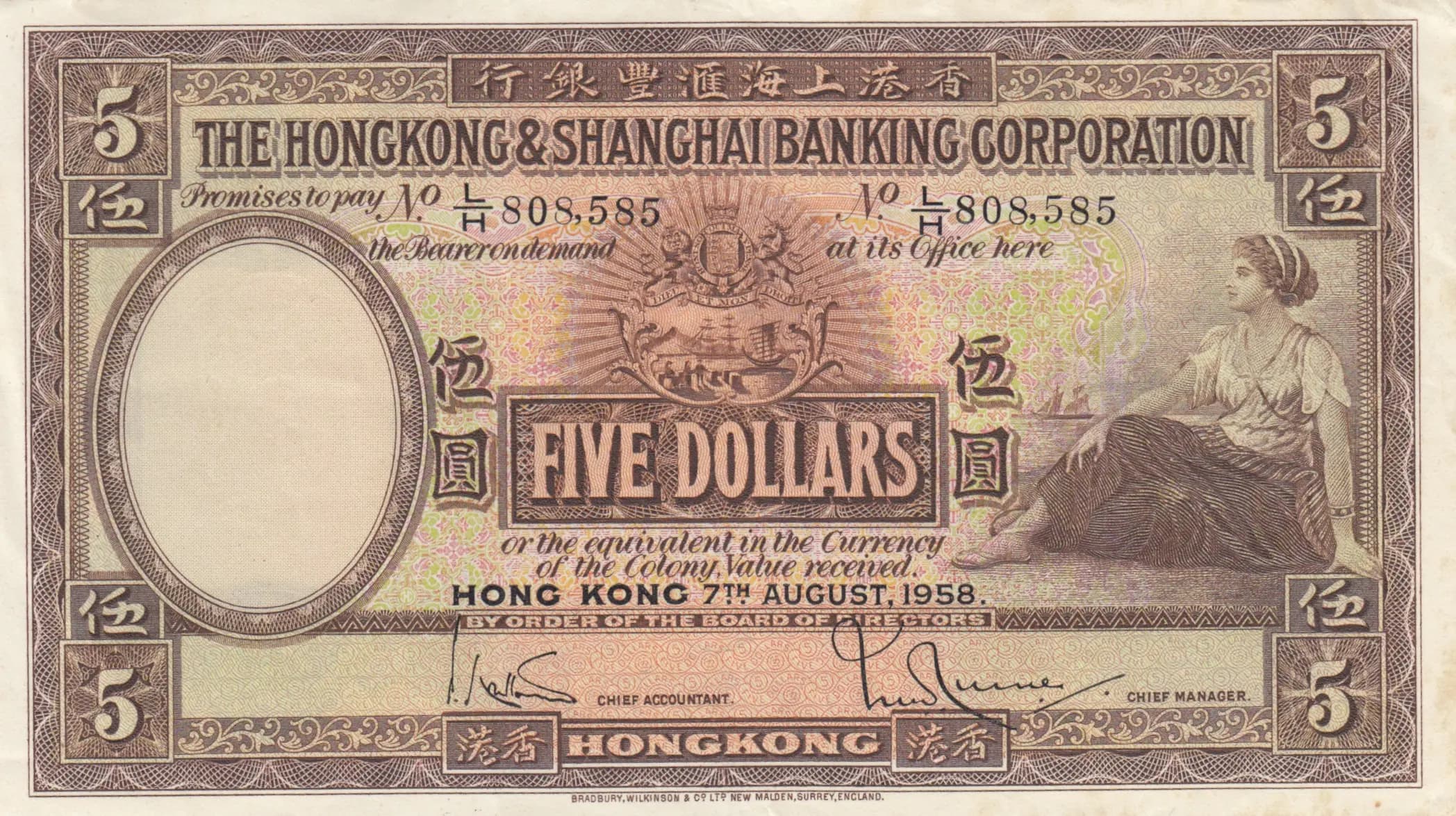
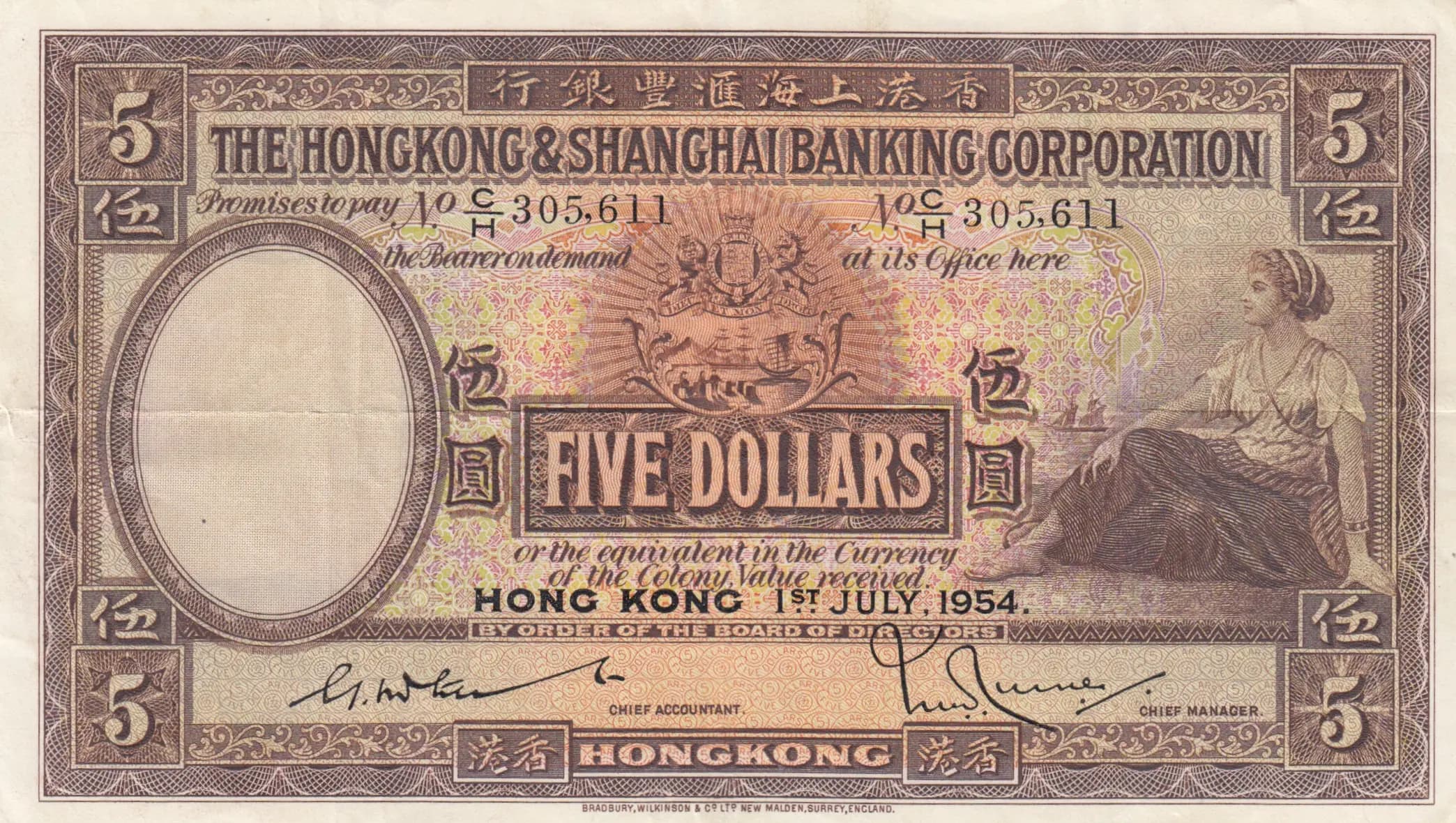
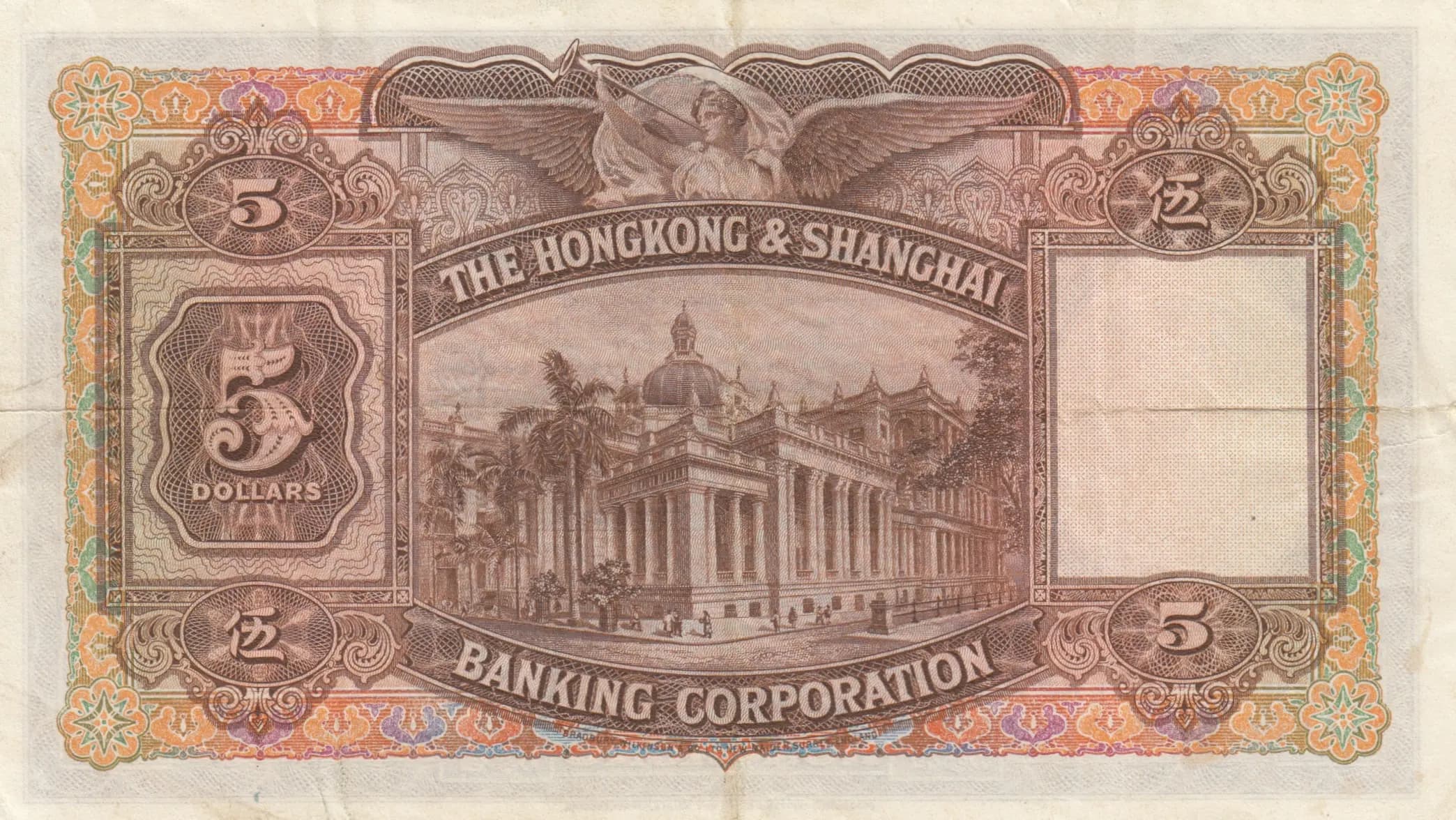
This 1954 Hong Kong & Shanghai Banking Corporation 5 dollar note presents a classic example of mid-20th century colonial banking currency, featuring elegant classical design elements on both sides. The front displays a female portrait in classical dress alongside ornate fan-pattern borders and the bank's coat of arms, while the reverse showcases a detailed neoclassical institutional building with palm trees in a tropical setting. In VF condition, the note exhibits expected aging with light foxing and creasing consistent with circulation, yet retains excellent legibility and the fine engraved details that characterize Bradbury Wilkinson's premium security printing work.
Common. The eBay price history provided shows consistent sales at moderate prices with multiple transactions: VF-graded examples have sold for $22-$82 in recent years, while ungraded VF sold for $82 in 2018. The 2016 catalog value for VF is only $30. This is a regular issue from a major international bank with substantial print runs during 1954-1959. The frequent appearance on eBay with multiple sales annually, combined with modest market prices even for higher grades (PMG 66 examples $300-$450), indicates this is a widely available banknote with no significant scarcity premium. Most collectors can acquire examples at reasonable cost.
Issued on 1st July 1954, this note represents Hong Kong's post-World War II economic recovery under the Hongkong & Shanghai Banking Corporation, which held the primary note-issuing authority for the colony. The classical female figure on the obverse and the prominent neoclassical bank building on the reverse reflect the institution's aspirations to project stability and prestige during a period of British colonial administration and Hong Kong's emergence as a regional financial center. The bilingual English-Chinese inscriptions throughout underscore Hong Kong's dual commercial culture during this transitional period of mid-century colonialism.
The obverse features an unnamed classical female figure positioned on the right side in draped Greco-Roman style clothing, facing right in profile—a generic allegorical representation of prosperity or commerce rather than a specific historical figure. The center displays 'FIVE DOLLARS' in bold letters flanked by the Hongkong & Shanghai Banking Corporation's coat of arms featuring a lion and shield design with radiating lines. Elaborate ornamental borders with repeating fan-pattern motifs frame the entire design in tan, brown, and pink-rose tones. The reverse showcases the HSBC's primary institutional building—a grand neoclassical structure with multiple supporting columns, a prominent central dome, and classical proportions, set within a tropical landscape with palm trees. A winged cherub or angelic figure adorns the top center, while large decorative numerals '5' appear in ornate cartouches at all four corners. The color palette on the reverse expands to include orange, green, and blue geometric and floral border patterns, creating a more vibrant design than the front.
FRONT: 'THE HONGKONG & SHANGHAI BANKING CORPORATION' / 'Promises to pay the Bearer on demand at its Office here' / 'FIVE DOLLARS or the equivalent in the Currency of the Colony, Value received' / 'HONG KONG' / '1ST JULY, 1954' / 'BY ORDER OF THE BOARD OF DIRECTORS' / 'CHIEF ACCOUNTANT' / 'CHIEF MANAGER' / Chinese: '香港上海匯豐銀行' (Hong Kong and Shanghai Banking Corporation) / '五圓' (Five Dollars) / Serial reference: 'O C 305,611'. BACK: 'THE HONGKONG & SHANGHAI BANKING CORPORATION' / 'FIVE DOLLARS' / Decorative corner cartouches with Chinese character references to denomination and Hong Kong (香港, 港, and numerical denomination markers). All inscriptions are rendered in traditional Chinese characters alongside English text, reflecting the bilingual nature of colonial Hong Kong commerce.
Intaglio engraving and letterpress printing, executed by Bradbury Wilkinson of New Malden (a premier British security printer). The visual analysis confirms the characteristic fine line work, intricate engraved patterns, and detailed architectural rendering typical of Bradbury Wilkinson's signature security printing methods. Multiple color separations evident in the ornate borders and corner designs indicate multicolor engraved production. Hand-signed signatures of bank officials (Chief Accountant and Chief Manager) authenticate the note. The extensive use of fine lines, geometric ornamentation, and fine detail throughout both sides exemplifies the high-security engraving standards employed for colonial currency of this period.
This specific note carries the serial number reference 'O C 305,611' visible in the lower portion of the obverse. The Pick catalog designation P-180a indicates this is from the first series of the 1954-1959 issue. Varieties within this Pick number likely exist based on signature variations (different Chief Accountant and Chief Manager signatures), serial number prefixes, and possibly color shade variations typical of multi-year print runs. The date '1ST JULY, 1954' on this example confirms it as an early issue from the first year of production. Collectors should note that subsequent issues (P-180b, P-180c, etc.) within the same denomination from later years may exist, representing different printing periods or signature combinations.