1 dollar 1940
Market Prices
52 salesAbout This Note
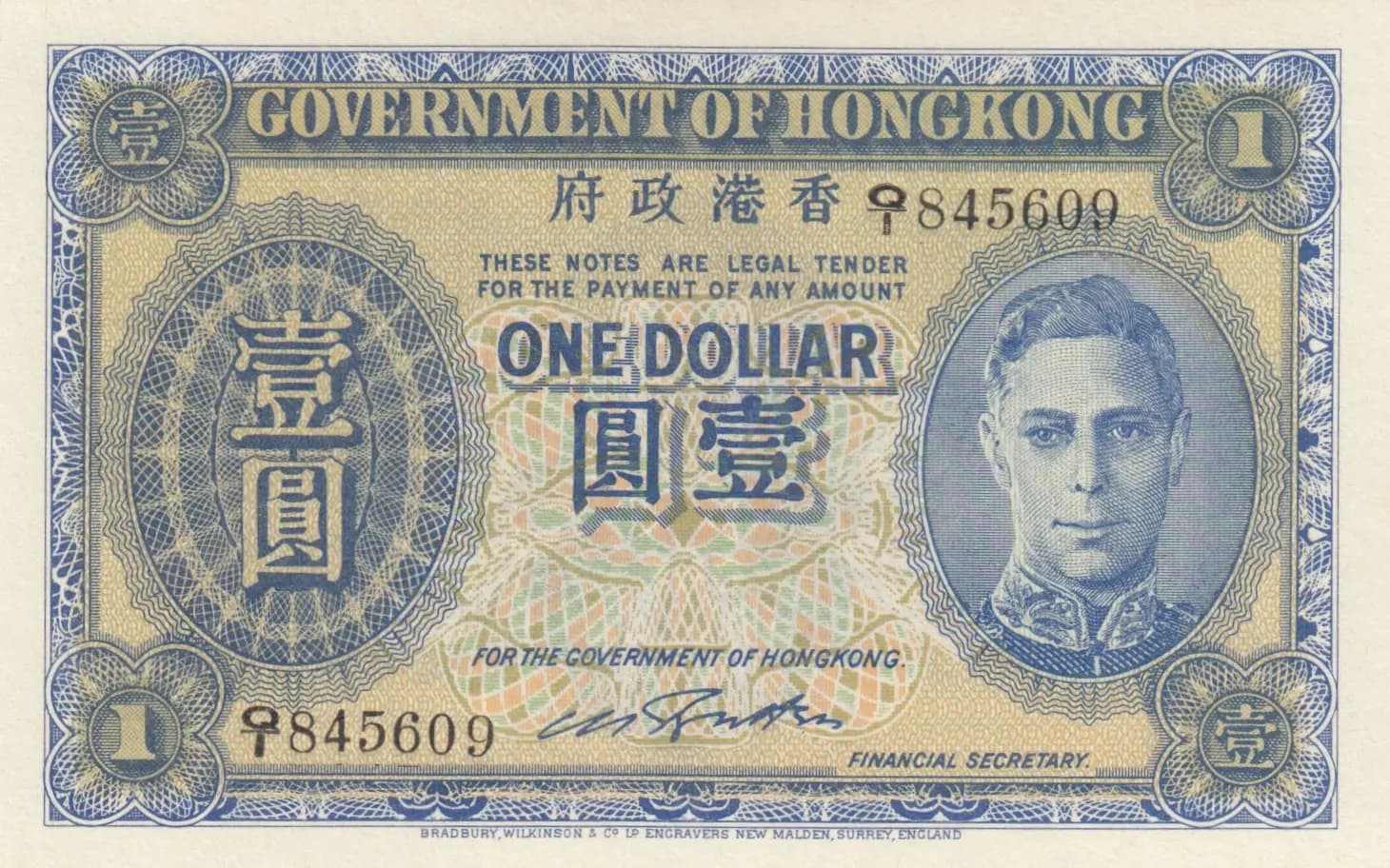
This Hong Kong Government one dollar banknote from 1940 presents an exceptional example of early colonial currency design, rendered in the classical engraved style characteristic of the era. The note features King George VI in profile on the obverse, accompanied by intricate bilingual inscriptions in English and Traditional Chinese, all executed in deep blue and cream tones with exceptional clarity and definition. In the observed UNC condition, this note displays pristine preservation with no evidence of circulation, making it a highly desirable example for collectors of British Commonwealth currency and Asian banknote history.
Common. While this is a pre-war colonial note with historical significance, eBay market data shows consistent circulation and sales across multiple condition grades. Recent sales of UNC examples (2014-2015) sold in the $100-$240 range, indicating strong collector demand but substantial supply. The catalog value of $250 for UNC and the consistent availability of this note across condition grades (from VG to UNC) in auction records spanning over a decade demonstrate this is a regularly encountered note rather than a scarce issue. The Government of Hong Kong's substantial production runs of this denomination support a common classification.
Issued during the height of British colonial rule in Hong Kong, this 1940 note represents the Government of Hong Kong's monetary authority during the pre-World War II period. The portrait of King George VI and the bilingual English-Chinese inscriptions reflect Hong Kong's dual cultural and administrative character as a British Crown Colony with a predominantly Chinese population. The note's design and printing by the prestigious London firm Bradbury Wilkinson & Co demonstrates the British Empire's commitment to high-security currency production in its colonial territories during this significant historical period.
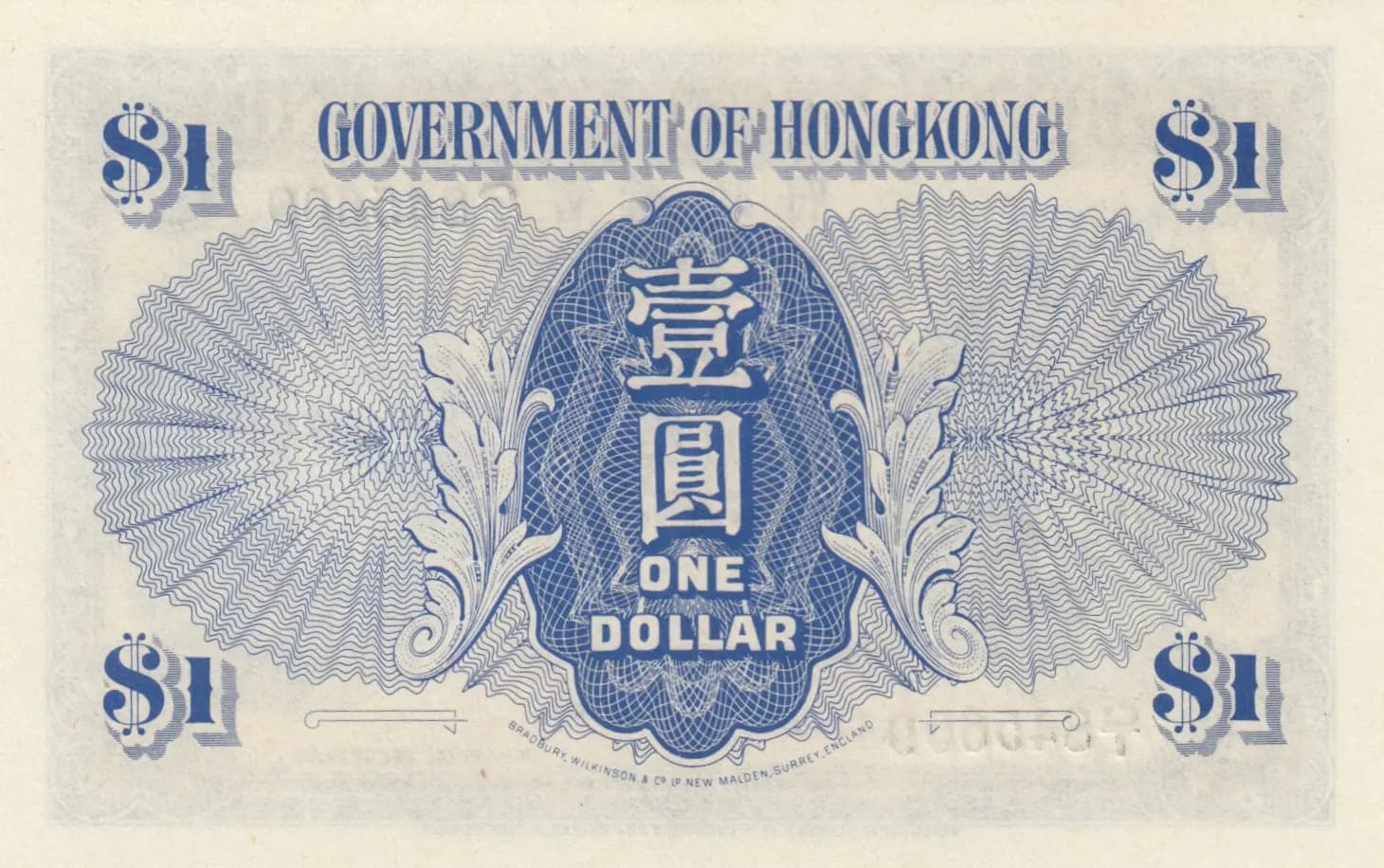
The obverse features an elegant portrait of King George VI positioned in profile on the right side of the note, rendered in fine engraved detail characteristic of security printing. The design is framed by ornate geometric border patterns in blue and cream, with four circular medallions in the corners containing traditional Chinese characters and designs. A large oval frame on the left side contains the Chinese denomination character '圓' (Yuan). The reverse presents a symmetrical, highly ornamental design dominated by elaborate radiating wave-like patterns forming a sunburst effect, creating a moiré security pattern. Four large dollar signs ($1) are positioned in the corners, with a central oval frame containing the denomination in both English ('ONE DOLLAR') and Chinese ('圓'). The bilingual presentation throughout reflects Hong Kong's unique position as a British colony with Chinese cultural significance.
FRONT: English text reads 'GOVERNMENT OF HONGKONG,' 'ONE DOLLAR,' 'THESE NOTES ARE LEGAL TENDER FOR THE PAYMENT OF ANY AMOUNT,' 'FOR THE GOVERNMENT OF HONGKONG,' 'FINANCIAL SECRETARY,' and 'BRADBURY WILKINSON & CO LTD ENGRAVERS NEW MALDEN SURREY ENGLAND.' Chinese text (Traditional, right-to-left reading): '府政港香' (Government of Hong Kong) and '圓壹' (One Dollar). Serial number: ¥8456609 (appears twice). BACK: English text includes 'GOVERNMENT OF HONGKONG,' 'ONE DOLLAR,' and 'BRADBURY WILKINSON & CO LTD NEW MALDEN SURREY ENGLAND.' The central oval frame contains the Chinese character '圓' (Yuan/Dollar) with 'ONE' and 'DOLLAR' inscribed in English. Four corner denominations marked '$1' in each corner.
This note was produced entirely through fine line engraving, the security printing method of choice for currency production in this era. Bradbury Wilkinson & Co Ltd, the renowned London-based security printer noted on the note itself, employed intaglio engraving for all design elements. The intricate geometric patterns, portrait detailing, and radiating wave designs visible on both sides demonstrate the high-quality craftsmanship and anti-counterfeiting measures characteristic of this printer's work. The tonal variations, fine line work, and precise detail register indicate production using traditional copperplate engraving with multiple passes.
The observed specimen carries serial number ¥8456609. No overprints or significant printing varieties are apparent from the visual analysis. Pick P-316 covers the 1940-1941 issue period, and the notation 'ND (1940-1941)' in catalog references indicates the specific year of issue (1940) is accepted by the numismatic community. Variations in this series may exist related to serial number prefixes or slight printing differences, but the specimen examined shows no notable distinguishing characteristics beyond its base design and condition grade.