5 lempira 1978
Market Prices
12 salesAbout This Note
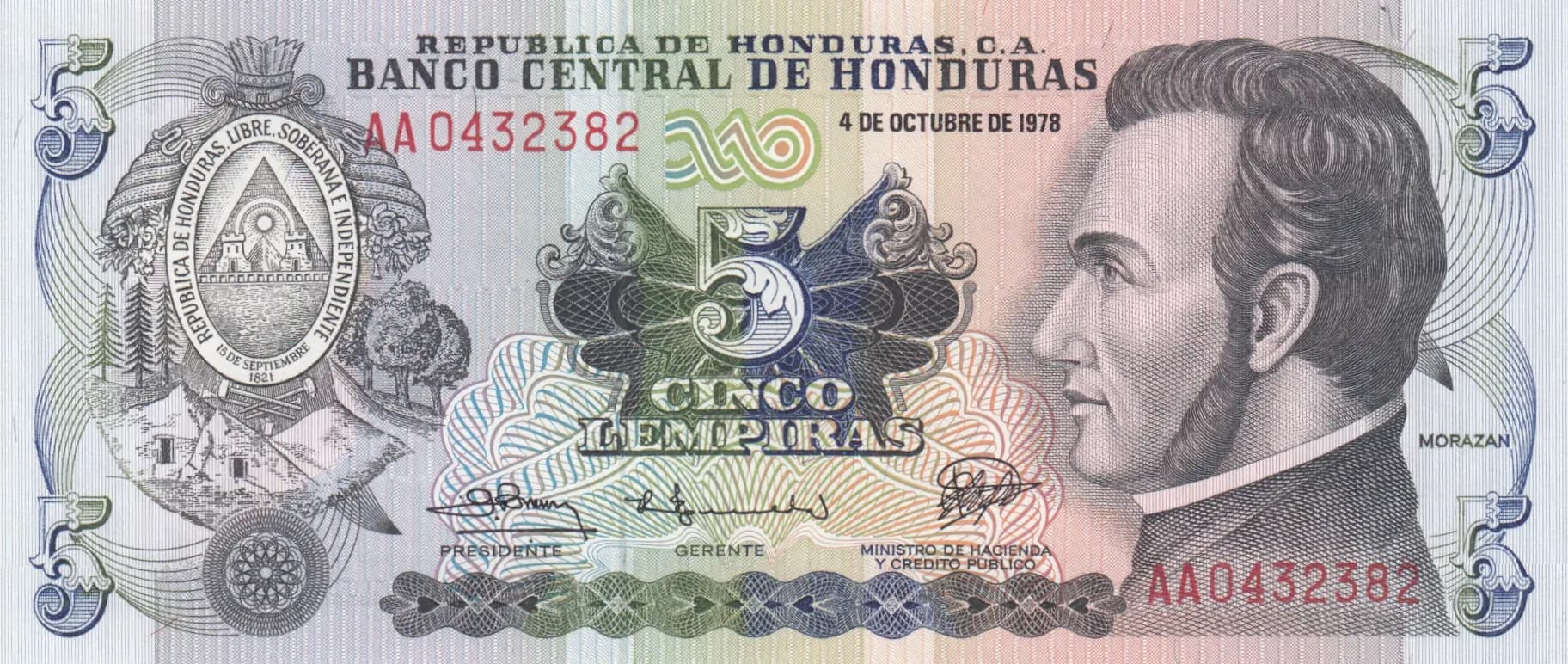
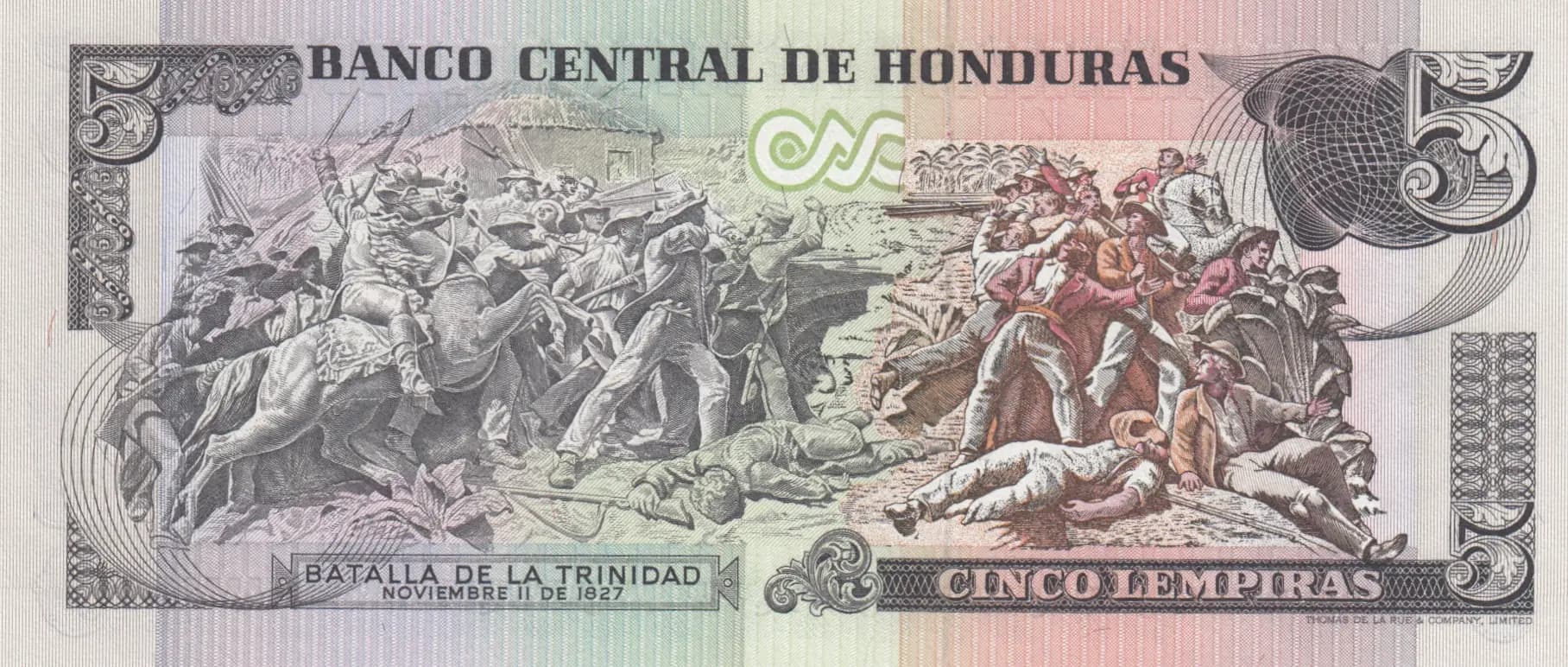
This is an exceptionally well-preserved uncirculated example of the 1978 Honduras 5 Lempiras (Pick P-63a), featuring a striking multi-color design with José Francisco Morazán's profile on the obverse and a detailed historical engraving of the Battle of Trinidad on the reverse. The note exhibits crisp, sharp printing with no signs of circulation, intact margins, and excellent preservation of the fine guilloche security patterns throughout, making it a desirable specimen for Central American currency collectors.
Common. This note is part of a standard regular-issue series produced by the Banco Central de Honduras between 1978 and 1994 with presumably substantial print runs. Market data from eBay shows consistent trading of UNC examples in the $6.99 to $24.50 range, with PMG 66-67 graded specimens commanding $12.50 to $36.50, indicating ready availability in the collector market. The catalog values (2019) list UNC specimens at $15, and this denomination appears routinely in Central American banknote dealers' inventories, confirming its common status.
Issued by the Banco Central de Honduras on October 4, 1978, this note commemorates two pivotal moments in Honduran history: the portrait of José Francisco Morazán Quezada, the 19th-century Central American statesman and military leader, and the Battle of Trinidad of November 11, 1827, a significant engagement during the wars of independence and regional consolidation in Central America. The oval seal on the obverse bears the inscription 'República de Honduras Libre, Soberana e Independiente desde 15 de Septiembre de 1821,' emphasizing the nation's independence from Spain and its sovereignty during this period of nation-building.
The obverse features a left-facing profile portrait of José Francisco Morazán Quezada, the prominent 19th-century Central American political and military figure, rendered in classical engraving style on the right portion of the note. The left side is dominated by the national coat of arms of Honduras within an ornate oval seal, featuring architectural and natural elements symbolic of the nation. The reverse showcases a detailed historical scene of the Battle of Trinidad, depicting armed cavalry and infantry soldiers engaged in combat, with mounted officers on the left and standing and fallen combatants across the composition. Fine line engraving and intricate guilloche patterns serve as security elements throughout both sides, with ornamental scrollwork in all four corners and decorative border patterns. The multi-color printing employs blues, greens, peach/pink, and gray tones over a complex underprint base.
{"front":{"REPUBLICA DE HONDURAS, C.A.":"Republic of Honduras, C.A.","BANCO CENTRAL DE HONDURAS":"Central Bank of Honduras","CINCO LEMPORAS":"Five Lempiras","4 DE OCTUBRE DE 1978":"October 4, 1978","PRESIDENTE":"President","GERENTE":"Manager","MINISTRO DE HACIENDA Y CREDITO PUBLICO":"Minister of Finance and Public Credit","REPUBLICA DE HONDURAS LIBRE SOBERANA E INDEPENDIENTE DESDE 15 DE SEPTIEMBRE DE 1821":"Free, Sovereign and Independent Republic of Honduras since September 15, 1821","AA0432382":"Serial Number"},"back":{"BANCO CENTRAL DE HONDURAS":"Central Bank of Honduras","BATALLA DE LA TRINIDAD":"Battle of Trinidad","NOVIEMBRE 11 DE 1827":"November 11, 1827","CINCO LEMPORAS":"Five Lempiras"}}
Intaglio engraving (line engraving and steel plate printing), executed by Thomas de la Rue, London, the renowned British security printer. The fine detail visible throughout—including the complex guilloche security patterns, cross-hatching for depth in the battle scene, and intricate line work in borders and portraits—is characteristic of high-security banknote production using steel plate engraving and multi-color offset printing. The printer's mark and craftsmanship reflect the premium security standards applied to Central American currency during the 1970s-1990s production period.
This note is cataloged as Pick P-63a, with known variant P-63b existing in the PMG population report. The serial number visible on this specimen (AA0432382) indicates standard series numbering. The date on the obverse reads October 4, 1978 (4 DE OCTUBRE DE 1978), consistent with the 1978 issuance year. No overprints, signatures, or distinguishing marks beyond standard production characteristics are evident. The note represents the base variety P-63a in the 5 Lempiras 1978 series; collectors should verify their specific examples against catalog references to distinguish between P-63a and P-63b variants.