2 lempira 1976
Market Prices
21 salesAbout This Note
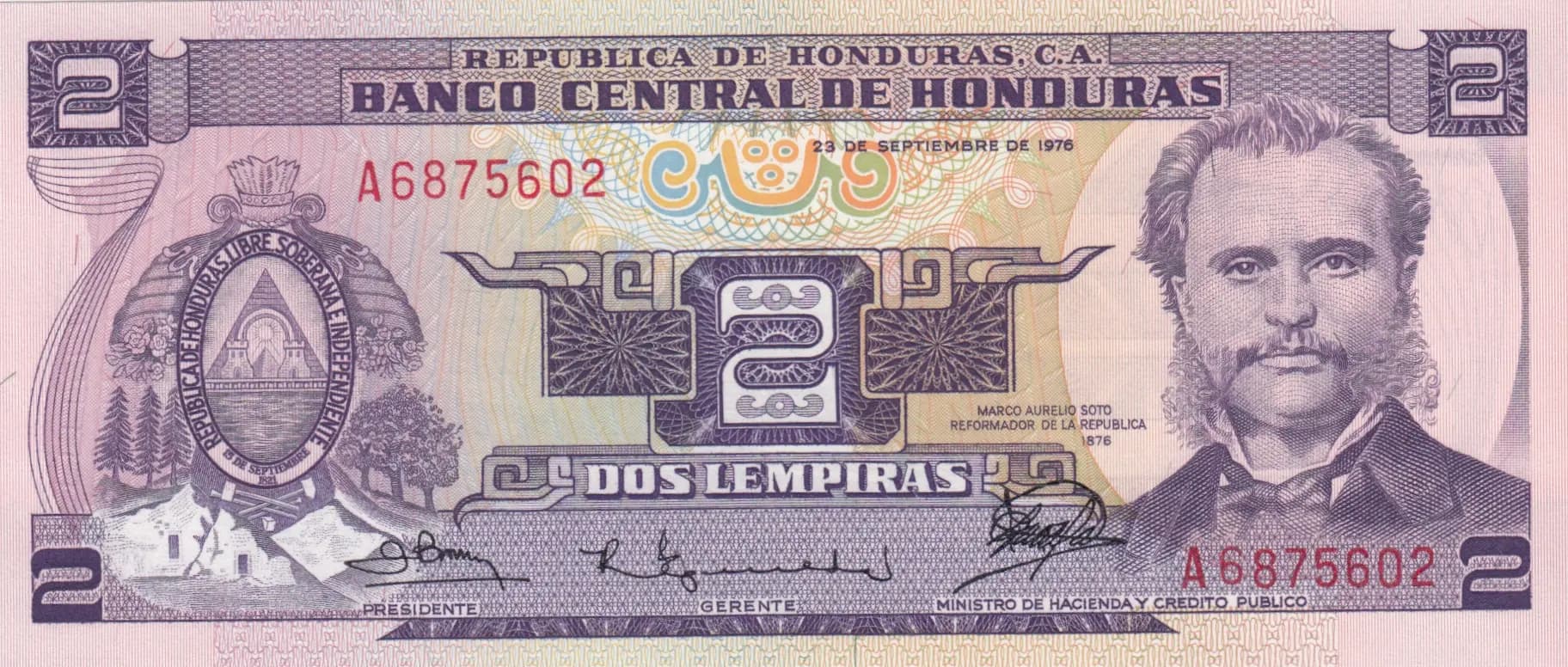
This is a stunning UNC example of Honduras's 2 Lempiras commemorative note from 1976, celebrating the centennial of Marco Aurelio Soto's government. The note displays exceptional clarity and sharpness throughout, with no visible wear, creases, or circulation marks—exactly as struck by Thomas de la Rue. The striking purple and violet color scheme combined with intricate geometric and Mayan-inspired patterns makes this an attractive piece of Central American numismatic history that exemplifies the high standards of British banknote security printing.
Common. This commemorative note, while historically significant, was issued in substantial quantities by the Banco Central de Honduras to mark the centennial occasion. eBay market data demonstrates consistent availability at modest prices, with UNC examples typically selling between $2-$10 (averaging around $3-$6 from 2009-2021), and even graded examples (PMG 66-67) rarely exceeding $40. The relatively recent printing date (1976), lack of reported short supply issues, and frequent availability in the secondary market all indicate this is a common issue despite its commemorative status. The denomination (2 Lempiras) as a moderate-value circulating note further suggests wide distribution.
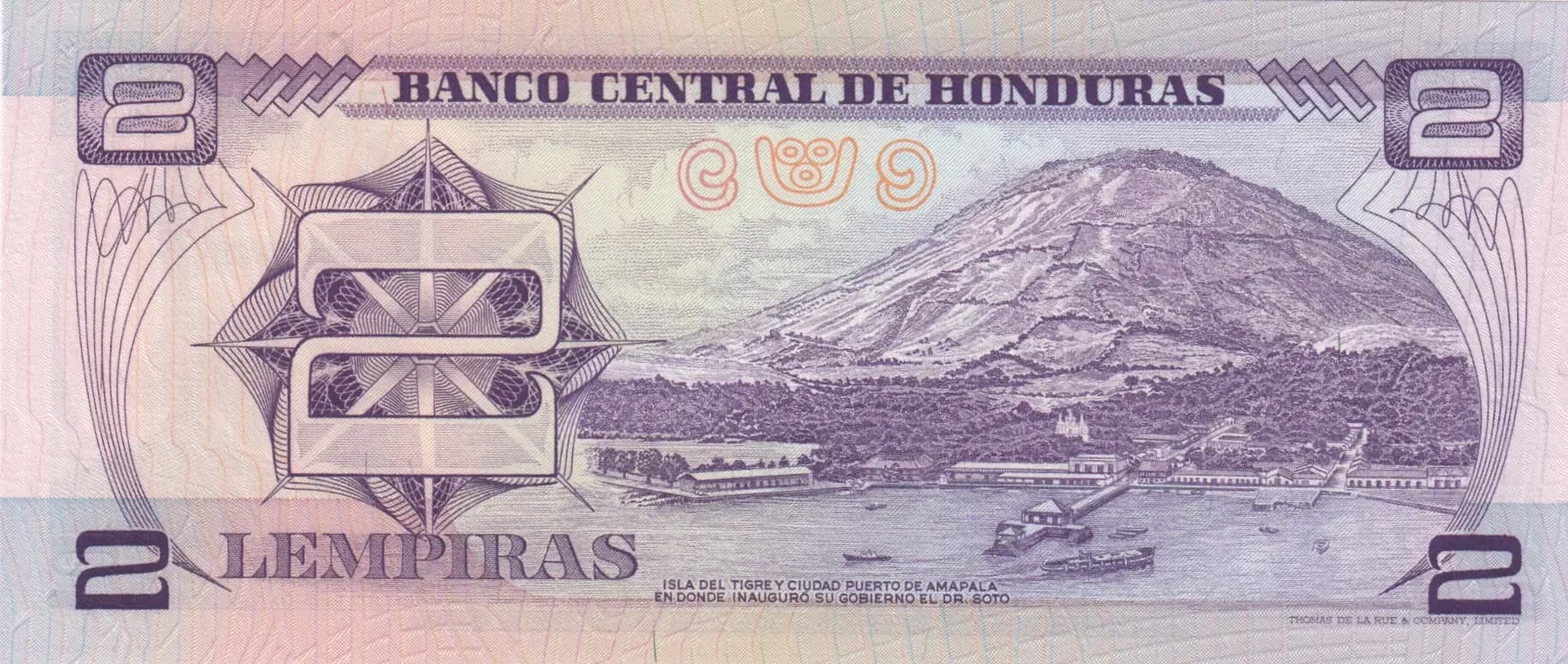
This commemorative note marks the 100th anniversary of Marco Aurelio Soto's presidency, who served as a major reformer (Reformador de la República) of Honduras beginning in 1876. The reverse depicts Tiger Island (Isla del Tigre) and the Port City of Amapala, specifically referencing where Soto inaugurated his government—a historically significant location in Honduras's political development. The September 23, 1976 issue date commemorates this centennial milestone and represents the Banco Central de Honduras's homage to one of the nation's most influential 19th-century leaders.
The obverse features a prominent portrait of Marco Aurelio Soto, rendered as a bearded gentleman facing right, with the inscription 'Reformador de la República, 1876' identifying him as the republic's reformer. The left side displays the national coat of arms of Honduras within an ornamental oval frame, featuring the symbolic trees and mountain imagery central to Honduran heraldry. The note employs sophisticated Mayan-inspired geometric patterns and decorative guilloche work throughout. The reverse presents an engraved landscape scene of Tiger Island (Isla del Tigre) dominated by a volcanic mountain, with colonial-era architecture and harbor structures visible along the waterfront at Amapala—the historical location where Soto established his government. Large denomination numerals appear in decorative geometric frames on the left side of the reverse. The overall color palette of purple, violet, cream, and gold/orange accents creates a visually distinctive and elegant commemorative piece.
FRONT SIDE: 'REPÚBLICA DE HONDURAS C.A.' (Republic of Honduras, Central America); 'BANCO CENTRAL DE HONDURAS' (Central Bank of Honduras); '23 DE SEPTIEMBRE DE 1976' (September 23, 1976); 'DOS LEMPIRAS' (Two Lempiras); 'MARCO AURELIO SOTO' (Marco Aurelio Soto); 'REFORMADOR DE LA REPÚBLICA' (Reformer of the Republic); '1876' (Year 1876); 'PRESIDENTE' (President); 'GERENTE' (Manager); 'MINISTRO DE HACIENDA Y CRÉDITO PÚBLICO' (Minister of Finance and Public Credit); Serial number: 'A6875602'. BACK SIDE: 'BANCO CENTRAL DE HONDURAS' (Central Bank of Honduras); 'LEMPIRAS' (Lempiras); 'ISLA DEL TIGRE Y CIUDAD PUERTO DE AMAPALA' (Tiger Island and Port City of Amapala); 'EN DONDE INAUGURÓ SU GOBIERNO EL DR. SOTO' (Where Dr. Soto inaugurated his government); 'THOMAS DE LA RUE & COMPANY LIMITED' (Thomas De La Rue & Company Limited - printer).
This note was produced using intaglio engraving by Thomas de la Rue & Company Limited, London, one of the world's premier security printers. The technique is evidenced by the fine line patterns, complex guilloche designs, and exceptionally sharp detail visible throughout both sides of the note. The intricate Mayan geometric patterns, detailed landscape engraving of Tiger Island and Amapala, and precision of the portrait work all demonstrate the multi-plate intaglio process characteristic of De la Rue's security printing standards. The clarity and crispness of all design elements in this UNC example reflect the high-quality engraved plates used in production.
The observed serial number is A6875602, which represents a standard variety from the initial print run. No overprints or special marks are visible that would indicate a distinct variety or limited printing stage. The consistent presence of signature lines for 'Presidente,' 'Gerente,' and 'Ministro de Hacienda y Crédito Público' suggests this is from the standard issue. Pick P-61 does not note major recognized varieties in standard catalogs. Collectors should note that as with most early 1970s Central American commemoratives, signature variations may exist among different printed sheets, though this represents normal production variance rather than recognized catalog varieties.