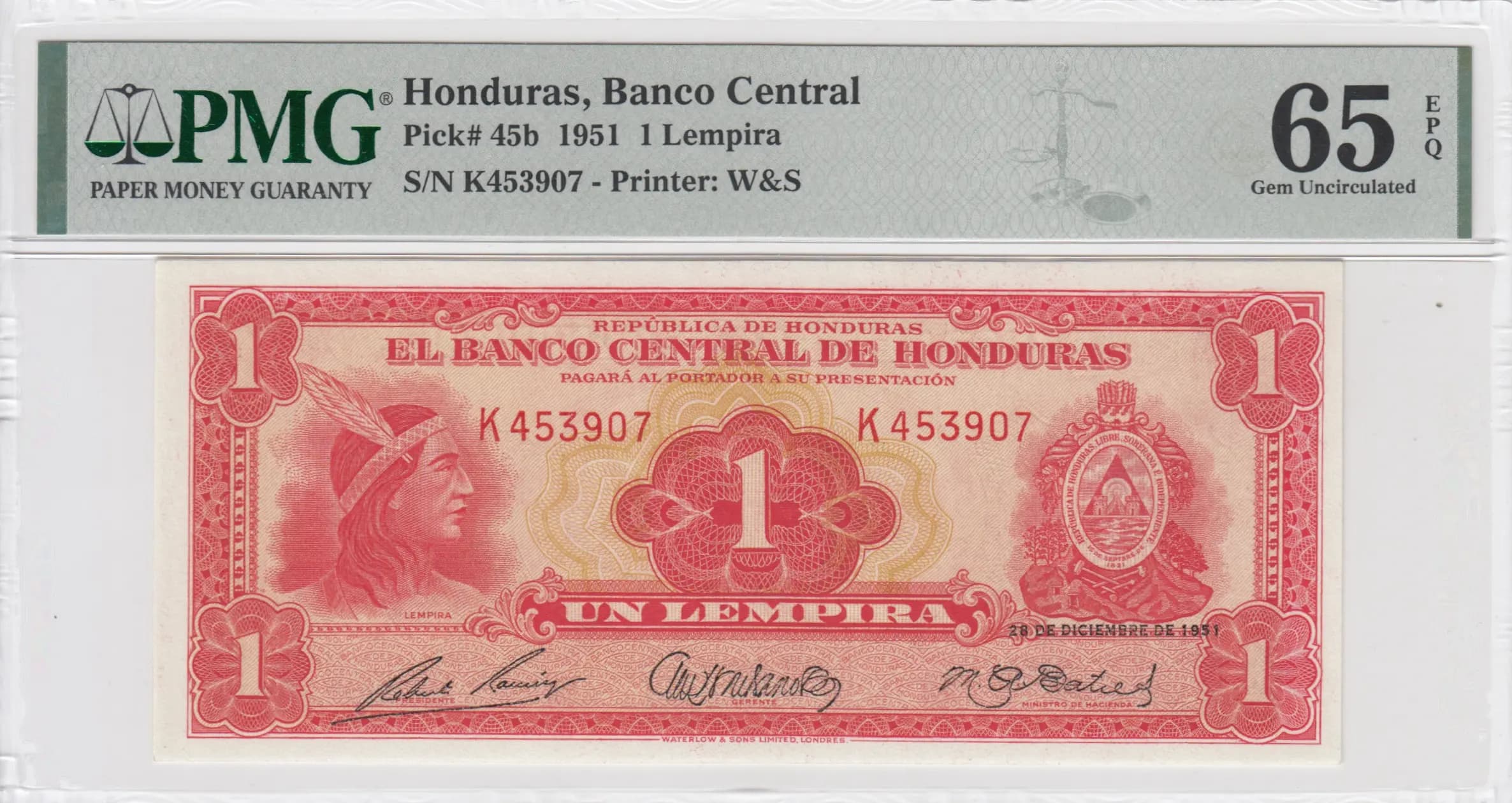
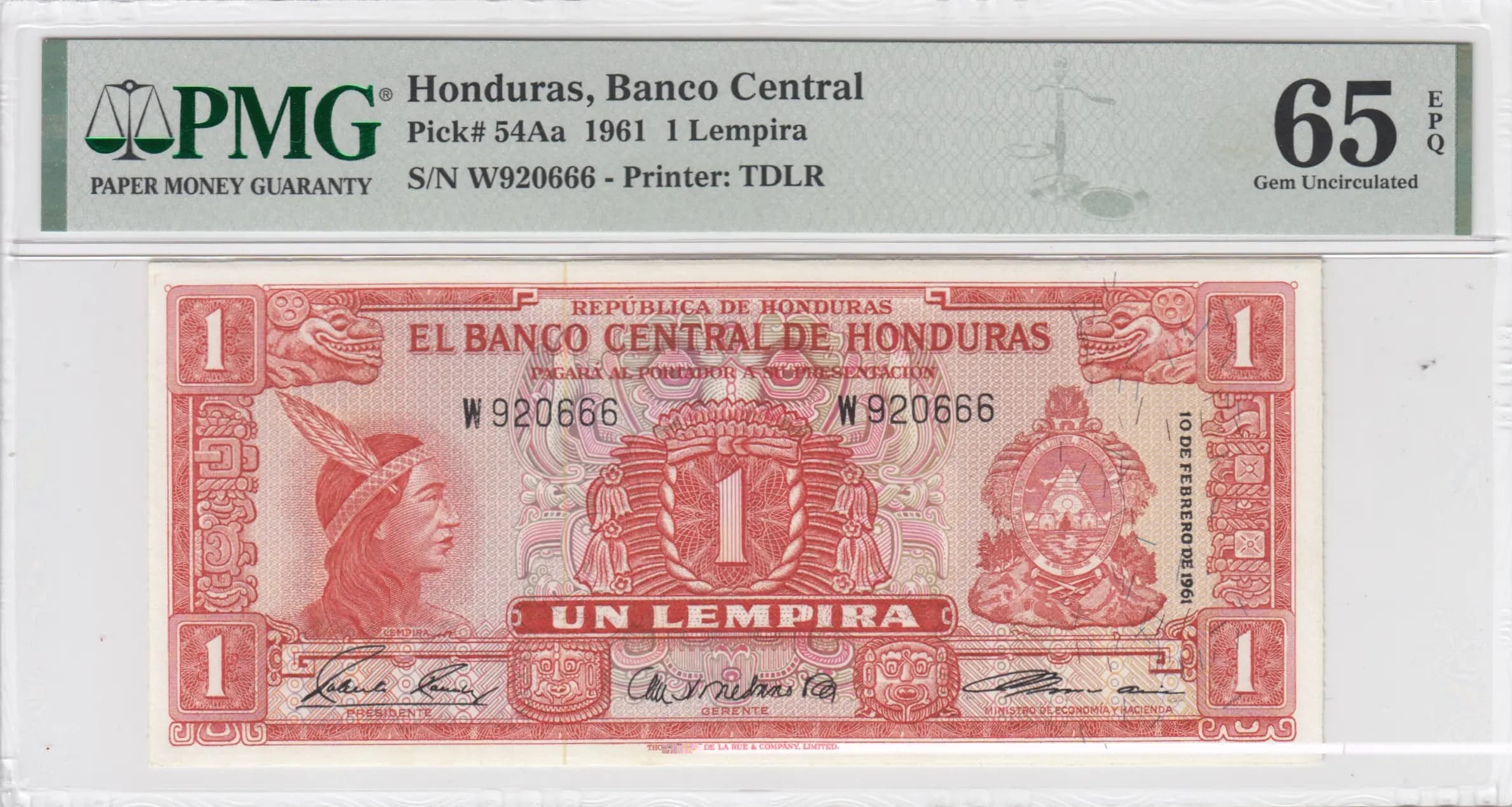
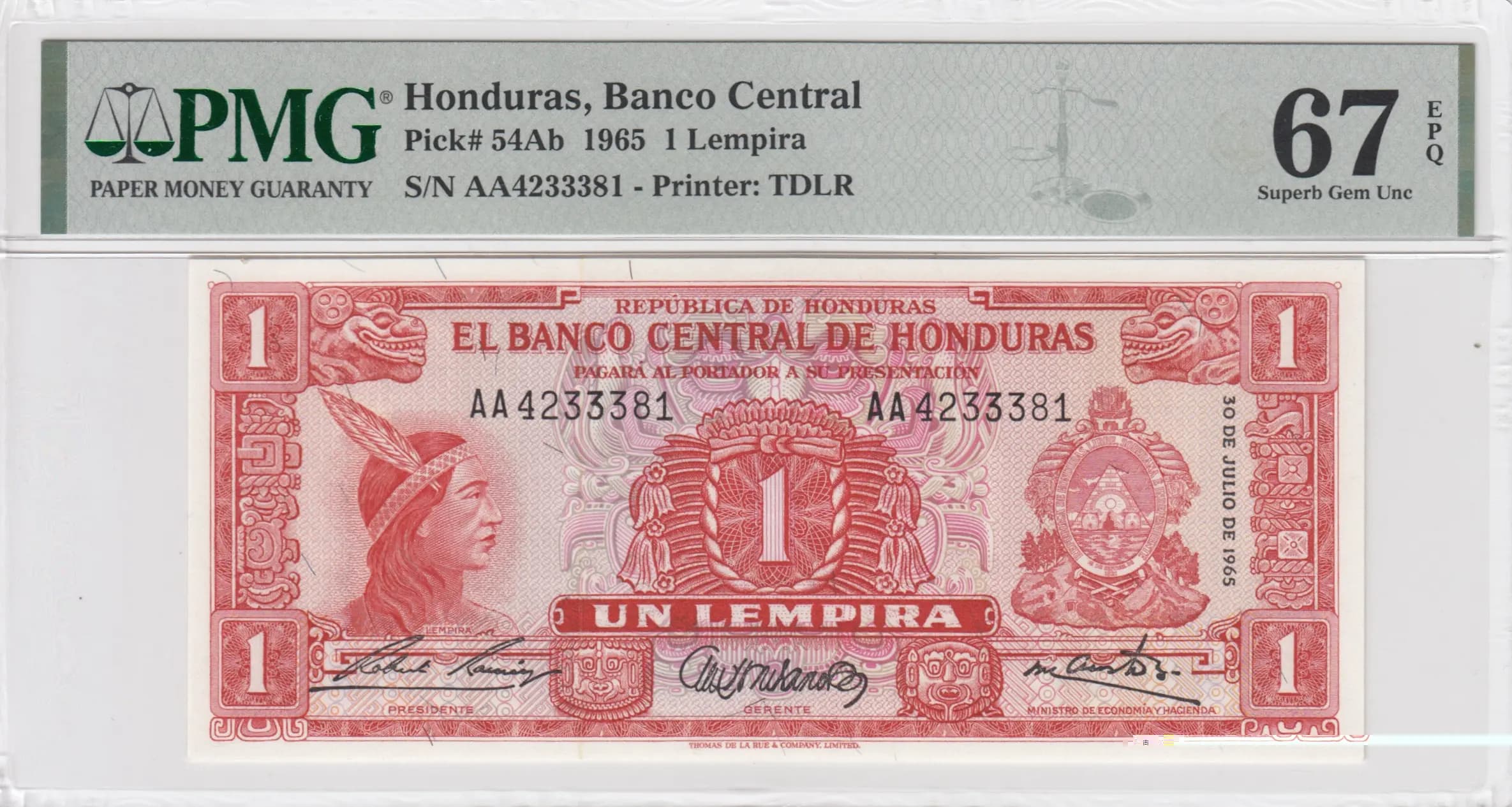
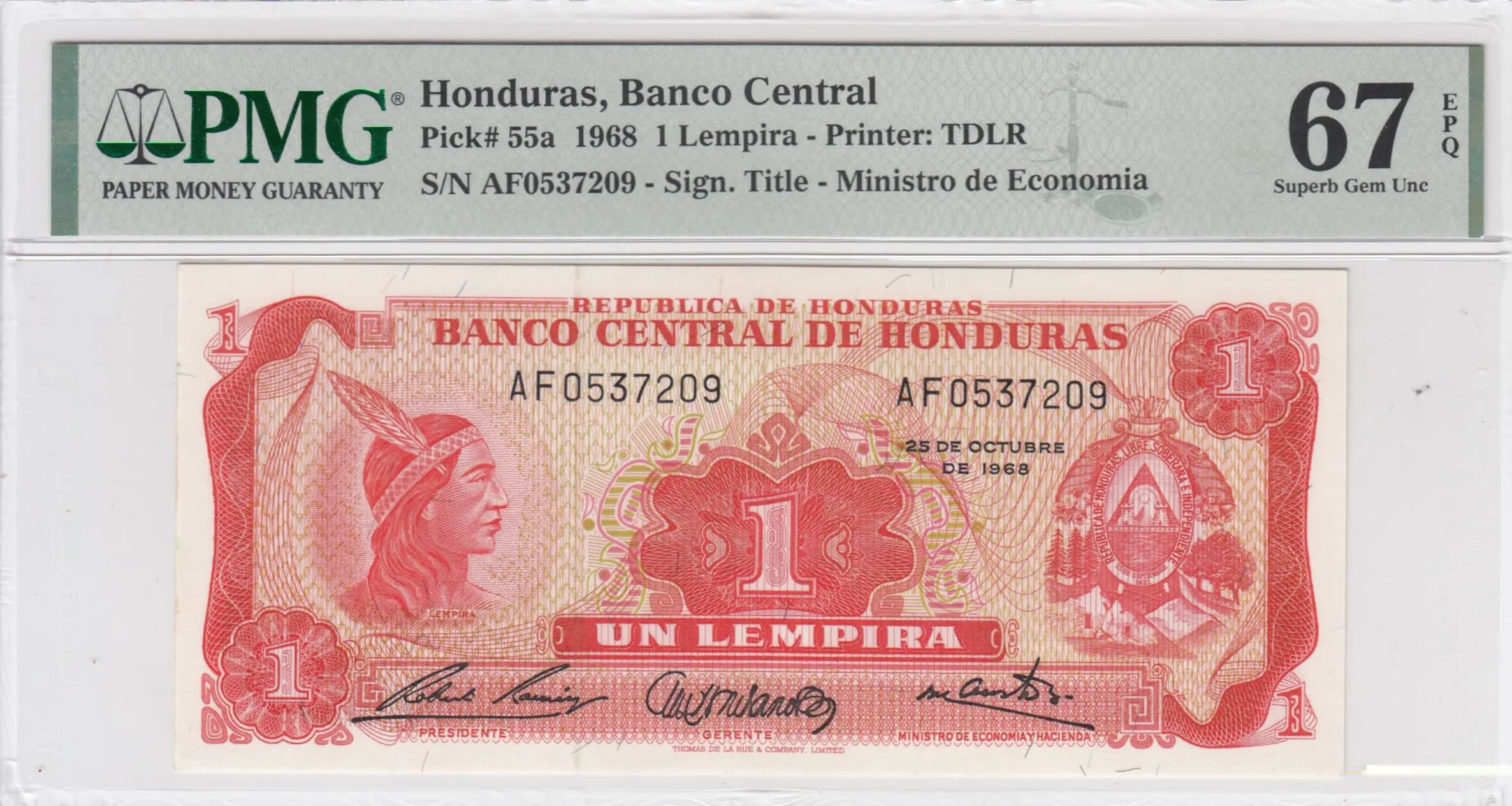
1 lempira 1980
Market Prices
15 salesAbout This Note
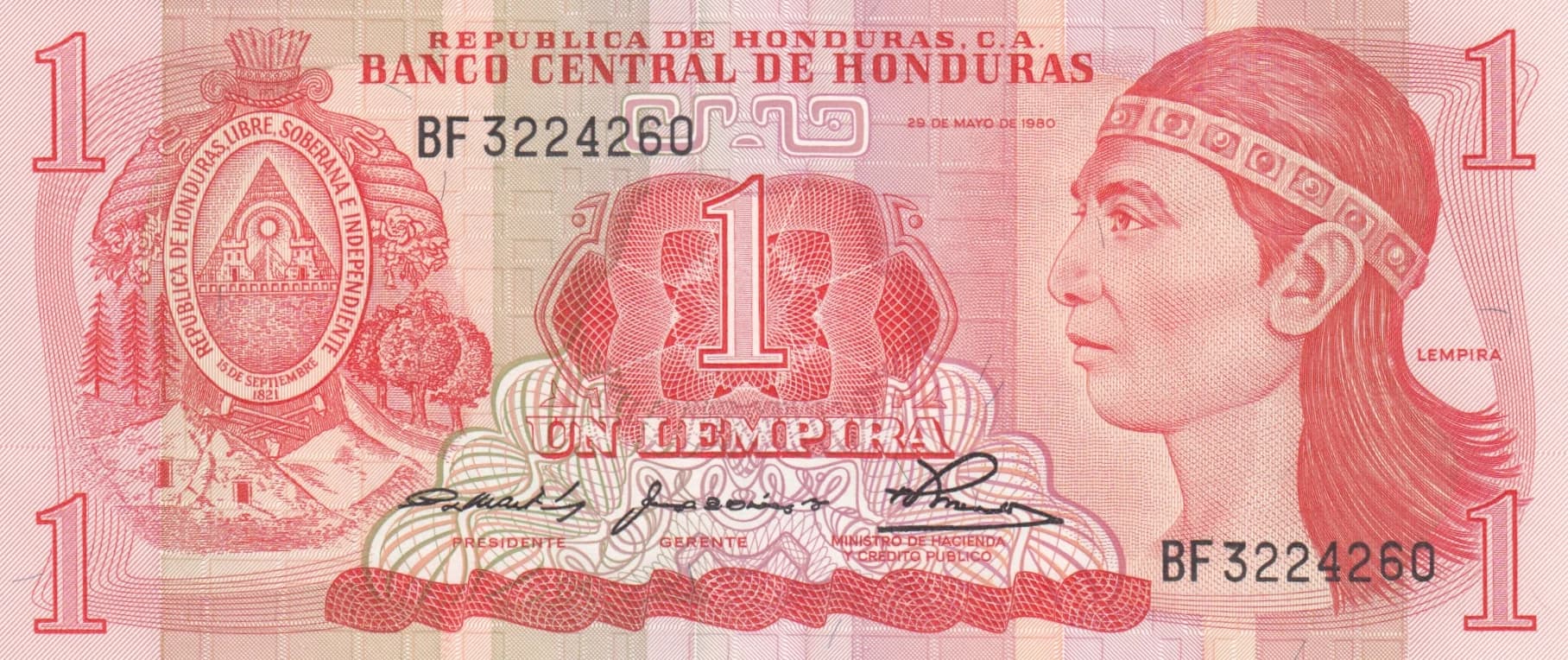
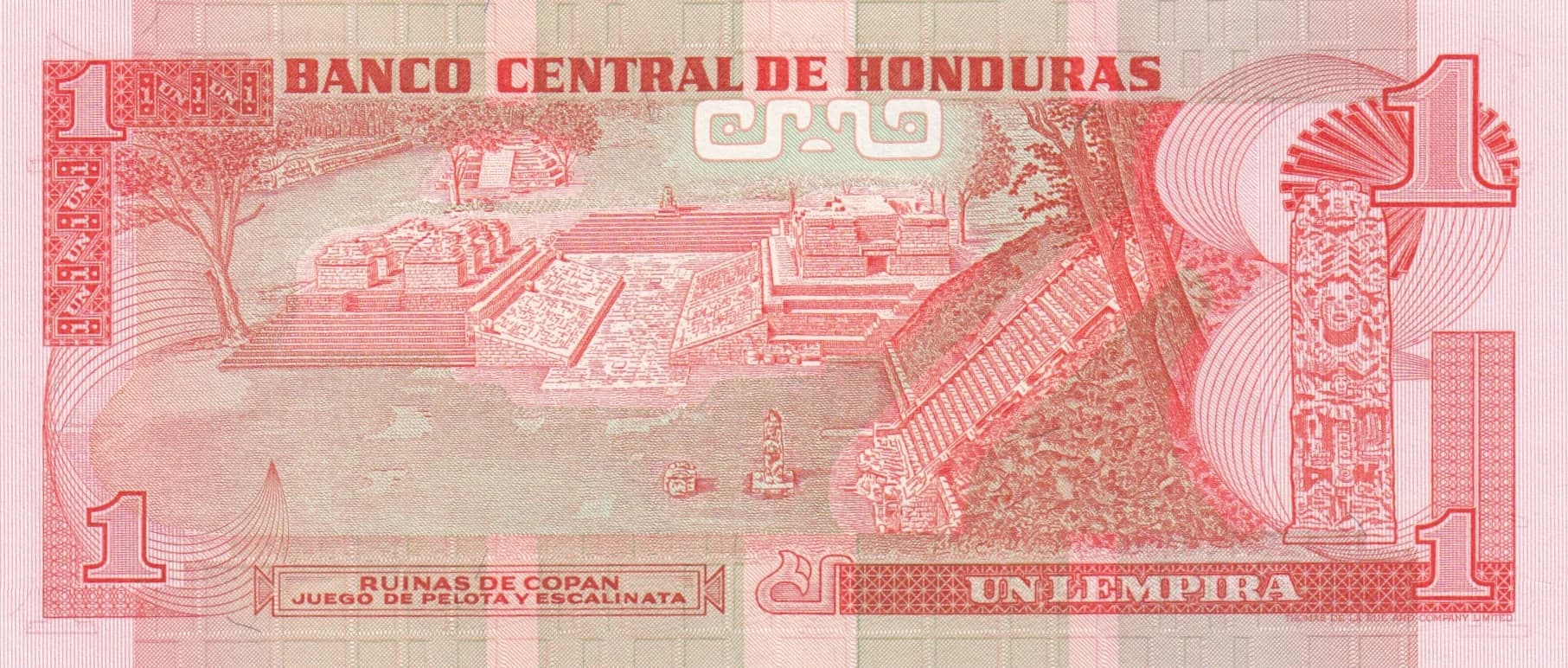
This is an uncirculated example of the Honduras 1 Lempira P-68a from 1980, printed by Thomas de la Rue in London. The note displays exceptional preservation with sharp, clear impressions throughout both sides, featuring the portrait of the indigenous leader Lempira on the obverse and a detailed engraving of the Copán archaeological site on the reverse. The red and multicolored design showcases fine security engraving throughout, making this an attractive example of Central American currency from this period.
Common. This P-68a issue had a substantial print run spanning the 1980-1989 period and remains widely available in the collector market. Market data from realbanknotes.com shows consistent eBay sales with UNC examples ranging from $1.26 to $30.08, with most premium-graded (PMG 66-67) examples in the $14-19 range. The current 2019 catalogue value for UNC is $6, and the note does not appear to have been subject to recall or withdrawal. Standard circulation issues from this era remain common in all grades.
This banknote was issued by the Banco Central de Honduras on May 29, 1980, during a period of significant economic and political transition in Honduras. The obverse honors Lempira, the 16th-century indigenous leader who famously resisted Spanish conquest, reflecting national pride in pre-Columbian heritage. The reverse depicts the Ball Court and Stairway at the ruins of Copán, one of the most important Mayan archaeological sites, emphasizing Honduras's connection to its Maya civilizational legacy.
The obverse features a profile portrait of Lempira, the legendary 16th-century Lenca indigenous resistance leader, shown facing right and wearing a traditional headband or crown. His portrait is positioned at the right side of the note. The left side displays the Honduran national coat of arms within a circular bordered seal, incorporating symbolic elements including a pyramid and palm trees representing the nation's heritage and resources. Large denomination numerals '1' appear in the corners. The reverse presents a detailed engraved landscape of the Copán archaeological site, specifically depicting the Ball Court (Juego de Pelota) and the associated monumental stairway, with architectural reconstructions of Maya structures and a prominent tree integrated into the scene. Both sides feature ornamental borders with geometric guilloche patterns providing security. The color scheme of red, pink, cream, and beige dominates throughout.
FRONT SIDE: 'REPUBLICA DE HONDURAS, C.A.' (Republic of Honduras, Central America); 'BANCO CENTRAL DE HONDURAS' (Central Bank of Honduras); 'UN LEMPIRA' (One Lempira); 'LEMPIRA' (name of the depicted figure); '29 DE MAYO DE 1980' (May 29, 1980); 'PRESIDENTE' (President); 'GERENTE' (Manager); 'MINISTRO DE HACIENDA' (Minister of Finance); 'CREDITO PUBLICO' (Public Credit); Serial number 'BF 3224260'. BACK SIDE: 'BANCO CENTRAL DE HONDURAS' (Central Bank of Honduras); 'RUINAS DE COPAN' (Copán Ruins); 'JUEGO DE PELOTA Y ESCALINATA' (Ball Court and Stairway); 'UN LEMPIRA' (One Lempira).
Intaglio (engraved) printing by Thomas de la Rue, London. The visual characteristics show extensive fine-line engraving, complex guilloche patterns in borders and background areas, and multiple layers of fine printing creating the security features. The sharp clarity of the engraved portrait, architectural details, and ornamental patterns indicates high-quality steel plate engraving typical of Thomas de la Rue's work during this period. No security thread is present on this issue.
This specific example bears the serial number BF 3224260 and is dated 29 DE MAYO DE 1980 (May 29, 1980). The BF prefix on the serial number may indicate a specific printing series. The Pick catalog designation P-68a suggests this is the first or 'a' variety of this design type, which typically indicates differences in signatures, dates, or printer marks compared to P-68 and later varieties (P-71, P-76, P-79, P-79A, P-84, P-89). Without additional examples for direct comparison, the specific distinguishing features of the P-68a variety versus other designations are not definitively identifiable from this single note, though the 1980 date and May 29 issue date are consistent with the P-68a classification.