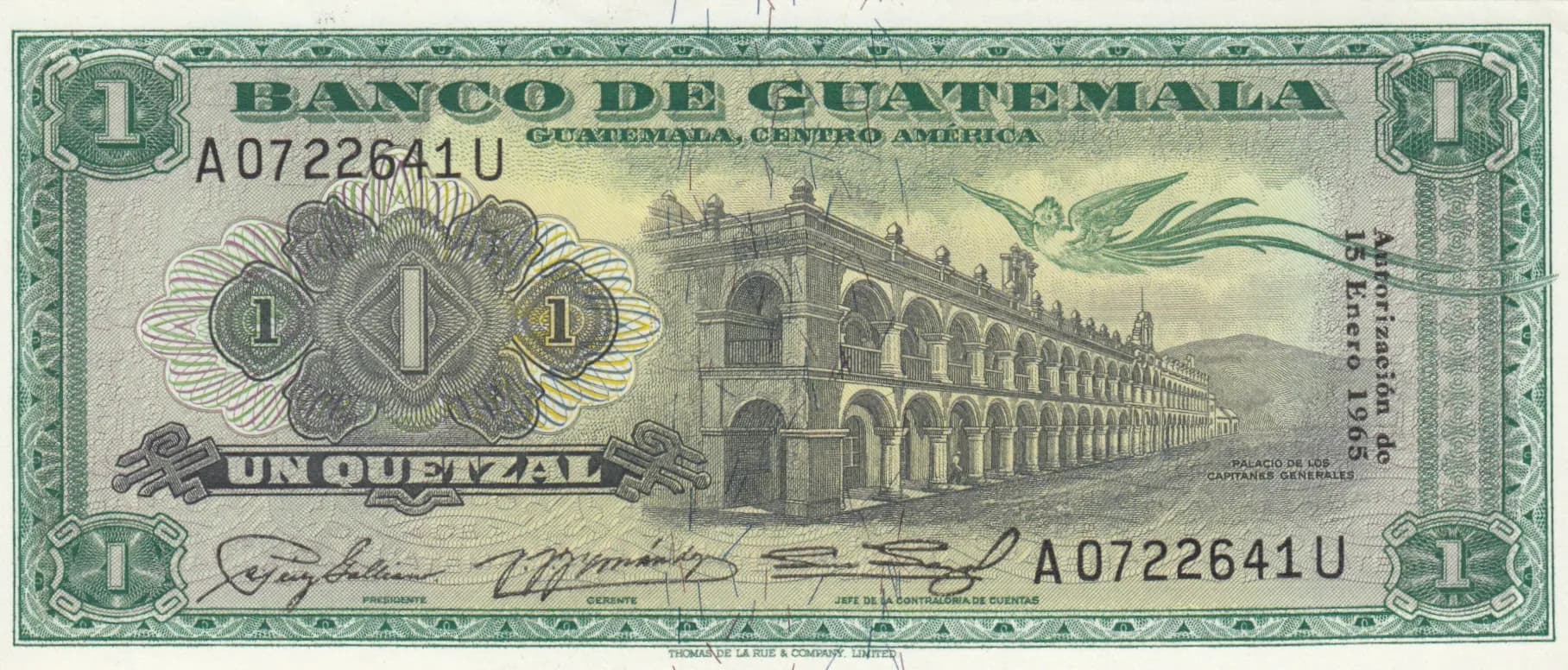
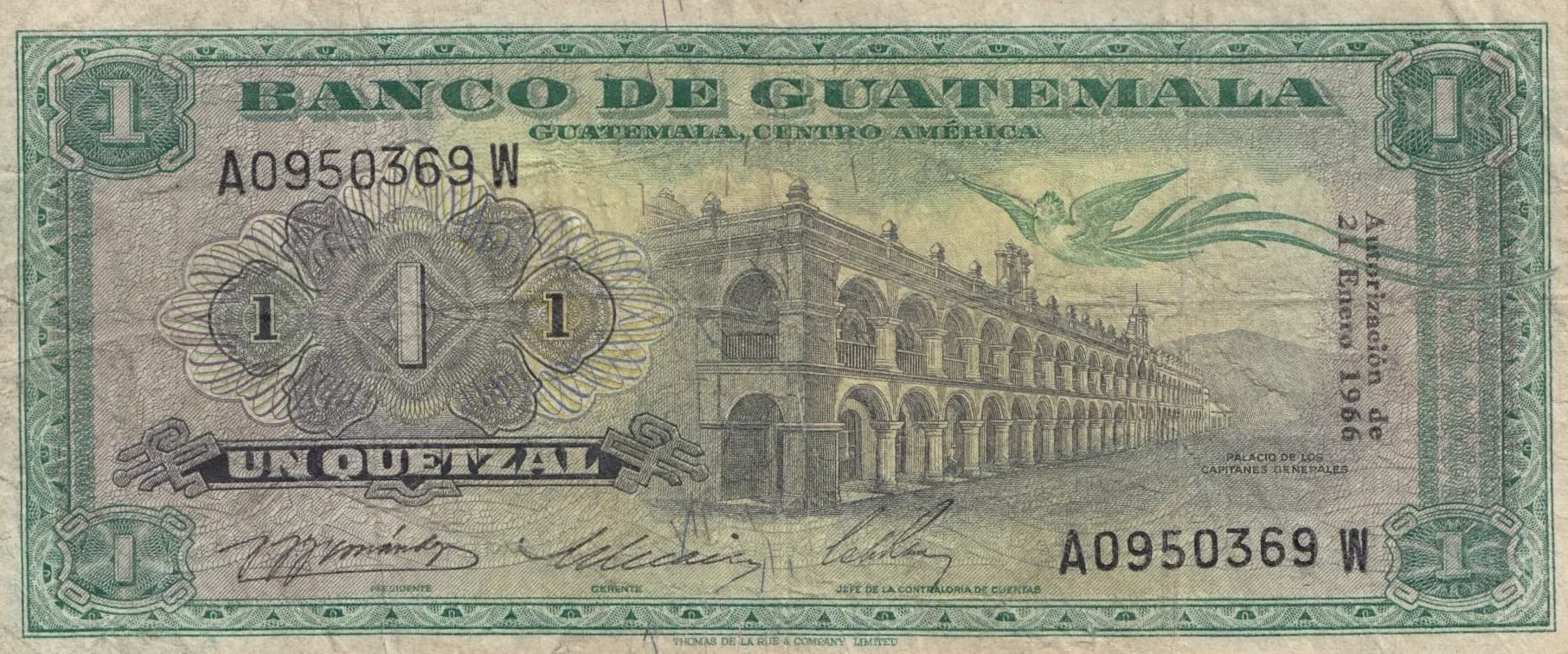
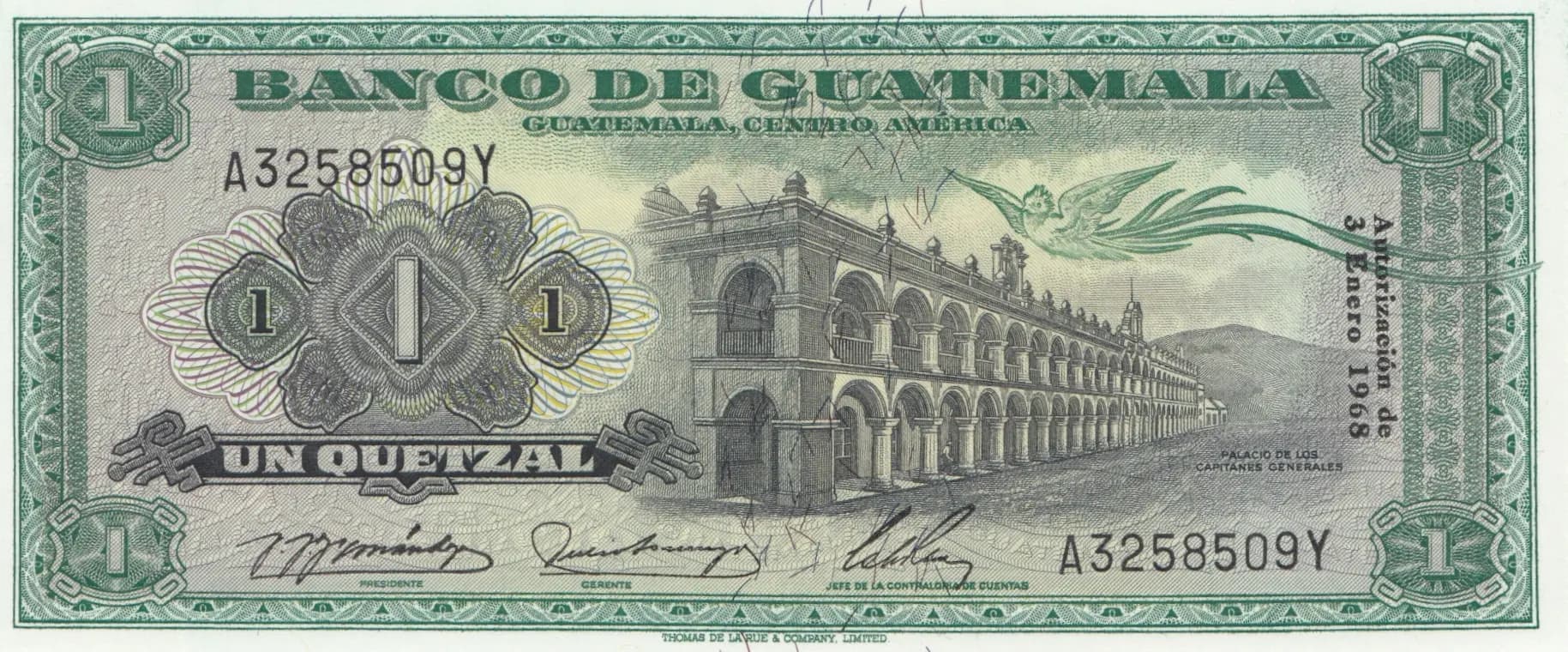
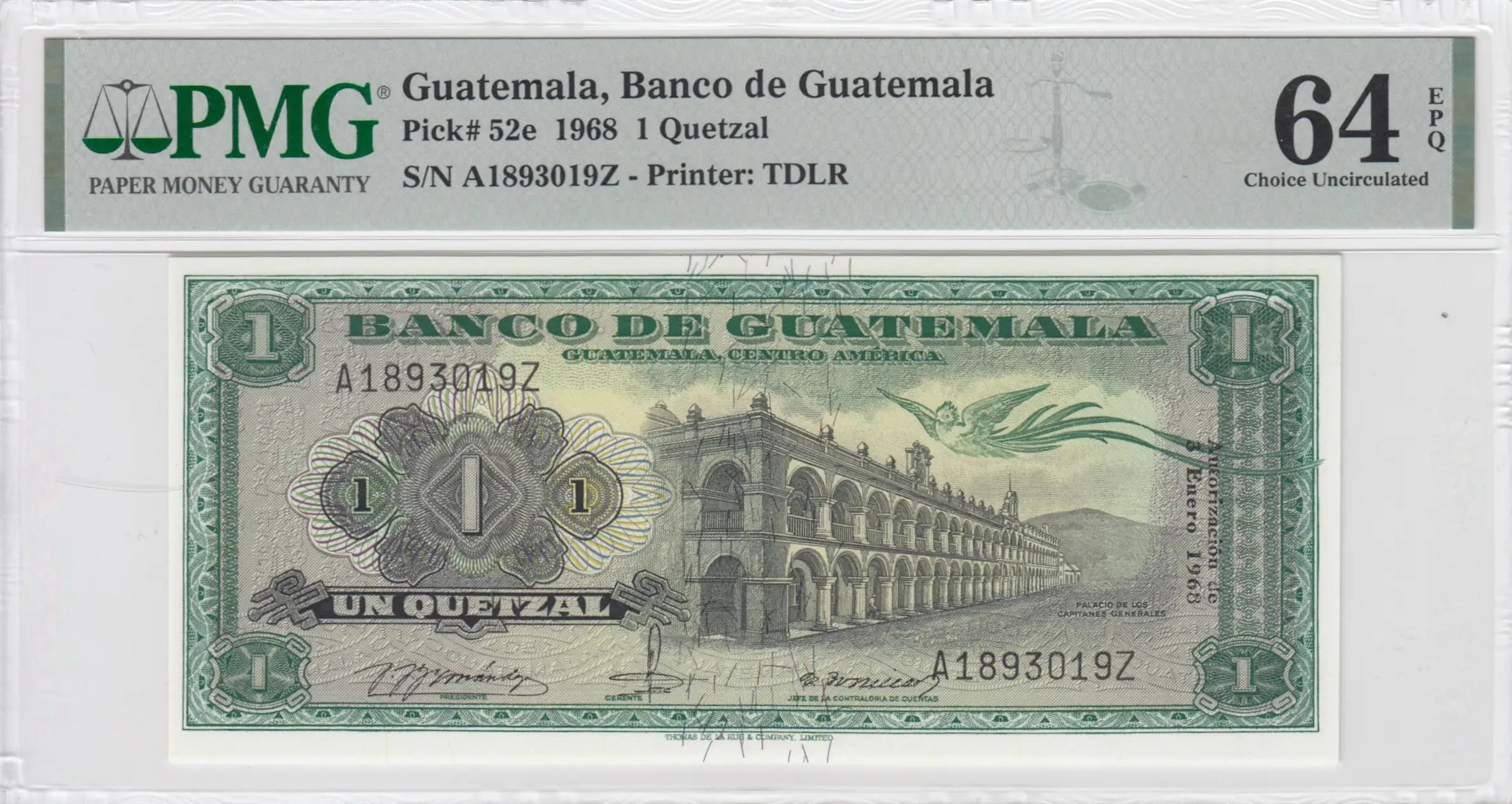
1 quetzal 1967
Market Prices
5 salesAbout This Note
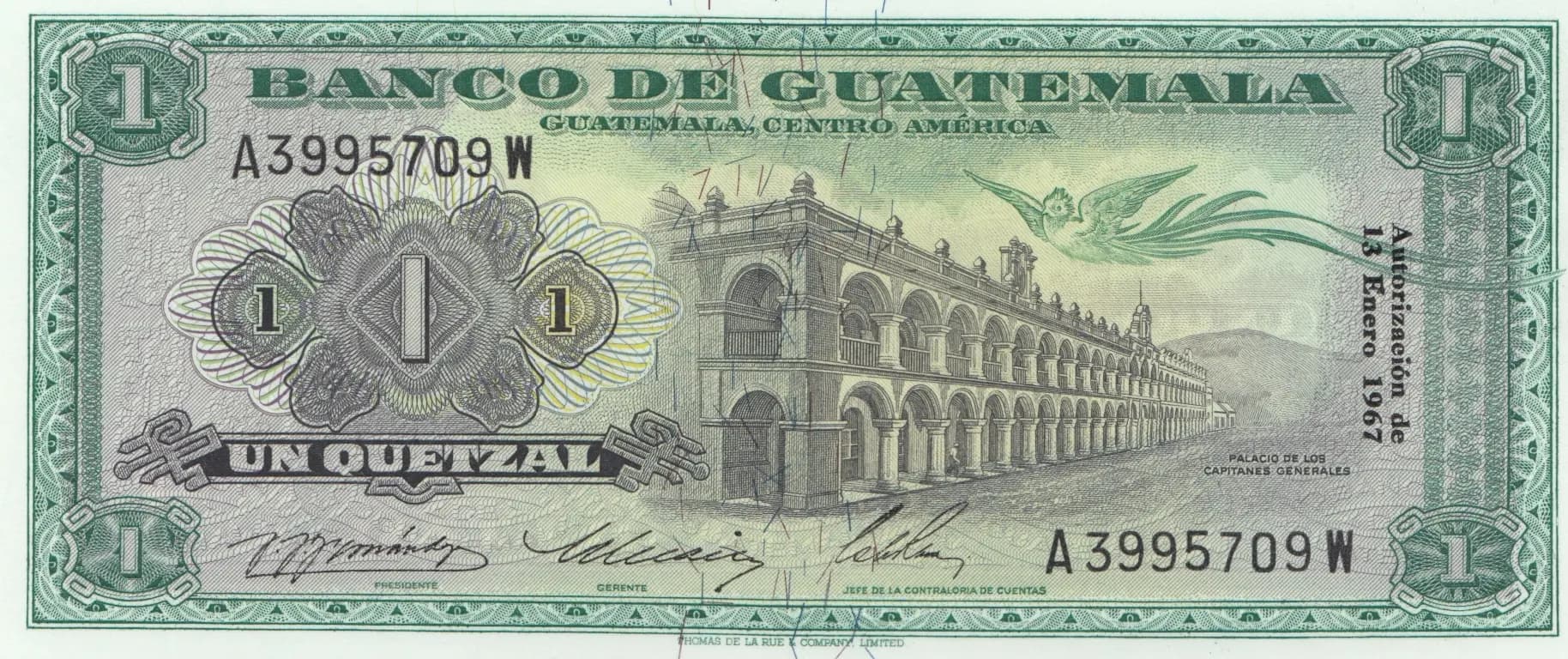
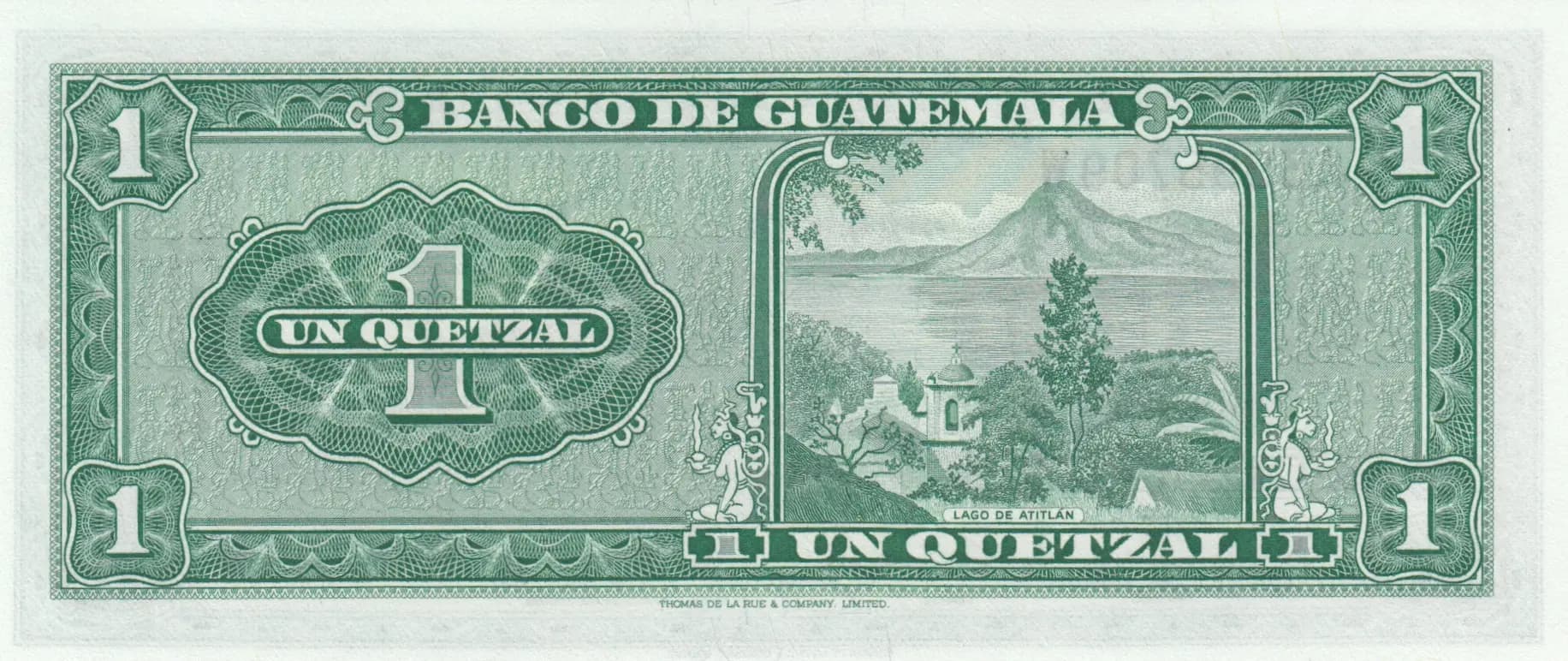
This is a 1967 issue 1 Quetzal note from Banco de Guatemala (Pick P-52d), printed by Thomas de la Rue. The note displays characteristic green and black intaglio engraving with the Palace of the Captain Generals prominently featured on the obverse and Lake Atitlán depicted on the reverse. While the front shows evidence of circulation with crossed pen marks and creasing, the reverse appears to be in near-mint condition, suggesting this may be a remainder note or one that saw limited circulation despite its catalog UNC grading.
Common. This is a regular-issue note from a long print run (1964-1972 date range per catalog), produced by a major security printer with substantial mintage. eBay market data shows consistent sales in the $5-$13 range for circulated and VF examples, with 2019 catalog values of $37.50 for UNC reflecting typical common-note appreciation. The catalog listing of P-52d indicates this is a standard variety within an extended series, not a rare or short-run issue.
Issued during 1967, this banknote represents Guatemala's monetary design during a period of relative stability under the Banco de Guatemala's mandate. The imagery—featuring the colonial-era Palacio de los Capitanes Generales and the sacred Lake Atitlán—reflects Guatemala's connection to its Spanish colonial heritage and natural landmarks that define the nation's cultural identity. Thomas de la Rue's printing reflects the era's reliance on British security printers for Central American currency production.
The obverse features the Palacio de los Capitanes Generales (Palace of the Captain Generals), a grand colonial-era administrative building with multiple stories, arches, and classical architectural ornamentation, positioned at center-right. A quetzal bird is depicted in flight in the upper right corner, symbolizing Guatemala's national identity and namesake currency unit. The reverse showcases a scenic landscape engraving of Lago de Atitlán (Lake Atitlán), featuring the lake with mountains, a church structure, coniferous vegetation, and surrounding landscape elements. Both sides employ ornamental rosette designs with the numeral '1' positioned in all four corners. The color scheme is predominantly green with black line work and cream underprinting, creating the distinctive appearance of Thomas de la Rue's intaglio engravings.
Front side: 'BANCO DE GUATEMALA' (Bank of Guatemala), 'GUATEMALA, CENTRO AMÉRICA' (Guatemala, Central America), 'UN QUETZAL' (One Quetzal), 'PALACIO DE LOS CAPITANES GENERALES' (Palace of the Captain Generals), 'Autorizado por Decreto 1067' (Authorized by Decree 1067), and serial number 'A3995709W'. Back side: 'BANCO DE GUATEMALA' (Bank of Guatemala), 'UN QUETZAL' (One Quetzal), 'LAGO DE ATITLÁN' (Lake Atitlán), and 'THOMAS DE LA RUE & COMPANY LIMITED' (printer identification).
Intaglio engraving, the hallmark of Thomas de la Rue security printing. The fine line work, ornamental borders, and intricate detail visible in both the architectural rendering and landscape engraving demonstrate the high-quality steel engraving techniques employed. The multicolored printing effect visible on the note results from careful registration of multiple engraved plates.
This note displays serial number A3995709W. The Pick P-52d designation indicates this is the 'd' variety of the 1 Quetzal 1967 issue—likely representing a printing from a specific series or date range within the 1964-1972 production window. Visual inspection suggests this particular specimen may represent a late-run or remainder note given the contrast between the circulated front (with pen markings and creases) and the pristine reverse, though the UNC grading suggests it was preserved from circulation. No overprints or unusual serial number characteristics are apparent.