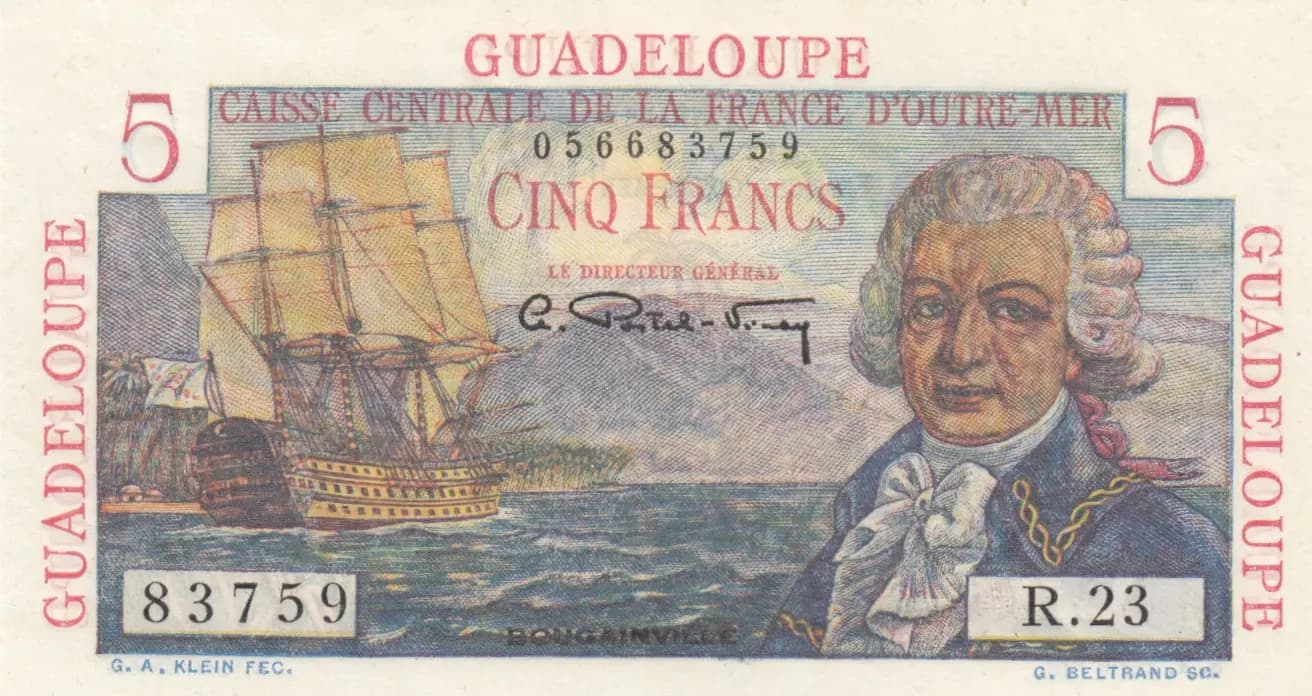
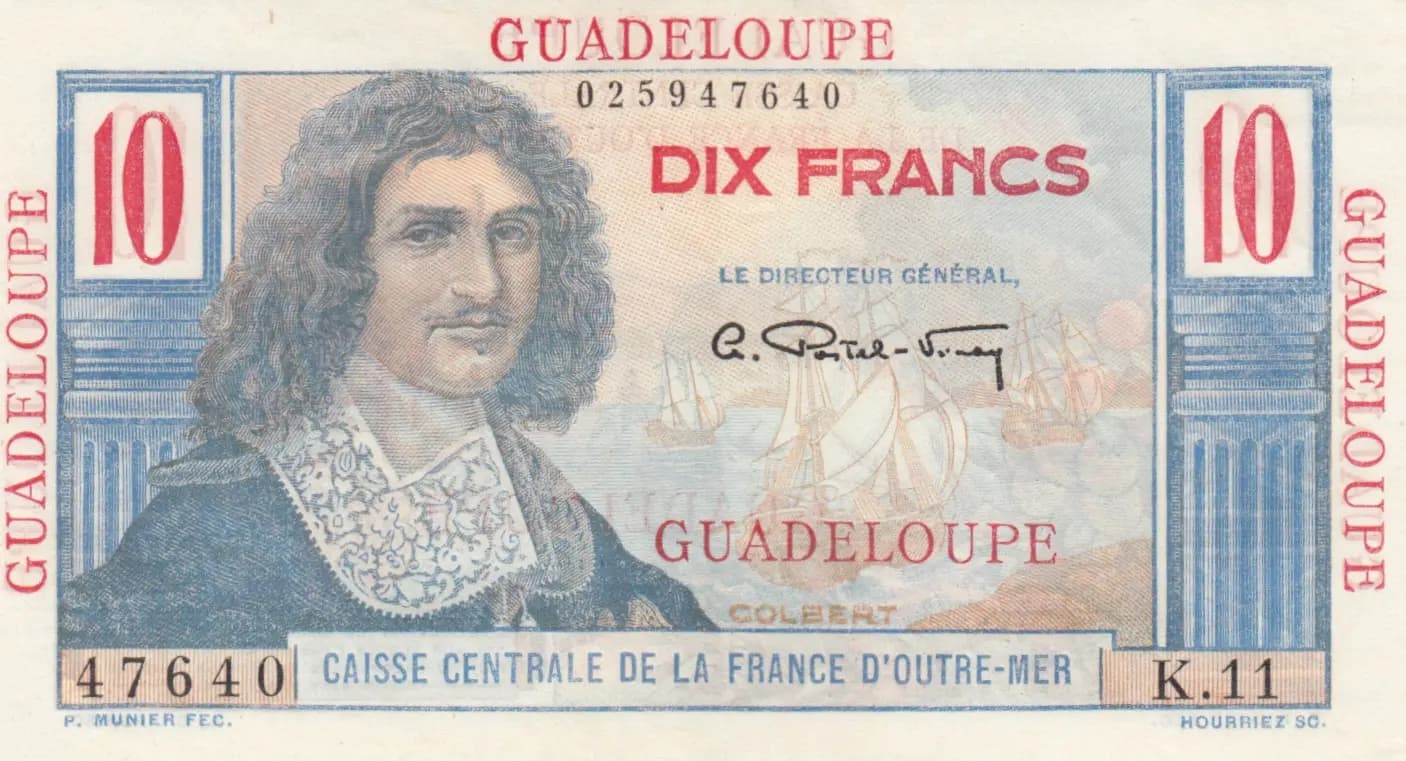
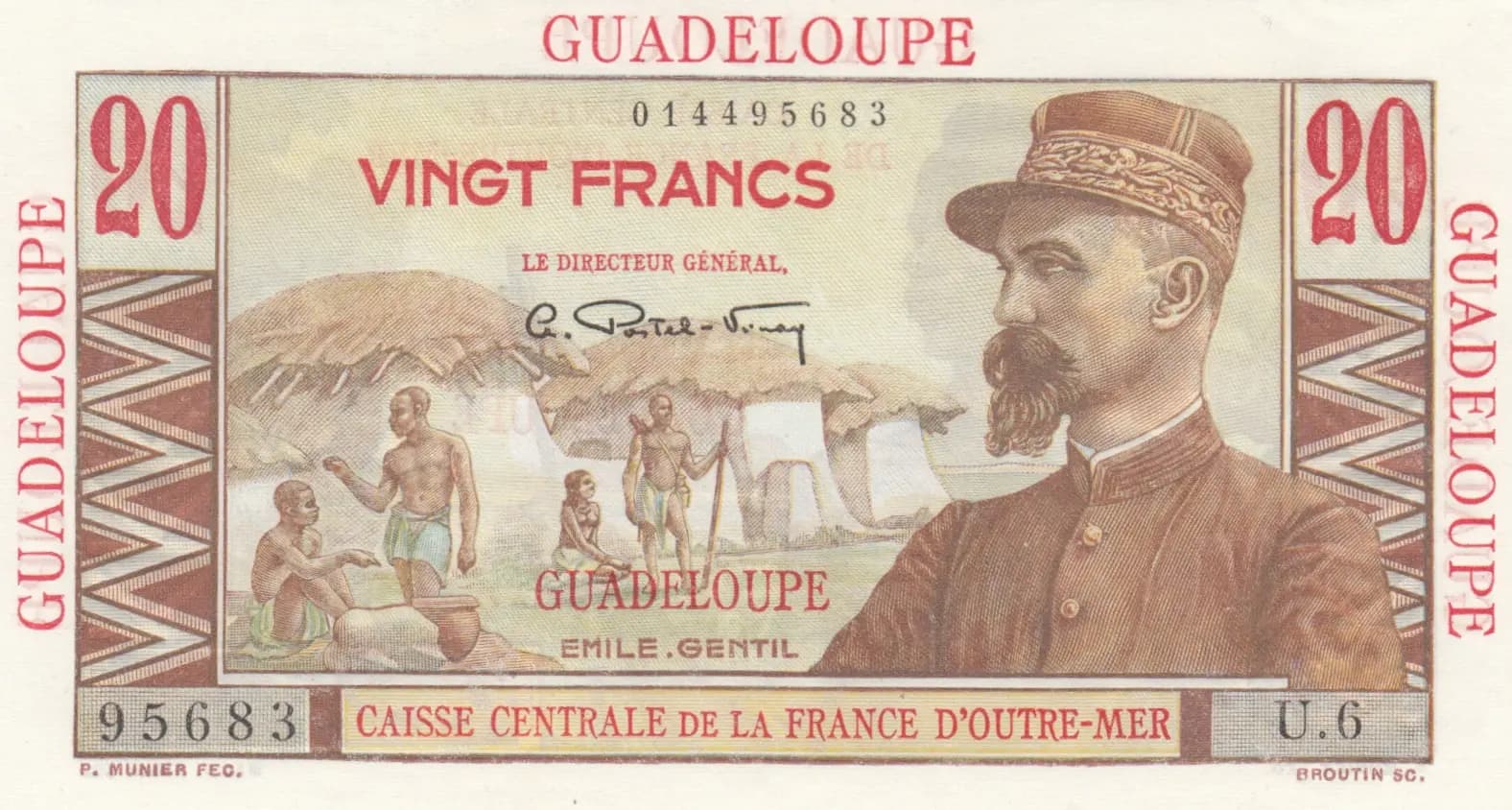
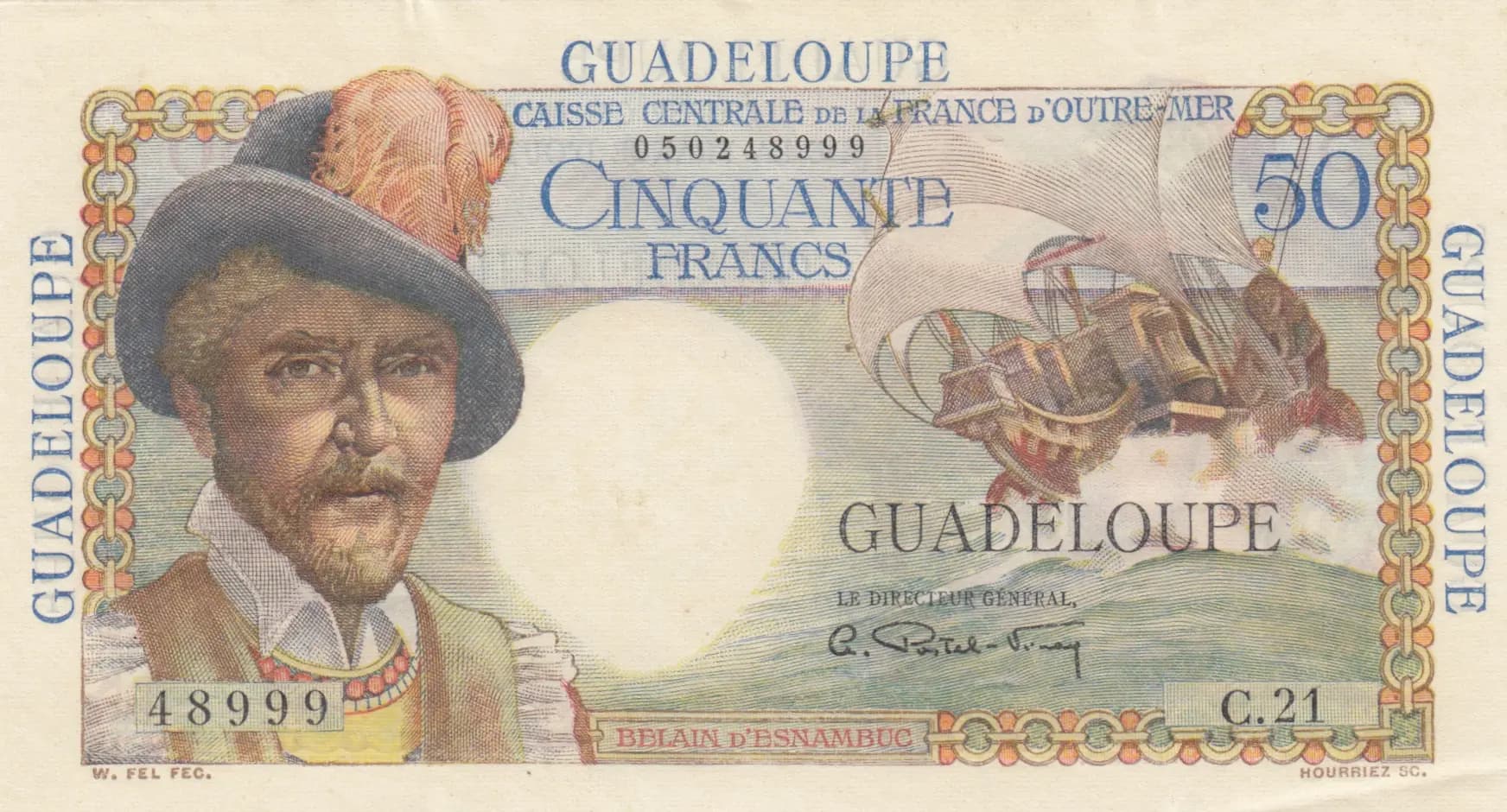
500 francs 1947 specimen
About This Note
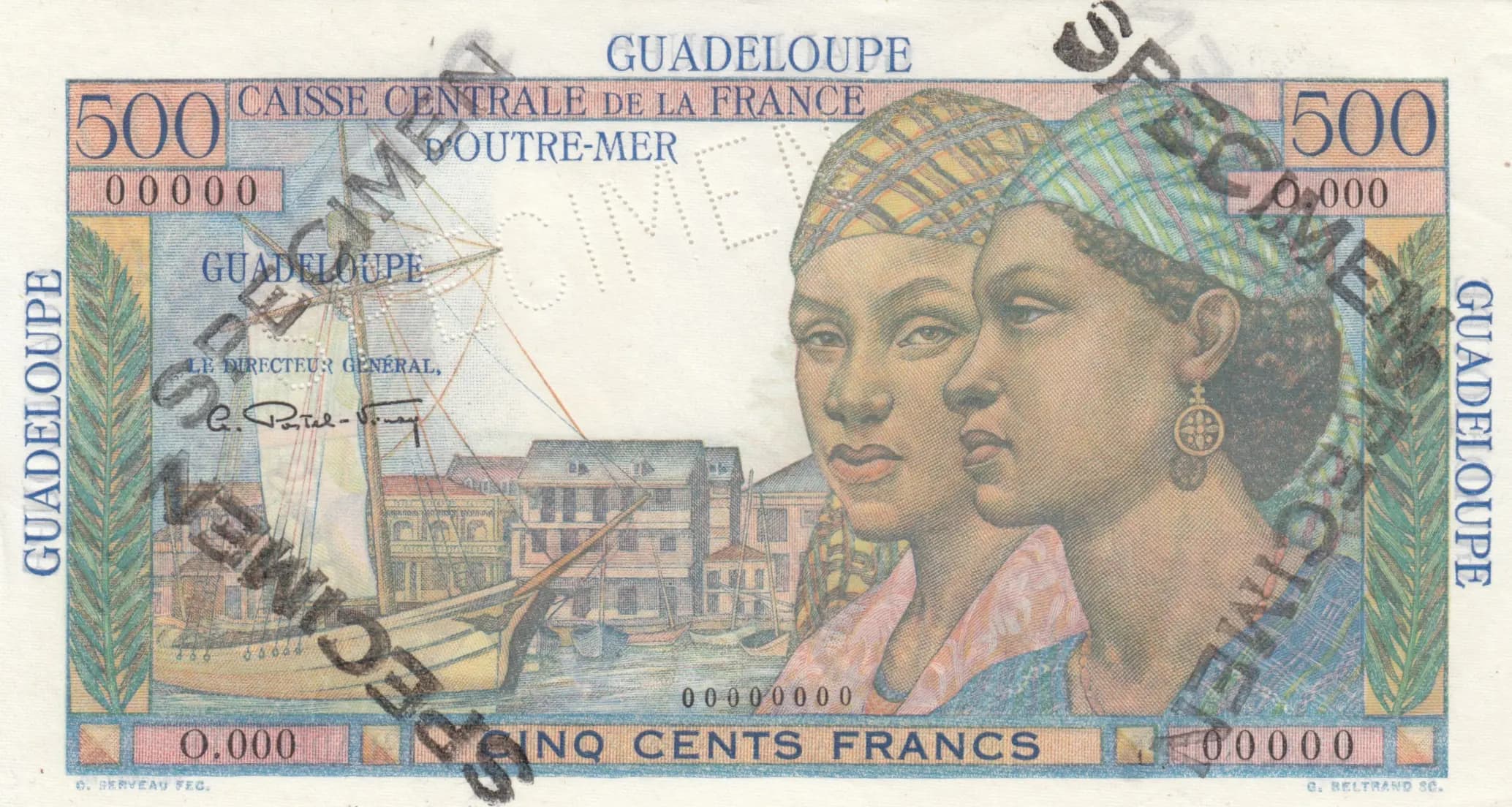
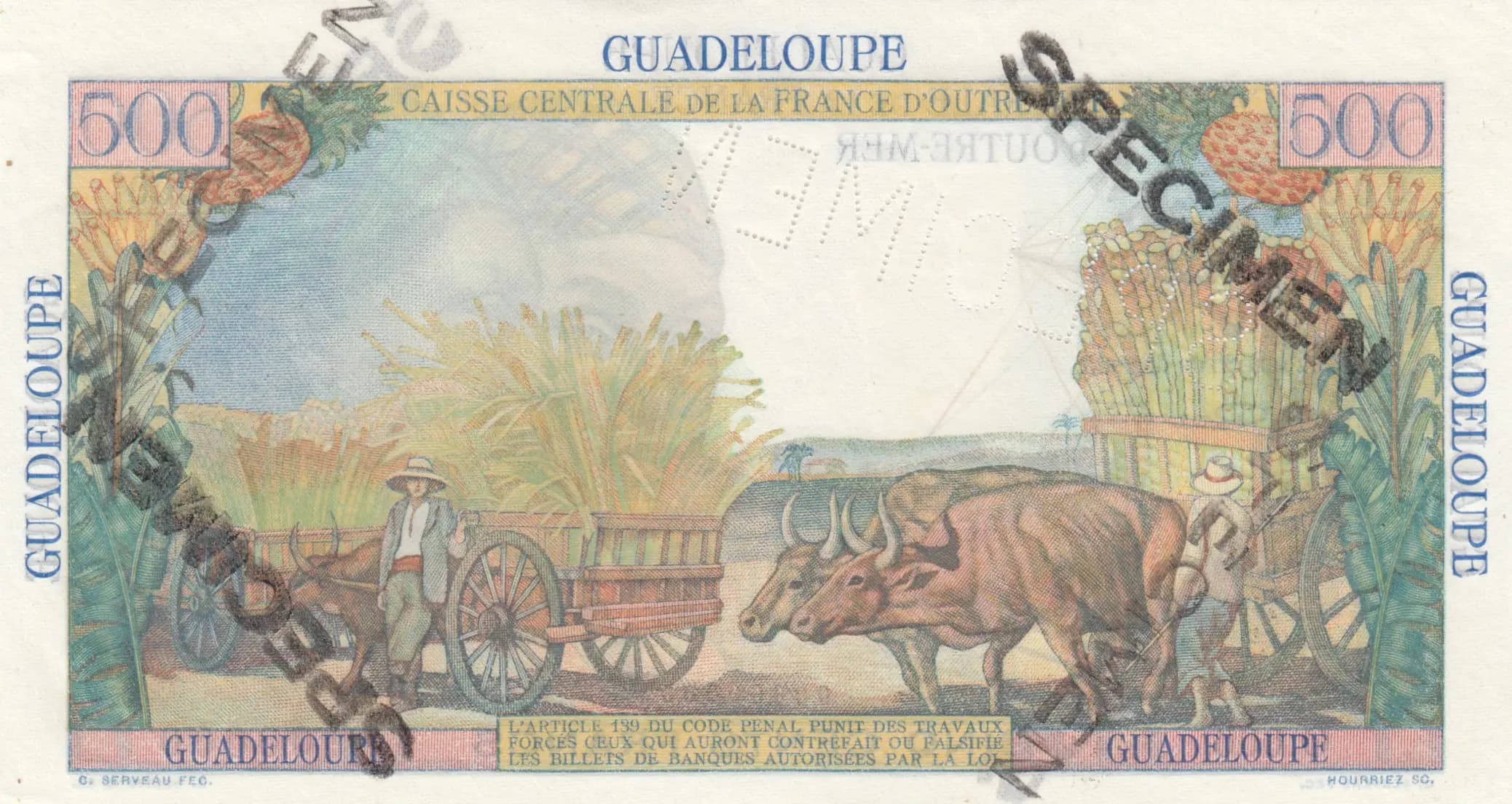
This is a 500 Francs specimen banknote from Guadeloupe issued in 1947 by the Caisse Centrale de la France d'Outre-Mer, graded AU condition. The note features exceptional engraving quality with colonial-era imagery: twin portrait busts of women wearing decorative headwraps on the obverse, and an agricultural scene with an ox-drawn cart on the reverse. The specimen marking and unused state preserve the fine details of the original design, making this an important example of French Overseas Territory currency during the post-war colonial period.
Common. The 500 Francs P-36 series was part of a substantial post-war issue by the Caisse Centrale de la France d'Outre-Mer for Guadeloupe and represents a standard denomination within the French Overseas Territory currency family. Specimen notes (P-36s) are less frequently encountered than circulated examples, but they were produced in moderate quantities for administrative and archival purposes. The AU condition grade, while desirable, does not substantially elevate rarity given the specimen status (which inherently preserves condition). No historical evidence suggests this was a short-lived or recalled issue, and the denomination and issuing period fall within normal production parameters for colonial French currency of this epoch.
This note was issued during the immediate post-World War II reconstruction period, when French Overseas Territories were reasserting economic and administrative control. The imagery reflects Guadeloupe's dual economic identity: the port scene with sailing vessels on the obverse represents maritime trade and colonial commerce, while the ox-drawn cart laden with agricultural products on the reverse symbolizes the sugar cane-based agricultural economy that defined the island's colonial period. The Caisse Centrale de la France d'Outre-Mer was established to provide centralized financial administration across France's overseas possessions during this transitional era.
The obverse features two female portrait busts in classical profile, both facing rightward, adorned with elaborate period headwraps and ornamental earrings characteristic of early 20th-century colonial artistic representation. To the left is an engraved maritime scene depicting a historical sailing vessel—likely a colonial merchant or naval ship—anchored before a colonial port settlement with period architecture and palm-framed coastline. The design employs a light blue background with ornamental palm frond borders along the left and right edges, establishing a tropical aesthetic. The reverse depicts a male agricultural worker in period attire (wide-brimmed hat and light shirt) standing beside a wooden ox-drawn cart heavily laden with what appears to be harvested sugar cane or similar tropical agricultural products. Tropical palm trees and lush vegetation frame the composition, and a colonial-era landscape suggests an active agricultural settlement. The entire note is dominated by fine engraving detail, with decorative botanical borders maintaining visual continuity with the obverse design. The color palette throughout consists of light blue, beige/cream, pink, green, orange, tan/brown, and gray/black tones, creating a sophisticated yet accessible design appropriate to mid-20th-century colonial currency.
FRONT SIDE: 'GUADELOUPE' (Guadeloupe); 'CAISSE CENTRALE DE LA FRANCE D'OUTRE-MER' (Central Treasury of Overseas France); '500' and 'CINQ CENTS FRANCS' (Five Hundred Francs); 'LE DIRECTEUR GÉNÉRAL' (The General Director); Signature of 'G. Petit-Jean' (General Director signature); Engraver marks 'G. BERVEAU FEC.' (G. Berveau engraved) and 'G. BELTRAND SC.' (G. Beltrand sculpted); Serial number placeholders. REVERSE SIDE: 'GUADELOUPE' (Guadeloupe, repeated in margins); 'CAISSE CENTRALE DE LA FRANCE D'OUTRE-MER' (Central Treasury of Overseas France); '500' (Denomination, left and right corners); 'ARTICLE 139 DU CODE PÉNAL PUNIT DES TRAVAUX FORCÉS CEUX QUI AURAIENT CONTREFAIT OU FALSIFIÉ LES BILLETS DE BANQUES AUTORISÉES PAR LA LOI' (Article 139 of the Penal Code punishes with forced labor those who would have counterfeited or falsified banknotes authorized by law); Engraver marks 'G. BERVEAU FEC.' (G. Berveau engraved) and 'BOURRIEZ SC.' (Bourriez sculpted).
This note was produced using traditional intaglio engraving (taille-douce), the standard security printing technique for French colonial banknotes of this era. The fine engraving detail visible throughout both sides, particularly in the portraiture, maritime scene, and agricultural tableau, is characteristic of hand-engraved intaglio work. The attribution marks to engravers G. Berveau, G. Beltrand, and Bourriez confirm individual artisan involvement in the design and plate preparation. The specimen marking was applied by overprinting after primary production. The watermark (indicated as a woman's head in the PMG population data) would have been incorporated during paper manufacture, a standard security feature for French Overseas Territory currency produced under central authority specifications.
This note is cataloged as Pick P-36s, identifying it specifically as a specimen variant (indicated by the 's' suffix). The PMG population data indicates two variants exist for the base Pick number P-36: the standard circulated note (P-36) and this specimen variant (P-36s), both featuring a watermark of a woman's head. The specimen designation is confirmed by the heavy diagonal 'SPECIMEN' overprinting visible across both obverse and reverse in the visual analysis. The engraver signatures (G. Berveau and G. Beltrand on obverse; G. Berveau and Bourriez on reverse) and the signature of General Director G. Petit-Jean are consistent with the standard issue design. No additional varieties relating to serial number prefixes, date variants, or location overprints are evident from the visual analysis; the 'GUADELOUPE' location marking on the margins is standard for this issue and distinguishes it from related issues for other French Overseas Territories (such as French Equatorial Africa P-25, noted in external reference data).