10 francs 1947
About This Note
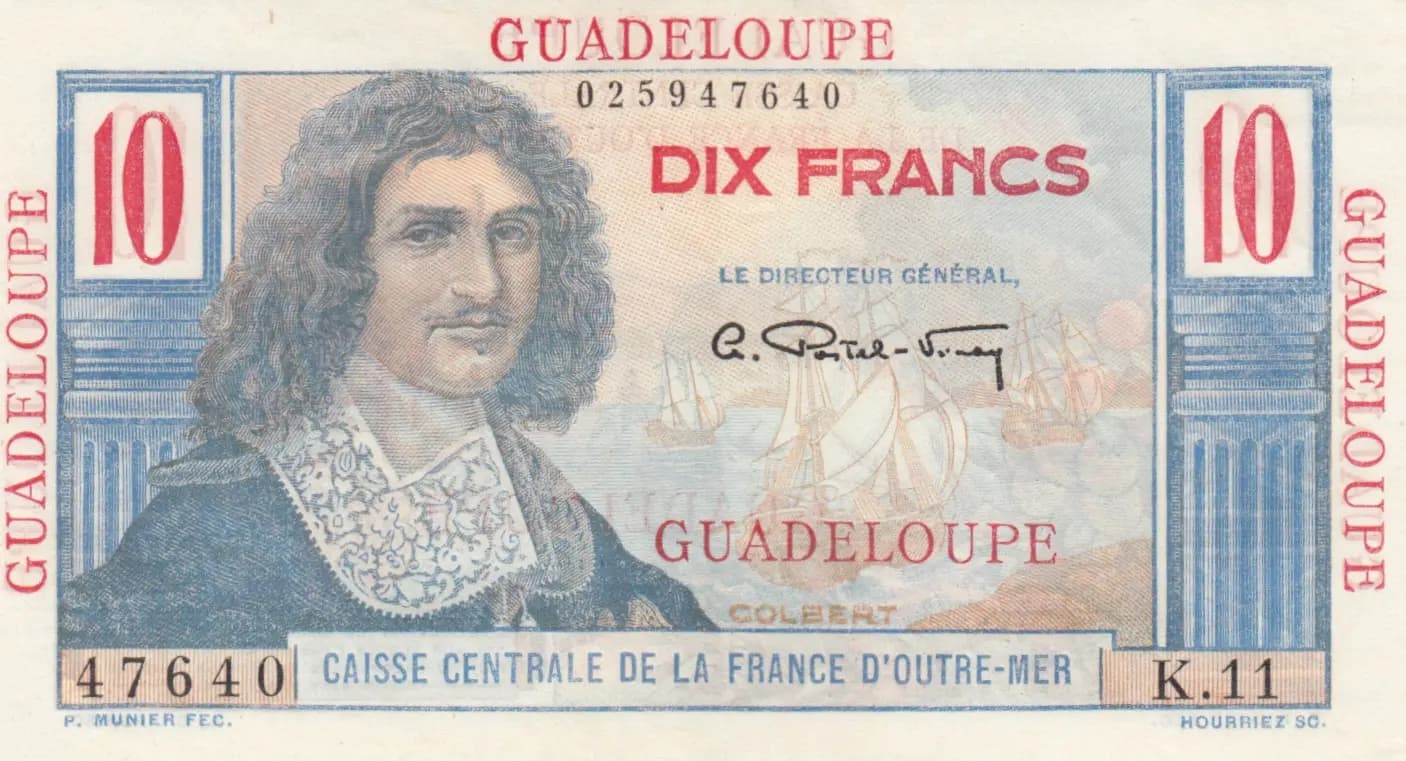
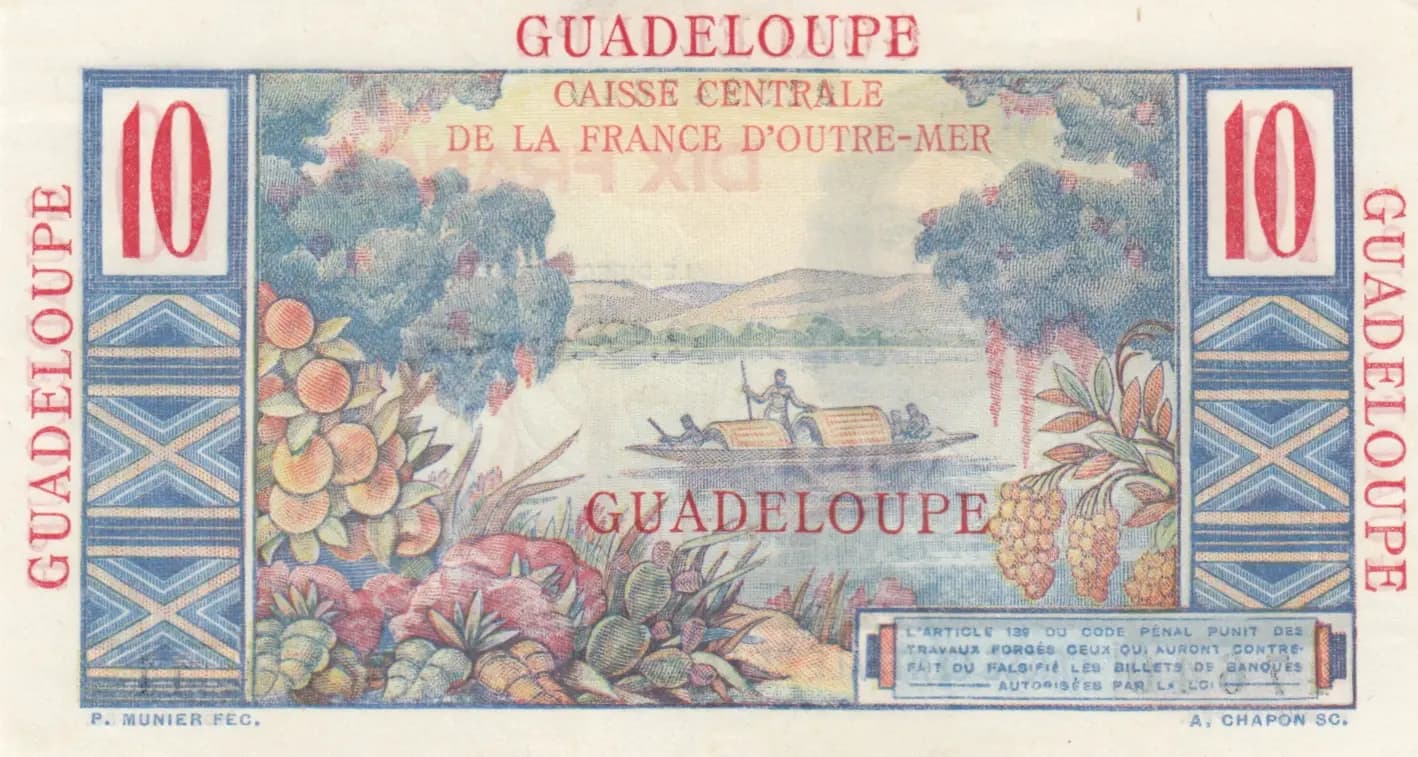
An exceptional example of the 1947 Guadeloupe 10 francs issued by the Caisse Centrale de la France d'Outre-Mer, presented in EF condition with no visible signs of circulation. The note features a striking portrait of Jean-Baptiste Colbert in 17th century attire on the obverse and a vibrant tropical landscape with a river scene, vegetation, and figures in a boat on the reverse. The fine line engraving and rich color palette (blue, red, and earth tones) are crisp and well-preserved, making this an attractive example for collectors of French colonial currency.
Common. The Caisse Centrale de la France d'Outre-Mer issued 10 francs notes for Guadeloupe during the 1947-1949 period in substantial quantities to serve the territory's monetary needs. This Pick 32 issue is a standard, widely-encountered note among collectors of French colonial and Caribbean currency. No historical evidence suggests limited print runs or recalls for this denomination and issuer. EF condition examples are desirable but not exceptionally rare.
This note was issued during the post-World War II period when the Caisse Centrale de la France d'Outre-Mer managed currency for French overseas territories. The portrait of Colbert, the 17th-century French statesman who established France's colonial enterprises, reflects France's historical connection to Guadeloupe and its assertion of governmental authority over the Caribbean possession. The reverse design depicting an idealized tropical landscape with productive agriculture and river commerce symbolizes the economic importance of Guadeloupe as a colonial resource territory.
The obverse features a formal portrait of Jean-Baptiste Colbert (Marquis de Seignelay), the 17th-century French statesman depicted with long curled hair and elaborate lace collar typical of the period, positioned on the left side. To the right is an engraved maritime scene showing sailing ships, reflecting Colbert's role in establishing French naval and colonial power. The denomination '10' appears in large red numerals in framed boxes on both lateral edges. The reverse displays a picturesque tropical landscape dominated by a river or waterway scene with figures in a small boat, framed by lush vegetation including trees, tropical fruits (oranges and grapes visible in the foreground), with distant mountains on the horizon. Both sides are bordered by decorative frames with geometric patterns (chevrons and zigzag designs) and ornamental corner elements. The color scheme combines blue, red, green, brown, orange, and cream tones.
FRONT SIDE: 'GUADELOUPE' (Guadeloupe); 'DIX FRANCS' (Ten francs); 'CAISSE CENTRALE DE LA FRANCE D'OUTRE-MER' (Central Treasury of Overseas France); 'COLBERT' (Colbert); 'LE DIRECTEUR GÉNÉRAL' (The Director General); 'K.11' (Series designation); 'P. MUNIER FEC' (P. Munier made/engraver); 'HOURIEZ SC' (Houriez engraved/engraver); Serial number and reference numbers present. BACK SIDE: 'GUADELOUPE' (Guadeloupe); 'CAISSE CENTRALE DE LA FRANCE D'OUTRE-MER' (Central Treasury of Overseas France); 'L'ARTICLE 139 DU CODE PÉNAL PUNIT DES TRAVAUX FORCÉS CEUX QUI AURAIENT CONTREFAIT OU FALSIFIÉ LES BILLETS AUTORISÉS PAR LA LOI' (Article 139 of the Penal Code punishes with hard labor those who would have counterfeited or falsified banknotes authorized by law); 'P. MUNIER FEC' (P. Munier made/engraver); 'A. CHAPON SC' (A. Chapon engraved/engraver).
The note was produced using fine line steel engraving, the standard security printing method for banknotes of this era. The exceptional sharpness and detail visible in the portrait, maritime scenes, landscape elements, and decorative borders indicate work by skilled engravers (P. Munier and Houriez on the obverse; P. Munier and A. Chapon on the reverse). The complexity of the border patterns and fine linework would have been created through traditional intaglio printing processes by a European security printer, likely in France given the issuer and the period.
The note displays the K.11 series designation visible on the front. Per PMG cataloging data, there is a standard P-32 variant and a P-32s variant (likely indicating a specimen note), both with a sailing ship watermark. This example appears to be the standard circulation type (P-32). The engraver signatures (P. Munier FEC / HOURIEZ SC on obverse; P. Munier FEC / A. CHAPON SC on reverse) and series letter K.11 are consistent with the standard issue. The 'GUADELOUPE' location designation appears on the margins as noted in the external reference, distinguishing it from similar notes issued for other French overseas territories.