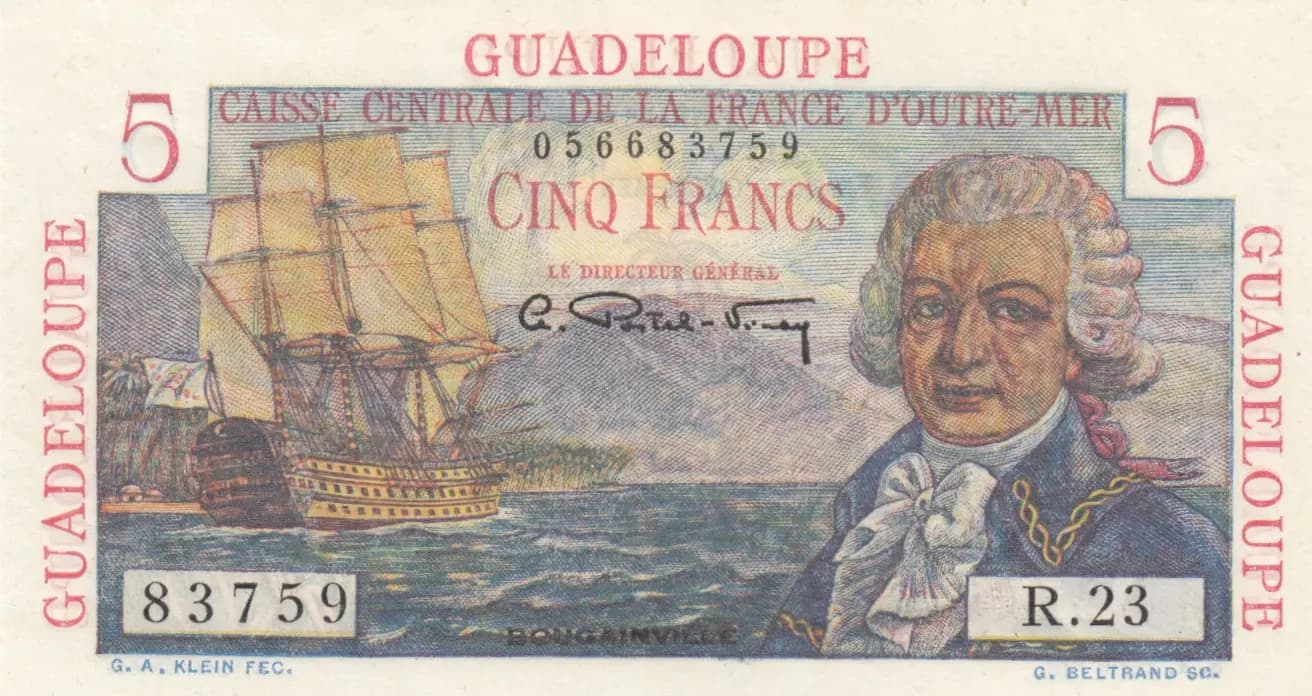
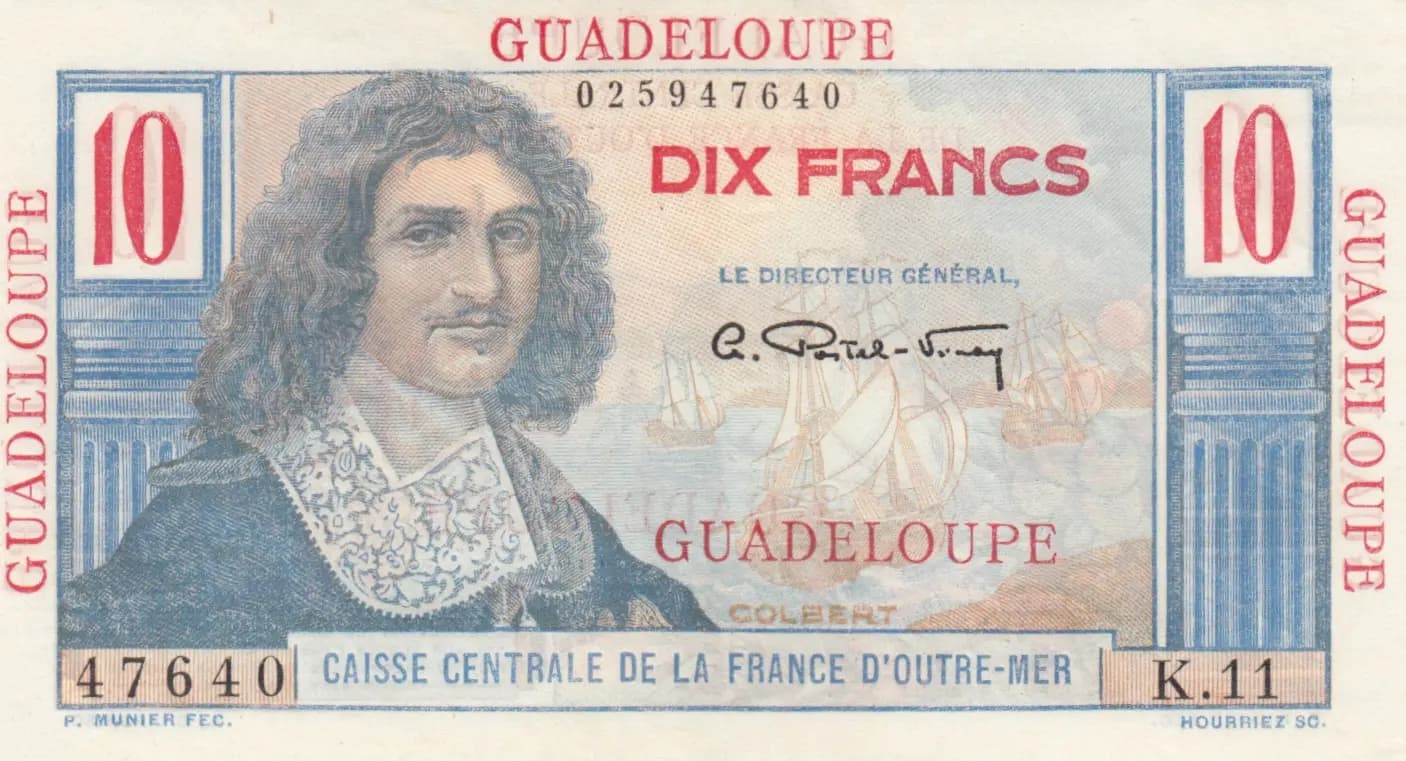
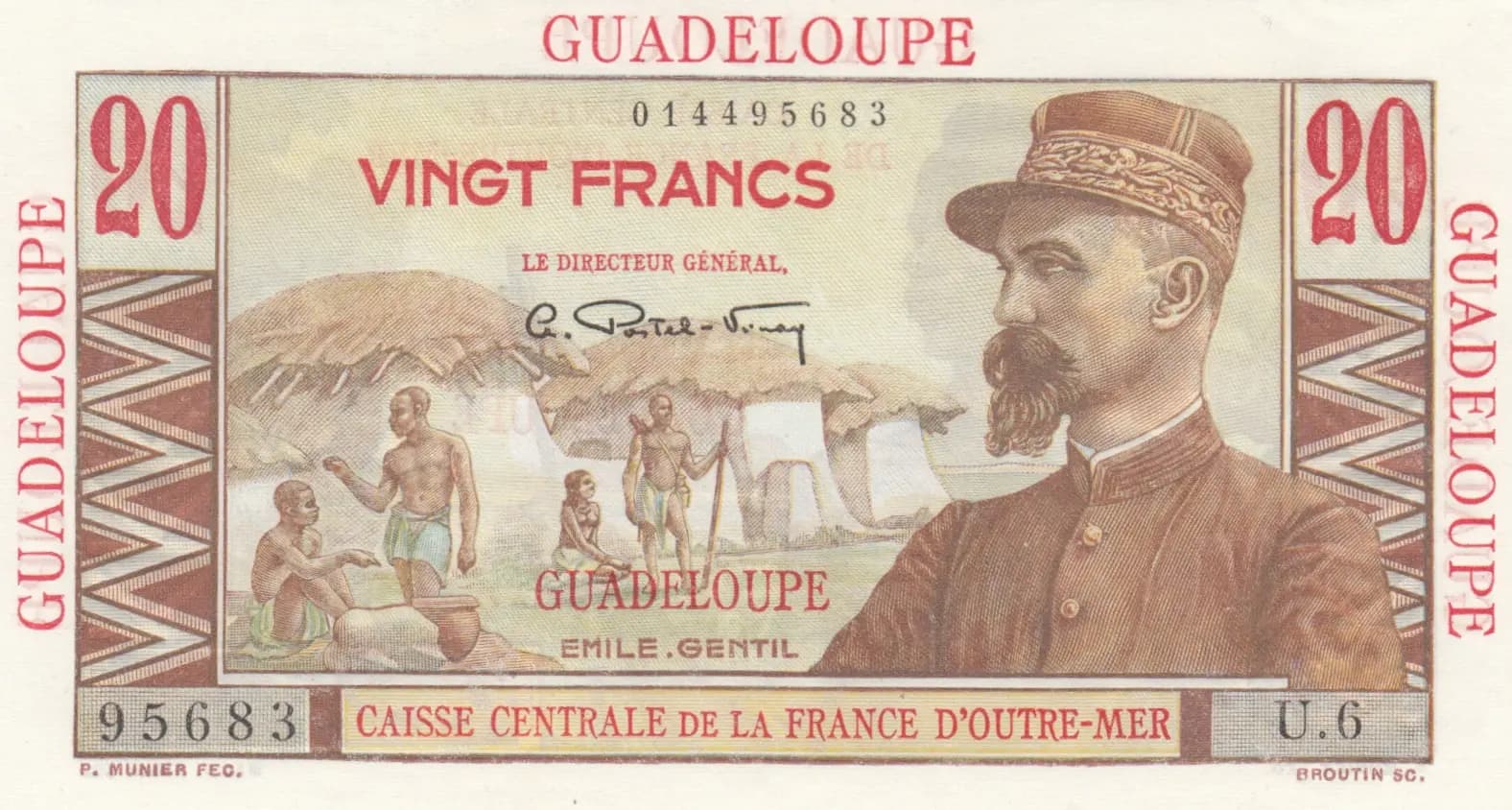
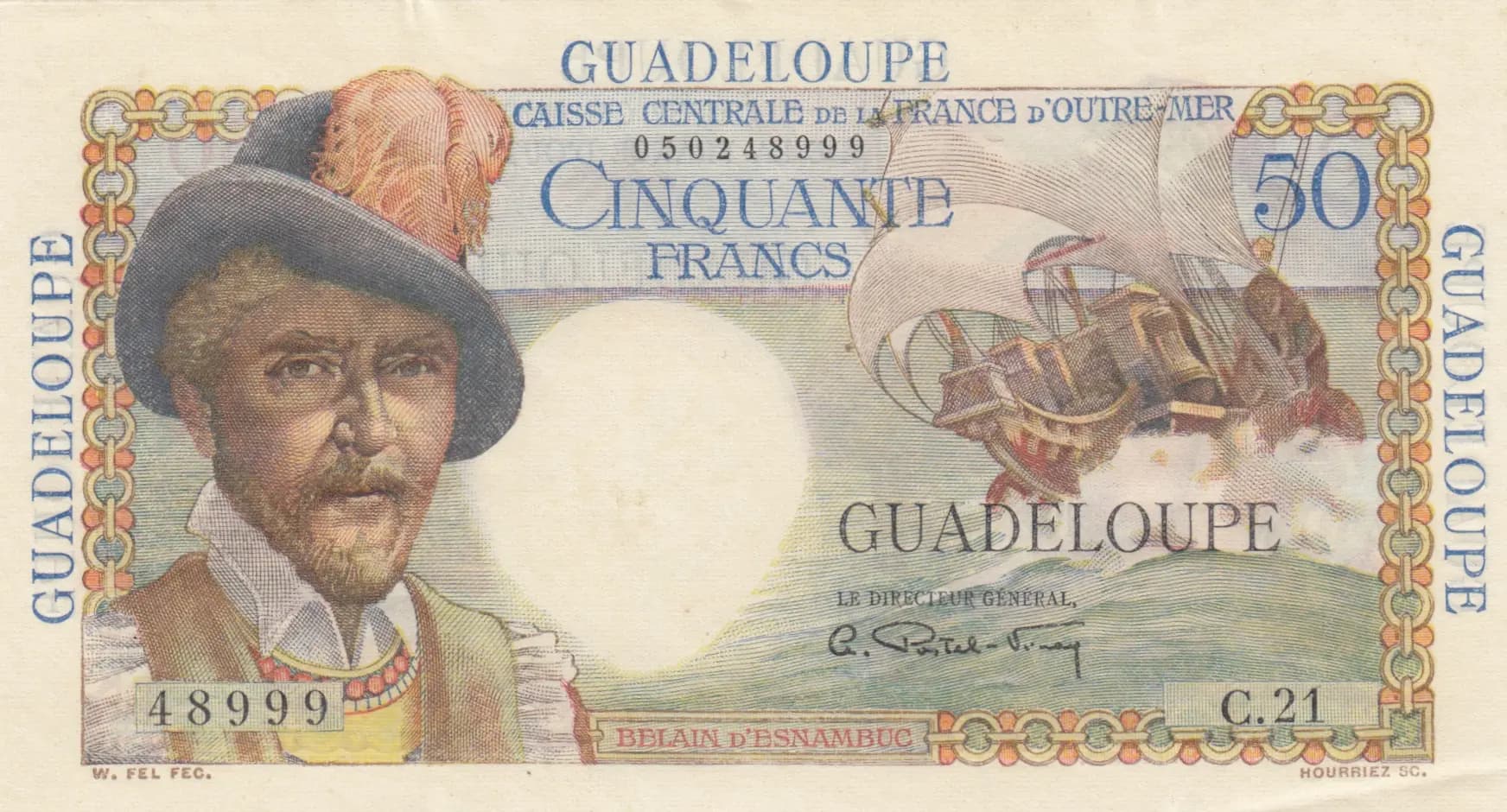
100 francs 1947 specimen
About This Note
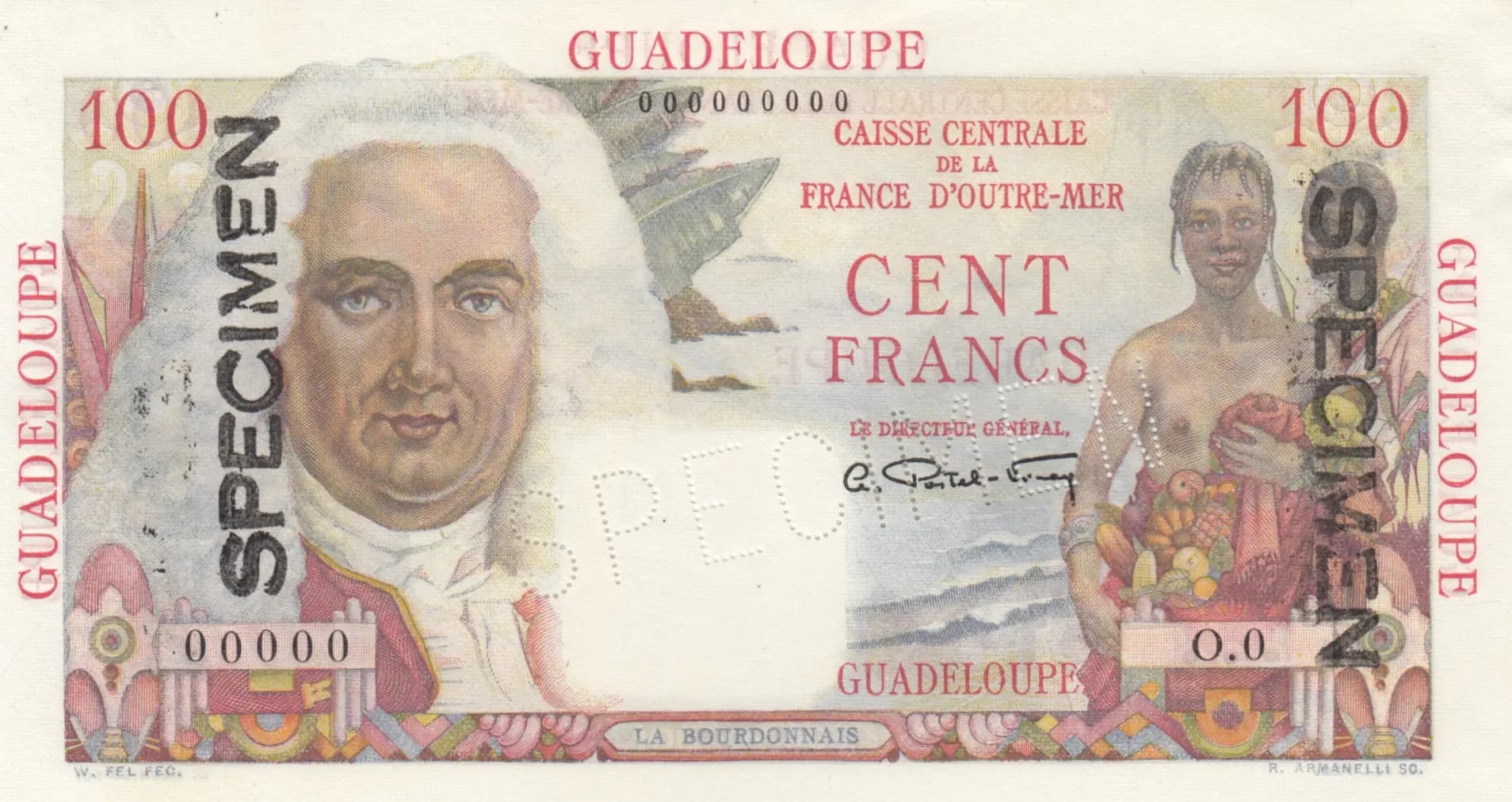
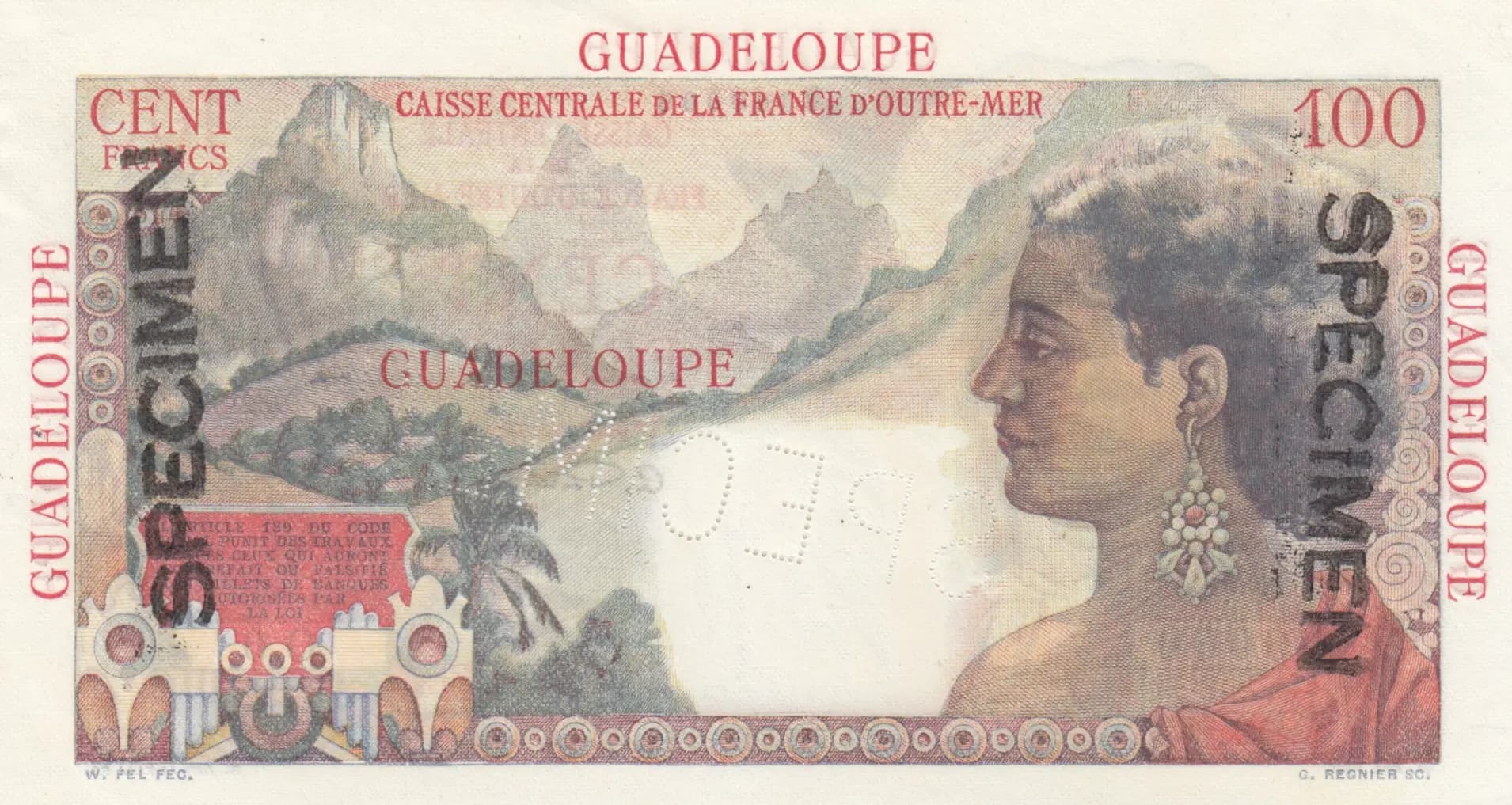
This is a striking 1947 specimen note from Guadeloupe issued by the Caisse Centrale de la France d'Outre-Mer, graded UNC. The note features dual portraits—a formally-dressed man with a white wig (Bertrand-François Mahé, comte de La Bourdonnais) on the obverse and a woman in profile on the reverse—separated by a carved wooden totem figure and tropical landscape vignettes rendered in fine line engraving. The specimen overprint and pristine condition make this an excellent example of mid-20th century French colonial currency design.
common. Specimen notes from this series, while not in circulation, were produced in multiple quantities for distribution to banks and official institutions across the French Caribbean territories. The 1947 Guadeloupe 100 francs (P-35s) represents a standard specimen variety from an established issuing authority with no evidence of limited print runs, special recalls, or extreme scarcity. Condition-appropriate examples of colonial-era French banknotes from this period remain readily obtainable in the international numismatic market.
Issued in 1947, this note reflects the post-World War II restructuring of French overseas financial administration through the Caisse Centrale de la France d'Outre-Mer. The prominent inclusion of La Bourdonnais, the 18th-century French colonial administrator and naval figure, alongside Caribbean landscape imagery and indigenous artistic motifs (the wooden totem) demonstrates France's effort to reinforce colonial authority while acknowledging local cultural identity during the immediate post-war period when Guadeloupe's status within the French Union was being redefined.
The obverse features a three-part composition: at left, a formal portrait of Bertrand-François Mahé, comte de La Bourdonnais (1699-1753), the French naval officer and colonial governor, rendered in classical engraving with fine cross-hatching and wearing formal 18th-century dress with white wig. The center contains denomination and issuer information within ornamental borders featuring circular medallions and geometric patterns. At right stands a carved wooden figure (indigenous Amerindian artifact or artistic representation) beside a profile portrait of a woman wearing pearl earrings, representing the cultural and demographic diversity of Guadeloupe. The reverse depicts a mountainous tropical landscape with coastal vegetation in the background, with the woman's profile portrait repeated on the right side, framed by ornamental circular patterns and decorative scrollwork. Both sides employ fine line engraving throughout with dotted security patterns in background areas.
FRONT: 'GUADELOUPE' (issuing territory), '100 CENT FRANCS' (denomination), 'CAISSE CENTRALE DE LA FRANCE D'OUTRE-MER' (issuing authority: Central Treasury of Overseas France), 'LE DIRECTEUR GÉNÉRAL' (The General Director), 'SPECIMEN' (specimen overprint), 'LA BOURDONNAIS' (historical figure portrayed), 'W. FEL FEC.' (W. Fel made [designer credit]), 'R. ARMANELLI SC.' (R. Armanelli sculpsit/engraved). BACK: 'GUADELOUPE', '100 CENT FRANCS', 'CAISSE CENTRALE DE LA FRANCE D'OUTRE-MER', 'SPECIMEN', 'W. FEL FEC.', 'G. REGNIER SC.' (G. Regnier sculpsit/engraved), with text plaque in lower left [content partially unclear in image examination].
Intaglio engraving (line engraving/gravure) produced by the Banque de France's security printing facilities, as indicated by the dual engraver credits (R. Armanelli and G. Regnier both listed as 'SC.' for sculpsit, indicating skilled engravers). The fine, detailed cross-hatching, dotted security patterns, and classical portraiture style are characteristic of mid-20th century French banknote production standards. The specimen designation and overprinting appear to be applied post-printing in black ink.
This note is catalogued as P-35s (specimen variant) as opposed to the P-35 circulation note. According to PMG population data, the base Pick number P-35 exists with a woman's head watermark, suggesting two principal varieties: regular circulation notes (P-35) and specimen overprints (P-35s). The visual analysis confirms the specimen overprint present on both obverse and reverse in black ink. The date ND (no date) printed on note reflects the practice of undated notes from this issuing authority, with the 1947 attribution based on catalogue research and historical documentation rather than face-printed dates.