1 nouveau franc 1960
About This Note
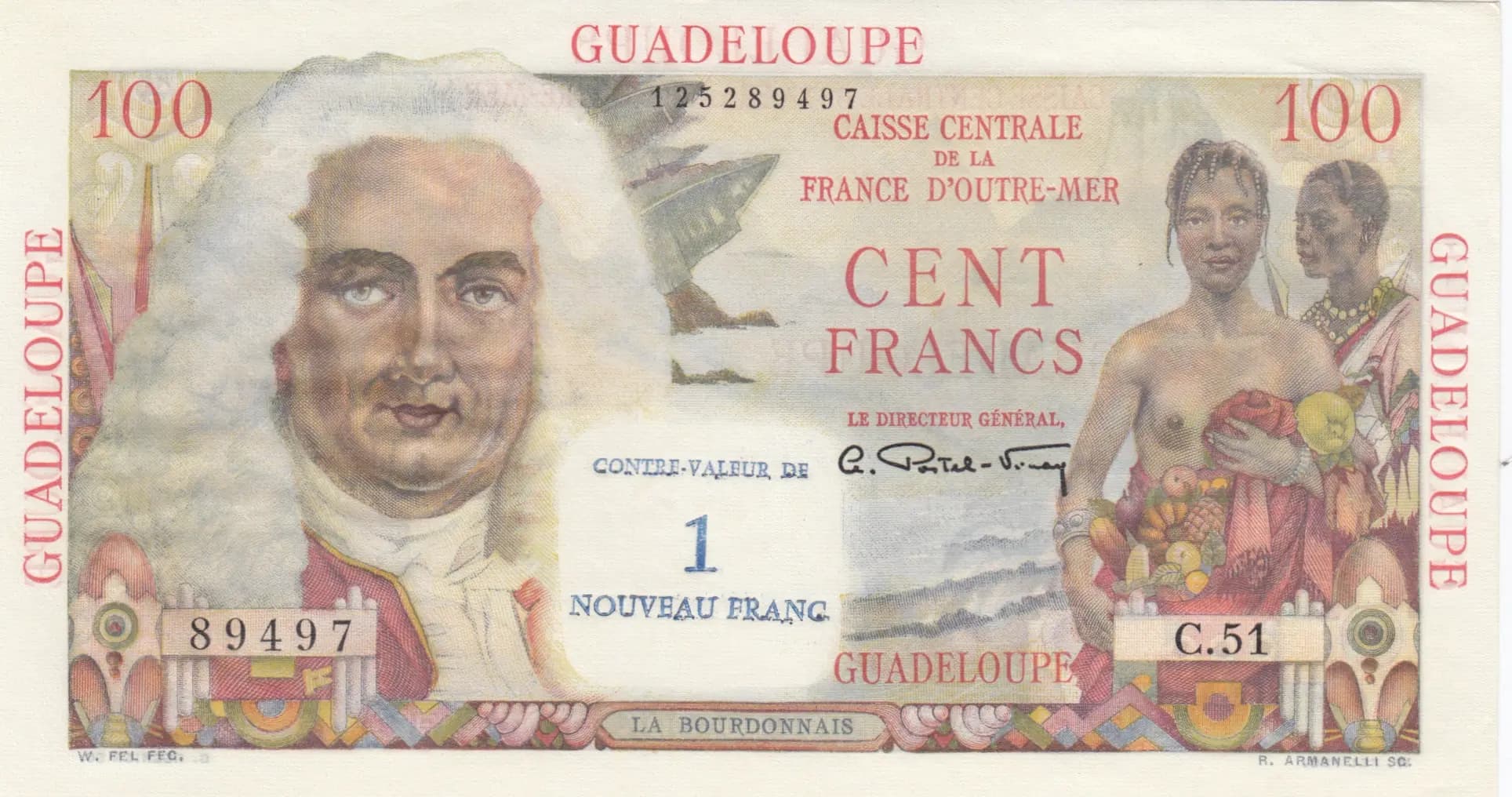
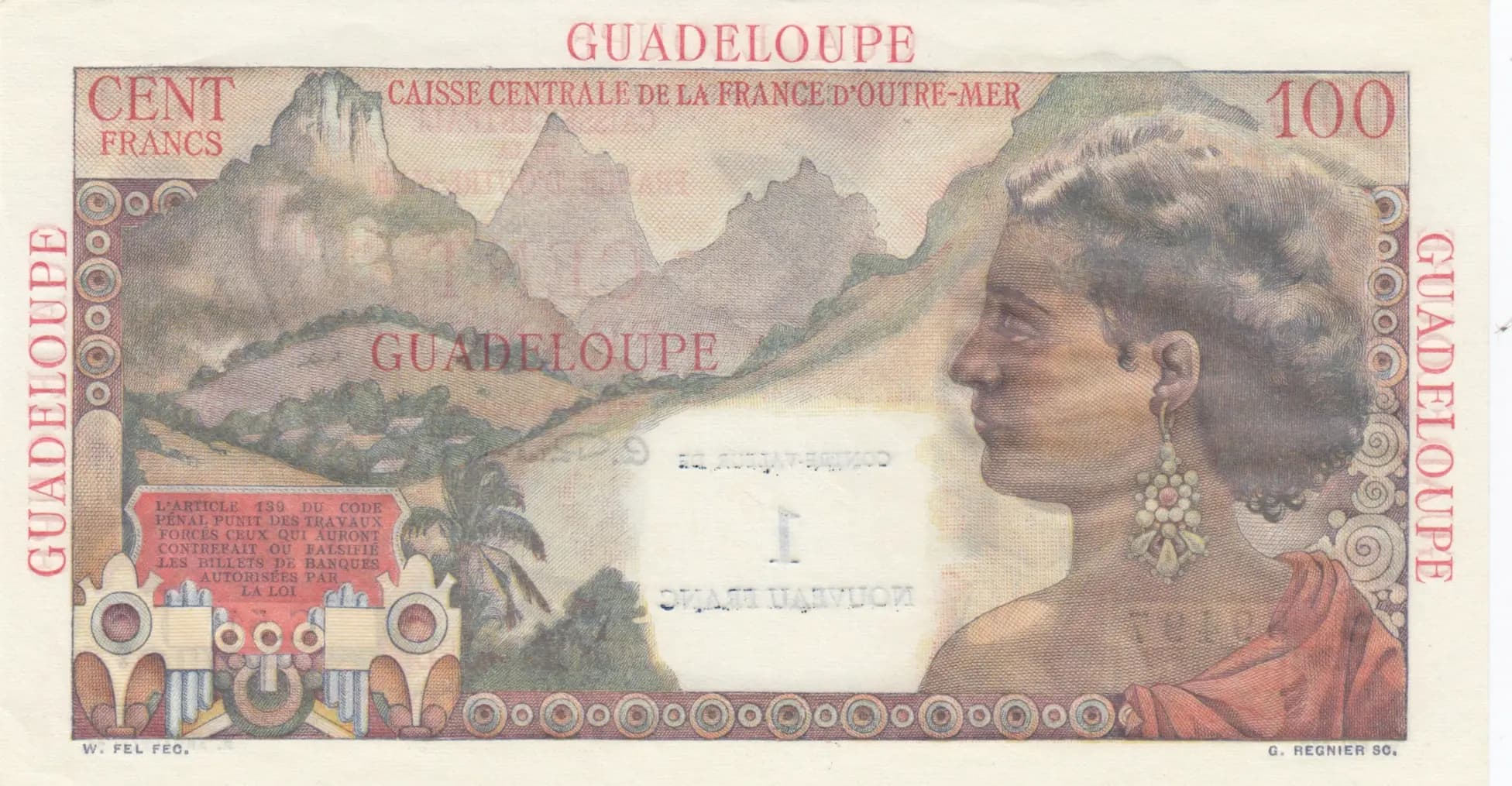
An exceptionally well-preserved example of this historically significant Guadeloupe 1 Nouveau Franc (100 Francs) note from 1960, graded AU with virtually no signs of circulation. The note features striking dual portraiture—the 18th-century French colonial figure Bertrand-François Mahé, comte de La Bourdonnais on the obverse, paired with a tropical colonial scene on the reverse depicting a woman in period dress alongside a mountain landscape. The exceptional clarity of the engraved detail and the vibrant color palette (reds, greens, and golds) are well-preserved, making this an attractive example of French overseas currency design during the transitional period from the old franc to the new franc.
Common. This note was part of a substantial circulation issue for Guadeloupe during the 1960 new franc transition period. The Caisse Centrale de la France d'Outre-Mer issued these notes in quantity to support the French Caribbean colonies' monetary conversion. No evidence of limited print runs, early recalls, or short issuing periods exists. While AU-graded examples in this condition are more desirable than circulated specimens, the base note type (P-41) itself is not scarce in the numismatic market. These notes regularly appear in collections and dealer inventories at moderate valuations.
Issued during 1960 by the Caisse Centrale de la France d'Outre-Mer, this note represents a critical moment in French colonial monetary policy—the introduction of the 'nouveau franc' (new franc) reform that decimalized the currency system. The dual denomination (printed as both 100 Francs and 1 Nouveau Franc) reflects the conversion rate of 100 old francs to 1 new franc. The portrait of La Bourdonnais, an 18th-century French naval officer and colonial administrator, alongside imagery of tropical agriculture and indigenous colonial life, symbolizes France's historical relationship with its Caribbean possession, while the mountain landscape and agricultural imagery underscore Guadeloupe's economic importance as a sugar and tropical produce colony.
This note exemplifies the classical French colonial banknote aesthetic of the mid-20th century. The obverse features a formal three-quarter portrait of Bertrand-François Mahé, comte de La Bourdonnais (1699-1753), rendered in fine engraved line work wearing 18th-century formal dress with a white powdered wig and decorative coat—a historical figure emphasizing French colonial legitimacy. Adjoining his portrait is an allegorical colonial scene depicting two figures in tropical dress among botanical elements (fruits and vegetation), representative of Guadeloupe's agricultural wealth. The reverse presents a allegorical female profile portrait facing right, adorned with pearl earrings and styled period hair, symbolizing the colonial territory itself. Behind this portrait is an expansive tropical landscape featuring mountain peaks, valleys, palm trees, and lush vegetation—the natural geography of Guadeloupe. Both sides are framed by ornate circular medallion patterns and decorative rosettes, with fine cross-hatching and architectural elements providing security and aesthetic appeal. The color scheme—predominant reds, pinks, greens, and beige tones—creates visual harmony while the intricate engraving work throughout demonstrates the high technical standards of French banknote production.
FRONT SIDE: 'Guadeloupe' (location identifier); '100' / 'CENT FRANCS' (face denomination in old francs); 'CAISSE CENTRALE DE LA FRANCE D'OUTRE-MER' (Central Bank of Overseas France); 'CONTRE-VALEUR DE 1 NOUVEAU FRANC' (Countervalue of 1 New Franc - the conversion notation); 'LA BOURDONNAIS' (portrait identifier); 'LE DIRECTEUR GÉNÉRAL' (The General Director - signature line); Serial number '125289497' with designation 'C.51'; Engraver signatures 'W. FEL FEC.' and 'R. ARMANELLI SC.'; and 'G. Strus-Vegy' (likely an official signature). BACK SIDE: 'GUADELOUPE' and '100' / 'CENT FRANCS' (repeated denomination); 'CAISSE CENTRALE DE LA FRANCE D'OUTRE-MER' (repeated issuer identification); Legal warning text 'L'ARTICLE 139 DU CODE PÉNAL PUNIT DES TRAVAUX FORCES CEUX QUI AURONT CONTREFAIT OU FALSIFIÉ LES BILLETS DE BANQUES AUTORISÉS PAR LA LOI' (Article 139 of the Penal Code punishes with forced labor those who counterfeit or falsify banknotes authorized by law); Engraver signatures 'W. FEL FEC.' and 'G. BÉGNIER SC.'
Intaglio (engraved line) printing, the standard security printing method for French banknotes of this era. The note exhibits characteristic fine-line engraving with complex cross-hatching patterns, precise portrait work, and ornamental security borders—all hallmarks of intaglio production. The signatures 'W. FEL FEC.' and engraver credits ('R. ARMANELLI SC.' on obverse; 'G. BÉGNIER SC.' on reverse) indicate individual master engravers involved in the design and production. The printer is consistent with the Banque de France's official engraving contractors, though the specific security printer for overseas currency issues (CCFOM) is not definitively identifiable from visible markings alone.
The specific variety is identified as P-41 per Pick's standard catalog, denoted as '1 Nouveau Franc on 100 Francs'—the dual-denomination format reflecting the 1960 franc conversion. The observed serial number '125289497' with prefix 'C.51' represents a standard issue variant within the standard printing. PMG reports only one cataloged variant for this base Pick number, indicating this represents the sole significant variety for this denomination and issuer combination. No overprints, color variations, or signature varieties of numismatic significance have been identified from the visual analysis.