100 kroner 1953 specimen
Market Prices
About This Note
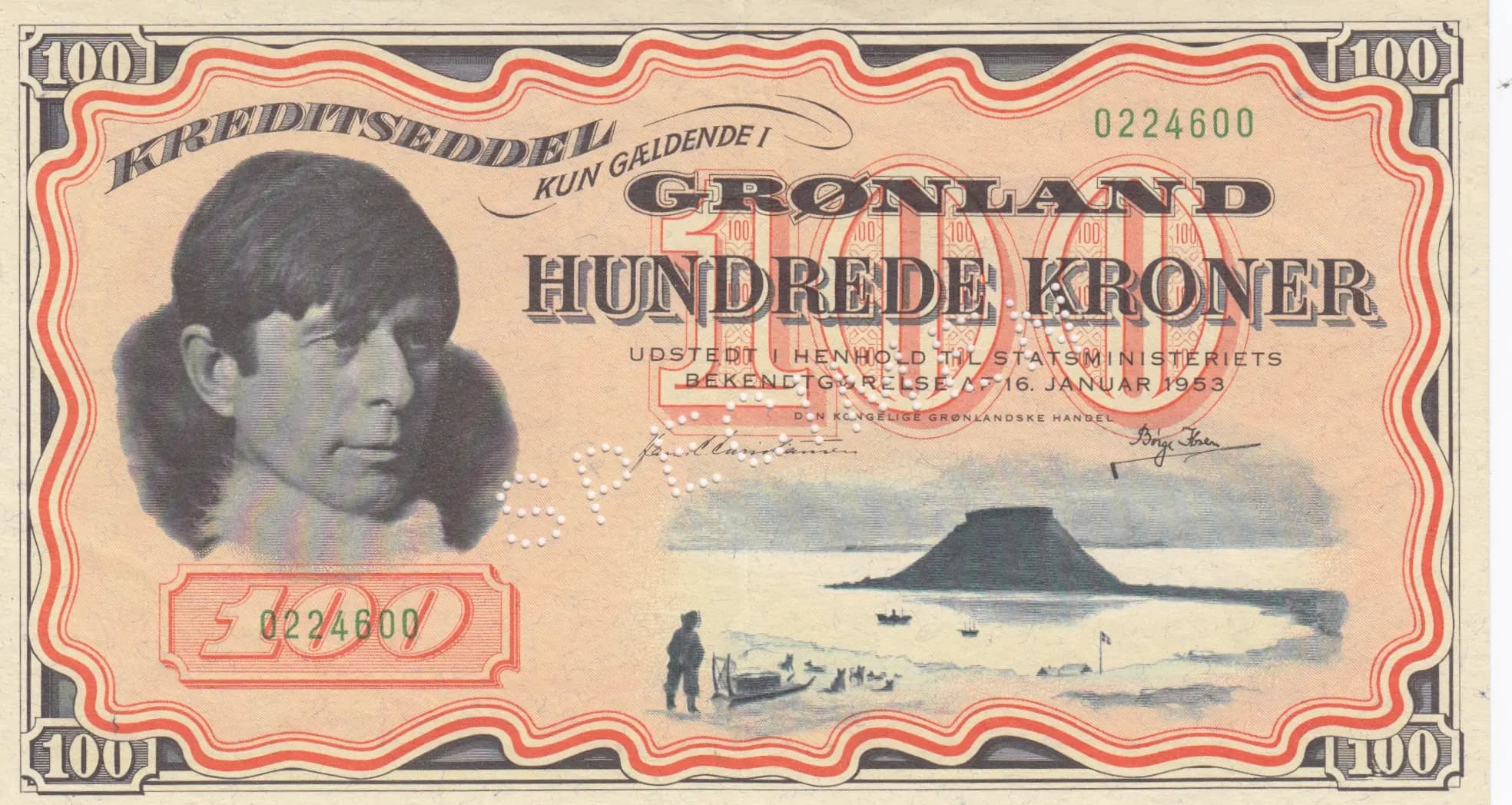
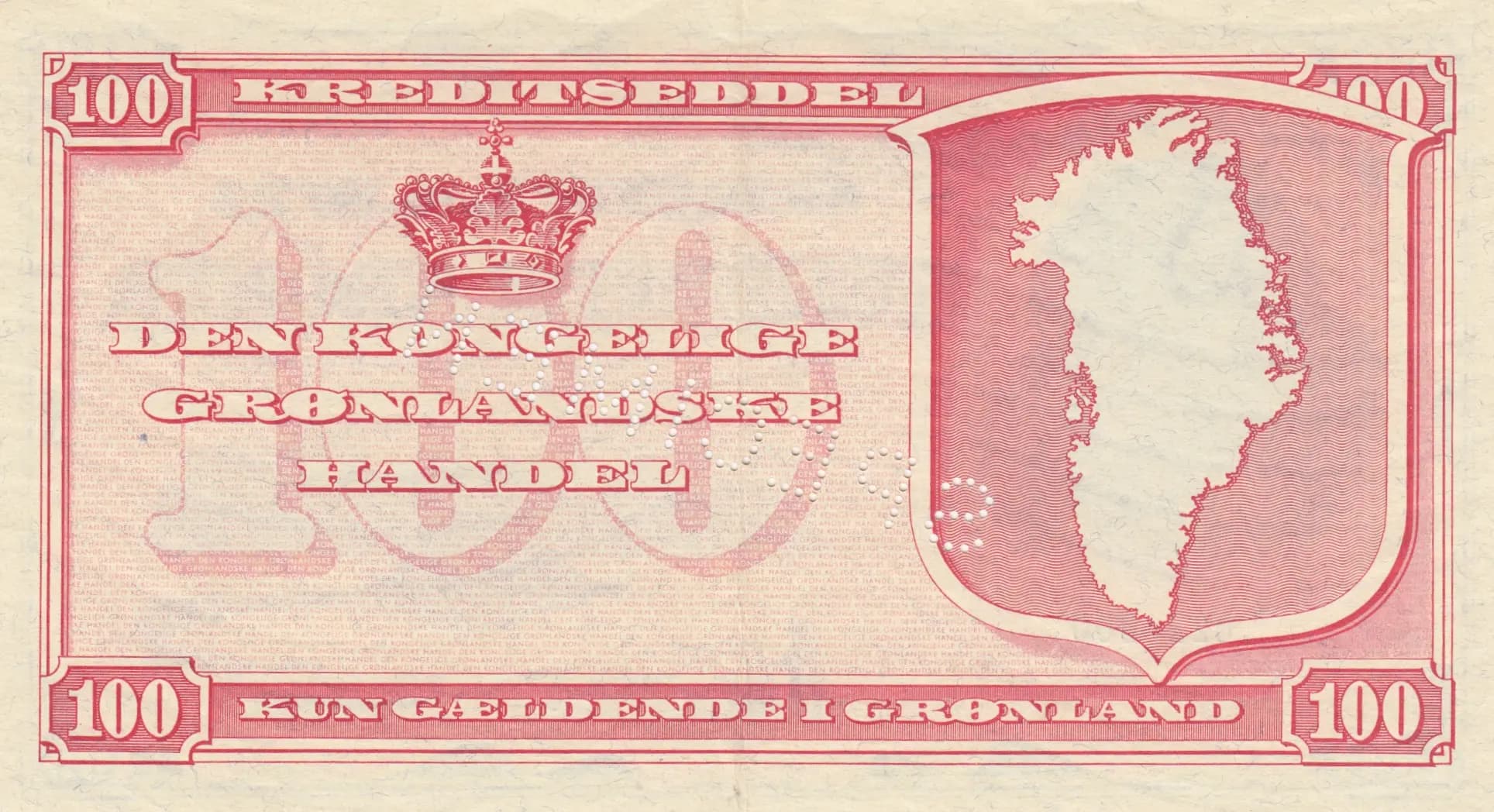
This 1953 100 kroner specimen note from Greenland's Royal Trade authority (Kongelige Grønlandske Handel) features a striking design with a portrait of Arctic explorer Knud Rasmussen on the obverse and a map of Greenland on the reverse. The note exhibits EF condition with visible aging, foxing, and discoloration consistent with a 70+ year old banknote, though all design elements remain clearly visible and the engraving work is well-preserved.
Common. While this is a 1953 specimen note from a specialized issuing authority with a limited geographic circulation area, eBay pricing data shows comparable grades (XF, AU, UNC) ranging from $885 to $1999, and catalog values from 2016 place VF at $1200 and UNC at $2400. The EF grade observed here falls within this normal market range. Specimen notes from Greenland's Royal Trade period are encountered with reasonable frequency in the market, indicating no exceptional scarcity for this Pick number.
Issued on January 16, 1953, following the Prime Minister's formal notification, this note represents Greenland's post-WWII currency period under the Royal Trade monopoly. The inclusion of Knud Rasmussen (1879-1933), the legendary Greenlandic Arctic explorer and ethnographer, reflects the Danish colonial administration's recognition of Greenlandic cultural identity. The reverse's prominent map of Greenland and royal crown symbolized Denmark's sovereignty over the territory during this period.
The obverse features a three-quarter profile portrait of Knud Rasmussen positioned on the left, rendered with fine dotted/stippled security engraving. The right side depicts Thule Rock (identified as a mountainous peninsula/island) with a coastal landscape including water, boats, and a standing figure on the beach—referencing Rasmussen's Arctic expeditions. The design uses a cream/beige base with red and gray wavy ornamental borders and fine line engraving throughout. The reverse employs a predominantly pink/magenta color scheme with a central shield-shaped frame containing a white silhouette map of Greenland, flanked by ornamental corner designs and a royal crown symbol in the upper left, reinforcing the note's official royal issuing authority.
Front side: 'KREDITSEDDEL' (Banknote/Credit note); 'KUN GÆLDENDE I GRØNLAND' (Only valid in Greenland); 'HUNDREDE KRONER' (Hundred kroner); 'UDSTEDT I HENHOLD TIL STATSMINISTERIETS BEKENDTGØRELSE AF 16. JANUAR 1953' (Issued in accordance with the Prime Minister's notification of January 16, 1953); Serial number '0224600'; Denomination '100'. Back side: 'KREDITSEDDEL' (Banknote); 'DEN KONGELIGE GRØNLANDSKE HANDEL' (The Royal Greenland Trade); 'HUNDREDE GRØNLAND' (Hundred Greenland); Denomination '100' (repeated in corners).
Intaglio engraving (recess printing) with multiple color passes, evident from the fine line work, dotted security patterns on the portrait, and the precise registration of red, gray, and black elements over the cream base. The dotted stippling effect on the portrait and background patterns is characteristic of early-to-mid 20th century security engraving practices. The note was likely produced by a Danish state security printer, consistent with Royal Danish banknote production standards of the era.
This specimen note corresponds to Pick-21cs (specimen variant). The visual analysis indicates watermark: Wavy Lines (consistent with P-21 base designation). The PMG population report identifies five cataloged variants for this base Pick number (P-21b, P-21c, P-21s1, P-21s2, P-21s3), with this specimen belonging to the 's' (specimen) category. The serial number observed (0224600) and the absence of signatures are consistent with specimen production protocols. The January 16, 1953 date is confirmed by the inscription referencing the Prime Minister's official notification of that date.