50 öre 1913
Market Prices
About This Note
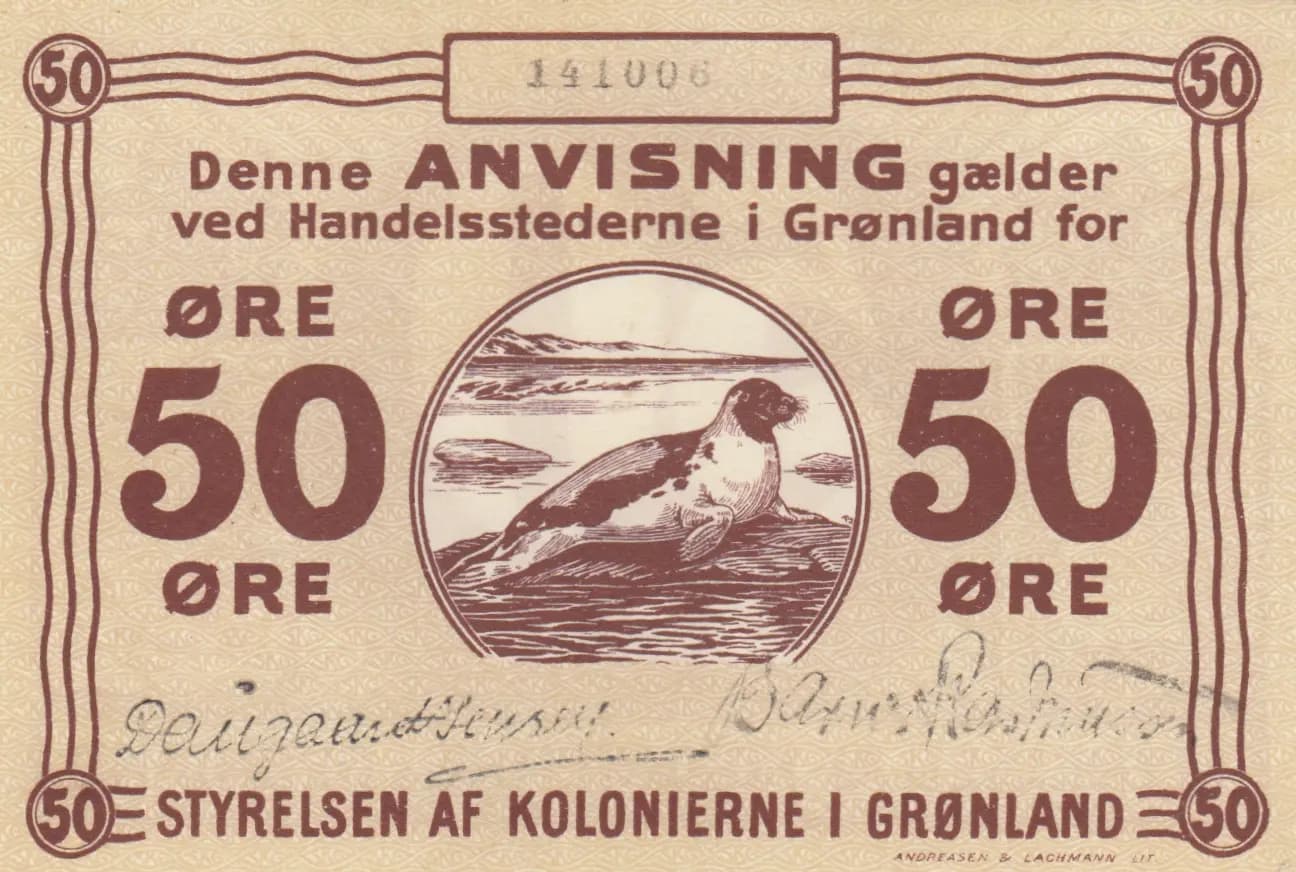
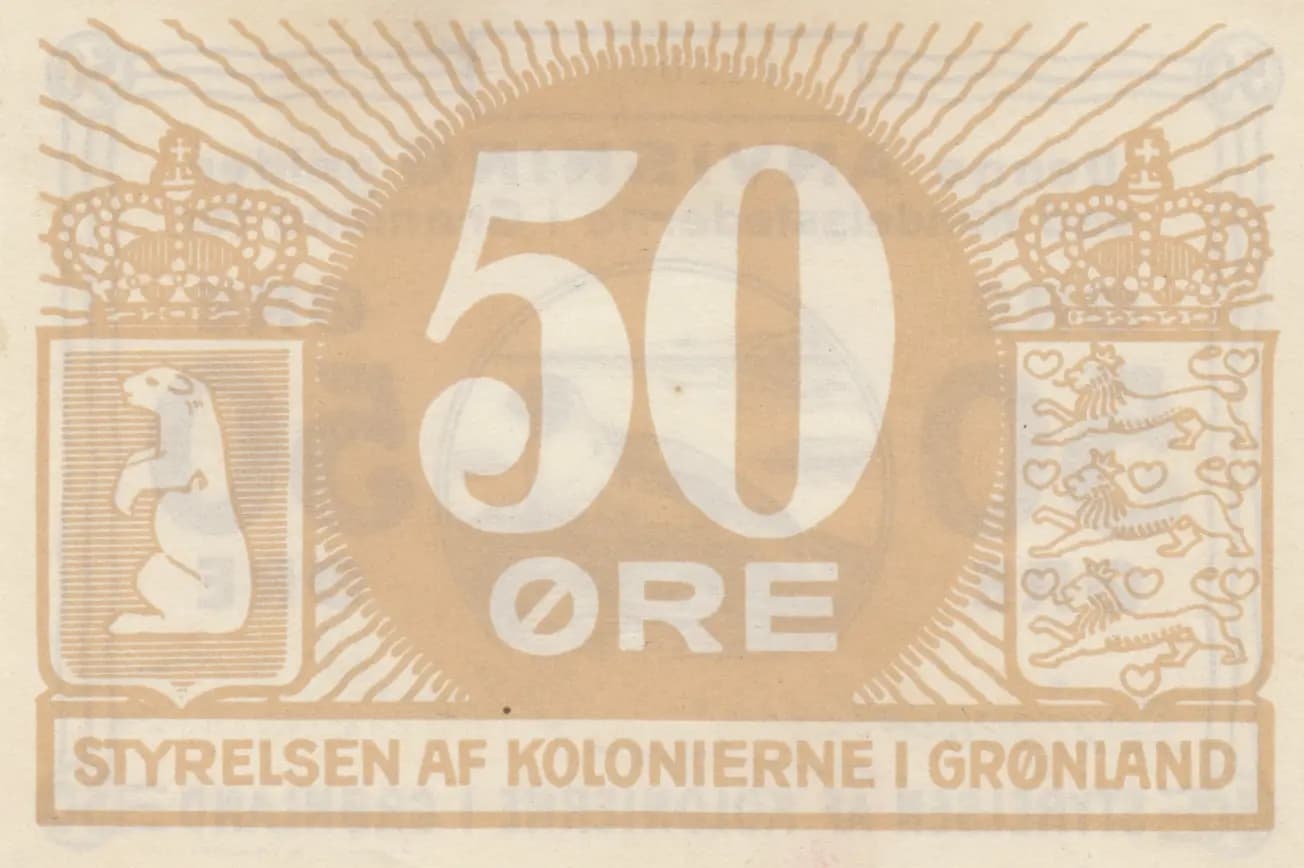
This 1913 50 öre note from Greenland presents an exceptional example of early colonial-era Nordic currency, featuring a striking saddleback seal vignette on the obverse rendered in brown and maroon tones. The reverse displays heraldic arms with Danish royal crowns flanking a prominent denomination numeral, characteristic of the formal authority imagery used by Styrelsen af Kolonierne i Grønland. In UNC condition, this note represents a well-preserved specimen of a scarce historical issue from a remote territorial administration.
Scarce. While the catalog reference prices suggest moderate availability (2016 catalogue value UNC: $500; eBay prices for UNC specimens ranging $624.95–$999.00), this note represents a specialized issue from a small, remote territorial administration with limited print runs. The PMG population report confirms multiple varieties (P-12, P-12b, P-12c, P-12d, P-12r) exist, but overall population numbers for Greenland colonial currency are restricted. The persistent eBay market presence at four-figure prices for UNC examples and significant gaps between conditions indicate limited availability and strong collector demand, placing this well above 'common' status.
Issued during the height of Danish colonial administration in Greenland, this 1913 note reflects the economic policies of the Danish War Ministry's colonial treasury (Pengemesterei Krigsministeriet visible on the obverse). The saddleback seal depicted on the front represents the fauna of Greenland's Arctic environment and would have been familiar to local traders and inhabitants of the trading posts where this currency circulated. The heraldic imagery featuring Danish royal symbols on the reverse underscores the colonial relationship between Copenhagen and Greenland during the early twentieth century.
The obverse features a central circular vignette depicting a saddleback seal (Phoca groenlandica), rendered in naturalistic style within an ornamental circular frame, surrounded by a decorative border of repeating wavy lines suggesting the Arctic maritime environment. Corner circles contain the denomination '50'. The reverse presents a minimalist heraldic design with a large central numeral '50' flanked by Danish royal crowns; within the heraldic shields appear a polar bear (sinister) and a heraldic lion (dexter), with hearts and decorative elements completing the achievement of arms. Radiating sunburst lines create an optical background pattern on the verso. Handwritten signatures of authorization officials appear on the lower portion of the obverse.
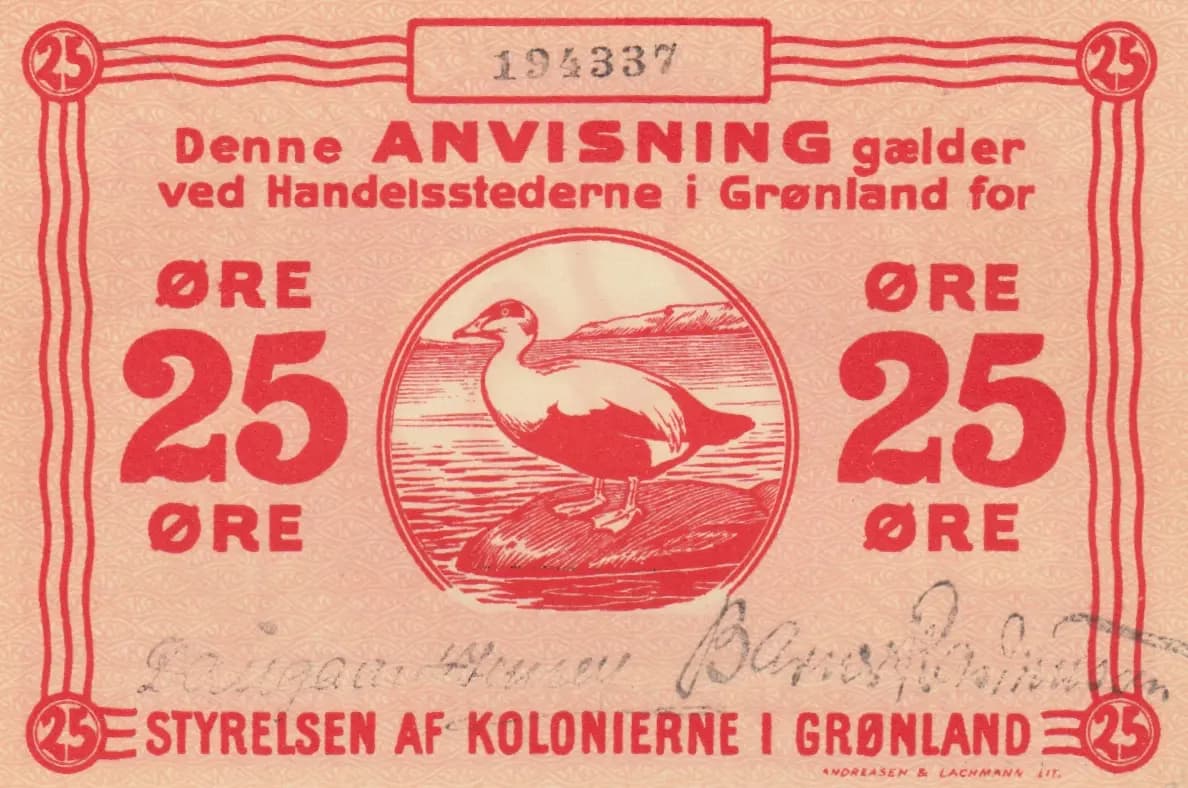
FRONT: 'Denne ANVISNING gælder ved Handelsstederne i Grønland for 50 ØRE' (This note is valid at trading posts in Greenland for 50 øre); 'STYRELSEN AF KOLONIERNE I GRØNLAND' (The Administration of the Colonies in Greenland); 'ANDREASEN & LACHMANN LIT' (Andreasen & Lachmann Lithography - printer); 'Pengemesterei Krigsministeriet' (Treasury / War Ministry); Serial number '141006'. BACK: '50 ØRE' (50 øre denomination); 'STYRELSEN AF KOLONIERNE I GRØNLAND' (The Administration of the Colonies in Greenland).
Lithography (as indicated by 'LIT' designation). The printer Andreasen & Lachmann of Copenhagen was responsible for this issue. The technique is evidenced by the fine line work visible in the vignette engraving, the decorative border patterns, and the heraldic detail on the reverse. The color application (brown/maroon on cream background for obverse; tan/cream with white elements for reverse) is consistent with chromolithographic production methods of the early twentieth century.
This note is catalogued as P-12c in the Pick standard. The PMG population report identifies five distinct varieties: P-12 (base), P-12b (signed D. Jensen and Munch), P-12c (this note), P-12d, and P-12r (specimen/remainder). The specific variety P-12c appears to represent a standard issue variant. The visible serial number '141006' and handwritten signatures ('Pengemesterei Krigsministeriet') on this specimen are consistent with authorized issue signatures of the period. No evidence of overprints, date variations, or color variants is apparent in the visual analysis of this particular note.