10 kroner 1926
Market Prices
1 saleAbout This Note
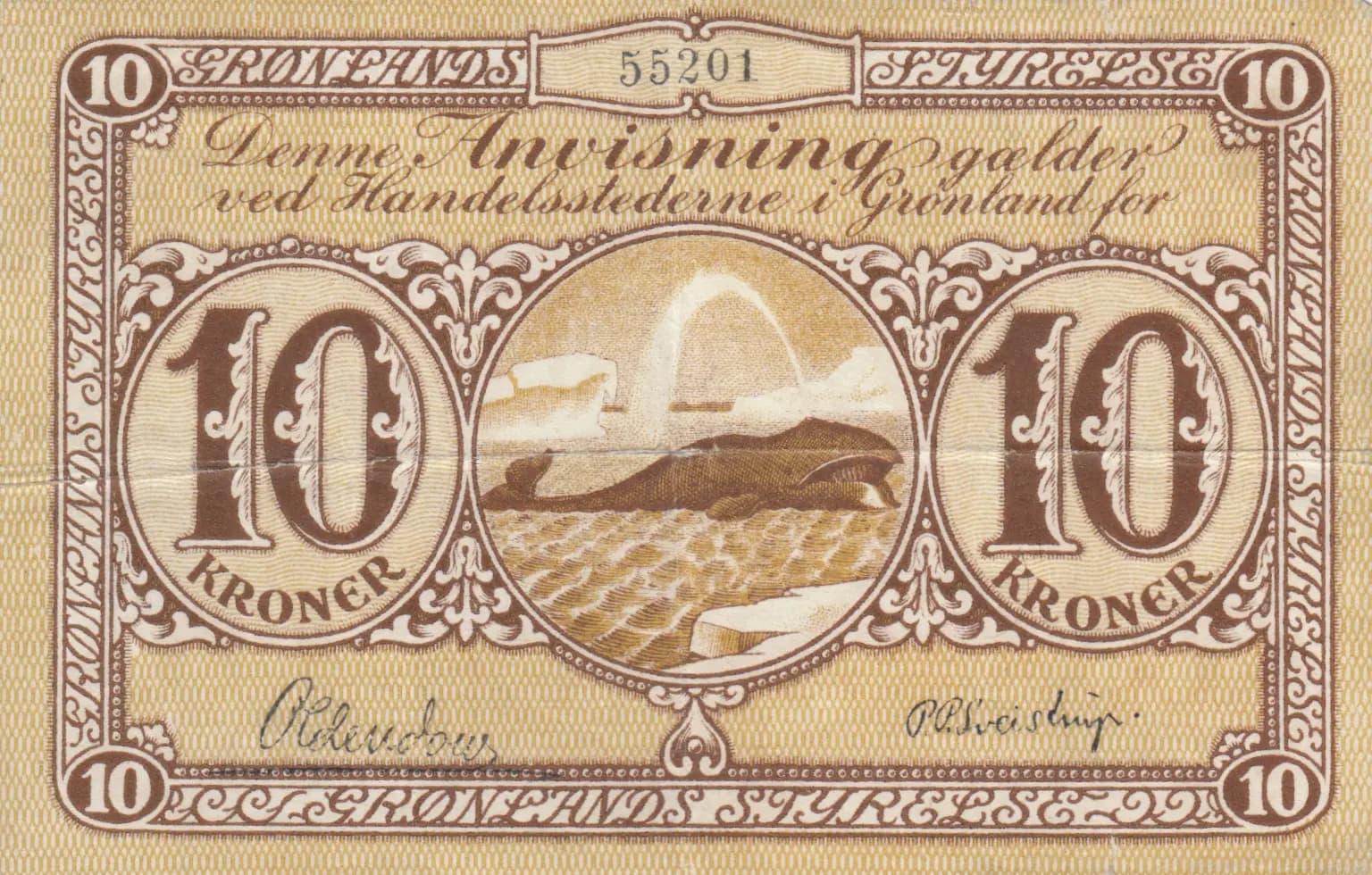
This 10 Kroner note from Greenland (1926) presents a scarce example of early Greenlandic currency issued by the Royal Greenland Trade Company. The front features an exquisite arctic landscape vignette depicting a humpback whale beached against a dramatic backdrop of mountains and natural rock formations, rendered in warm brown and tan tones characteristic of the period's engraving style. The note displays the cross-folds and foxing typical of well-handled examples from this era, consistent with the VF grade assessment.
Uncommon. While not exceedingly rare, this specific Pick variant (P-16d) from 1926 represents a scarcer type within the broader 10 Kroner series, as evidenced by the existence of six catalogued variants (P-16A through P-16f plus P-16r) for this single base denomination. The eBay market data showing VF examples selling at approximately $132 in 2020, against catalog values of $350, suggests moderate collector demand. The 1926-1945 series saw limited circulation relative to later issues, and VF specimens have seen some appreciation but remain accessible to collectors.
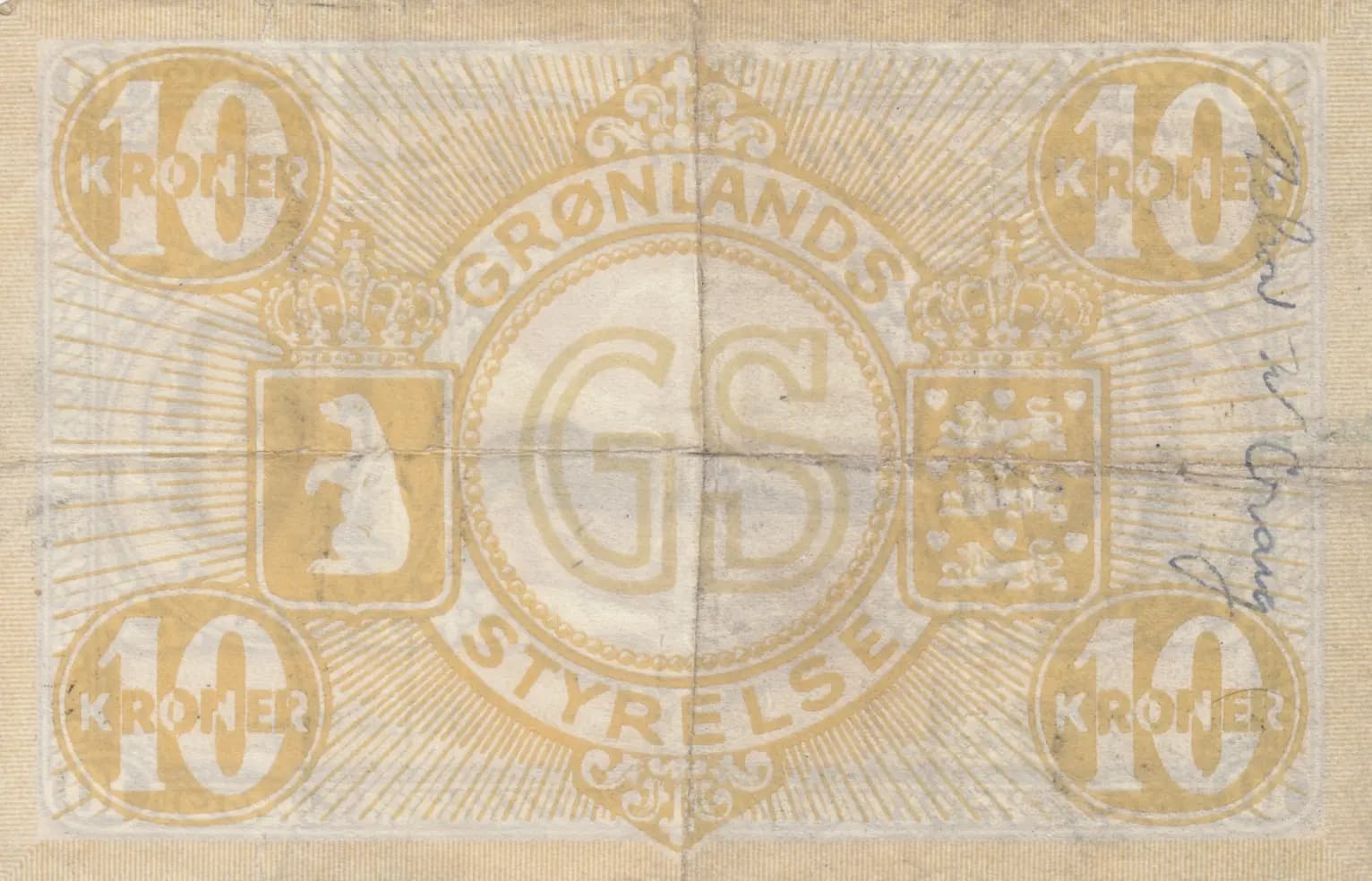
This note represents a crucial period in Greenland's monetary history when the Kongelige Grønlandske Handel (Royal Greenland Trade Company) maintained authority over the territory's currency before the transition to full Danish administrative control. The prominent whale imagery reflects Greenland's economic dependence on marine resources and whaling during the 1920s-1940s period, while the heraldic arms on the reverse symbolize the Danish crown's sovereignty over the colony. The dual inscriptions in Danish and Greenlandic administrative titles underscore the complex governance structure of the territory during this interwar period.
The obverse showcases an intricately engraved arctic seascape in the central vignette, featuring a humpback whale (the primary economic resource of Greenland) beached or stranded on a shoreline, with towering mountains and a distinctive natural arch or rock formation visible in the background—likely depicting the actual Hamelssted Islands geographic location referenced in the inscription. The composition is framed by elaborate baroque-influenced scrollwork and floral ornamental borders typical of early 20th-century Scandinavian banknote design. The reverse displays a more formal heraldic composition with Danish royal shields or coat-of-arms positioned left and right of a central monogram or administrative seal, surrounded by radiating fine line patterns that create a sunburst effect. The entire design demonstrates exceptional fine line engraving work throughout.
Front: '10' (denomination marker in circular frames, left and right), 'KRONER' (currency designation), 'Den Grønlandske Handel' (The Greenland Trade/Royal Greenland Trade Company), 'Hamelssted Øer. Grønland for' (Hamelssted Islands, Greenland for [continuation]). Serial number: 55201. Back: '10 KRONER' (denomination in four corner circles), 'GRØNLANDS STYRELSE' (Greenland Administration, curved around central design).
Intaglio engraving (line engraving) on both obverse and reverse, evidenced by the fine, intricate line work visible throughout the design elements, particularly in the border scrollwork, the radiating patterns on the reverse, and the detailed landscape vignette. The precision of the monogram and heraldic elements indicates professional security printing characteristic of Danish state printing facilities that handled Greenlandic currency during this period.
This is catalogued as Pick P-16d, one of seven known variants of the 10 Kroner series. The visual analysis indicates this is the full-printing variant (print extending across the entire front area) as distinct from P-16A which features a white margin on the front. The serial number 55201 and the inscription 'Den Grønlandske Handel' confirm attribution to the 1926 Kongelige Grønlandske Handel issue. The visible cross-fold pattern and foxing are consistent with field-circulated VF specimens from this era.