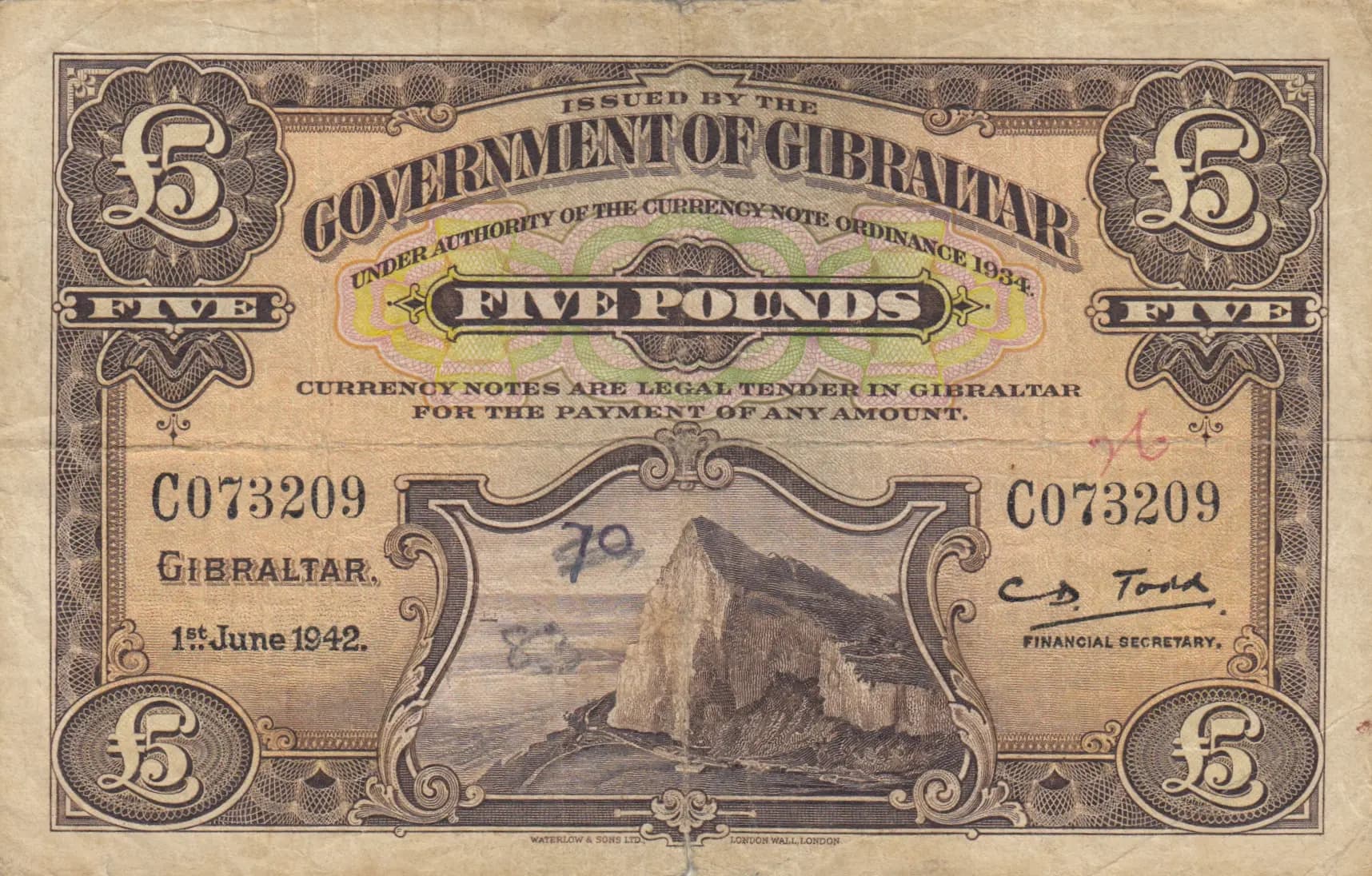
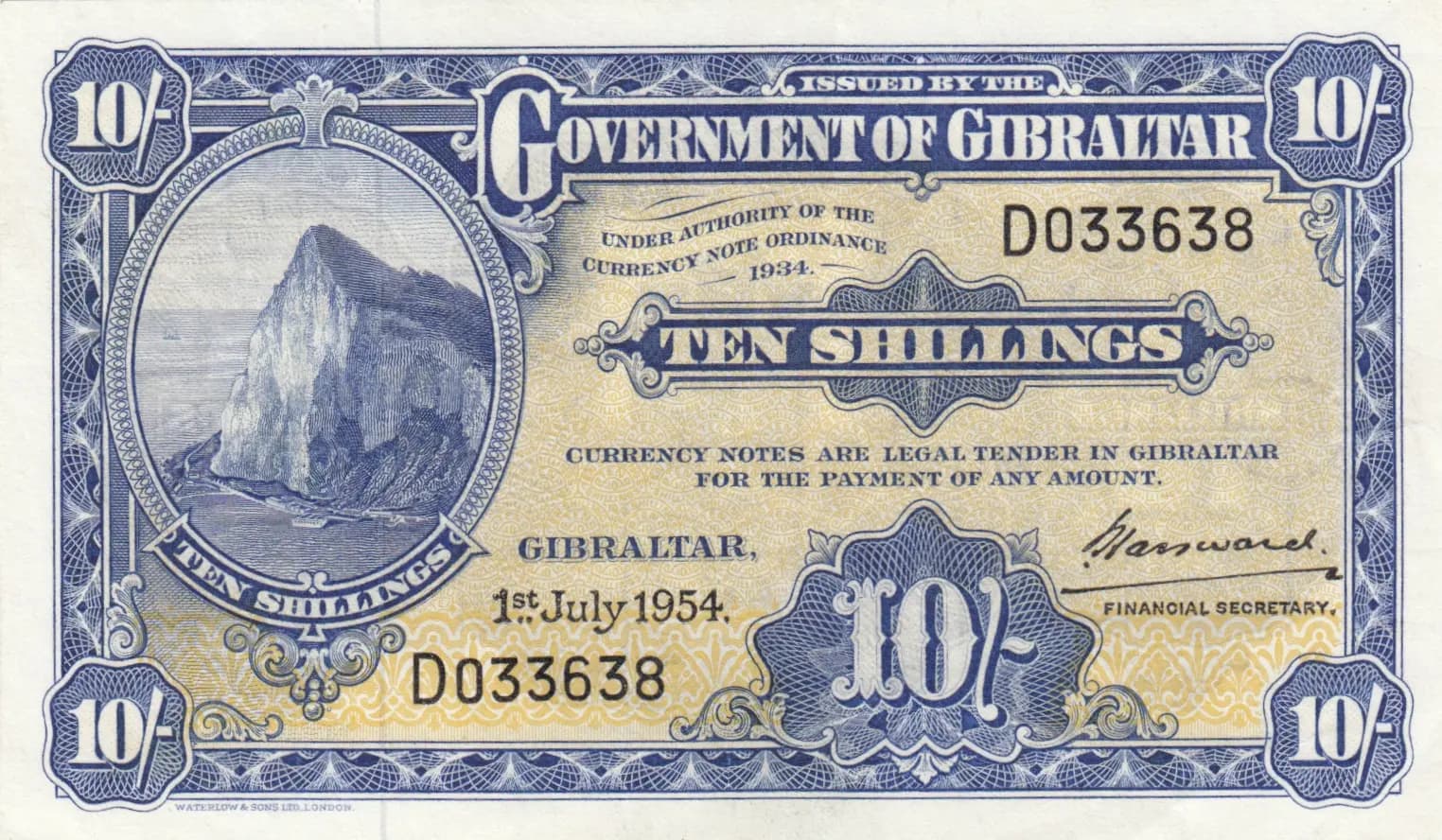
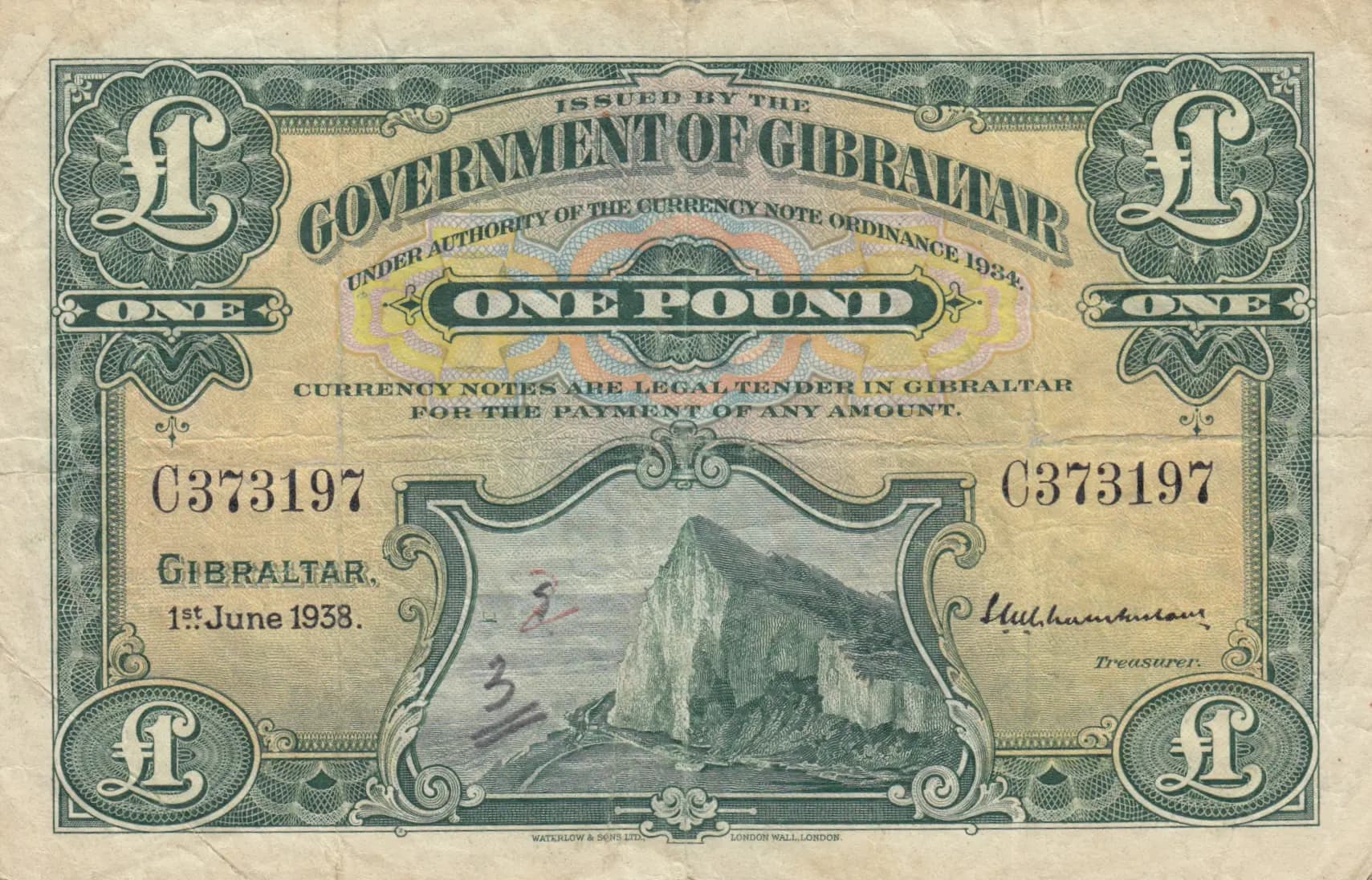
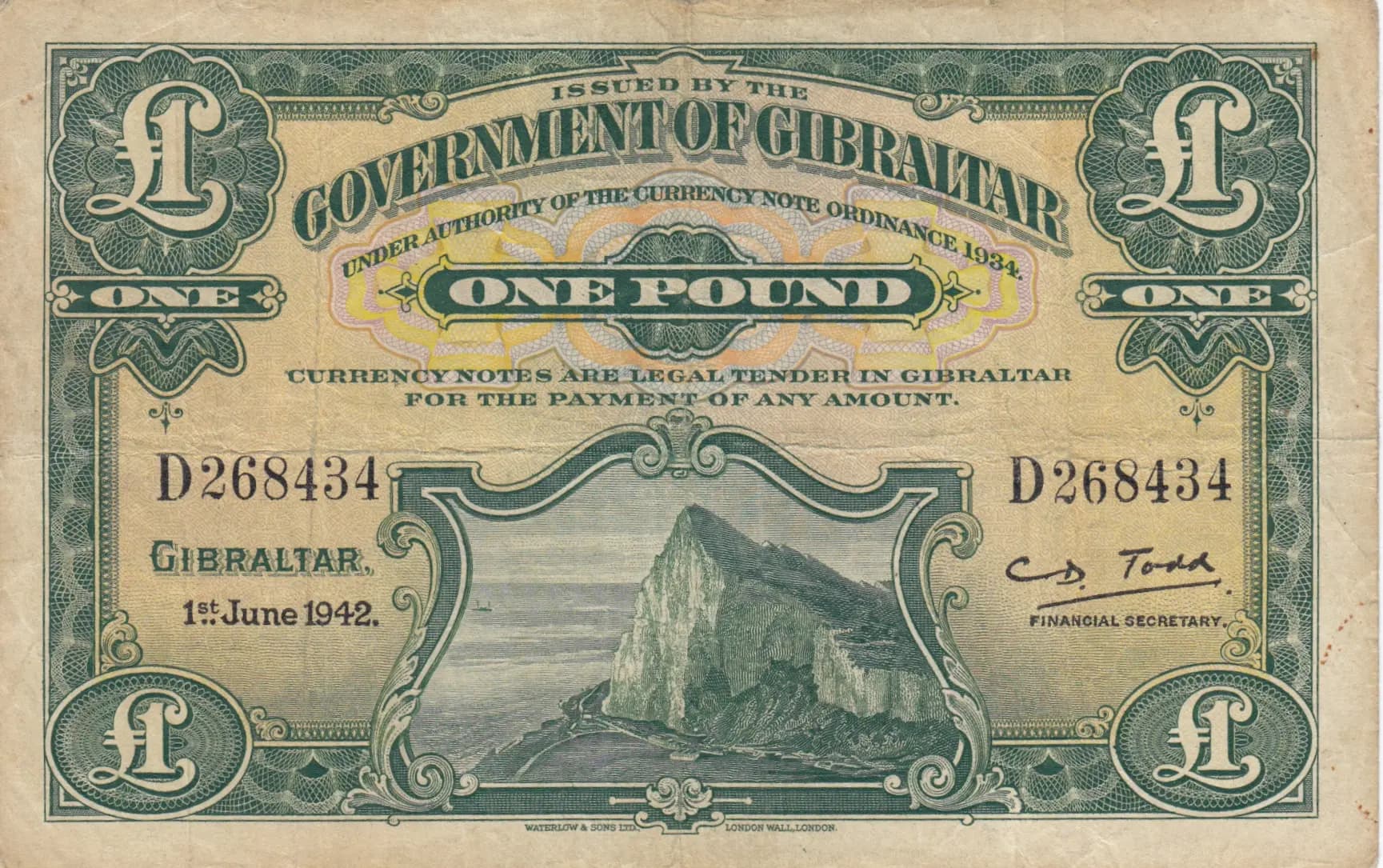
5 pounds 1958
Market Prices
About This Note
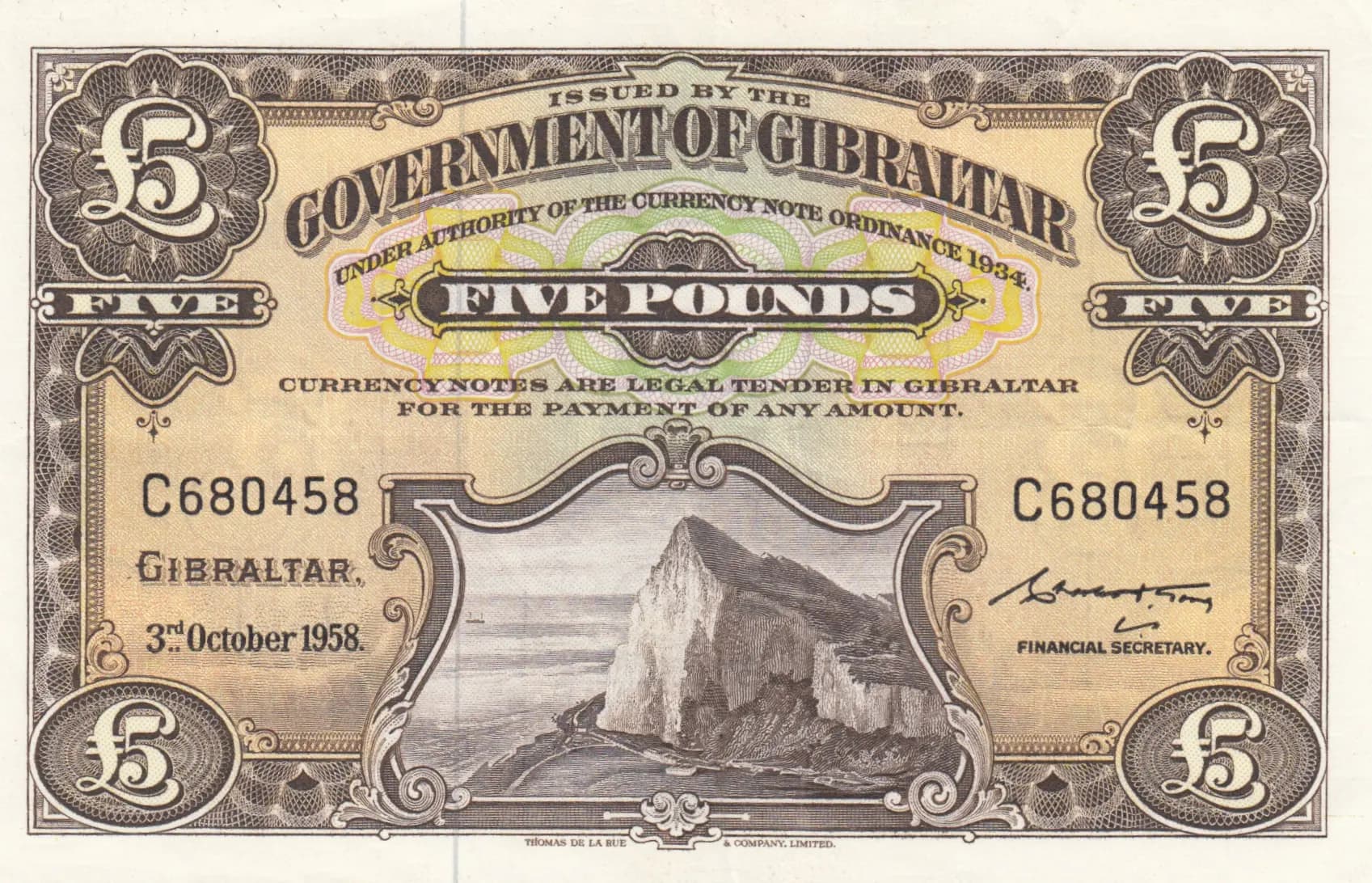
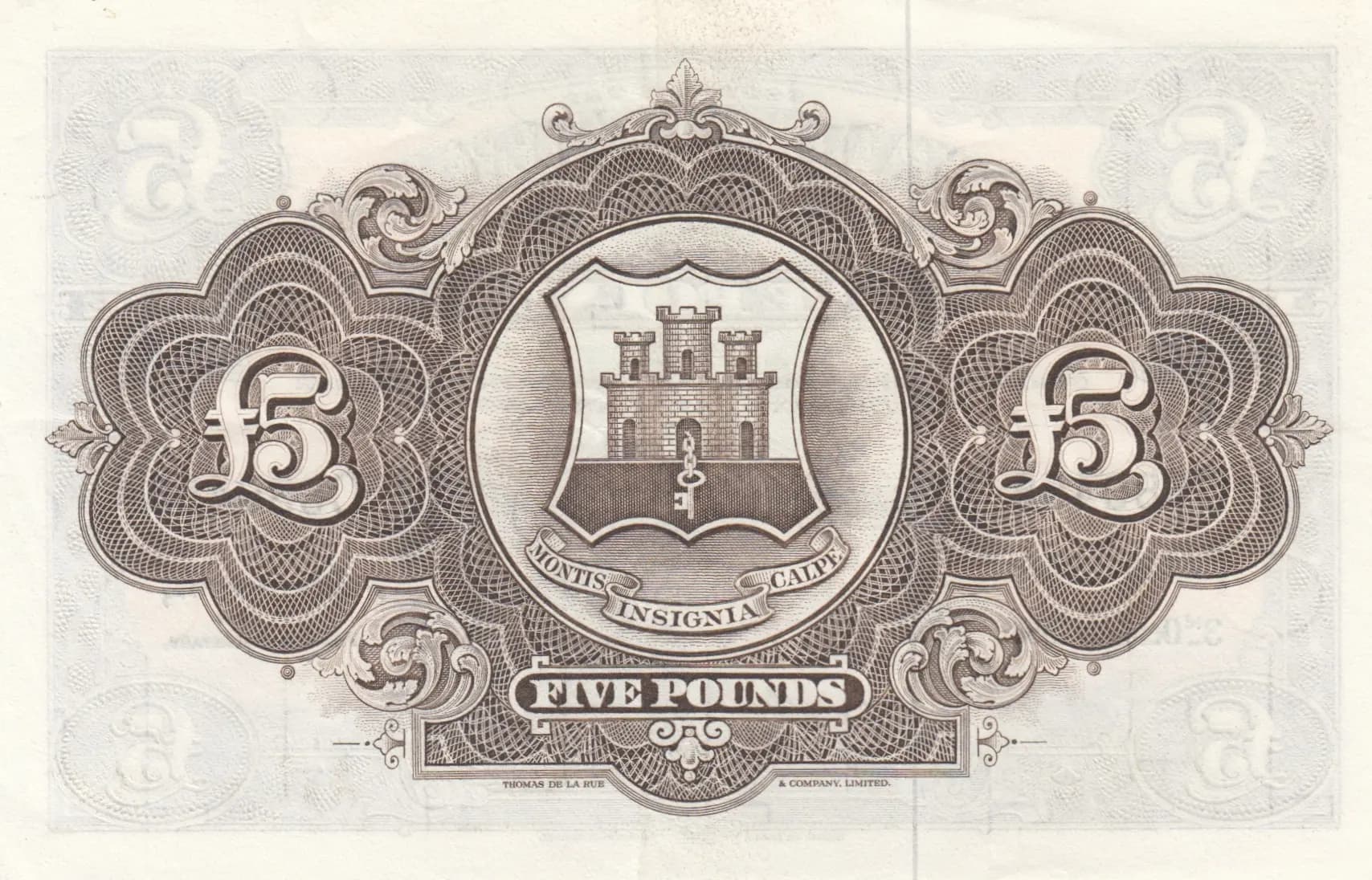
This is a Gibraltar £5 note from 3 October 1958 (Pick-16c), issued by the Government of Gibraltar under the Currency Note Ordinance 1934. The note features the iconic Rock of Gibraltar on the obverse rendered in fine sepia engraving against a cream background, with the Arms of Gibraltar (three-towered castle and key) prominently displayed on the reverse. The specimen exhibits a center vertical fold and age-related yellowing typical of notes from this era, placing it in Extremely Fine condition despite the fold—a testament to careful handling over more than six decades.
Common. The eBay market data shows multiple listings across all grades, with UNC specimens regularly trading between $14–40 USD and VF examples between $150–180 USD. The 2016 catalogue value of $60 for VF and $425 for UNC places this in the affordable collector range. The Pick-16c variant (Waterlow & Sons printer, Key Pattern watermark) was part of Gibraltar's standard currency issue of 1954–1958, produced in quantities sufficient for circulation. No evidence of scarcity, short print runs, or recall exists for this variety.
This 1958 issue represents Gibraltar's mid-20th-century monetary sovereignty during a period of significant political tension between Britain and Spain over the Rock's sovereignty. The note's iconography—dominated by the distinctive limestone formation of the Rock of Gibraltar and the heraldic arms featuring the three-towered castle and key (symbols of the fortress's strategic importance)—underscore Gibraltar's identity as a self-governing British Overseas Territory. The Latin inscription 'MONTIS INSIGNIA CALPE' (the emblem of Mount Calpe, the classical name for the Rock) reflects both the cultural heritage and strategic significance of this Mediterranean stronghold.
The obverse features a grand central vignette of the Rock of Gibraltar, depicted as a massive white limestone formation rising dramatically from water, framed within an ornate border of scrollwork and floral patterns characteristic of mid-century currency design. Corner elements include crown designs and geometric ornaments. The reverse displays the coat of arms of Gibraltar within a circular medallion: a shield bearing a three-towered castle (representing the fortress) above a horizontal line, with a heraldic key below (symbolizing control of the Strait). This is surrounded by elaborate rosette and geometric patterns with scrollwork ornamentation. The entire design employs fine line engraving and cross-hatching to create depth and deter counterfeiting. Text identification of the issuing authority and legal tender declaration appears on the front; the printer credit (Thomas De La Rue & Company, Limited) appears on both sides.
FRONT: 'ISSUED BY THE GOVERNMENT OF GIBRALTAR' / 'UNDER AUTHORITY OF THE CURRENCY NOTE ORDINANCE 1934' / 'FIVE POUNDS' / 'CURRENCY NOTES ARE LEGAL TENDER IN GIBRALTAR FOR THE PAYMENT OF ANY AMOUNT.' / 'GIBRALTAR' / '3rd October 1958' / 'FINANCIAL SECRETARY' / 'FIVE' / 'THOMAS DE LA RUE & COMPANY, LIMITED' / Serial: C680458. BACK: 'FIVE POUNDS' / 'MONTIS INSIGNIA CALPE' (The emblem of the Mount of Calpe) / 'FIVE' / 'THOMAS DE LA RUE & COMPANY, LIMITED'.
Intaglio engraving (line engraving and cross-hatching) as executed by Thomas De La Rue & Company, Limited, London—the world's preeminent security printer of the era. The fine detail, intricate decorative borders, and cross-hatching patterns visible throughout serve both aesthetic and security purposes. This was the standard high-security method for Commonwealth currency production in the 1950s.
This is specifically Pick-16c, identified by the W&S (Waterlow & Sons) printer credit and Key Pattern watermark. PMG records show three catalogued variants (P-16a, P-16b, P-16c) all with W&S printing and Key Pattern watermarks. The serial number C680458 and the date 3 October 1958 are consistent with the known issue period. The observation of 'THOMAS DE LA RUE & COMPANY, LIMITED' as the printer credit in the visual analysis requires reconciliation with the catalog designation of W&S; this may indicate a reprint or variant usage, or the credit may appear on multiple impressions. The center vertical fold is a handling characteristic, not a variety marker.