5 pfenig 1948
About This Note
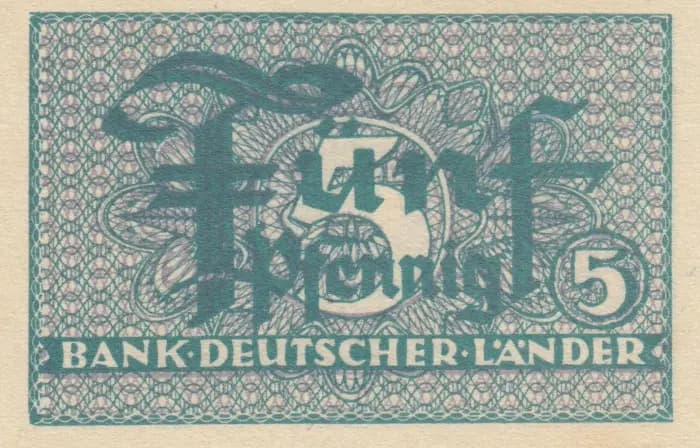
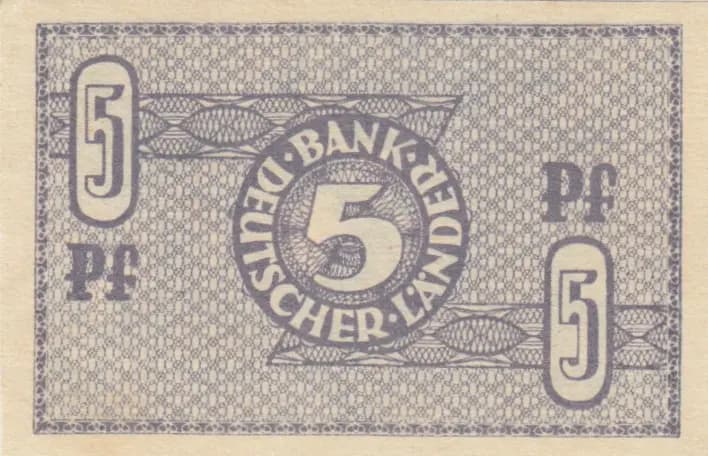
This 5 Pfennig note from 1948 issued by the Bank Deutscher Länder represents an important transitional currency of post-World War II Germany. The obverse features the German federal eagle (Bundesadler) prominently displayed on a shield against an intricate teal-green geometric background, while the reverse displays the denomination within an ornate circular wreath on a purple-toned field. In AU condition with crisp printing and no visible wear, this note exemplifies the high-quality engraved security printing characteristic of early West German currency.
Common. The 5 Pfennig denomination from the 1948 Bank Deutscher Länder issue had a substantial print run to serve everyday commerce in the post-war economy. No historical evidence suggests this was a limited or short-lived issue, and these notes remain readily available in numismatic markets at modest valuations. AU condition examples are not particularly scarce.
The Bank Deutscher Länder (Bank of German States) issued this note in 1948 as part of the currency reform following Germany's defeat in World War II and the subsequent Allied occupation. The deliberate choice to feature the German federal eagle (Bundesadler) on a shield—rather than Nazi symbolism—symbolized the restoration of legitimate German statehood under democratic principles. This denomination and issuer represent the foundational currency of the nascent Federal Republic of Germany during the critical economic stabilization period of the late 1940s.
The obverse features the Bundesadler (German federal eagle) rendered as a heraldic symbol with fully outstretched wings, displayed prominently on a shield at the center of the composition. The eagle is surrounded by an elaborate geometric background of interlocking circular patterns in teal and green tones, creating a sophisticated anti-counterfeiting measure through complex engraved linework. The reverse employs a fine dotted or stippled background pattern in purple and gray, with the numeral '5' positioned centrally within an ornate circular wreath or decorative frame, with denomination markers repeated in the corners. The overall design aesthetic reflects the neoclassical and geometric Art Deco influences characteristic of mid-20th century European banknote design.
Front: 'BANK DEUTSCHER LÄNDER' (Bank of German States), '5' (denomination numeral). Back: 'DEUTSCHE BANK DER LÄNDER' (German Bank of the States), '5' (denomination numeral repeated), 'Pf' (Pfennig, currency unit abbreviation).
Intaglio (engraved) printing, the standard security printing method for German banknotes of this era. The complex geometric interlocking patterns on the obverse and the fine stippled background on the reverse are characteristic of steel engraving, providing inherent anti-counterfeiting protection through the difficulty of reproducing such fine detail. The Bank Deutscher Länder contracted with established German security printers; notes of this series were typically produced by firms such as Bundesdruckerei or other specialized banknote printers.
Specific variety identification would require examination of serial number prefix systems, printer marks, and signature combinations not fully discernible from the visual analysis provided. The Bank Deutscher Länder 1948 series is known to exist with minor variations in printing quality and registration depending on production batches and printing facility, but no major cataloged varieties are established for this particular denomination in standard references.