1 mark 1948
About This Note
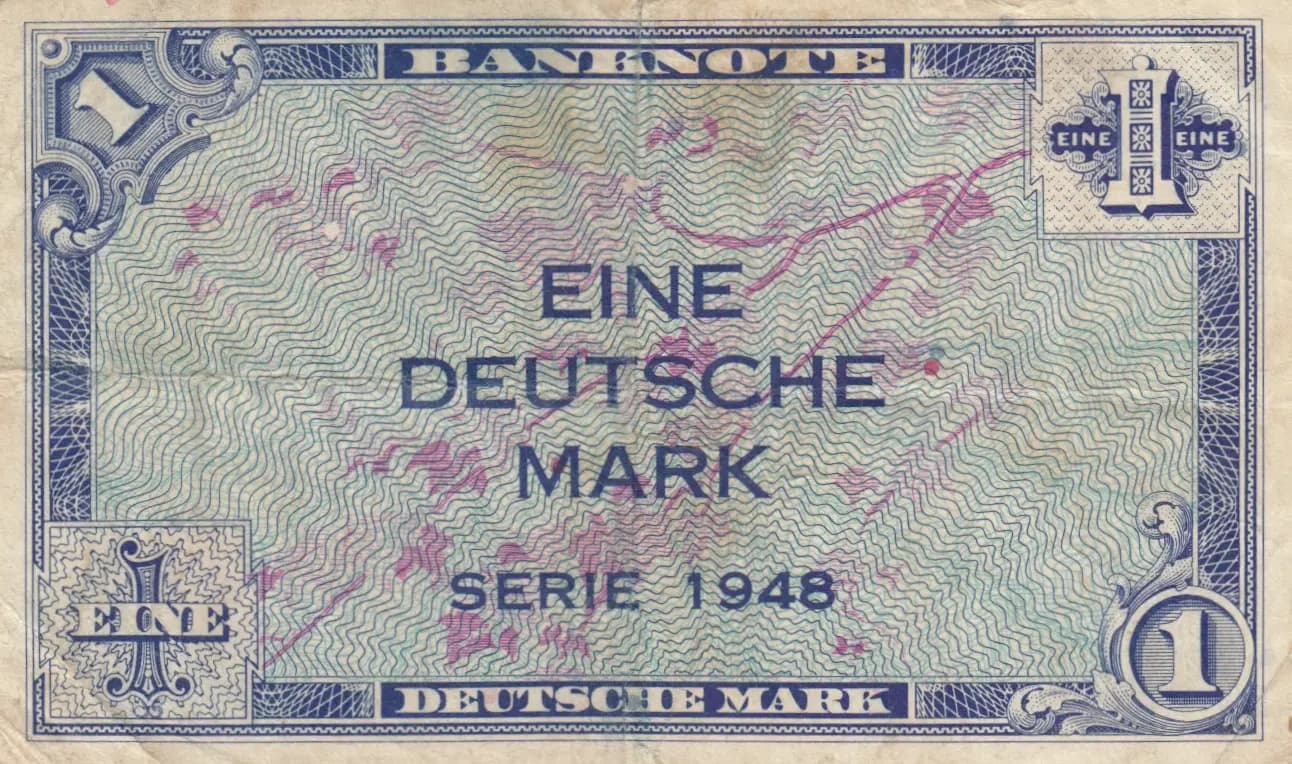
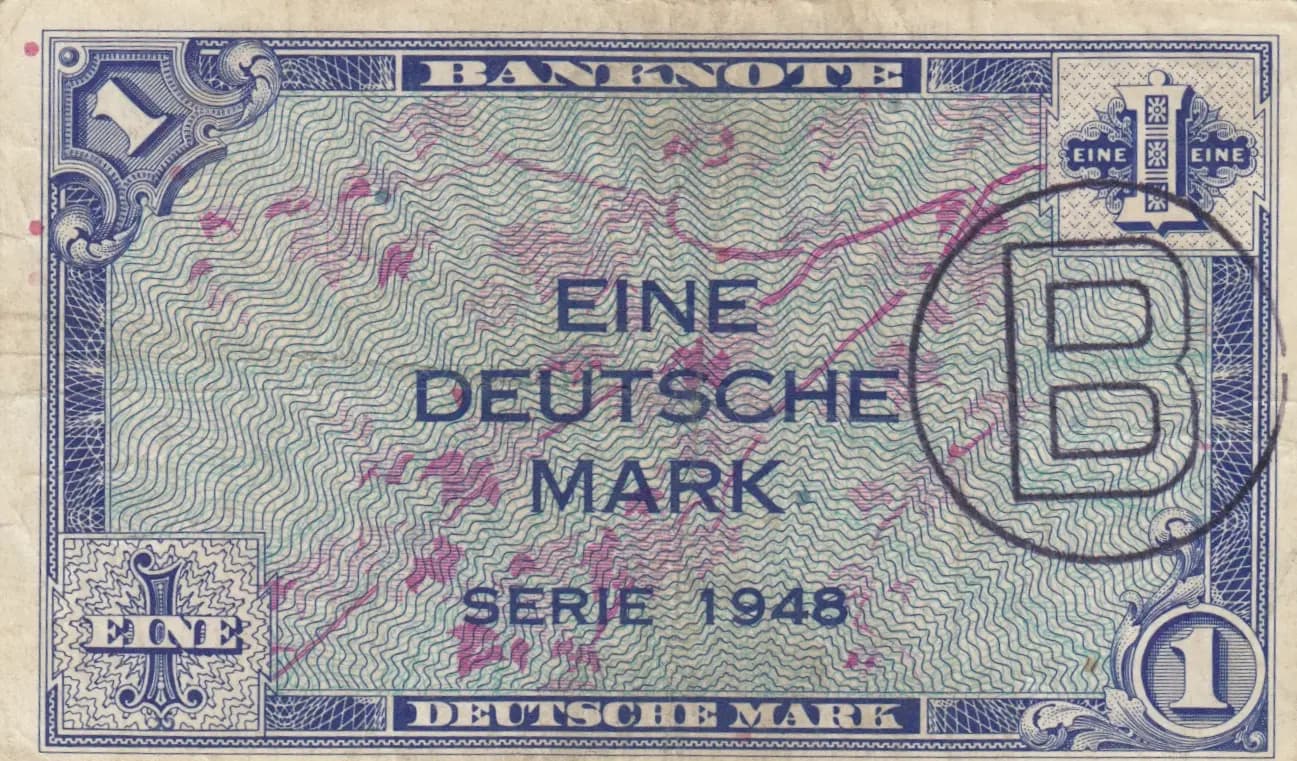
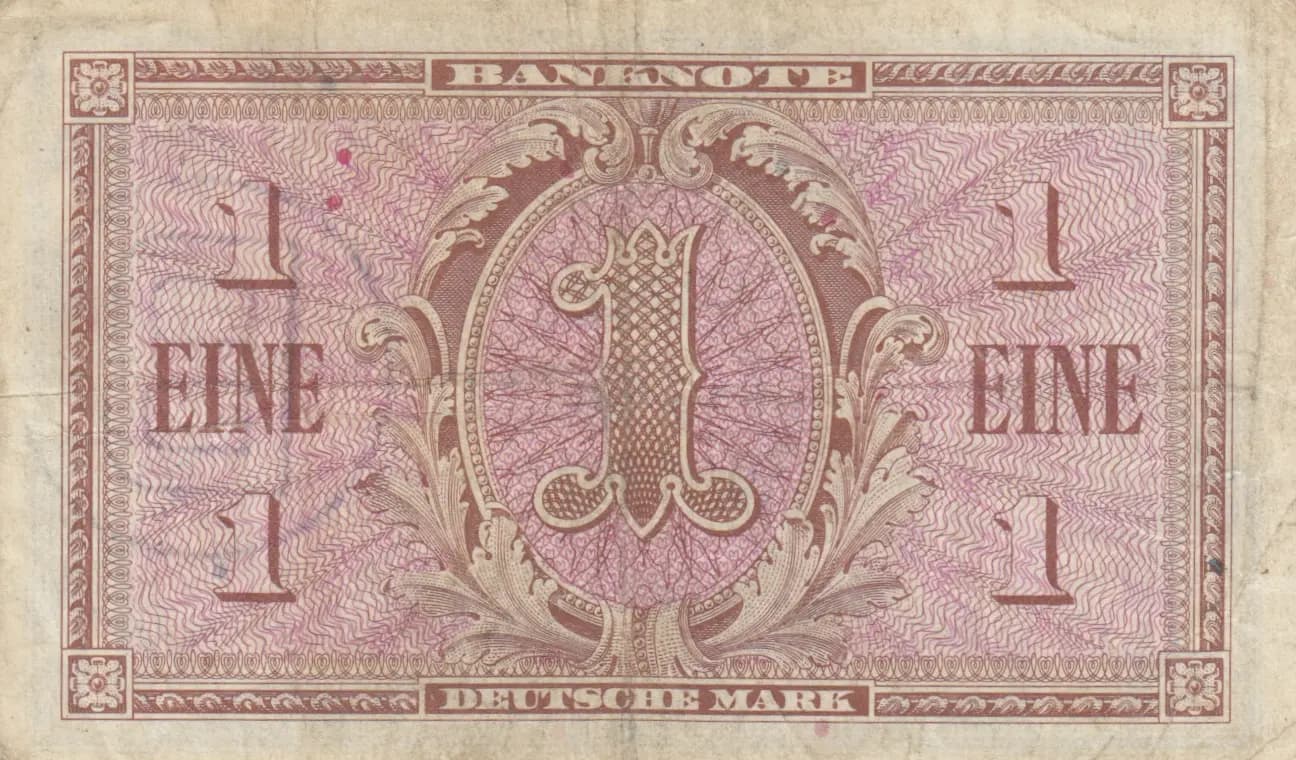
This 1948 1 Deutsche Mark note from the U.S. Army Command represents an important early postwar German currency issue. The front displays distinctive multicolor printing in green, pink, and dark blue with intricate wavy line patterns and ornate classical borders, while the back features an elegant reddish-brown monochromatic design centered on an ornate oval medallion with fine crosshatch detailing. The note exhibits moderate circulation wear with creasing and age-related patina, consistent with its F (Fine) grade, making it a solid example of this historically significant transitional currency.
Common. The 1948 1 Mark occupation currency was issued in substantial quantities by the U.S. Army Command as everyday circulating currency in the American zone of Germany. Hundreds of millions of these notes were printed to support the occupation economy. Even in Fine condition, this denomination and series remains widely available to collectors at modest prices, reflecting the high original print runs and the note's lack of restricted distribution or early recall.
Issued by the U.S. Army Command in 1948, this mark represents the American occupation authorities' monetary control in their zone of postwar Germany, predating the establishment of the Deutsche Bundesbank and the formal Deutsche Mark currency. The ornate, classical design elements reflect a deliberate aesthetic choice to project stability and legitimacy during the fragile early reconstruction period, while the multicolor security printing demonstrated contemporary anti-counterfeiting technology. This series marked the transition from Reichsmark hyperinflation and wartime chaos to a structured, controlled monetary system under Allied supervision.
The obverse features a formally structured layout with no figurative portraits, instead emphasizing geometric security elements: a prominent multicolor design with green and pink undulating wave patterns across the central field, bordered by ornate dark blue decorative frames with classical flourishes at the corners. A cross symbol with 'EINE EINE' text appears in the upper right, while a circular numeral '1' occupies the bottom right corner, with a decorative cross emblem in the lower left. The reverse presents a more subdued, elegant composition dominated by a large ornate oval central medallion containing intricate diamond/crosshatch hatching patterns, rendered in warm reddish-brown tones, with matching fine decorative borders and corner ornaments throughout. This design scheme reflects 1940s-era security printing practices emphasizing pattern complexity and multicolor differentiation between sides.
Front side: 'BANKNOTE' (Banknote), 'EINE DEUTSCHE MARK' (One German Mark), 'SERIE 1948' (Series 1948), 'DEUTSCHE MARK' (German Mark). Back side: 'BANKNOTE' (Banknote), '1 EINE 1' (1 One 1), 'EINE' (One), 'DEUTSCHE MARK' (German Mark). All inscriptions appear in German, appropriate for currency issued in occupied German territory.
The note was produced using intaglio (engraving) and letterpress printing techniques, evidenced by the sharp line work, precise border details, and the quality of the fine crosshatch patterns in the central medallion on the reverse. The multicolor security printing on the obverse (distinct green, pink, and blue inks) indicates careful plate alignment typical of high-security banknote production. The printer for U.S. Army Command occupation currency in this period was typically the U.S. Bureau of Engraving and Printing, which managed design and production of occupation marks under military administration.
This note is identified as Pick P-2b, indicating it is the second variety (b) of the basic 1 Mark 1948 design. Varieties within this series typically differ in signature blocks, serial number prefixes, or subtle printing variations reflecting different production runs or security measures implemented by the occupation authorities. The visual characteristics observed—particularly the specific ornamental design elements and color scheme—are consistent with documented P-2b specifications. No overprints or obvious serial number anomalies are noted in the visual analysis, suggesting this is a standard circulation example of the variety.