10 pfennig 1967
About This Note
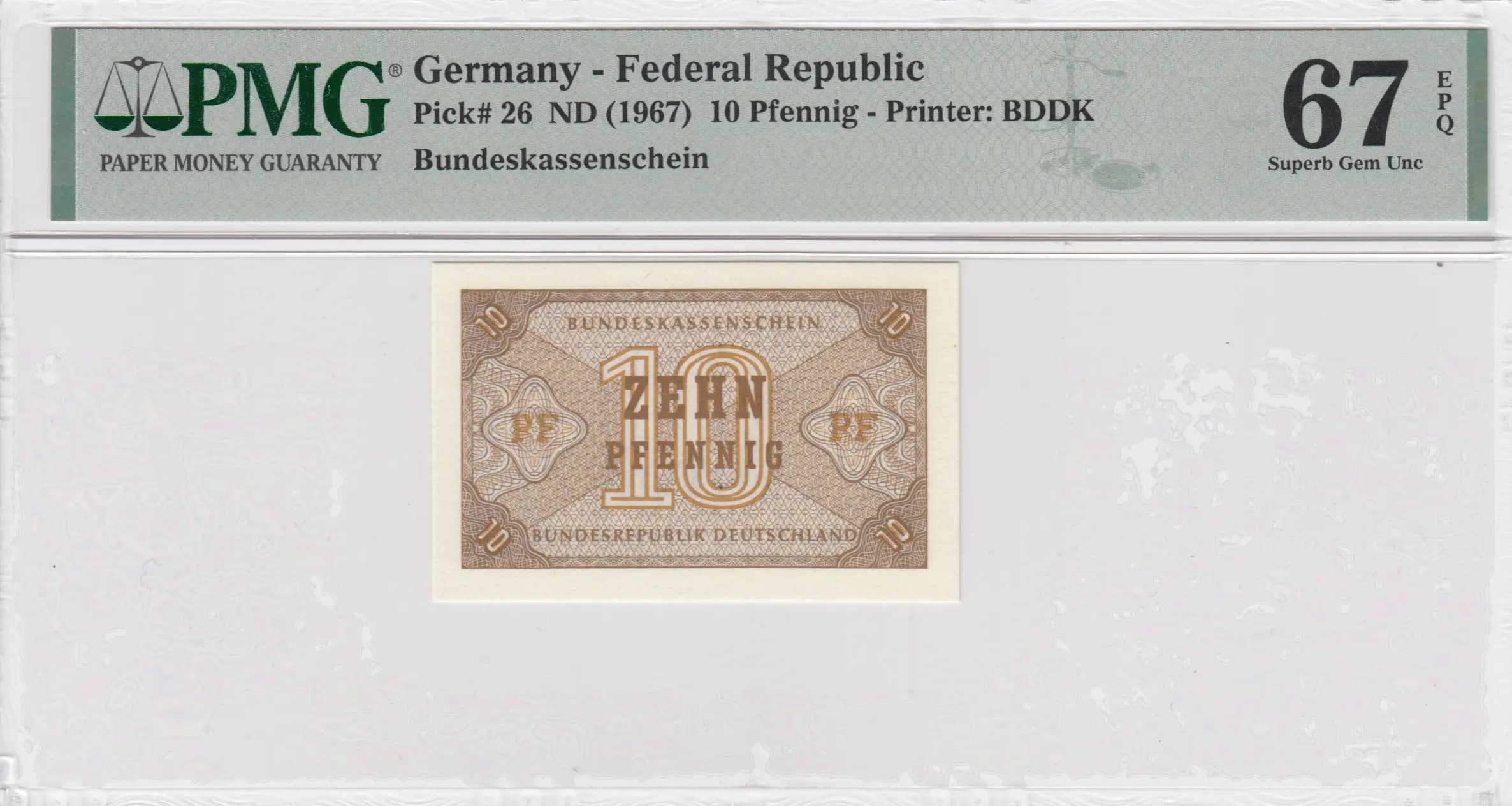
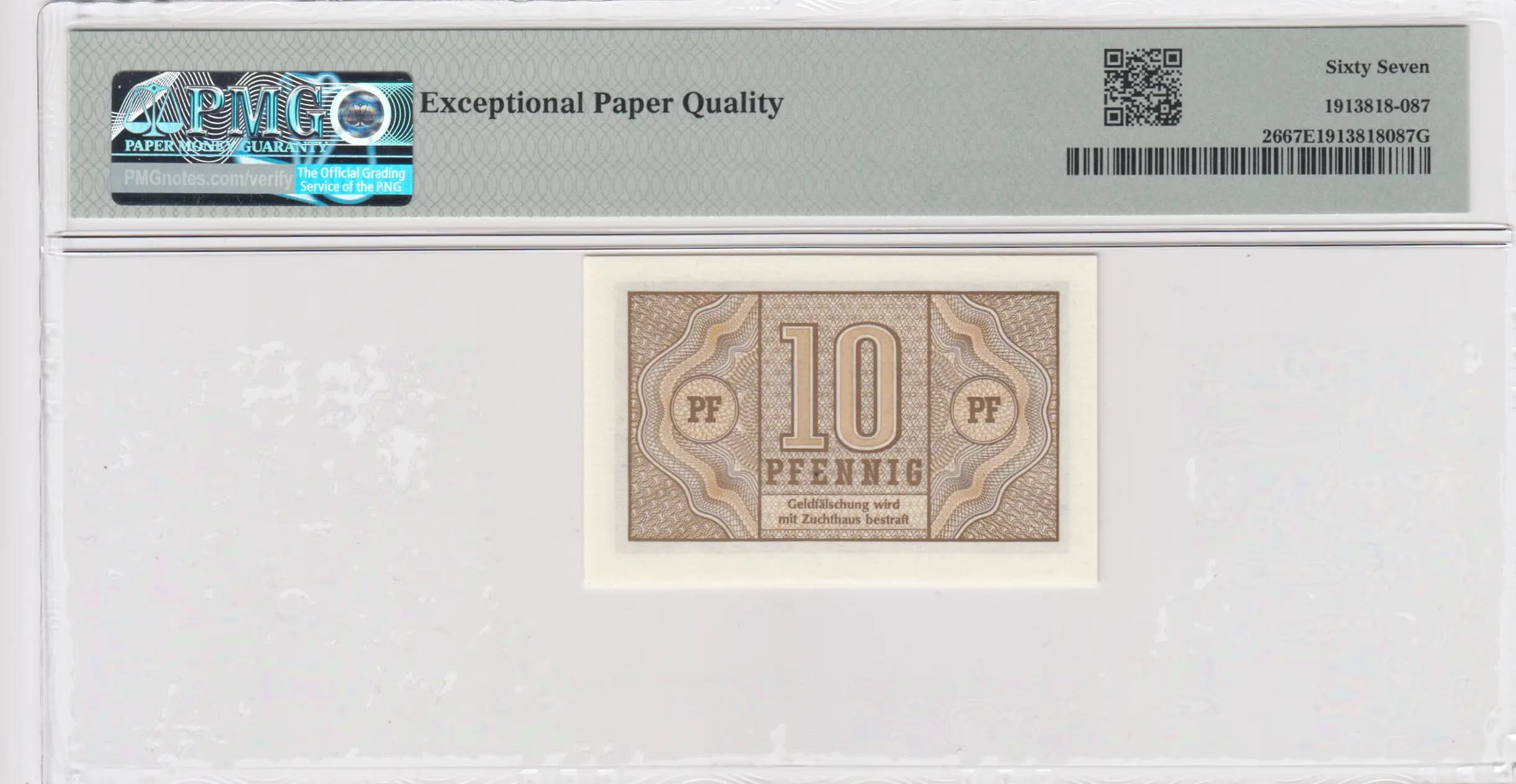
This is a pristine 10 Pfennig banknote from the Deutsche Bundesbank (West Germany), graded PMG 67 Superb Gem Uncirculated with Exceptional Paper Quality. The note displays exceptional eye appeal with sharp, crisp impressions throughout its ornate geometric design in warm brown and tan tones. This Bundesrepublik Deutschland treasury note represents the early post-war currency period and shows no signs of circulation, making it an excellent example of mid-1960s German monetary design.
Common. The 10 Pfennig denomination from the Deutsche Bundesbank was issued in large quantities throughout the 1960s as a standard circulating currency. While this specific Pick-26 note in PMG 67 condition represents an exceptionally well-preserved example (most circulated), the denomination itself was produced in high print runs and remains readily available to collectors. High-grade uncirculated examples command modest premiums, but the note is not scarce or rare in any meaningful numismatic sense.
Issued in 1967 by the Deutsche Bundesbank of the Federal Republic of Germany, this 10 Pfennig note was part of the post-World War II currency system that established West Germany's independent monetary identity. The 'BUNDESKASSENSCHEIN' (Federal Treasury Note) designation and 'BUNDESREPUBLIK DEUTSCHLAND' inscription reflect the young democratic state's assertion of sovereignty and financial independence during the Cold War era. The pfennig remained the standard currency unit of West Germany until the Deutsche Mark was introduced in 1948 and continued through the 1960s until eventual decimalization.
This 10 Pfennig note features a classical, austere design characteristic of early Bundesrepublik currency, emphasizing stability and legitimacy rather than pictorial elements. The front and back both present a large central denomination numeral '10' surrounded by intricate geometric line-work and ornamental borders in a quatrefoil pattern at the corners. The color scheme employs warm brown and tan tones with gray accents, creating a sophisticated yet utilitarian appearance befitting a low-denomination note. No portraits, historical figures, or landmarks appear on this design—instead, the security and aesthetic interest derive from the fine engraved geometric patterns and precise typography, reflecting post-war German design principles emphasizing order and technical excellence.
FRONT SIDE: 'BUNDESKASSENSCHEIN' (Federal Treasury Note) — identifying this as an official government-backed currency instrument; '10' and 'PFENNIG' (10 Pfennig) — denomination marking; 'BUNDESREPUBLIK DEUTSCHLAND' (Federal Republic of Germany) — issuing nation. BACK SIDE: '10' and 'PF' with 'PFENNIG' — reiterating denomination on reverse; 'Geldfälschung wird mit Zuchthaus bestraft' (Counterfeiting is punishable by imprisonment) — standard anti-counterfeiting warning required on German currency of this period.
This note was produced using intaglio (engraved) printing, the standard security printing method for Bundesbank currency of this era. The fine, detailed geometric line patterns visible throughout the design, the sharp clarity of denomination numerals, and the crisp impression of all text elements are characteristic of intaglio engraving. The German security printer for Bundesbank notes during the 1960s was typically Bundesdruckerei (Federal Print Office) or Giesecke+Devrient, both employing traditional intaglio techniques combined with anti-counterfeiting geometric and line-work security measures.
The 1967 date and Pick-26 catalog assignment indicate this is from the standard Bundesbank 10 Pfennig series. Varieties for this type may include different signature combinations (Bundesbank officials' signatures appear on these notes), different printing dates within the 1967 issue, or serial number prefix variations indicating different printing batches. The observed serial number on the PMG holder (1913818-087) represents this specific certificate number rather than the note's original serial. Without close examination of the note's serial number prefix and signature block visible in the image, specific variety determination would require additional inspection of those security elements.