5 mark 1960
About This Note
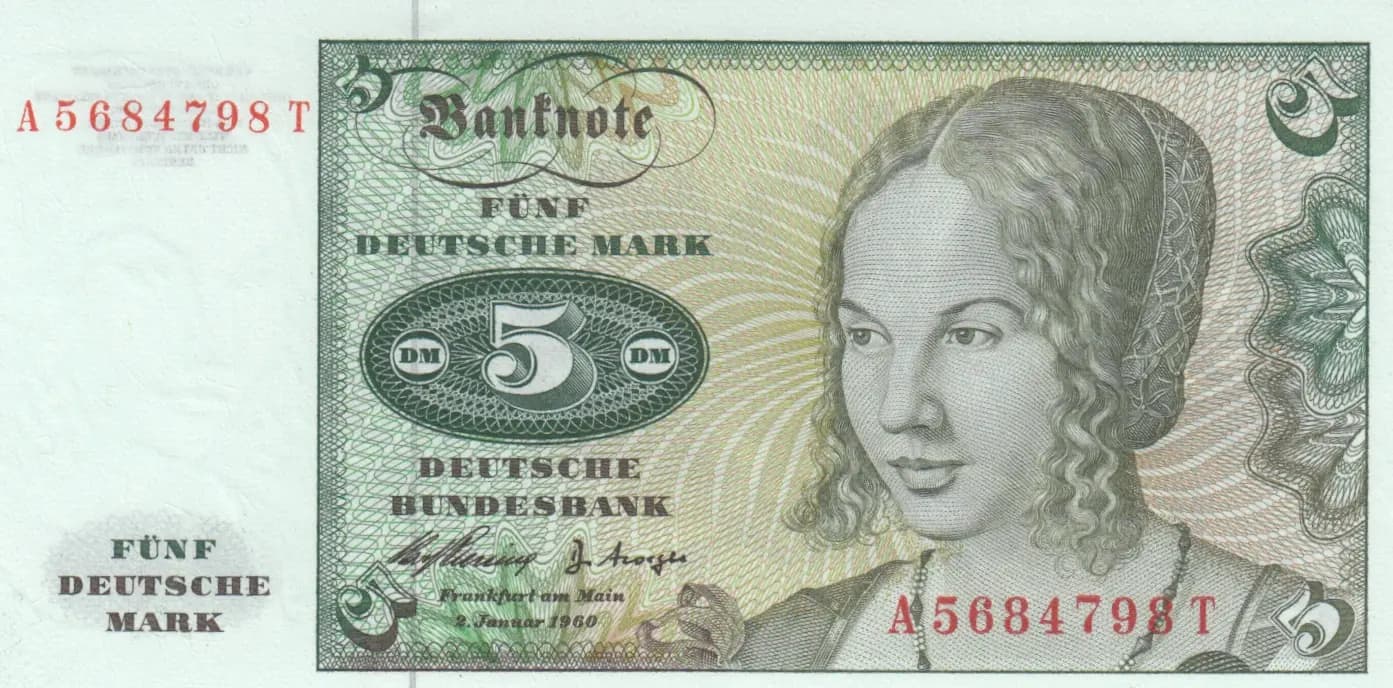
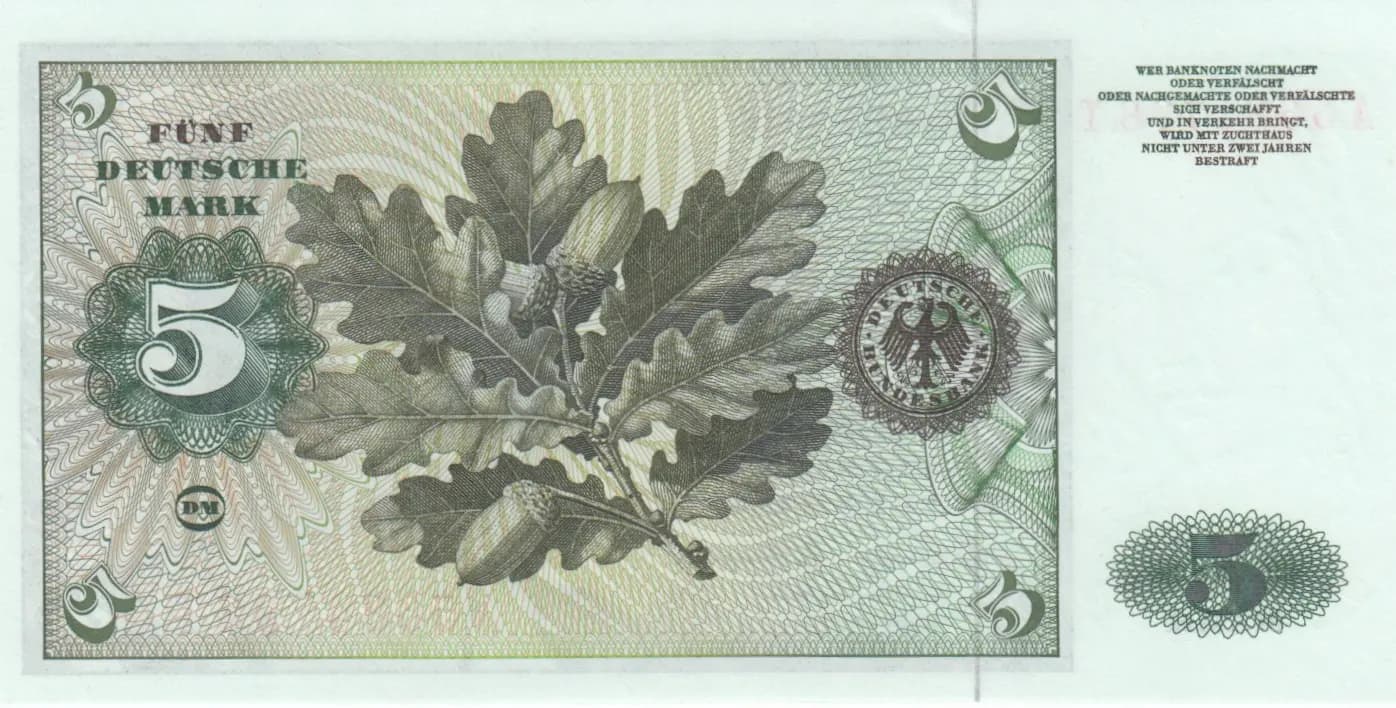
This is a 5 Deutsche Mark banknote from January 1960, issued by the Deutsche Bundesbank and graded UNC (uncirculated). The note features an elegant portrait of a young woman in three-quarter profile on the obverse, with the reverse displaying detailed botanical imagery of oak leaves and acorns. The exceptional condition, sharp engraving, and vibrant green-black color scheme make this a fine example of early Federal Republic currency design.
Common. The 5 Deutsche Mark banknote of 1960 (Pick P-18) was issued in large quantities by the Deutsche Bundesbank and remains readily available to collectors. No evidence of limited print runs, recalls, or scarcity factors is known for this denomination and date. Uncirculated examples such as this one, while always more desirable than circulated specimens, are not exceptionally difficult to acquire in the current market. Notes from this regular issue typically trade at modest premiums over face value.
Issued during the formative years of the Federal Republic of Germany (Bundesrepublik Deutschland), this 1960 banknote represents the economic stabilization and currency confidence of the post-war West German state under the Deutsche Bundesbank. The oak leaves and acorns depicted on the reverse symbolize German heritage and strength, while the portrait on the obverse reflects the refined aesthetic standards of mid-20th century German currency design. The Frankfurt am Main imprint denotes the seat of the Deutsche Bundesbank, emphasizing the institutional authority behind the currency.
The obverse features a portrait of a young woman with wavy, shoulder-length hair, depicted in three-quarter profile facing left, rendered in the classical style typical of mid-20th century European currency. The portrait is framed by ornate decorative scrollwork and filigree patterns characteristic of intaglio banknote design. The denomination is prominently displayed in multiple locations, including within an oval cartouche marked 'DM' and '5', and in large text reading 'FÜNF DEUTSCHE MARK'. A Federal eagle emblem (Bundesadler) appears in the lower right, representing the authority of the Federal Republic. The reverse showcases an elaborate botanical engraving of oak leaves and acorns, a traditional symbol of German strength and heritage, executed with meticulous detail. Ornamental numerals '5' in decorative frames appear alongside the eagle seal in a circular border. The dominant color scheme of green and black on a cream background was standard for Deutsche Bundesbank notes of this era.
{"front":{"inscriptions":[{"original":"DEUTSCHE BUNDESBANK","translation":"German Federal Bank"},{"original":"FÜNF DEUTSCHE MARK","translation":"Five German Marks"},{"original":"FÜNF","translation":"Five"},{"original":"DM","translation":"Deutsche Mark (currency abbreviation)"},{"original":"Frankfurt am Main","translation":"Frankfurt am Main (city of issuance)"},{"original":"Januar 1960","translation":"January 1960"},{"original":"A 5684798 T","translation":"Serial number"}]},"back":{"inscriptions":[{"original":"FÜNF DEUTSCHE MARK","translation":"Five German Marks"},{"original":"WER BANKNOTEN NACHMACHT ODER VERFÄLSCHT ODER VERFÄLSCHTE ODER VERFÄLSCHTE BANKNOTEN IN VERKEHR BRINGT, WIRD MIT ZUCHTHAUS NICHT UNTER ZWEI JAHREN BESTRAFT","translation":"Whoever counterfeits banknotes or forges them or brings forged or counterfeited banknotes into circulation will be punished with imprisonment of not less than two years"}]}}
Intaglio (copperplate/steel engraving), the standard security printing method for Deutsche Bundesbank banknotes. The fine line engraving patterns, intricate filigree work, and detailed botanical motifs visible throughout both sides are characteristic of high-quality intaglio production. The sharp, crisp impressions and complex background patterns indicate professional government security printing, likely produced by Bundesdruckerei (Federal Print Office) or other authorized German security printers contracted by the Deutsche Bundesbank.
This note is dated January 1960 (Januar 1960) and bears the serial number prefix 'A 5684798 T'. The 'A' prefix and letter suffix 'T' are consistent with early Deutsche Bundesbank series numbering. No major varieties (signatures, overprints, or significant design modifications) have been documented for the 5 DM 1960 issue. The portrait on the obverse is believed to represent a classical allegorical female figure rather than a historical personage, consistent with Deutsche Bundesbank design philosophy of the period.