20 mark 1970
About This Note
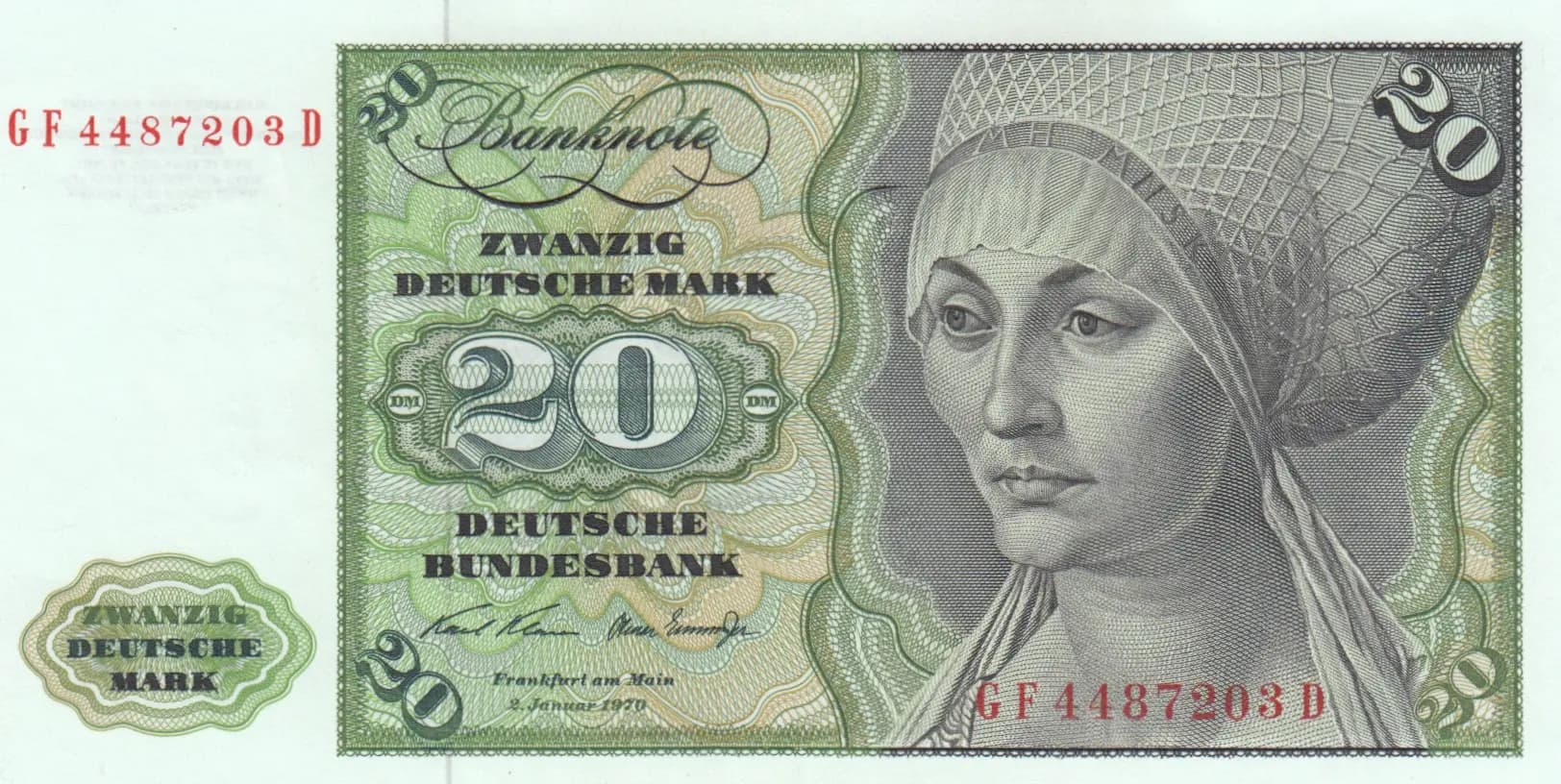
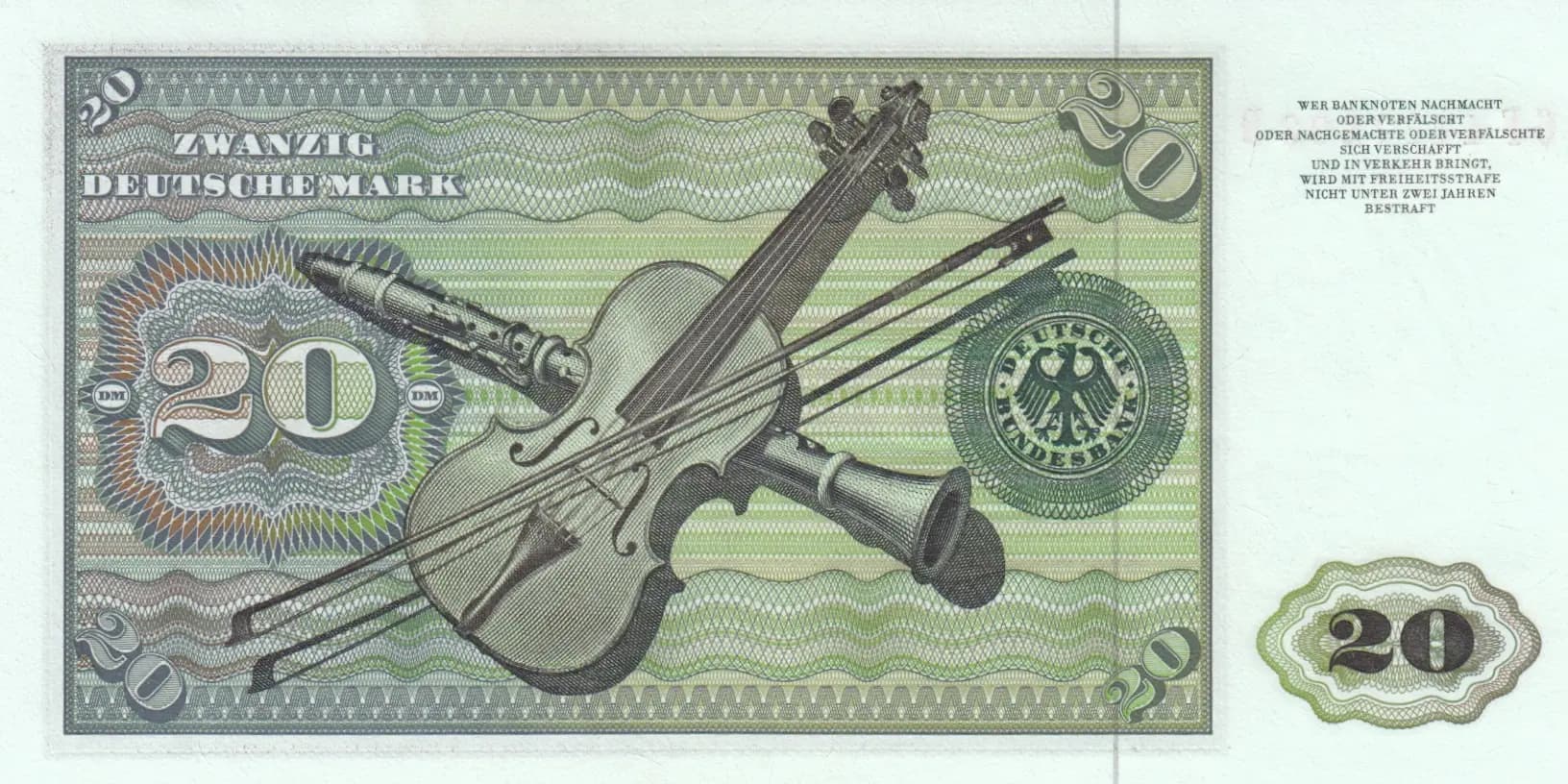
This is a pristine uncirculated specimen of the 1970 Deutsche Bundesbank 20 Deutsche Mark note (Pick P-32a(2)), displaying the distinctive green and beige color scheme characteristic of this series. The front features an elegant portrait of a woman in profile with period-appropriate styling and head covering, while the reverse showcases a beautifully engraved violin and bow as its central artistic element. The crisp printing, sharp registration, and complete absence of wear marks this as an exceptional example worthy of serious collectors of German Federal Republic currency.
Common. The 1970 20 Deutsche Mark notes were issued in substantial quantities by the Deutsche Bundesbank and remain readily available in the numismatic market. This particular Pick number (P-32a(2)) represents a standard production variety from a major currency system with no known scarcities, print run restrictions, or early recalls. Uncirculated examples are frequently encountered, indicating robust initial production and good survival rates due to the banknote's regular use in a stable economy.
Issued on 8 January 1970 by the Deutsche Bundesbank in Frankfurt am Main, this note represents the early post-war West German monetary system during a period of economic stability and cultural confidence. The selection of a violin as the reverse design reflects the high value placed on German cultural and musical heritage during this era, while the austere female portrait on the obverse embodies classical artistic traditions. The security text warning of severe imprisonment penalties for counterfeiting underscores the seriousness with which the West German authorities protected their currency during the Cold War period.
The obverse features a sophisticated portrait of a woman in three-quarter profile facing right, rendered in fine engraving style with long hair and a delicate head covering or veil characteristic of classical artistic representation. The denomination is presented in ornamental frames on the left side with the numeral '20' and spelled-out 'ZWANZIG,' surrounded by elaborate decorative borders featuring intricate geometric patterns and security line work. The reverse presents a meticulously engraved violin and bow as the central design element, symbolizing German cultural achievement and artistic excellence. A German Federal Eagle (Bundesadler) emblem appears in a circular seal on the right side of the reverse, representing state authority and sovereignty. The overall composition employs symmetrical ornamental frames containing denomination markers and complex anti-counterfeiting patterns throughout.
FRONT SIDE: '20' (denomination), 'ZWANZIG' (Twenty), 'DEUTSCHE MARK' (German Mark), 'DEUTSCHE BUNDESBANK' (German Federal Bank), 'Frankfurt am Main' (city of issue), '8. Januar 1970' (8 January 1970), 'GF4487203D' (serial number). BACK SIDE: '20' and 'ZWANZIG DEUTSCHE MARK' (Twenty German Mark, repeated left and right), 'WER BANKNOTEN NACHMACHT ODER VERFÄLSCHT ODER NACHGEMACHTE ODER VERFÄLSCHTE BANKNOTEN IN VERKEHR BRINGT, WIRD MIT FREIHEITSSTRAFE NICHT UNTER ZWEI JAHREN BESTRAFT' (Whoever counterfeits banknotes or falsifies them or puts counterfeit or falsified banknotes into circulation shall be punished with imprisonment for not less than two years).
Intaglio engraving (copperplate/steel plate printing), the standard security printing method for Deutsche Bundesbank notes of this era. The intricate line work, fine cross-hatching, detailed ornamental patterns, and sharp registration visible throughout indicate the high-security printing standards maintained by the Bundesbank's authorized security printer. The depth and precision of the engraved lines, particularly visible in the portrait work and decorative borders, confirm the use of traditional intaglio methodology rather than lithography.
The serial number prefix 'GF' and date of 8 January 1970 are consistent with early production of this series. The Pick catalog designation P-32a(2) indicates this is the second sub-variety of the basic 1970 design type, likely distinguished by signature combinations or minor design elements. The letter prefix 'GF' on the serial number may relate to a specific printing facility or batch designation. No overprints or extraordinary markings are evident on the observed specimen.