5000 mark 1922
Market Prices
6 salesAbout This Note
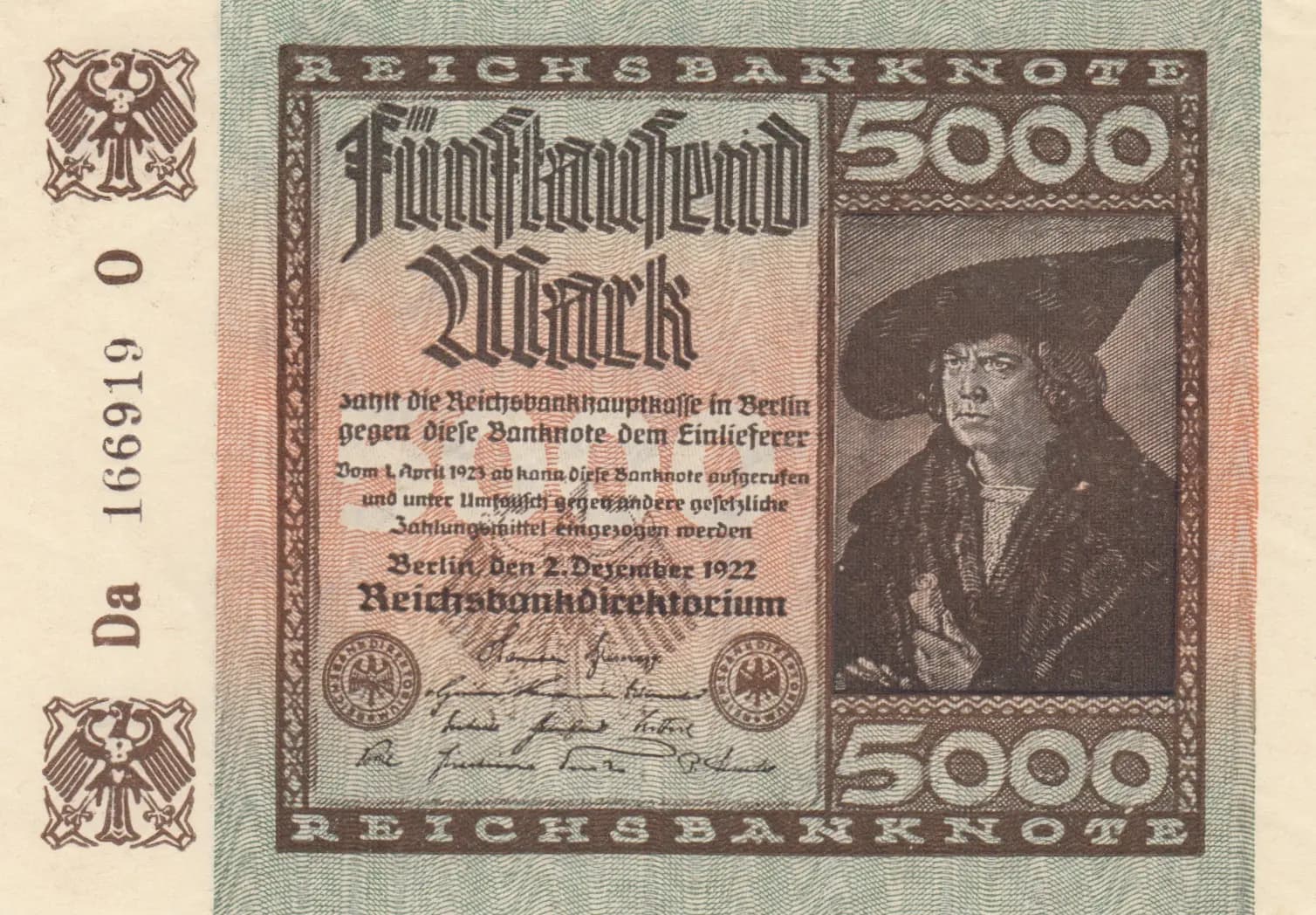
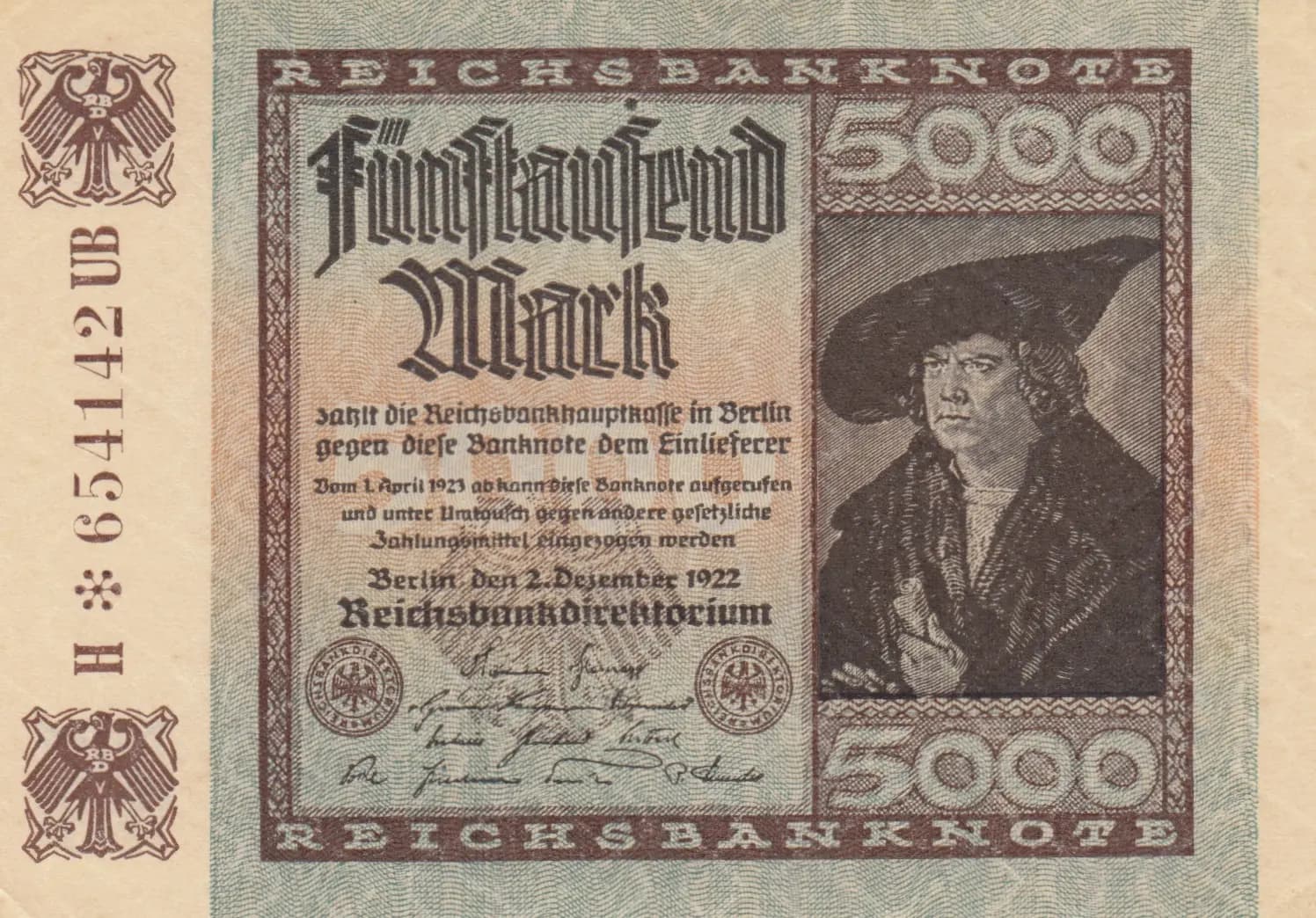
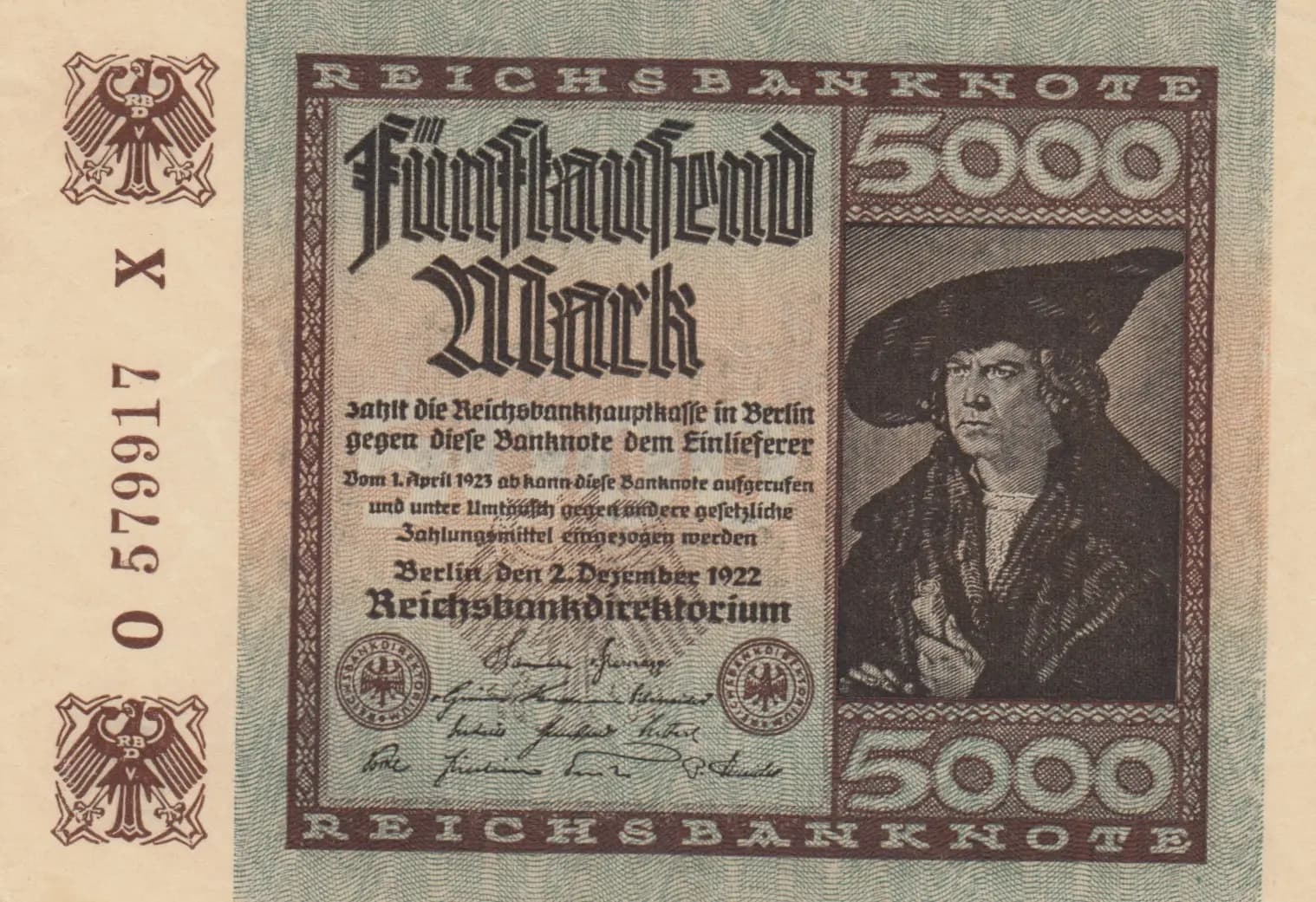
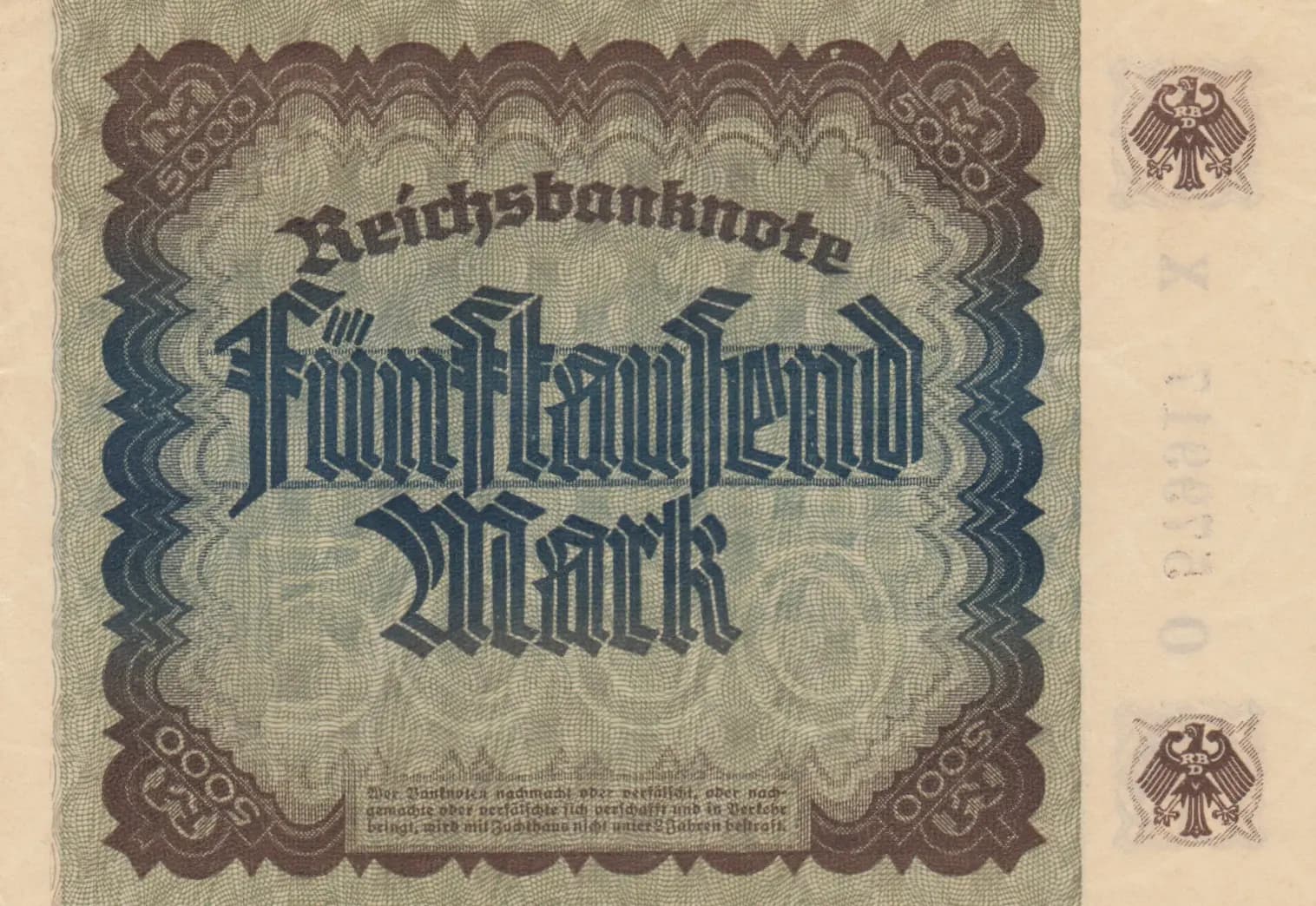
This is a German Reichsbanknote for 5000 Mark issued on December 2, 1922, during the hyperinflation period of the Weimar Republic. The note presents in AU (About Uncirculated) condition with sharp printing, clean margins, and no visible circulation wear. The front features a classical portrait of merchant Hans Imhof after a Dürer engraving, positioned at right with the denomination prominently displayed in the corners, while the reverse showcases elaborate Gothic-style typography and ornamental borders characteristic of high-denomination German currency of this era.
Common. Despite its historical significance and the dramatic economic context of its issuance, this note remains common in the collector market. The eBay price tracking data shows consistent sales in the $25-$40 range for PMG 65-66 graded examples, with catalog values at $5-$10 for VF-UNC condition as of 2016. Print runs for this denomination during 1922 were substantial, and many examples survive today. The AU grade specimen offered here would be expected to command prices in line with recent eBay sales ($30-$40), placing it firmly in the common category despite its collectible appeal.
This note was issued during the catastrophic hyperinflation of 1922-1923 that devastated the German economy following World War I and the Treaty of Versailles reparations. The dated issuance of December 2, 1922, places it during the final months before the introduction of the Rentenmark in November 1923, making these high-denomination notes a direct artifact of economic collapse. The classical portraiture of Hans Imhof—a Renaissance merchant depicted by Dürer—ironically contrasts with the note's rapidly-depreciating value and the warning notice on the reverse indicating potential currency recall after April 1, 1923.
The obverse features a three-quarter profile portrait of Hans Imhof, a Renaissance merchant, rendered in the classical style of Albrecht Dürer's original engraving, positioned at the right margin wearing period-appropriate clothing including a distinctive wide-brimmed hat. The note employs a brown, green, and light brown color scheme with cream/beige underprinting. The German Imperial Eagle (Reichsadler) with shield appears on the left margin, serving as the official state symbol. The denomination '5000' is prominently displayed in both upper right and lower right corners. The reverse presents a more austere design dominated by large Gothic-style typography spelling 'Fünftausend Mark' in the center field, with the Reichsadler repeated on the right margin. Both sides feature fine line guilloche background patterns and ornate decorative borders with repeating geometric patterns, providing intricate security printing. Circular seal impressions appear at the bottom of the central design area on the obverse and at corners on the reverse.
FRONT: 'REICHSBANKNOTE' (Reichsbank Note); 'Fünftausend Mark' (Five Thousand Mark); '5000' (denomination in numerals); 'zahlbar die Reichsbankhautkasse in Berlin gegen diese Banknote dem Einlieferer' (Payable at the Reichsbank central office in Berlin against this banknote to the depositor); 'Vom 1. April 1923 ab können diese Banknote aufgerufen und unter Umständlich gesetzlich Zahlungsmittel eingezogen werden' (From April 1, 1923 onwards, these banknotes may be called in and under certain circumstances may be withdrawn as legal tender); 'Berlin, den 2. Dezember 1922' (Berlin, December 2, 1922); 'Reichsbankdirektorium' (Reichsbank Board of Directors); 'X 1667 59617' (serial number). BACK: 'Reichsbanknote' (Reichsbank Note); 'Fünftausend Mark' (Five Thousand Mark); '5000' (denomination numerals, appears twice); 'Wer Banknote nachgemacht oder verfälscht, oder nachgemachte oder verfälschte Banknote weitergeben, in den Verkehr bringt, wird nach geltendem Strafgesetzbuch mit Gefängnis bis zu 2 Jahren und (oder) mit Geldstrafe bis zu 200,000 Mark bestraft.' (Whoever counterfeits or falsifies banknotes, or distributes or puts counterfeit or falsified banknotes into circulation, shall be punished according to the applicable criminal code with imprisonment of up to 2 years and/or with a fine of up to 200,000 Mark).
This note was produced using traditional intaglio (engraved) printing combined with letterpress typography, characteristic of high-security Reichsbank notes from this period. The fine line guilloche patterns, detailed portraiture, and complex border designs indicate the work of skilled security printers. The Reichsbank notes of 1922 were produced by the Reichsbank's own printing facilities in Berlin under strict security protocols. The layered color printing (brown, green, and cream underprints) demonstrates multi-pass printing technique typical of premium currency production of the Weimar era.
This note is Pick catalog P-81c, specifically the December 2, 1922 dated issue with the Reichsbank Board of Directors signatures. The serial number visible on the example (X 1667 59617) shows the standard letter-number format used during this issue. Known varieties of this denomination relate to signature combinations and minor date variations within the 1922 issuance. The 'X' prefix on the serial number indicates this particular printing batch. No major known varieties with significant premium value have been documented for this Pick number in standard references.