5000 mark 1922
Market Prices
7 salesAbout This Note
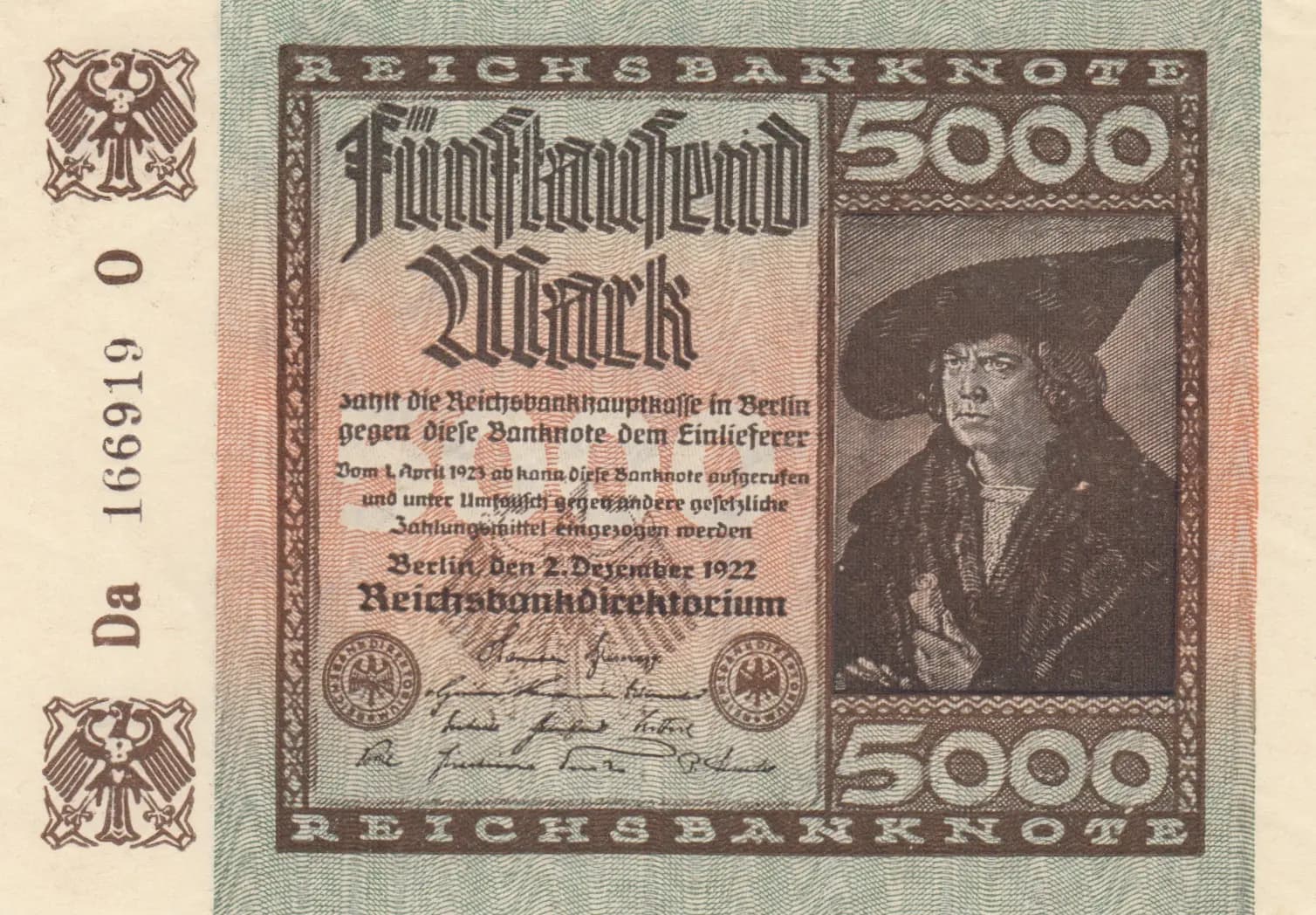
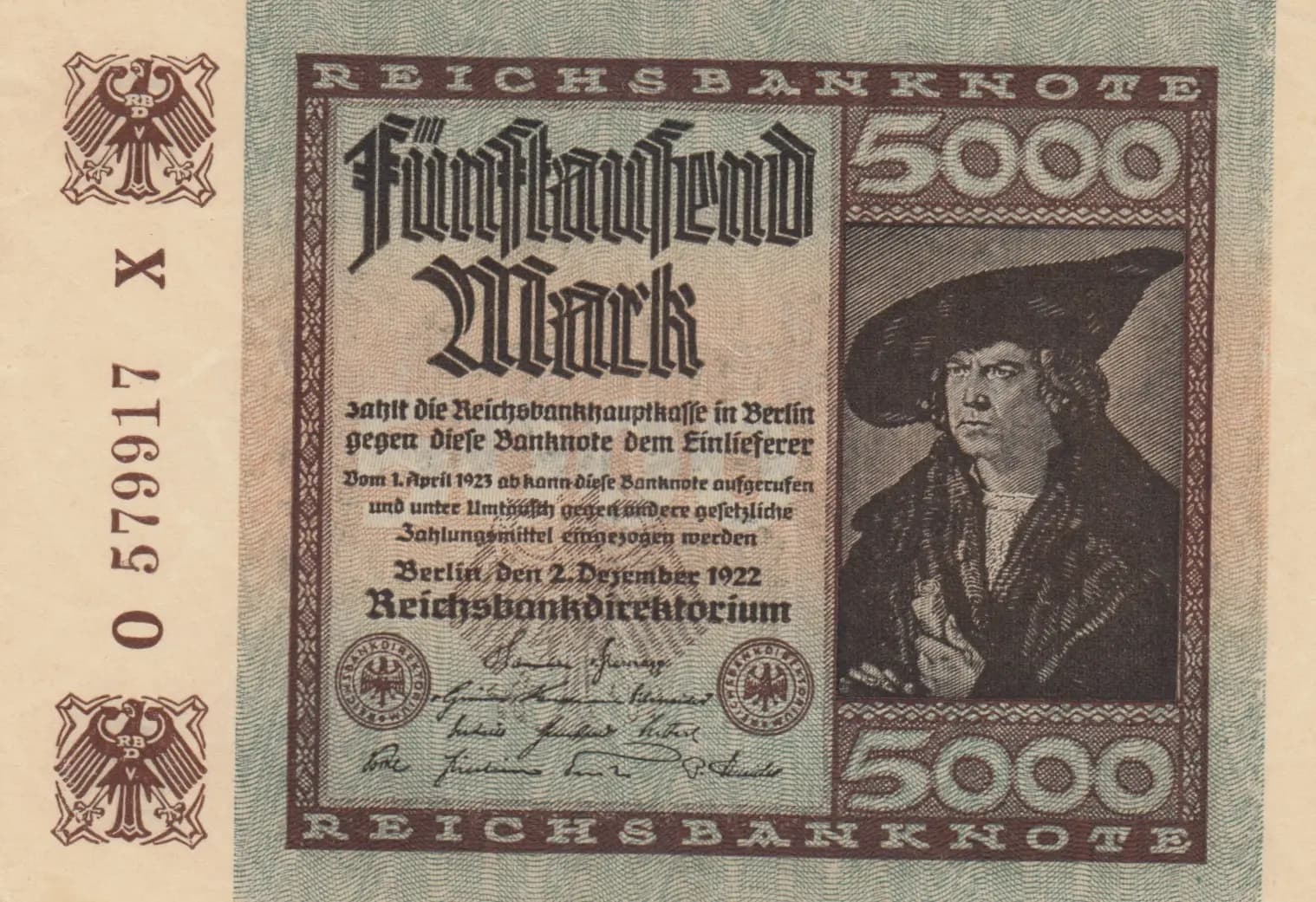
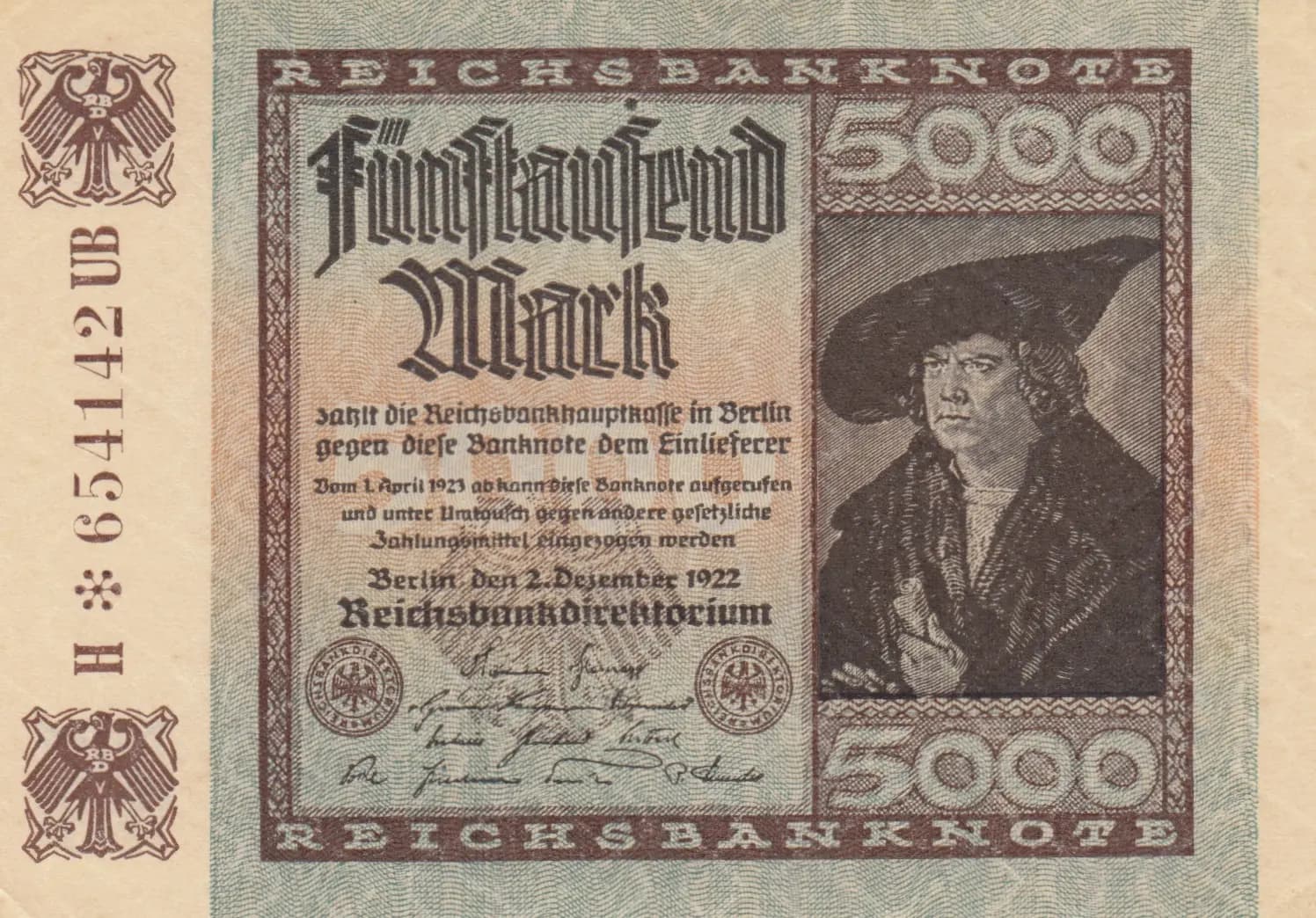
This German 5000 Mark banknote from December 2, 1922, represents an exceptional example of Weimar-era currency during the hyperinflation period. The note exhibits AU condition with no visible creases, tears, or significant wear, displaying crisp margins and clean surfaces consistent with light circulation or storage. The ornate design featuring the portrait of merchant Hans Imhof after Albrecht Dürer, combined with intricate guilloche security patterns in brown and green tones, exemplifies the high-quality engraving standards maintained by the Reichsbank even as currency values collapsed.
Common. This is a regular-issue Reichsbank note from a high-denomination hyperinflation series with substantial print runs. The eBay pricing data provided shows historical sales ranging from $1.51 to $355 depending on condition and grading service, with most uncertified examples in EF or VF condition selling for $2–$7.50. Even PMG-graded AU examples have sold for under $50 in recent sales, indicating steady availability in the collector market. The 1922 5000 Mark is not a short-run variety or recall issue; it circulated widely before currency reform and remains readily obtainable for collectors.
Issued during the height of German hyperinflation in late 1922, this 5000 Mark note reflects the Reichsbank's desperate attempt to maintain currency stability through increasingly high denominations. The December 2, 1922 date places this note just weeks before the complete monetary collapse of 1923, when the Reichsmark would become virtually worthless; the printed notice on the front indicating the note could be called in from April 1, 1923 onwards demonstrates the issuing authority's awareness of impending currency reform. The choice to feature a Renaissance merchant portrait by the old master Dürer invoked German cultural heritage and economic tradition during a period of acute national financial crisis.
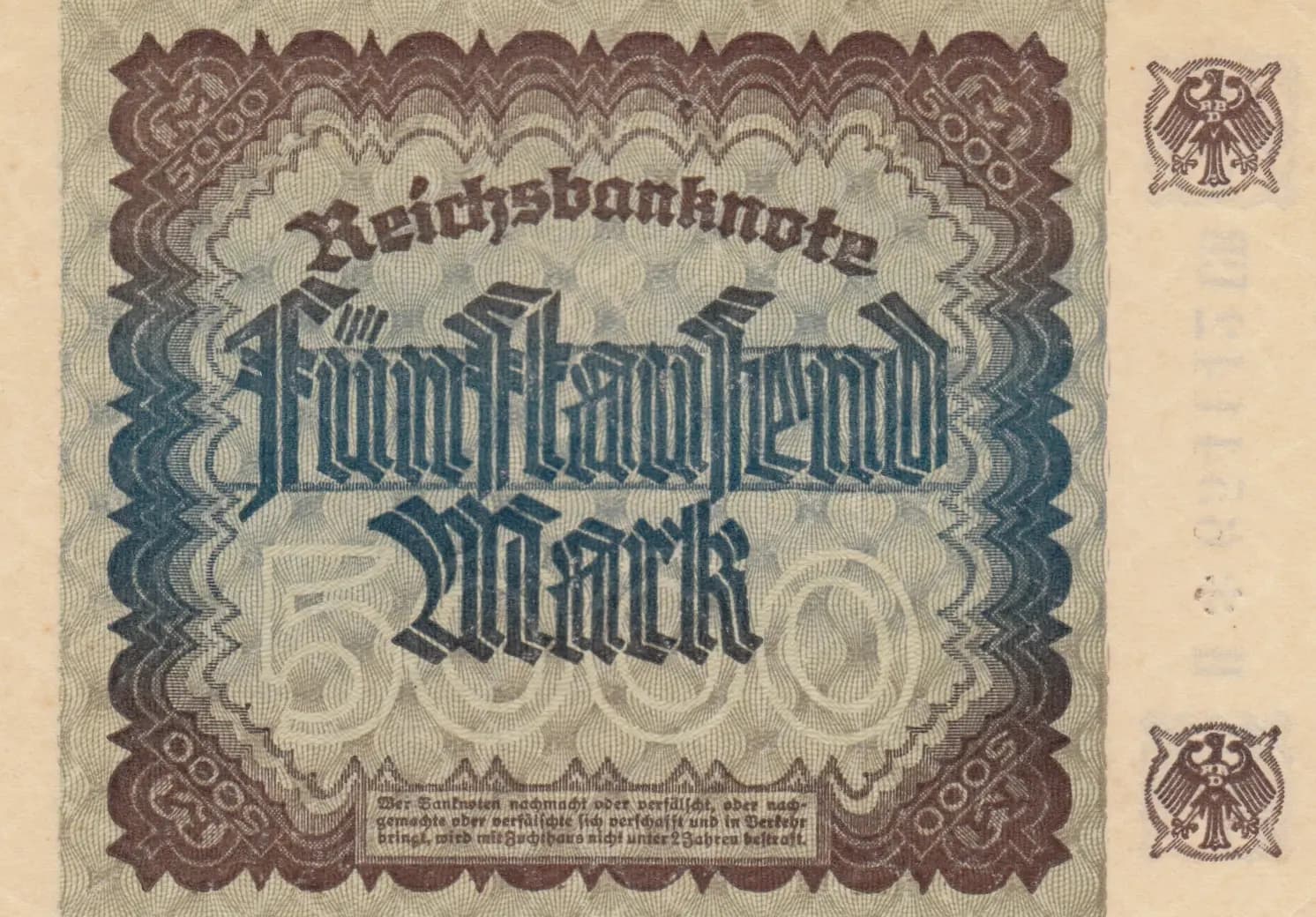
The obverse features a three-quarter right-facing portrait of Hans Imhof, a 16th-century merchant, rendered in the style of Albrecht Dürer's original engraving. Imhof is depicted wearing a wide-brimmed hat and period costume consistent with Renaissance merchant dress. The portrait is positioned on the right side of the note, while the center displays the denomination 'Fünftausend Mark' in bold gothic lettering, flanked by numerals '5000' above and below. The left margin contains the Reichsbank eagle emblem (appearing twice) and vertical text elements. Both sides employ ornate decorative borders featuring intricate guilloche patterns and geometric designs in brown and green on cream underprint. The reverse continues the decorative theme with an elaborate ornamental frame surrounding the central denomination text, with additional eagle emblems positioned in the upper and lower right areas. Circular seals appear at the bottom center of the obverse.
FRONT: 'REICHSBANKNOTE' (Reich Bank Note); 'Fünftausend Mark' (Five Thousand Mark); '5000' (denomination in numerals); 'damit die Reichsbankhauptkaße in Berlin gegen diese Banknote dem Einlieferer' (so that the Reichsbank main office in Berlin against this banknote to the depositor); 'Vom 1.April 1923 ab kann diese Banknote aufgerufen und unter Umlauf gegen andere gesetzliche Zahlungsmittel einzogoen werden' (From April 1, 1923 onwards, this banknote can be called in and withdrawn from circulation against other legal tender); 'Berlin, Den 2. Dezember 1922' (Berlin, December 2, 1922); 'Reichsbankdirektorium' (Reichsbank Directorate); Serial number 'H * 654142 UB'. BACK: 'Reichsbanknote' (Reich Bank Note); 'Fünftausend Mark' (Five Thousand Mark); Warning text regarding stolen or counterfeit notes and legal penalties for circulation.
Intaglio (copperplate) engraving, the standard security printing method for Reichsbank notes of this period. The fine line engraving work, intricate guilloche patterns, and precise geometric designs visible throughout are characteristic of high-security intaglio production. Multiple printing passes in brown and green inks over a cream underprint create the layered color effect observed. The Reichsbank employed Germany's finest security printers during this era; this note was likely produced by either Reichsdruckerei (the official state printing works) or a licensed private security printer under Reichsbank supervision.
This example carries the serial number H * 654142 UB, with 'H' as the series prefix letter. Varieties of the 1922 5000 Mark are primarily distinguished by: (1) serial number prefix letters (A through Z), which may show differing print run allocations; (2) signature varieties of the Reichsbankdirektorium officials (though signatures are often not clearly visible on hyperinflation notes due to printing speed and quality control issues); and (3) subtle differences in watermark clarity (lattice with 'G' watermark noted in reference data). Pick P-81b specifically denotes the standard 1922 issue as opposed to earlier 1919-1920 issues of the same denomination (P-81 and P-81a). No overprints or special markings are noted on this specimen.