50 000 mark 1922
Market Prices
30 salesAbout This Note
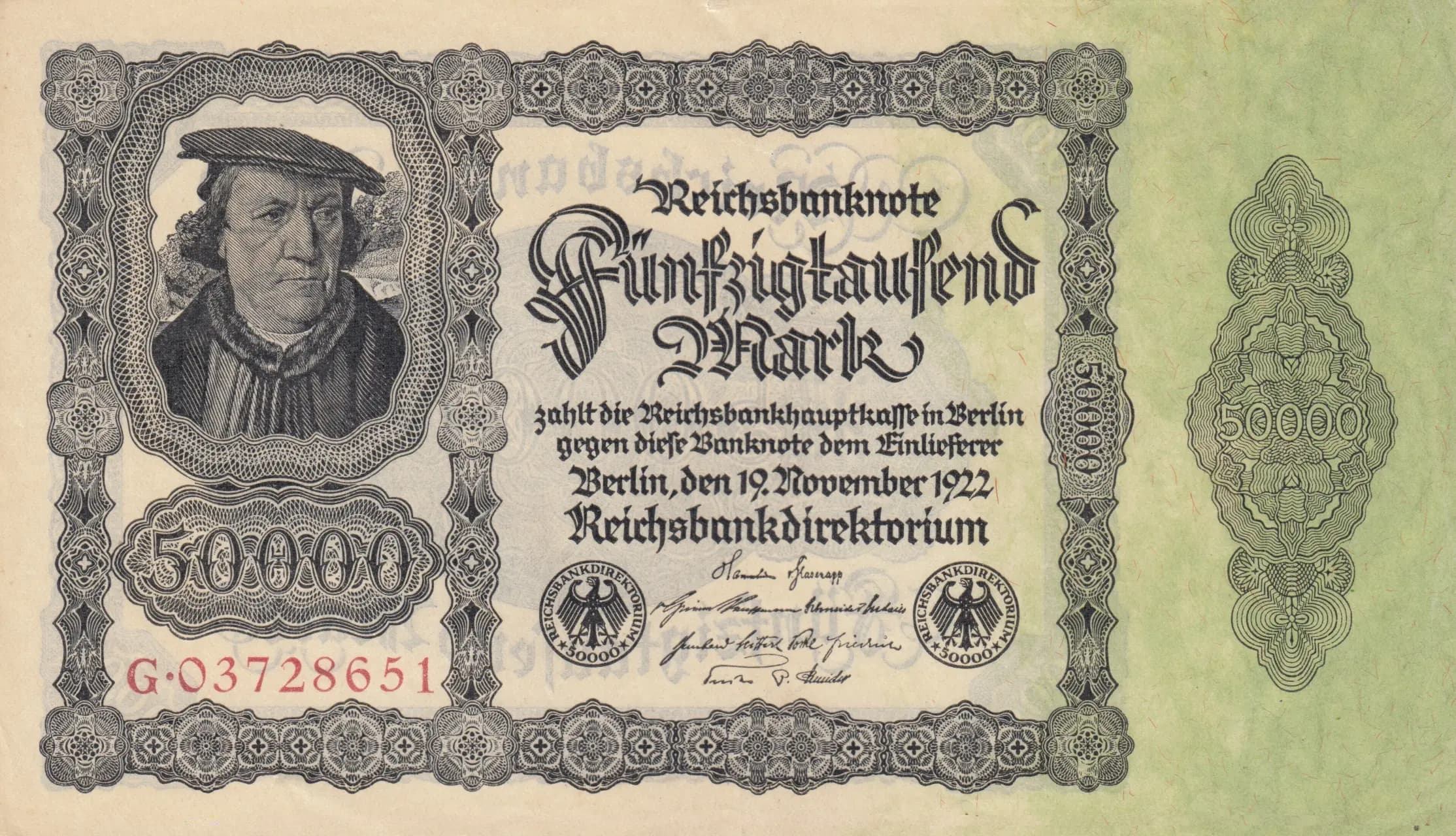
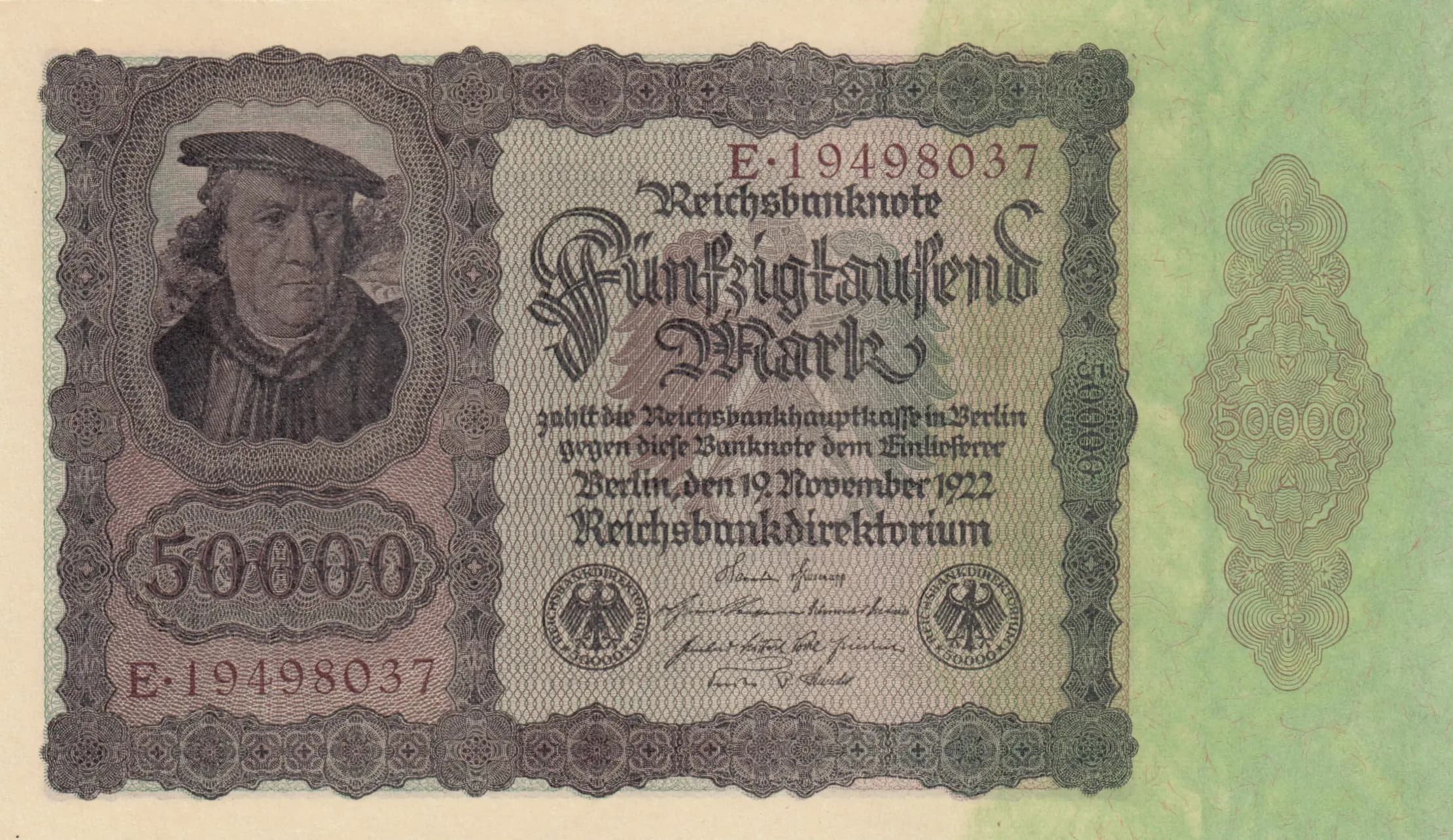
This is a remarkable example of the German Reichsbank's 50,000 Mark note from November 19, 1922, issued during the height of the Weimar hyperinflation crisis. The note presents in pristine uncirculated condition with sharp printing throughout, featuring an elegant portrait of Bürgermeister Brauweiler rendered in dark tones against a cream background with sophisticated ornamental borders. The exceptional preservation and the historical significance of this denomination—representing the exponential currency devaluation occurring in 1922—make this a notable specimen for collectors of Weimar-era currency.
Common. Despite its historical importance during hyperinflation, this denomination was issued in large quantities as the Reichsbank struggled to meet demand for cash during the currency crisis. eBay market data confirms common status, with numerous sales across multiple grades ranging from $1.75 to $51, with UNC examples typically selling between $25-$44. The wide availability of examples in all conditions and consistent low-to-moderate pricing indicate this is a frequently encountered note in the numismatic market.
Issued on November 19, 1922, this note represents a critical moment in German monetary history, as the Reichsbank was forced to issue increasingly larger denominations due to runaway inflation following World War I. The date itself is historically significant, occurring just days before the worst phase of hyperinflation would accelerate dramatically through 1923. The formal design, with its dignified portrait and ornate Germanic artistic elements, reflects the Reichsbank's attempt to maintain confidence in the currency despite its rapidly deteriorating real value.
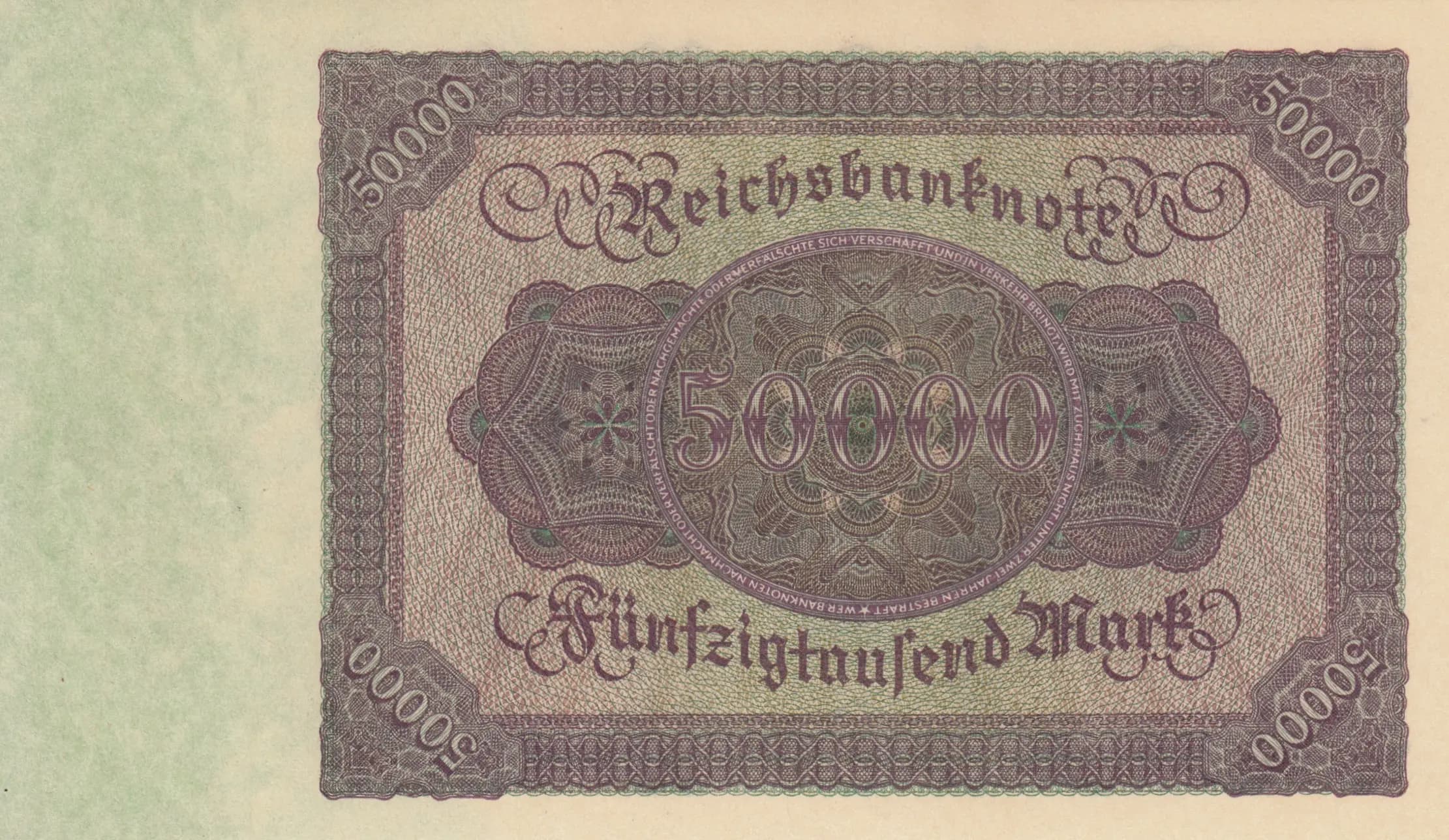
The obverse features a left-facing profile portrait of Bürgermeister (Mayor) Brauweiler, rendered by artist B. Bruyn, depicted as a bearded man wearing a flat cap and period Renaissance-style clothing, positioned in the upper left quadrant. The portrait is rendered in dark brown tones with an underprint beneath it. The reverse displays a prominent ornate numeral '50000' centered within an elaborate oval decorative cartouche. Both sides feature intricate Gothic-style geometric and floral border patterns forming frames around the design elements, with repeated shield-like rosettes and corner ornaments typical of high-security Reichsbank note design. The pale cream/beige background with dark gray and purple-brown printing creates strong visual contrast characteristic of Reichsbank denominations from this period.
FRONT: 'Reichsbanknote' (Reichsbank Note); 'Fünfzigtausend Mark' (Fifty Thousand Mark); 'Berlin, den 19. November 1922' (Berlin, November 19, 1922); 'Zweiter Reichsbankhauptasse in Berlin gegen diese Banknote dem Einlieferer' (The Second Reichsbank headquarters in Berlin will exchange this banknote to the depositor); 'Reichsbankdirektorium' (Reichsbank Directorate); Serial number 'E19498037' (appears twice). BACK: 'Reichsbanknote' (Reichsbank Note); 'Fünfzigtausend Mark' (Fifty Thousand Mark); Large numeral denominations '50000' displayed multiple times in corners and central oval cartouche.
This note employs intaglio (recess) printing, the standard security printing method for German Reichsbank currency, evidenced by the exceptionally fine line work visible in the filigree borders, the portrait's subtle tonal gradations, and the sharp definition of ornamental elements. The complex geometric security patterns and the precision of the double serial numbers indicate advanced security printing capabilities. The Reichsbank contracted with specialized security printers (typically Giesecke+Devrient or Reichsdruckerei for denominations of this significance) for production.
This is Pick P-80, specifically identified by the presence of the eagle underprint on the front, distinguishing it from P-79 (the similar note without underprint, also from November 19, 1922). The serial number prefix 'E' and the date of November 19, 1922 are consistent with standard issue characteristics. No signature varieties or significant printing variations are documented for this Pick number. The specimen exhibits the standard design characteristics with no known rarity variants.