50 000 mark 1922
Market Prices
63 salesAbout This Note
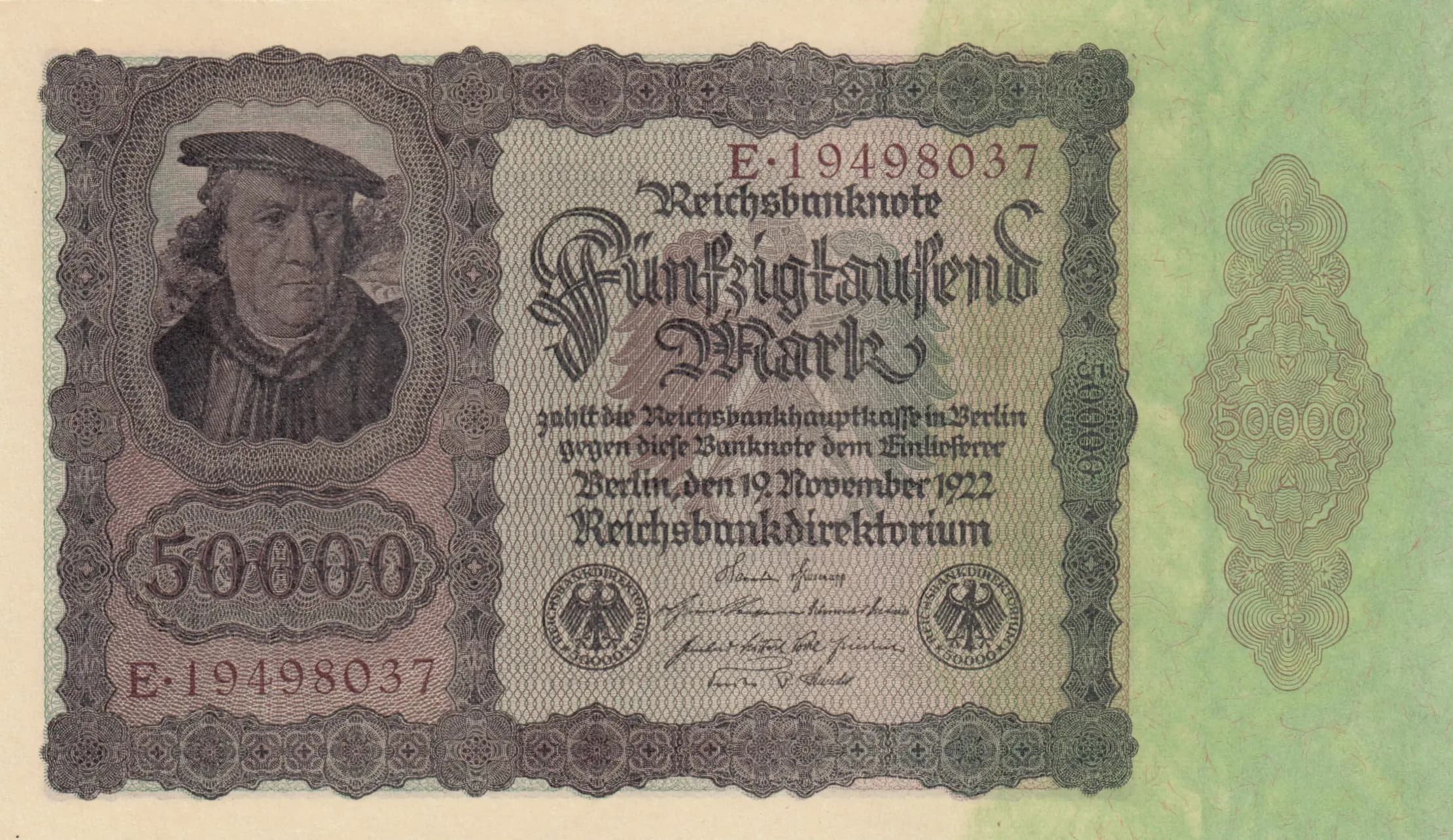
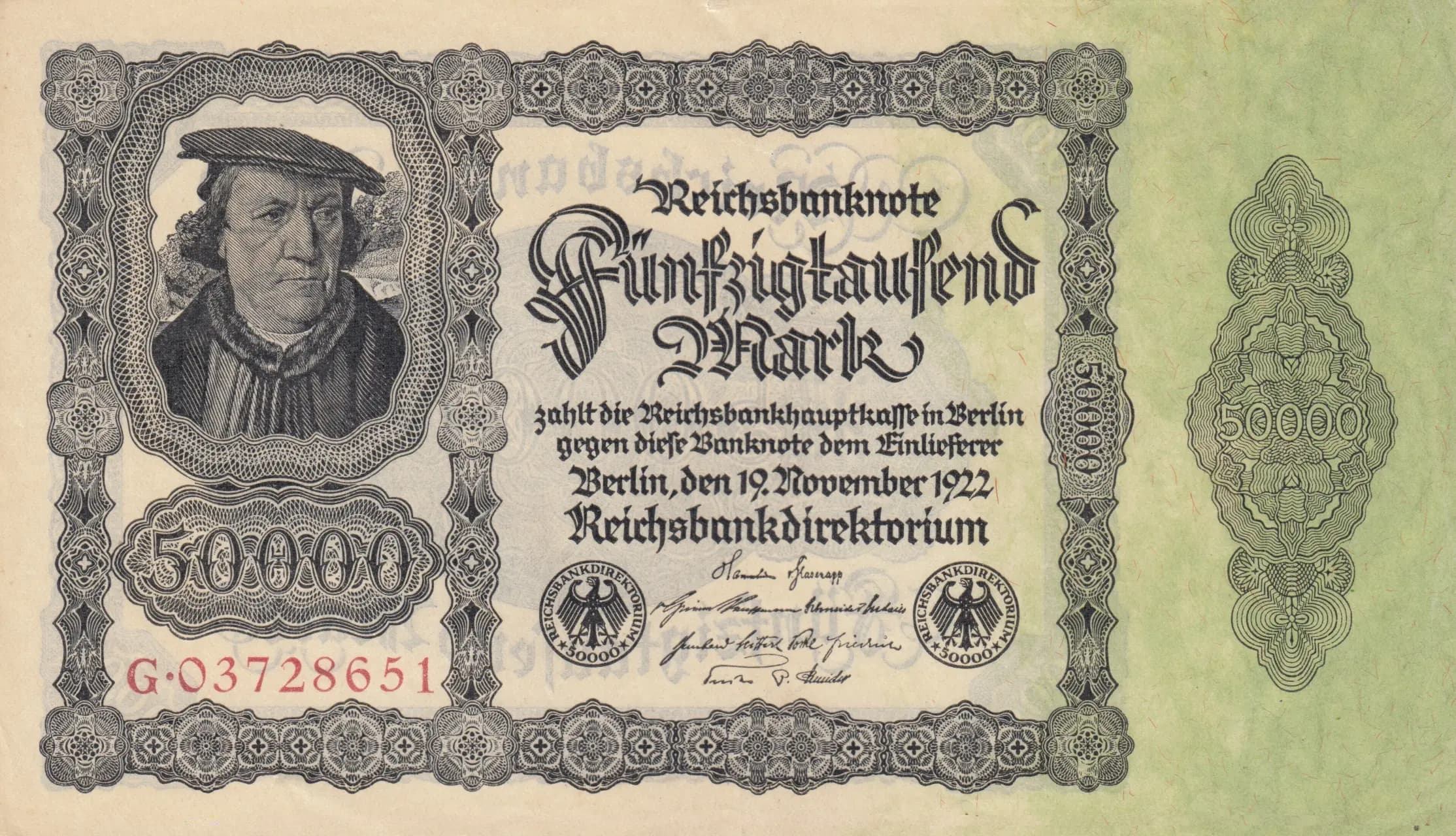
This German Reichsbank 50,000 Mark note from November 19, 1922 represents a fascinating artifact of the hyperinflation era, featuring an ornate portrait of Bürgermeister (Mayor) Brauweiler by artist B. Bruyn within an elaborate Renaissance-inspired frame. The note exhibits the characteristic cream-colored paper with green tinting typical of this issue, displaying age-appropriate wear including foxing and light yellowing consistent with a note over 100 years old, yet remaining structurally intact. As a P-79 variant without underprint, this is a significant hyperinflation-period currency that captures the economic chaos of Weimar Germany through its exceptionally high denomination.
Common. Despite being from the hyperinflation period, this denomination and date were produced in substantial quantities by the Reichsbank. eBay market data confirms common status, with comparable notes consistently selling in the $1-$10 range for standard circulated grades (VF condition averaging $2-$5), and even higher-grade PMG specimens (65-67) typically selling between $30-$75. The large print runs characteristic of emergency currency issues during hyperinflation, combined with the abundance of surviving examples in the market, establish this as a common note in numismatic terms.
Issued during the peak of German hyperinflation in November 1922, this 50,000 Mark note reflects the rapid collapse of the Reichsmark's value in the post-World War I period. The Reichsbank's dignified design—featuring a historical Renaissance-era figure rather than contemporary political imagery—was typical of this period's attempt to convey stability and tradition amid economic catastrophe. Within months of this note's issue date, denominations would reach astronomical levels, making this note a crucial historical document of one of history's most severe currency crises.
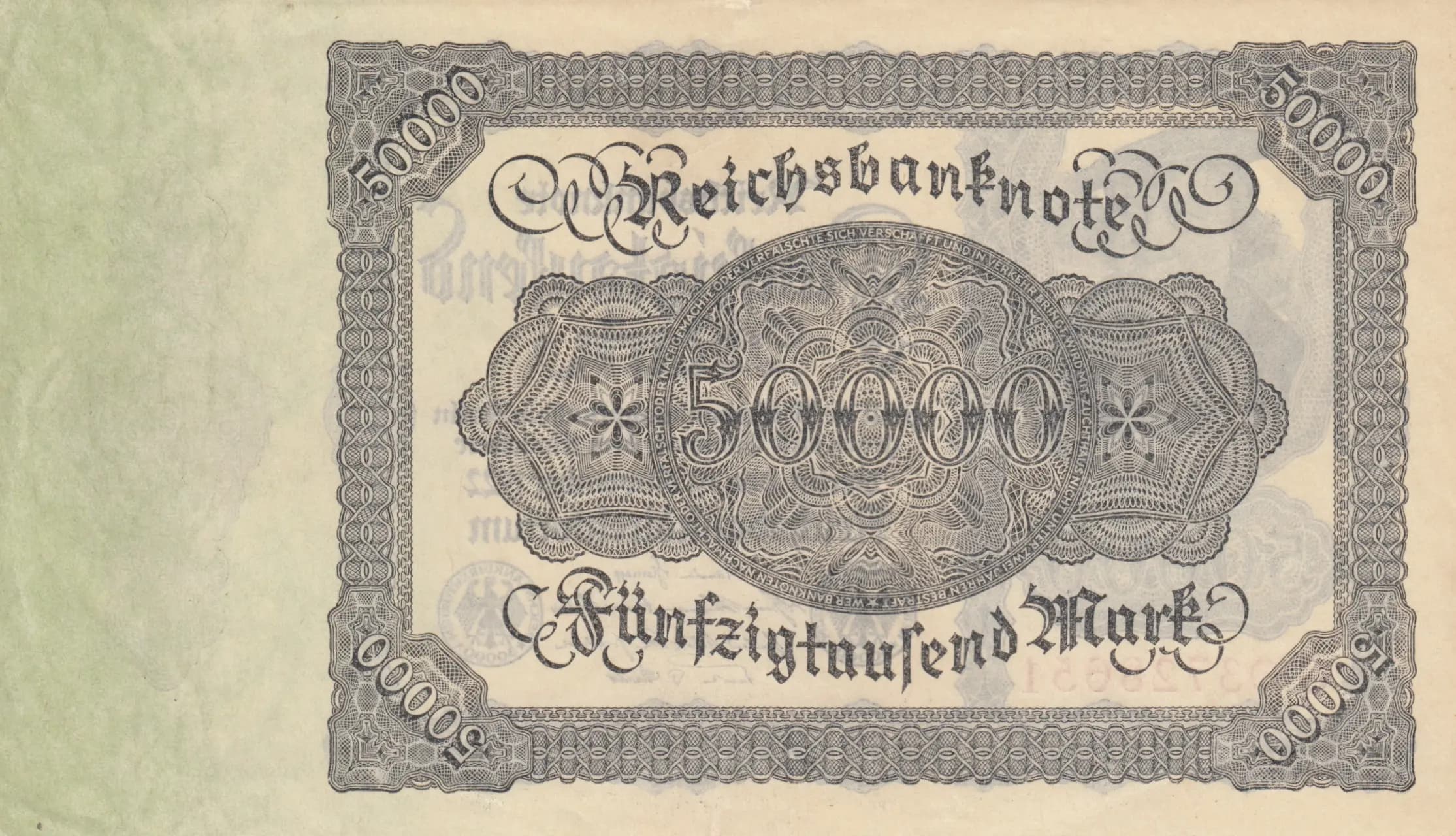
The obverse features a three-quarter portrait of Bürgermeister Brauweiler, depicted as a bearded Renaissance-era figure wearing period-appropriate clothing and a distinctive hat, rendered by artist B. Bruyn. The portrait is set within an elaborate rectangular frame of complex geometric and floral ornamentation, characteristic of early 20th-century security printing. The reverse displays the denomination prominently within a decorative rosette or shield-shaped frame at center, surrounded by geometric border patterns and ornamental corner designs. Two circular seals bearing eagle emblems (Reichsbank directorate marks) appear on the obverse. The entire design employs fine-line engraving techniques across both sides, with the predominant color scheme of black ink on cream paper with green tinting at the right margin—a security feature of the period.
FRONT: 'Reichsbanknote' (Reichsbank Note); 'Fünfzigtausend Mark' (Fifty Thousand Mark); 'zahlt die Reichsbankhautpkasse in Berlin gegen diese Banknote dem Einlieferer Berlin, den 19. November 1922' (The Reichsbank main office in Berlin pays against this banknote to the depositor in Berlin, on November 19, 1922); 'Reichsbankdirektorium' (Reichsbank Directorate); Serial number 'G.0372,6651'. BACK: 'Reichsbanknote' (Reichsbank Note); '500000' (Five hundred thousand); 'Fünfzigtausend Mark' (Fifty Thousand Mark).
Intaglio (engraved) printing, evidenced by the fine line work, intricate ornamental borders, and precise geometric patterns visible throughout both sides. The complex portrait rendering and multi-layered decorative frames are characteristic of high-security intaglio production. The crisp detail preservation in the ornamental elements and the depth of the black ink indicate professional security printing, consistent with Reichsbank standards of the period. No underprint is present on the front, distinguishing this as Pick P-79 variant (in contrast to P-80 which includes an eagle underprint).
This note is cataloged as Pick P-79, specifically identified as the variant WITHOUT underprint on the front. The closely related Pick P-80 represents the same note with an eagle underprint on the obverse—a distinguishing feature that creates a separate catalogue entry. Serial number G.0372,6651 is visible but does not indicate a notable printing variety; serial number prefixes and ranges for this issue are not documented as collecting varieties in standard references. The date (19 November 1922) is fixed for this denomination and is not variable.