20 000 mark 1923
Market Prices
17 salesAbout This Note
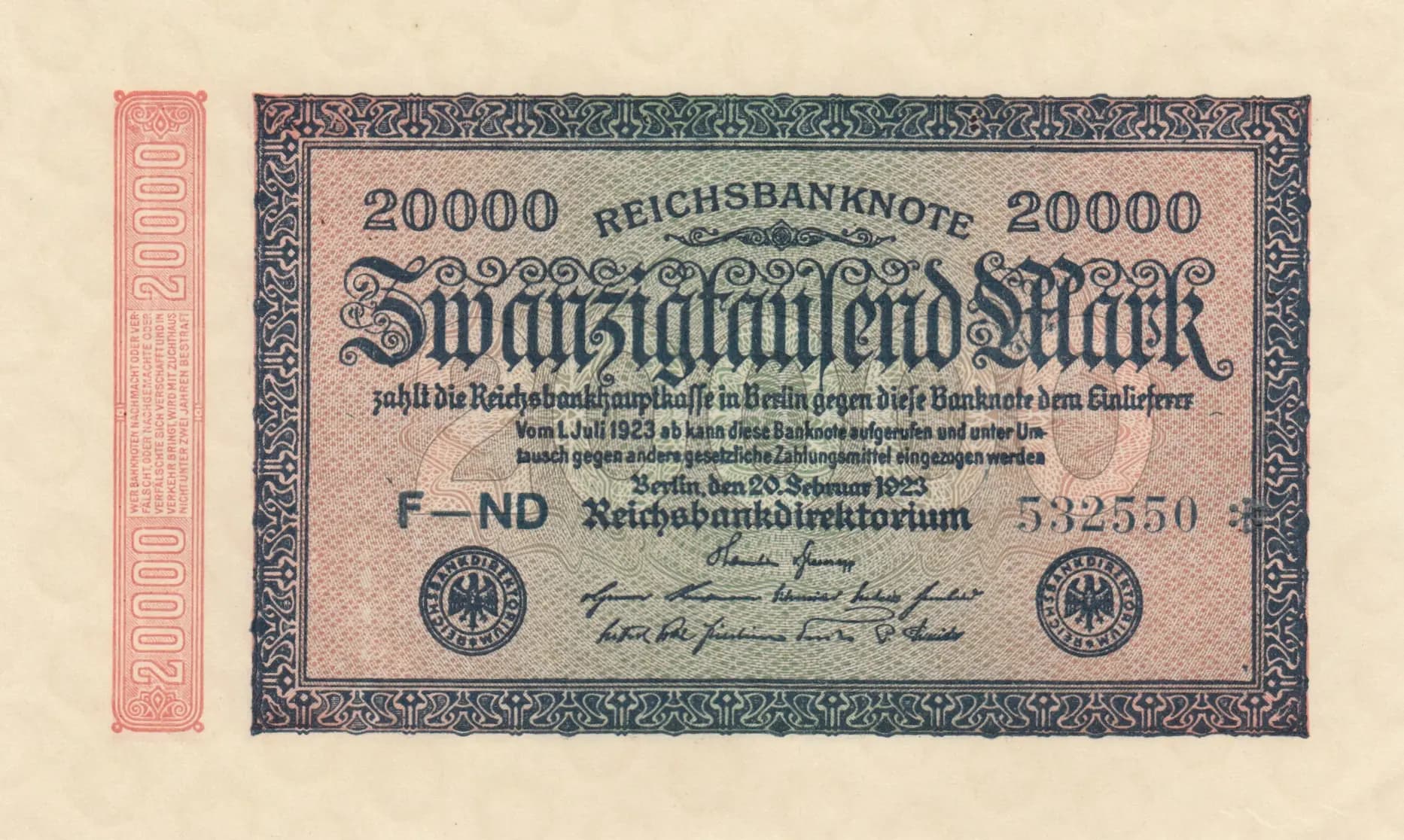
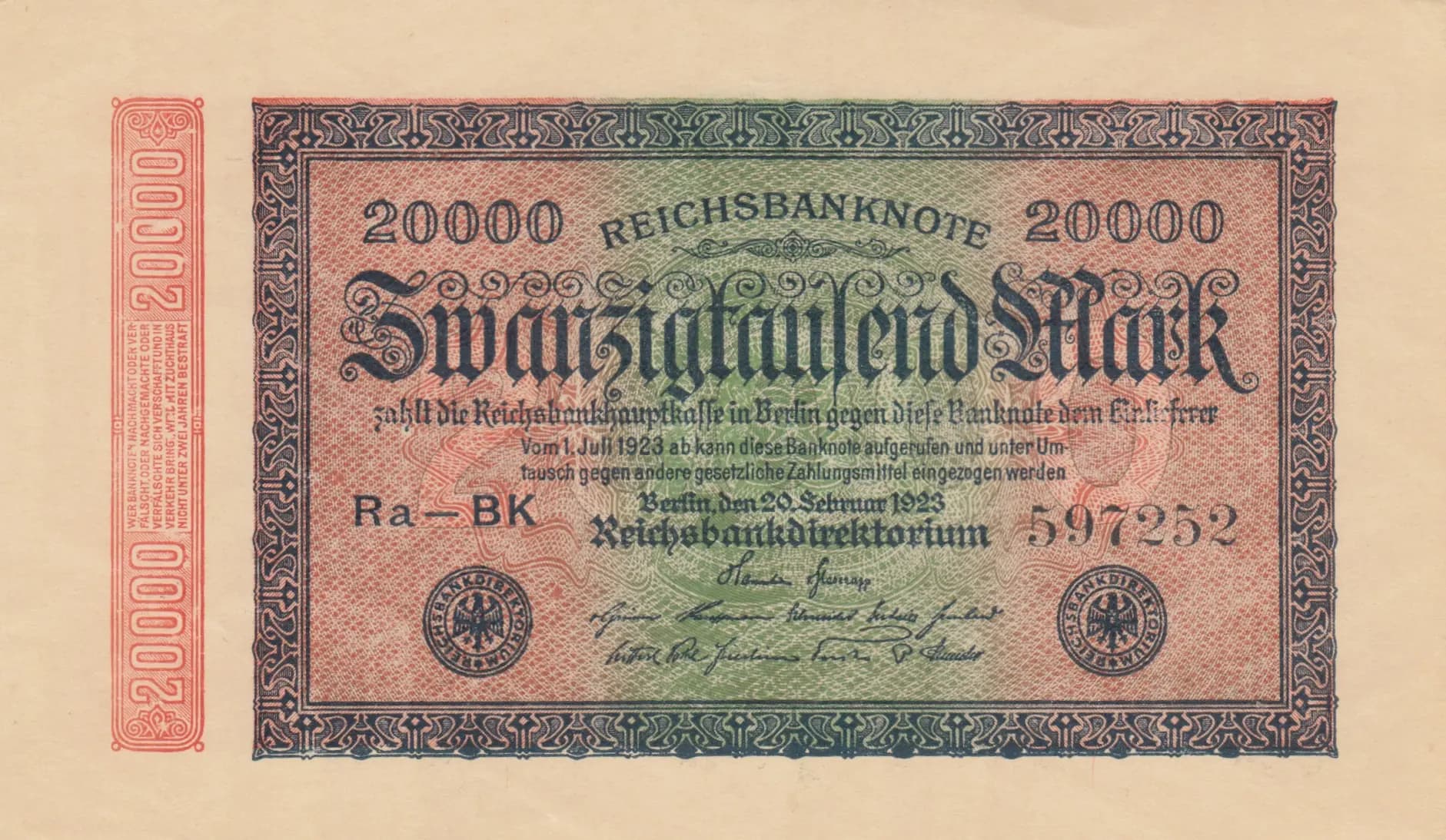
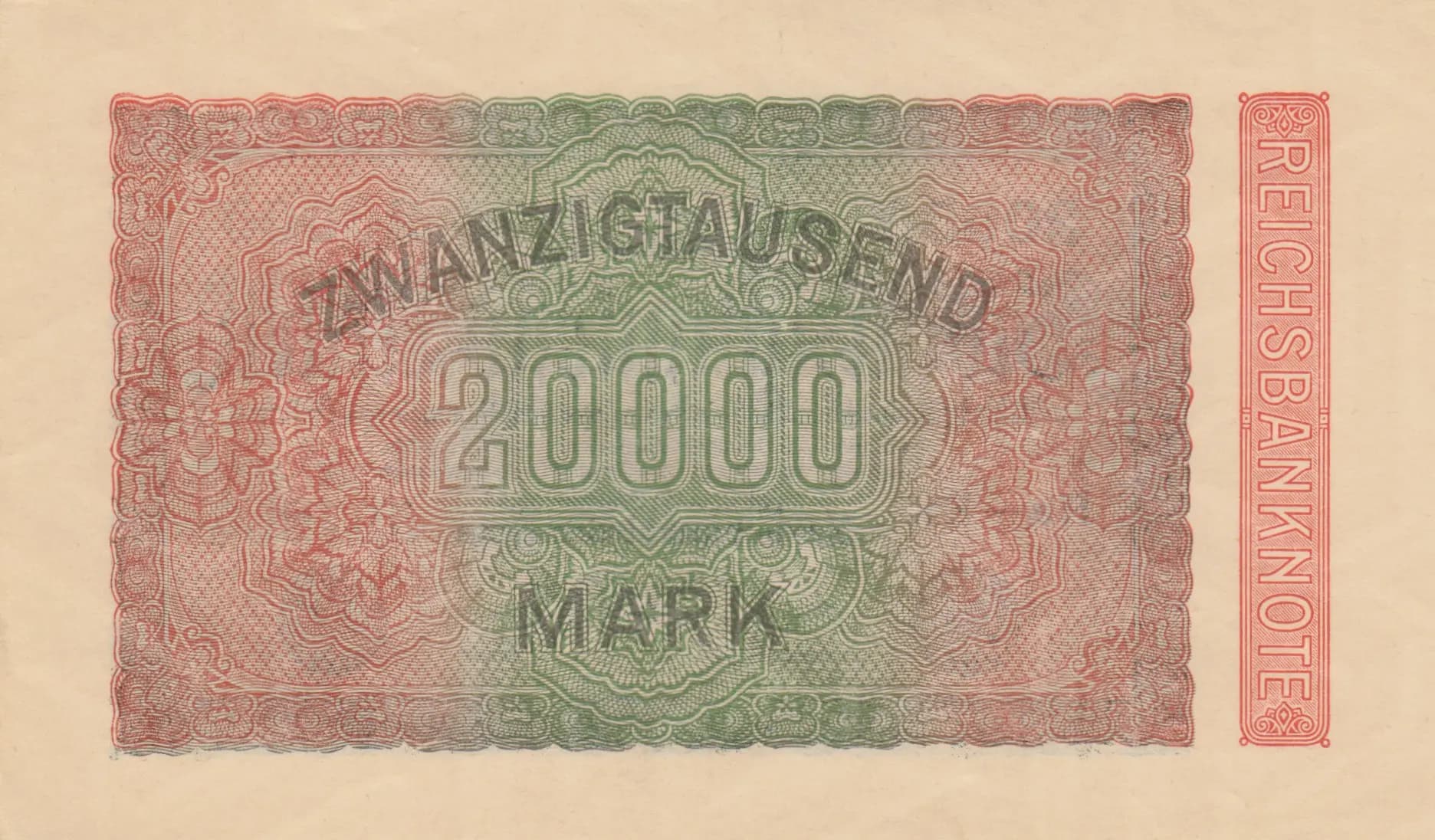
This is a German 20,000 Mark Reichsbanknote from September 20, 1923, issued during the height of the Weimar hyperinflation crisis. The note displays exceptional condition consistent with AU (About Uncirculated) grade, with pristine paper, sharp printing, and no visible wear, creasing, or foxing. The elaborate geometric and floral security patterns in pink, green, and navy dominate both sides, reflecting the Reichsbank's efforts to combat counterfeiting during this economically turbulent period.
Common. This denomination was produced in large quantities during the hyperinflation period, and eBay market data confirms widespread availability at modest prices ($6–$44 depending on grade, with most sales under $20). The AU specimens regularly appear on the market, and the 2016 catalog valuation of $17 for UNC condition further supports common status. While historically significant, these notes were printed by the millions and remain abundant in collections.
This note was issued on September 20, 1923, near the climax of German hyperinflation when the Mark had become nearly worthless against foreign currencies. The Reichsbanknote bears an inscription dated July 1, 1923, warning that the note could be recalled and exchanged for other legal tender, reflecting the monetary instability of the Weimar Republic. The denomination of 20,000 Mark—astronomical by pre-war standards—exemplifies how rapidly the currency deteriorated, with even larger denominations (up to 100 trillion Mark) being printed before the introduction of the Rentenmark in November 1923.
The 20,000 Mark note features a purely typographic and ornamental design without portraits or landmarks, which is typical of high-denomination German hyperinflation currency. Both sides employ fine interlocking geometric patterns and floral decorative elements in pink/coral, red, and green tones on a cream background, creating a complex wallpaper-like security design. The front displays the denomination '20000' in large outlined numerals along the left margin, with official text centered including the Reichsbank directorate notice and date. Two circular Reichsbank seals/emblems appear at the lower corners of the obverse. The reverse emphasizes the denomination prominently within an ornate decorative frame, with 'REICHSBANKNOTE' in outlined letters running vertically on the right margin. The microprint-style fine crosshatching and geometric patterns serve as anti-counterfeiting measures appropriate to the crisis period.
FRONT: 'REICHSBANKNOTE' (Reichsbank Note), 'Zwanzigtausend Mark' (Twenty thousand Mark), '20000' (denomination in numerals), 'stellt die Reichsbanknotenstelle in Berlin gegen diese Banknote einen Ersatz, jener Vom 1. Juli 1923 ab kann diese Banknote aufgerufen und unter Umtausch gegen andere gesetzliche Zahlungsmittel eingezogen werden' (The Reichsbank note office in Berlin provides a replacement for this banknote; from July 1, 1923 onwards this banknote can be called in and exchanged for other legal tender), 'Berlin, den 20. September 1923' (Berlin, September 20, 1923), 'Reichsbankdirektorium' (Reichsbank Directorate), 'Ra—BK' (Reichsbank abbreviation), serial number '5972252'. BACK: 'ZWANZIGTAUSEND' (Twenty thousand), '20000' (denomination), 'MARK' (Mark currency), 'REICHSBANKNOTE' (Reichsbank Note).
This note was produced using traditional intaglio (engraved) printing combined with lithography for the colored underprints in pink, green, and red. The fine crosshatch backgrounds, geometric borders, and detailed security patterns are characteristic of intaglio work. The Reichsbank's primary printing contractor during this period was J.D. Reichelt in Berlin, though multiple printers were employed for high-denomination hyperinflation currency. The two-color (pink/green) underprint with dark navy overprinting demonstrates sophisticated multi-plate color printing typical of Reichsbank security practices in 1923.
This note is cataloged as Pick P-85b, indicating it is the 'b' variant of the 20,000 Mark series. The catalog data notes that Pick P-85a and P-85c variants also exist, with P-85f noted as another variant. The visual analysis shows a serial number of 5972252 with the 'Ra—BK' prefix marking. The specific date of 'Berlin, den 20. September 1923' on this specimen distinguishes it within the 1923 issue window. PMG population data confirms at least three catalogued variants for the base Pick number, though visual characteristics distinguishing P-85b from P-85a and P-85c are not definitively evident from the provided images.