20 000 mark 1923
Market Prices
26 salesAbout This Note
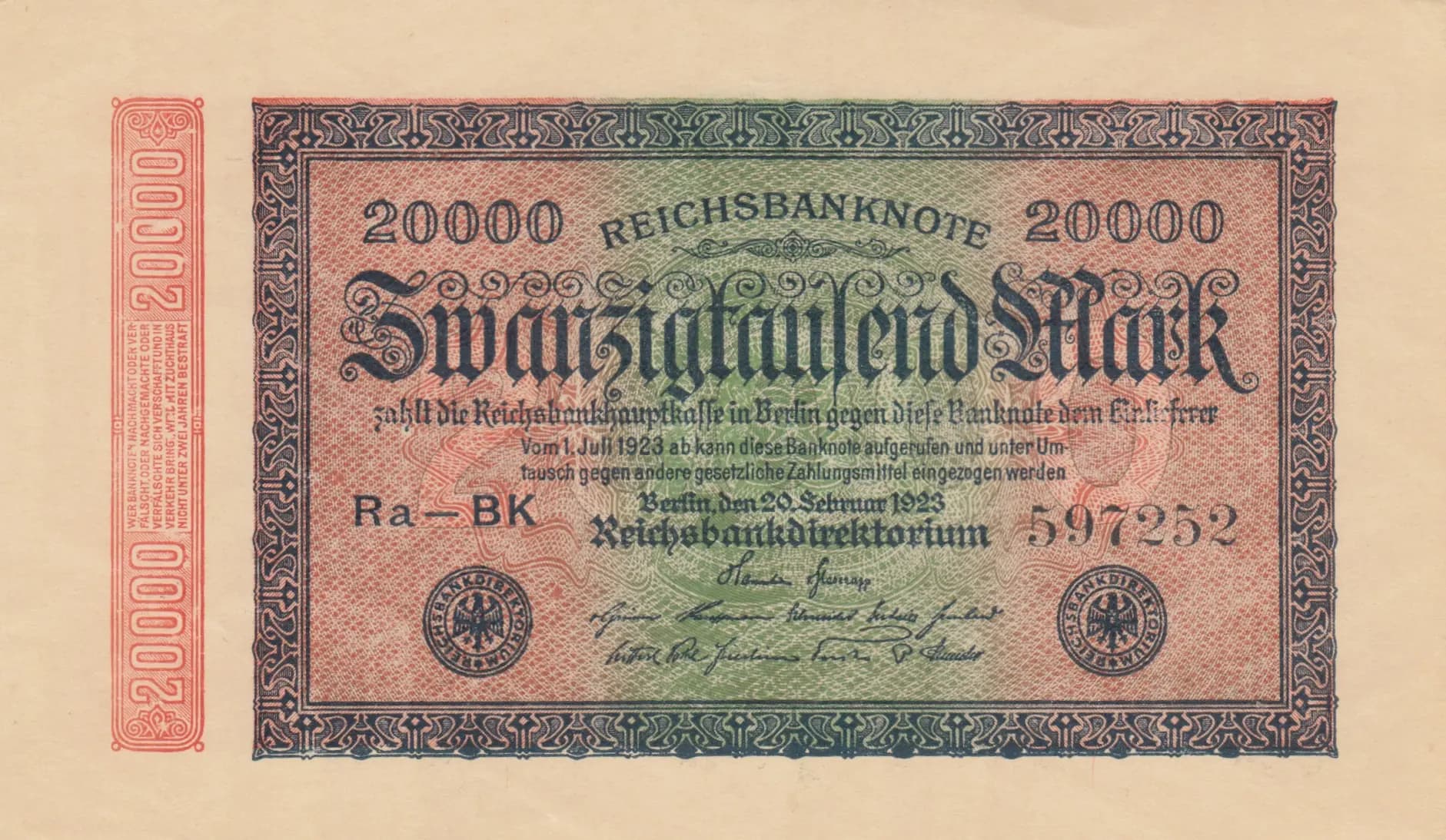
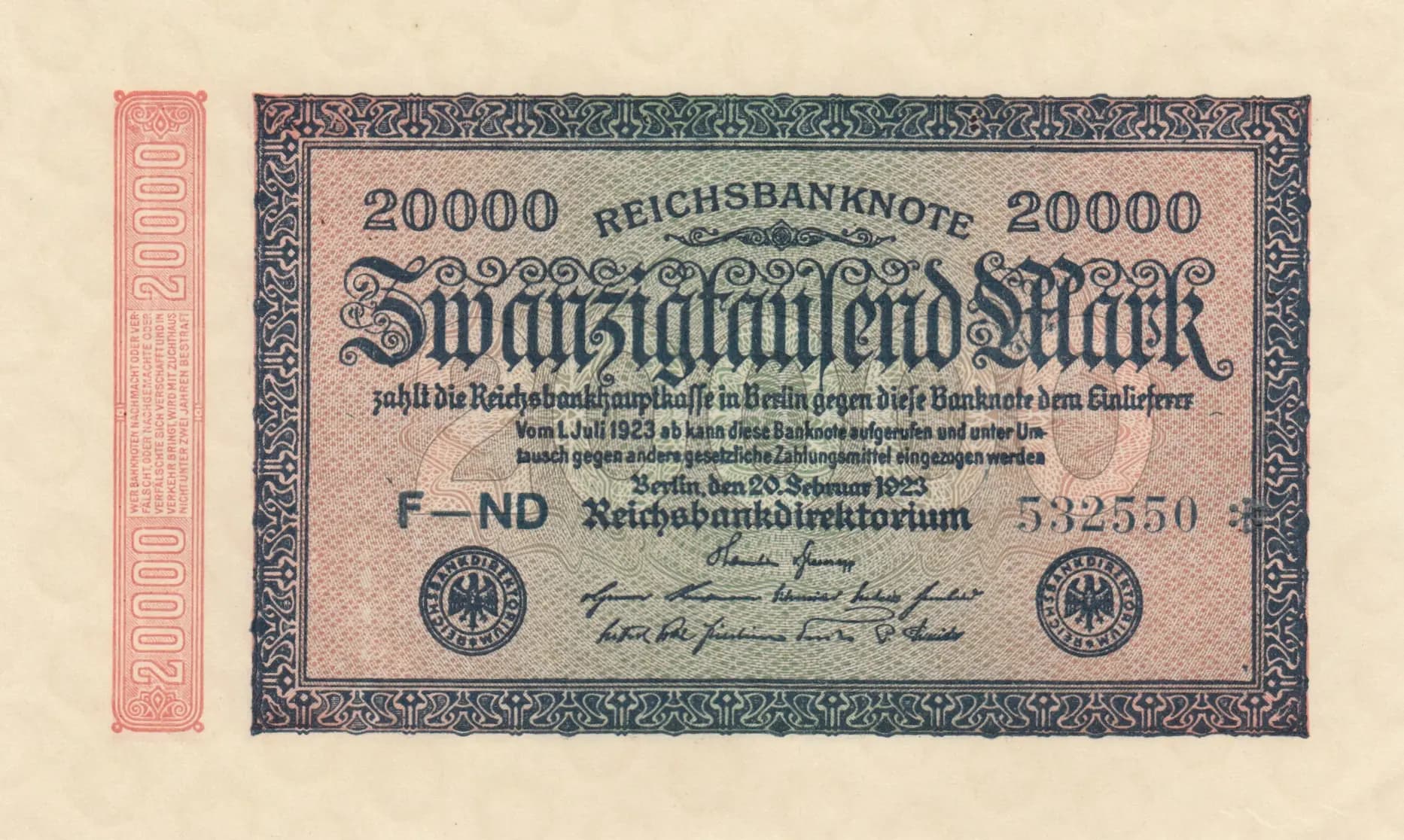
This is an uncirculated example of the German Reichsbank 20,000 Mark note from February 1923, representing the catastrophic hyperinflation period of the Weimar Republic. The note exhibits pristine condition with crisp, clean surfaces and no visible wear, displaying the characteristic ornate Art Nouveau-inspired design with intricate fine-line engraving, pink and green color printing, and the distinctive Imperial seals. As one of the most common hyperinflation-era German notes, this denomination survives in large quantities, making it highly affordable for collectors despite its historical significance.
Common. The 20,000 Mark denomination from this 1923 series survives in large quantities, with extensive eBay transaction history showing consistent sales in the $1-27 range regardless of grade over a 15-year period. Millions of these notes were printed during the hyperinflation crisis, and they remain abundant in the collector market. The 2016 catalog valuation of $17 for UNC examples and the consistent sub-$50 pricing across all grades confirm this is one of the most accessible hyperinflation notes for collectors.
This note was issued during Germany's severe hyperinflation crisis of 1923, when the Reichsmark's value collapsed rapidly following World War I reparations and economic instability. The denomination of 20,000 Mark reflects the increasingly astronomical figures required for ordinary transactions during this period—by November 1923, the currency would require denominations in the billions and trillions. The official Reichsbank directorate signatures and Berlin issuing location visible on the note underscore the central bank's desperate attempts to maintain monetary authority even as the currency became nearly worthless.
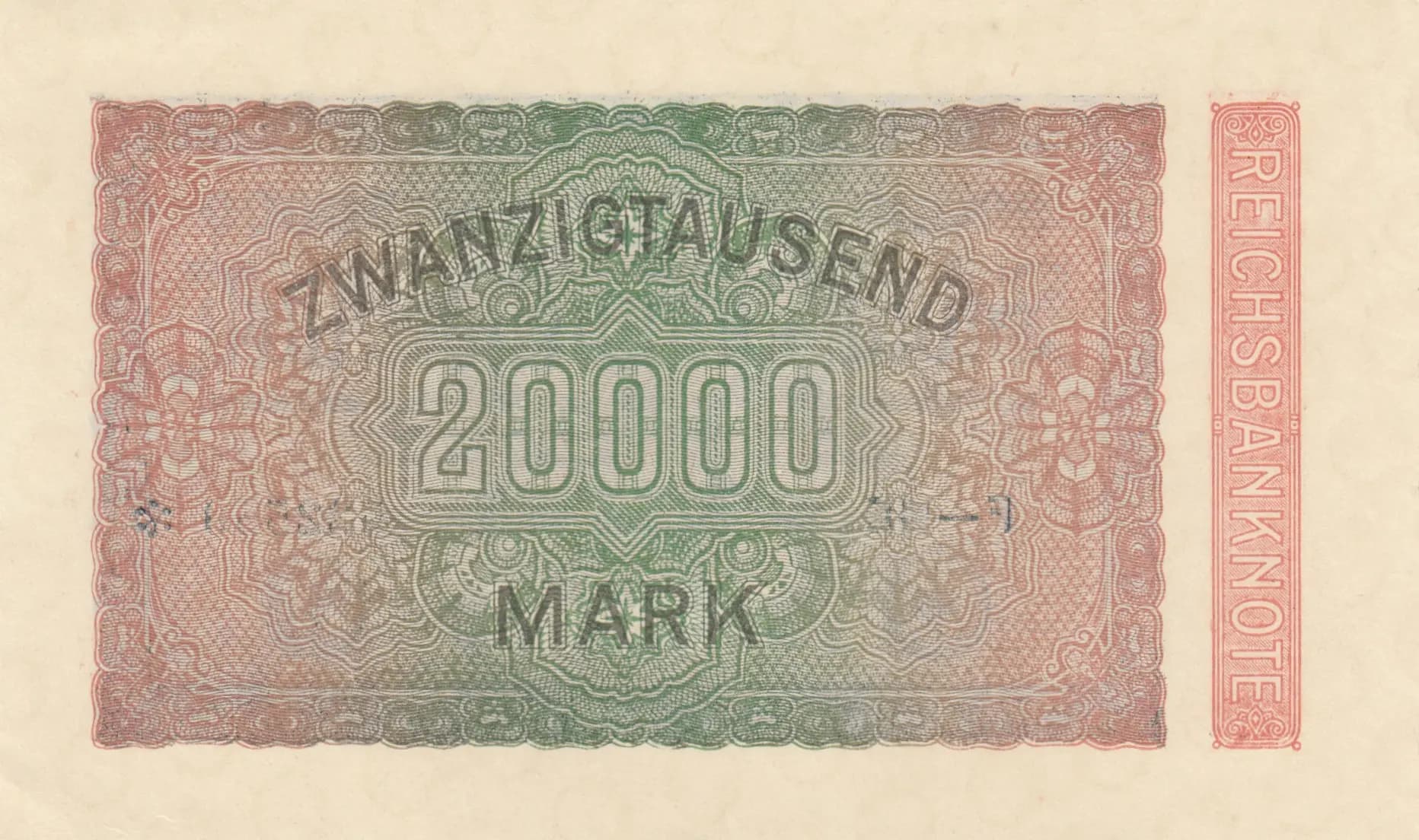
The obverse features the denomination prominently displayed in gothic blackletter typeface, surrounded by an ornate double border composed of interlocking geometric patterns and floral scroll motifs characteristic of German Imperial design. Two circular state seals appear in the lower portion, each featuring eagle emblems and radiating sunburst patterns—these represent the Imperial authority of the Reichsbank. A vertical red-pink margin strip runs along the left edge with repeating decorative elements. The background employs a sophisticated multi-color printing technique with light pink/beige base, dark navy blue borders, and green undertones creating visual depth. The reverse displays a symmetrical design with the denomination 'ZWANZIGTAUSEND MARK' and '20000' as the central focus, surrounded by matching ornate corner decorations and a complex woven geometric pattern background in pink, green, and cream tones. The overall aesthetic reflects late Imperial German design traditions, emphasizing traditional authority and craftsmanship during a period of severe monetary collapse.
FRONT SIDE: Reichsbanknote (Reich Bank Note) / Zwanzigtausend Mark (Twenty Thousand Mark) / '20000' / 'The Reichsbank main office in Berlin pays against this banknote to the depositor...' / 'From July 1, 1923 onwards, this banknote can be called in and exchanged for other legal tender' / Berlin, den 20. Februar 1923 (Berlin, February 20, 1923) / Reichsbankdirektorium (Reichsbank Directorate) / Serial number: 532550. BACK SIDE: Zwanzigtausend Mark (Twenty Thousand Mark) / '20000' / Mark.
Intaglio engraving (line engraving) combined with multi-color letterpress printing. The fine-line engraving is evident throughout in the intricate decorative borders, geometric patterns, and floral motifs. The multi-color printing technique—combining pink, green, blue, and cream—was achieved through successive passes of different colored inks, typical of Reichsbank note production of this era. The note exhibits the characteristic sharp detail and complex layering of Imperial German security printing practices.
This note is identified as Pick P-85a, one of three cataloged variants (P-85a, P-85c, P-85f) for the 20,000 Mark denomination. The specific variety P-85a is distinguished by its watermark pattern of small circles and L. 2 serial number varieties. The observed serial number 532550 and the date of February 20, 1923 are consistent with the regular issue variant. The note exhibits the characteristic pink and green color underprint with blue-black printing typical of P-85a examples.