20 000 000 mark 1923
Market Prices
26 salesAbout This Note
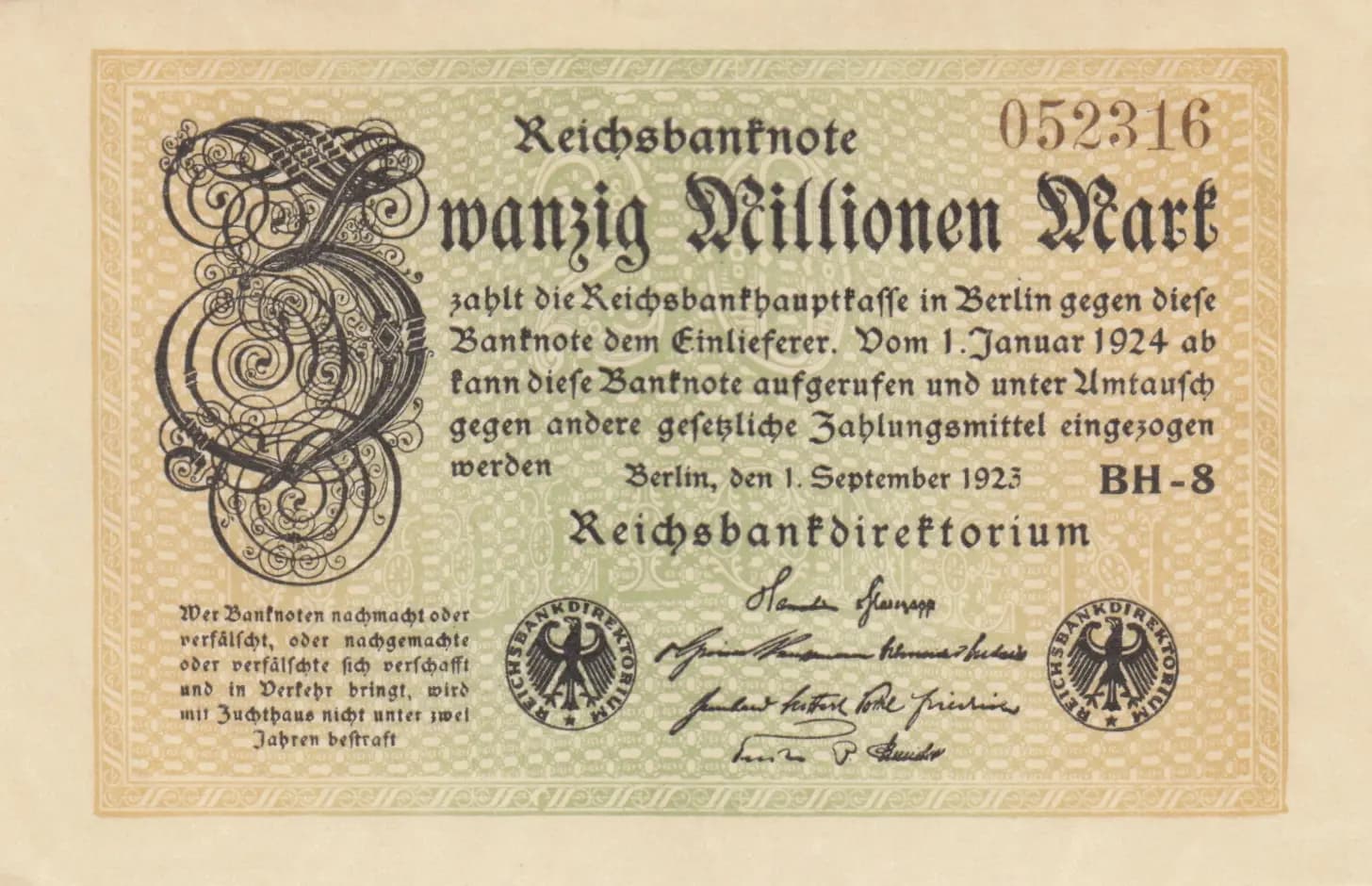
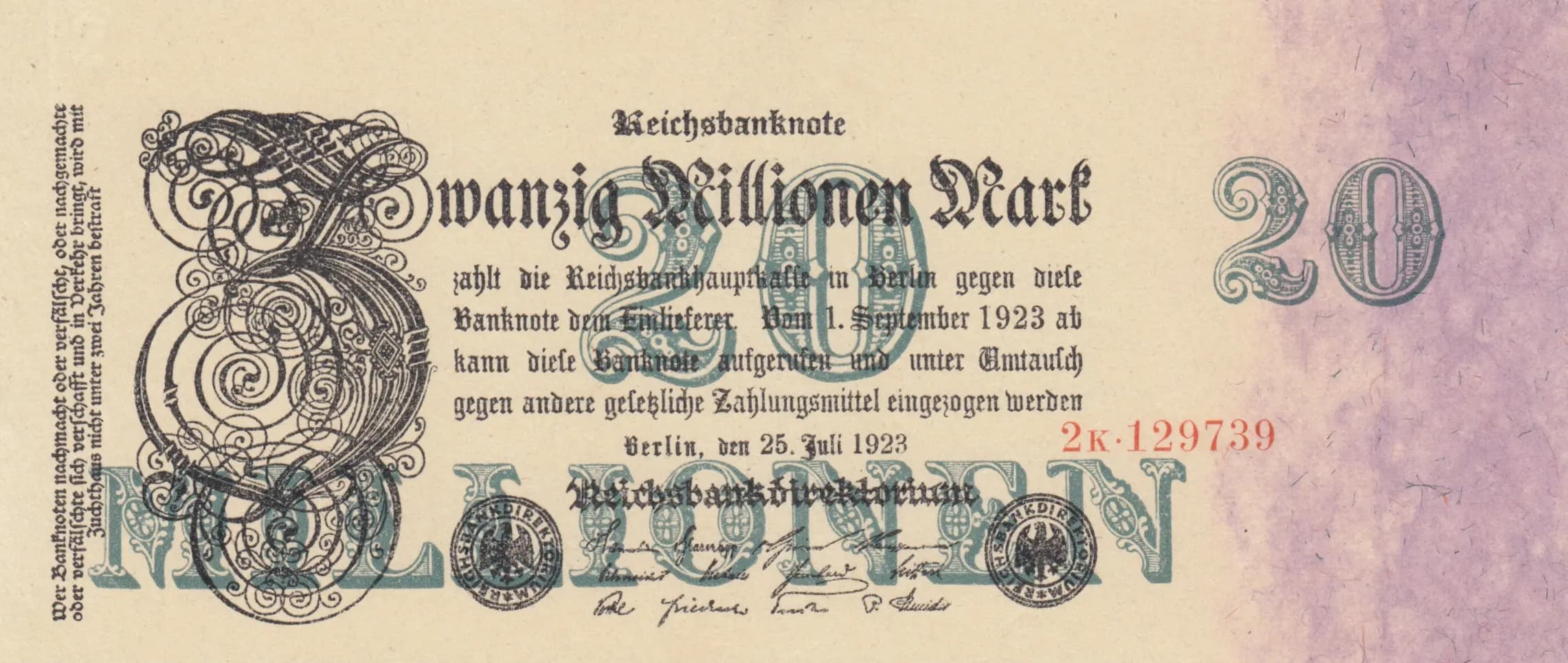
This German hyperinflation-era 20 Million Mark note from July 1923 exhibits an attractive AU condition with well-preserved ornate decorative typography and excellent ink clarity on the obverse. The note displays the characteristic elaborate Art Nouveau filigree patterns and calligraphic elements typical of late Weimar currency, with visible age-related creasing and slight edge toning (purple/pink discoloration) consistent with historical circulation. The serial number 2k·129739 and Berlin date of 25 July 1923 place this in the peak hyperinflation period, making it a historically significant example of emergency currency issued during Germany's economic collapse.
Common. The eBay market data provided shows consistent sales well below $20 for comparable grades (AUNC at $5, VF specimens at $0.95–$3.26), indicating robust supply and modest collector demand. The 20 Million Mark denomination was issued in massive quantities during July–August 1923 as hyperinflation accelerated, with print runs in the hundreds of millions or billions. While AU grade commands premium over VF/EF specimens, the Pick-97b remains fundamentally common due to high original mintage and widespread survival. These notes are affordable entry points to hyperinflation collecting precisely because they were produced in such enormous volume.
Issued by the Reichsbank on 25 July 1923, this note represents the catastrophic final phase of German hyperinflation when the Mark had become nearly worthless—denominations soared from thousands to millions within weeks. The formal typography, official seals, and Berlin location emphasized governmental authority even as the currency's real value evaporated; by November 1923, such denominations were completely superseded by the Rentenmark. The elaborate decorative elements visible in the design were partly security measures intended to prevent counterfeiting of increasingly worthless but still technically legal tender.
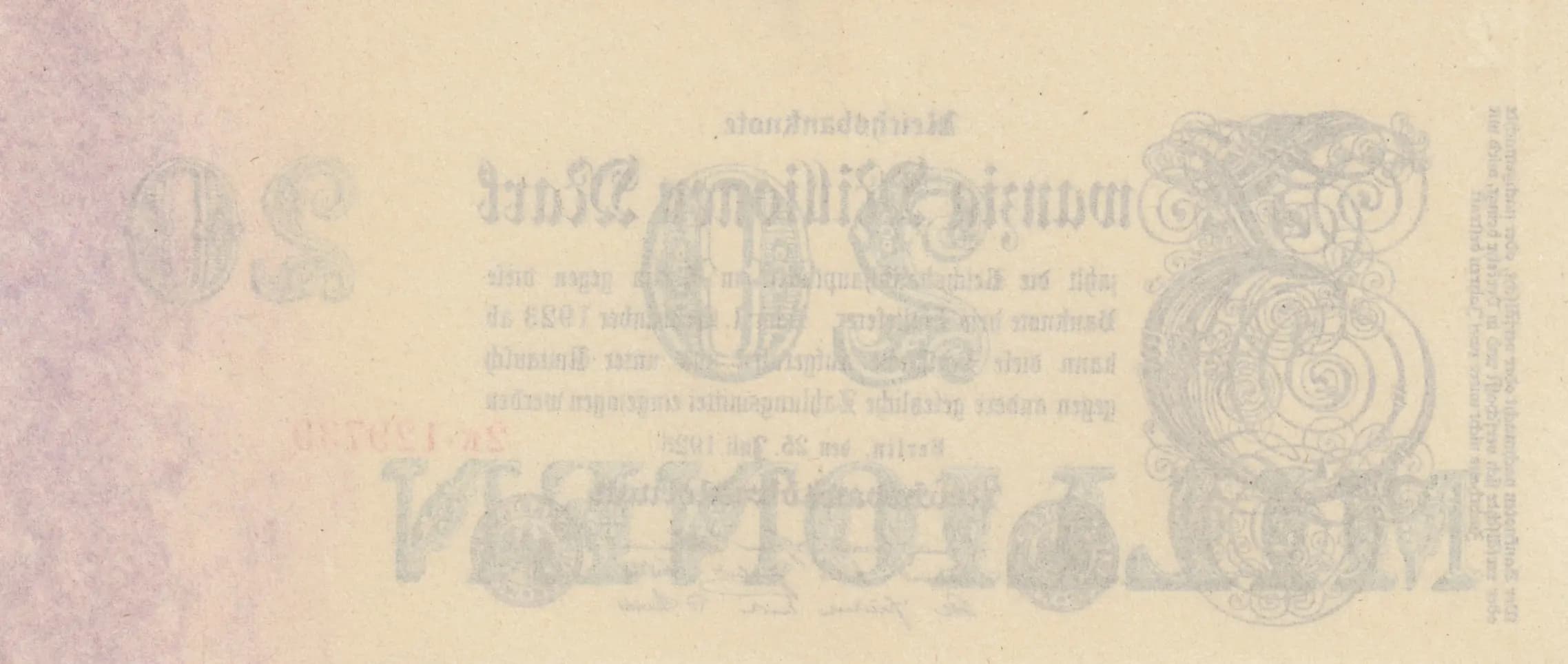
The obverse features a non-pictorial design typical of late Weimar emergency currency, dominated by elaborate ornamental typography rather than portraiture or landmarks. The left side displays an enlarged decorative capital letter 'B' (for 'Bank') with intricate Art Nouveau scrollwork and filigree detailing in dark blue-black ink. The denomination '20' appears as large ornamental numerals on the right in matching style. The center prominently displays 'zwanzig Millionen Mark' in formal Gothic-influenced capital letters. Twin circular official seals of the Reichsbank flank the signature line at bottom center, with 'BERLIN' below. The color scheme utilizes cream/beige paper with dark blue-black primary printing, subtle green tinting, and the noted purple-pink edge discoloration from age. The verso is printed in very faint impressions, a characteristic economy measure of hyperinflation currency when paper quality and printing resources were compromised.
FRONT: 'Reichsbanknote' (Reich Bank Note) / 'zwanzig Millionen Mark' (Twenty Million Mark) / Main legal text: 'The Reichsbank in Berlin pays to the bearer of this banknote from September 1, 1923; this banknote can be exchanged and redeemed in exchange for other legal tender' / 'Berlin, den 25. Juli 1923' (Berlin, July 25, 1923) / Serial number: '2k·129739' / 'BERLIN' (location) / Left margin contains fine print regarding counterfeiting penalties and legal restrictions. BACK: Reverse side shows only extremely faint impressions of decorative patterns and numerals, consistent with lighter or deteriorated printing on verso.
Intaglio (engraved) printing combined with letterpress elements, standard for Reichsbank notes of this period. The fine decorative filigree patterns, sharp line work, and precise registration visible in the ornamental capitals indicate engraved plates. The Reichsbank's principal security printer during 1923 was Giesecke & Devrient (G&D), though notes were also produced by other authorized German printers. The faint verso printing suggests deliberate light impression or secondary printing pass, possibly a cost-saving measure during the hyperinflation crisis when notes were produced in astronomical quantities with minimal security expectation given their rapidly diminishing value.
This example is identified as Pick-97b (the 'b' variant designation), issued 25 July 1923. The serial number format '2k·129739' represents a standard issue serial, with the '2k' prefix indicating a printing batch designation. No unusual overprints, color varieties, or emergency markings are visible in this specimen. The note shows typical characteristics of the main issue with no evident signature varieties or substantial printing anomalies; differences between 97a and 97b variants typically relate to minor design elements or printing characteristics not distinctly apparent from this image. The AU condition and clear provenance date make it a representative example of the standard circulation issue.