20 000 000 mark 1923
Market Prices
3 salesAbout This Note
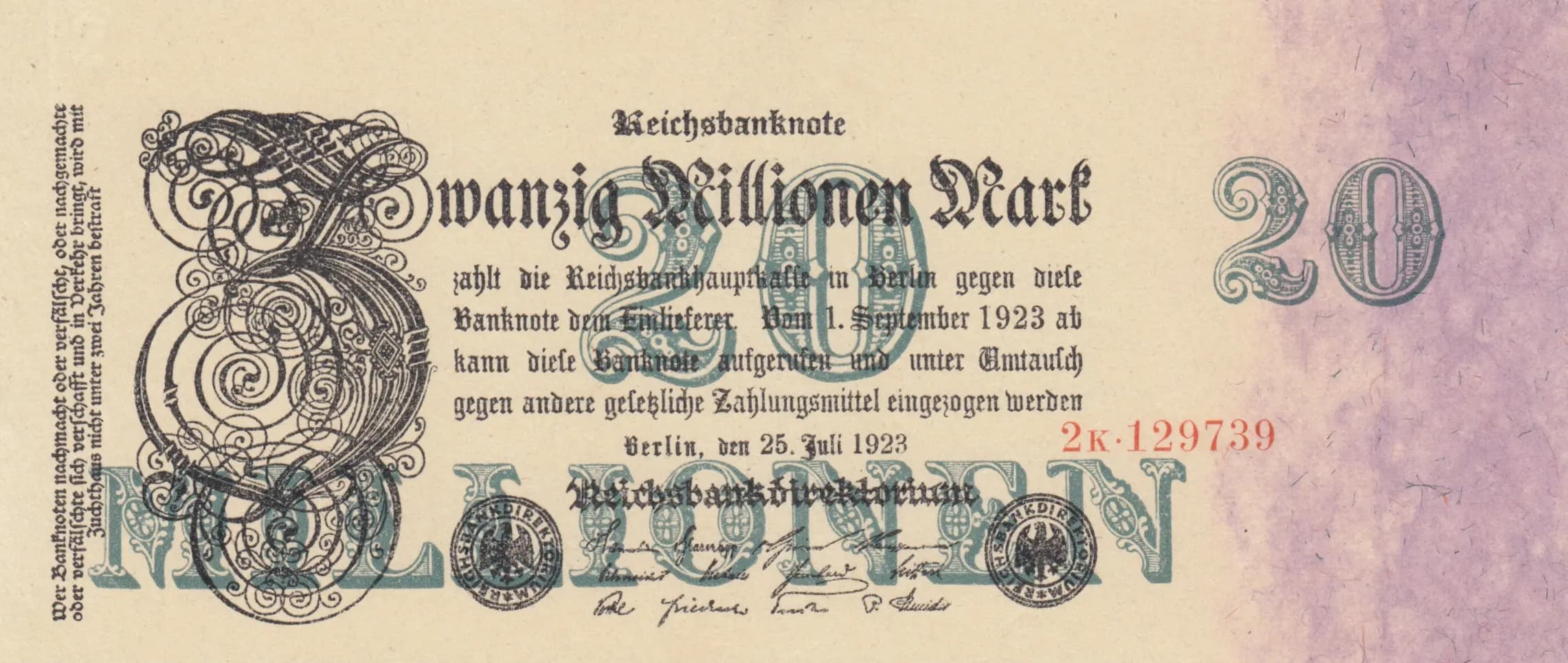
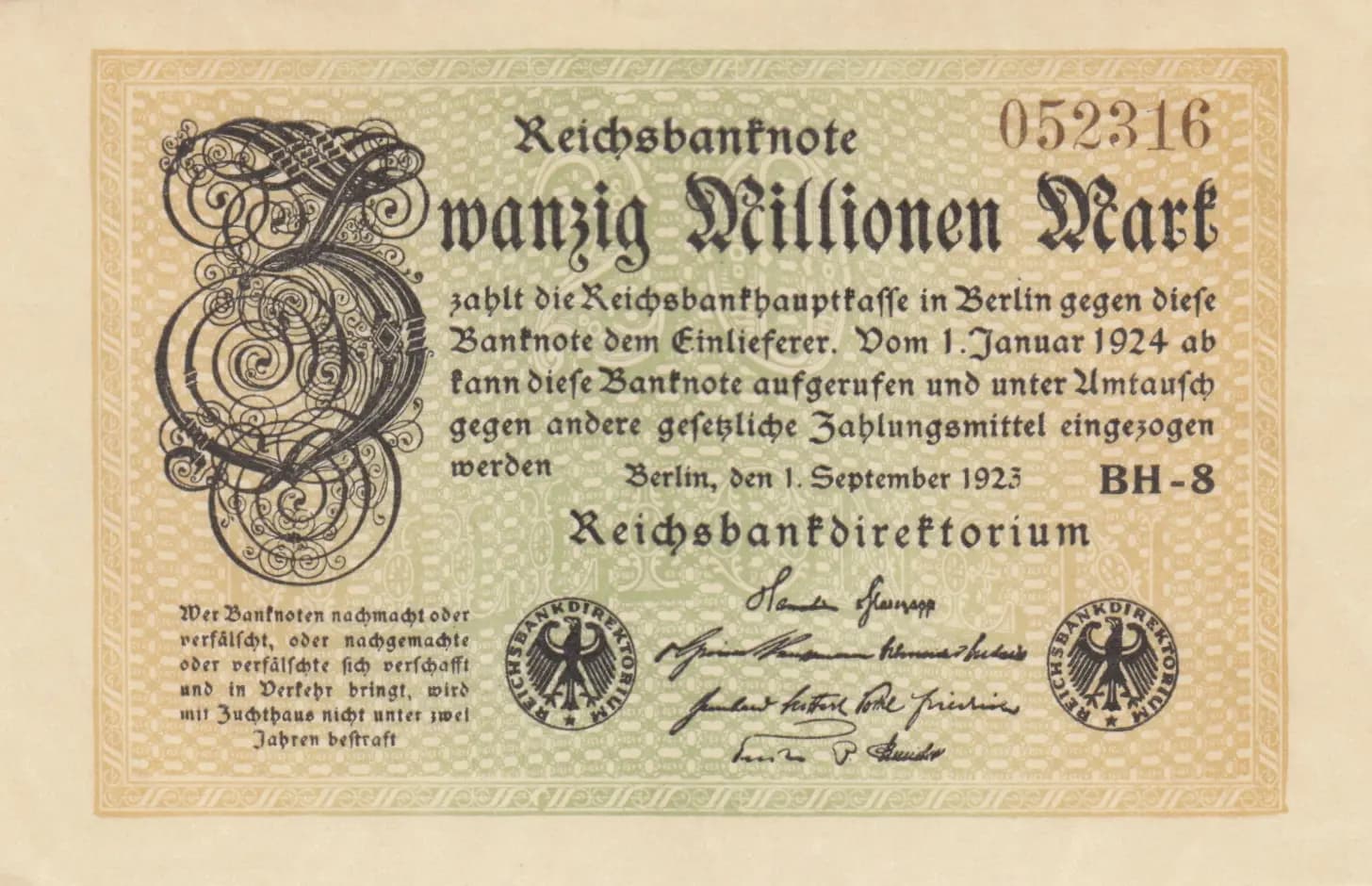
This Pick-108c 20 Million Mark note from September 1, 1923, represents a remarkable artifact of Germany's hyperinflation crisis, issued at the peak of currency collapse. The note exhibits pristine uncirculated condition with crisp black printing on cream/beige stock, showcasing elaborate Art Nouveau ornamental borders, double Reichsadler seals, and fine geometric patterns characteristic of Reichsbank security printing of the period. This denomination exemplifies the desperate measures taken by German authorities to maintain currency supply as the Mark's value plummeted during the final months of the Weimar Republic's most severe economic crisis.
Common. This denomination and Pick number were issued in substantial quantities during the hyperinflation period; these notes were printed by the millions as emergency currency. The eBay market data provided confirms common-grade pricing, with UNC examples selling for $1.25–$12.50 in recent transactions and catalog values at only $10 for UNC condition (2016 reference). The high print runs, survival of examples in circulation, and active market supply all indicate this is a standard hyperinflation-period note readily available to collectors at modest prices.
Issued on September 1, 1923, during the terminal phase of German hyperinflation, this note represents the Reichsbank's response to currency demands when the Mark had become nearly worthless in international markets. The ornate Imperial Eagle (Reichsadler) seals and formal 'Reichsbanknote' designation reflect the institution's attempt to maintain confidence in increasingly astronomical denominations—by August 1923, exchange rates had reached millions of Marks per dollar, necessitating notes valued in the millions. The callability notice dated January 1, 1924, printed on the note itself, indicates the temporary nature of these emergency issues, which were indeed withdrawn within months as the currency stabilized under the Dawes Plan and the introduction of the Rentenmark in November 1923.
This uniface note (printed on obverse only) features a masterwork of Art Nouveau security design typical of Reichsbank issues from 1923. The left side displays intricate ornamental scrollwork with elaborate floral and geometric motifs forming a protective border. Two identical Reichsadler (Imperial Eagle) seals appear on the right side, each positioned within circular medallions—these eagles face left and represent the authority of the German state banking system. The denomination 'Zwanzig Millionen Mark' dominates the center in large bold text, with the issuer name 'Reichsbanknote' displayed prominently above. Fine geometric border patterns encircle the entire design, providing both decorative effect and anti-counterfeiting protection through their complexity. The cream/beige background with black printing creates high contrast for legibility while the intricate line work throughout would have been difficult to reproduce with period counterfeiting technology. Signature lines appear in the lower right, belonging to Reichsbank directorate officials.
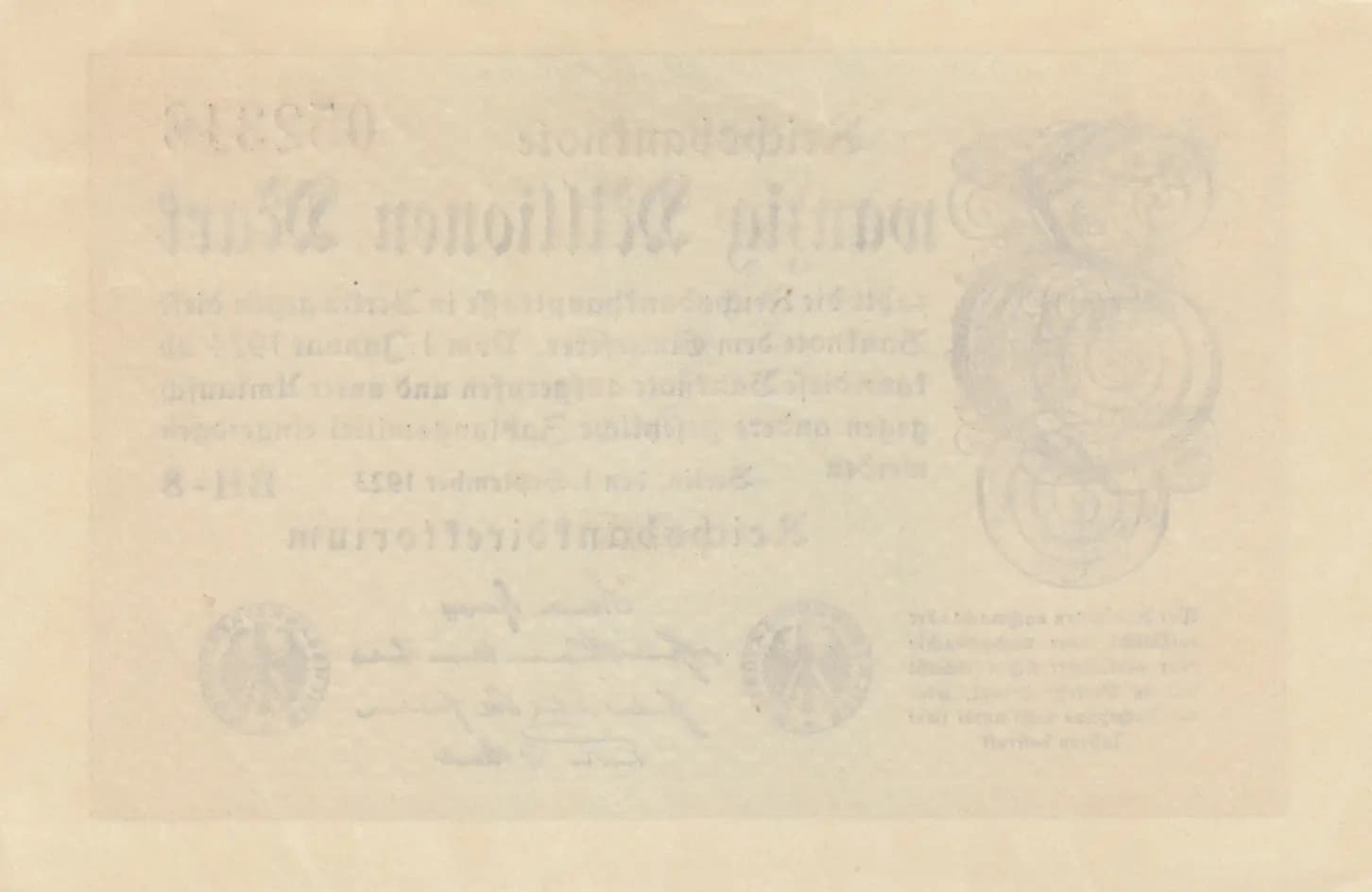
FRONT SIDE: 'Reichsbanknote' (Imperial Bank Note) / 'Zwanzig Millionen Mark' (Twenty Million Mark) / 'Die Reichsbanthauptcasse in Berlin zahlt gegen diese Bantnote dem Einlieferer. Dom 1. Januar 1924 ab kann diese Bantnote aufgerufen und unter Umtausch gegen andere gesetzliche Zahlungsmittel eingezogen werden' (The Reichsbank main office in Berlin pays against this banknote to the presenter. From January 1, 1924, this banknote can be called in and exchanged for other legal tender) / 'Berlin, den 1. September 1923' (Berlin, September 1, 1923) / 'Reichsbantdirektorium' (Imperial Bank Directorate) / 'Wer Bantnoten nachmacht oder verfälscht, oder nachgemachte oder verfälschte sich verschafft und in Verkehr bringt, wird mit Zuchthaus nicht unter zwei Jahren bestraft' (Whoever counterfeits or forges banknotes, or obtains counterfeited or forged ones and puts them into circulation, will be punished with imprisonment of not less than two years) / Serial number: 052316 / Printer designation: BH-8. BACK SIDE: Predominantly faint printing with minimal visible inscriptions; watermark areas present but not clearly legible in image.
Intaglio (copperplate engraving) printing, the standard security printing method employed by the Reichsbank for banknote production during the Weimar period. The crisp, fine line work visible throughout the design, particularly in the ornamental scrollwork and geometric borders, is characteristic of intaglio's ability to produce precise detail. The deep, consistent black impression and the three-dimensional quality apparent in the original would be consistent with steel engraving followed by press printing. The note exhibits the security features typical of Imperial German banknote printing: elaborate borders, multiple seal impressions, and fine-line geometric patterns designed to prevent counterfeiting through sheer complexity of reproduction.
Pick-108c represents the third variety of the 20 Million Mark denomination issued September 1, 1923 (varieties 108a, 108b, and 108c are distinguished by printer marks and signature combinations). The observed printer designation 'BH-8' and serial number 052316 represent this specific 108c variety. The uniface printing (obverse only) is standard for this Pick number. No known major varieties or rare overprints are documented for this particular issue, though printer mark combinations and signature variations exist across the print run.