2 000 000 mark 1923
Market Prices
24 salesAbout This Note
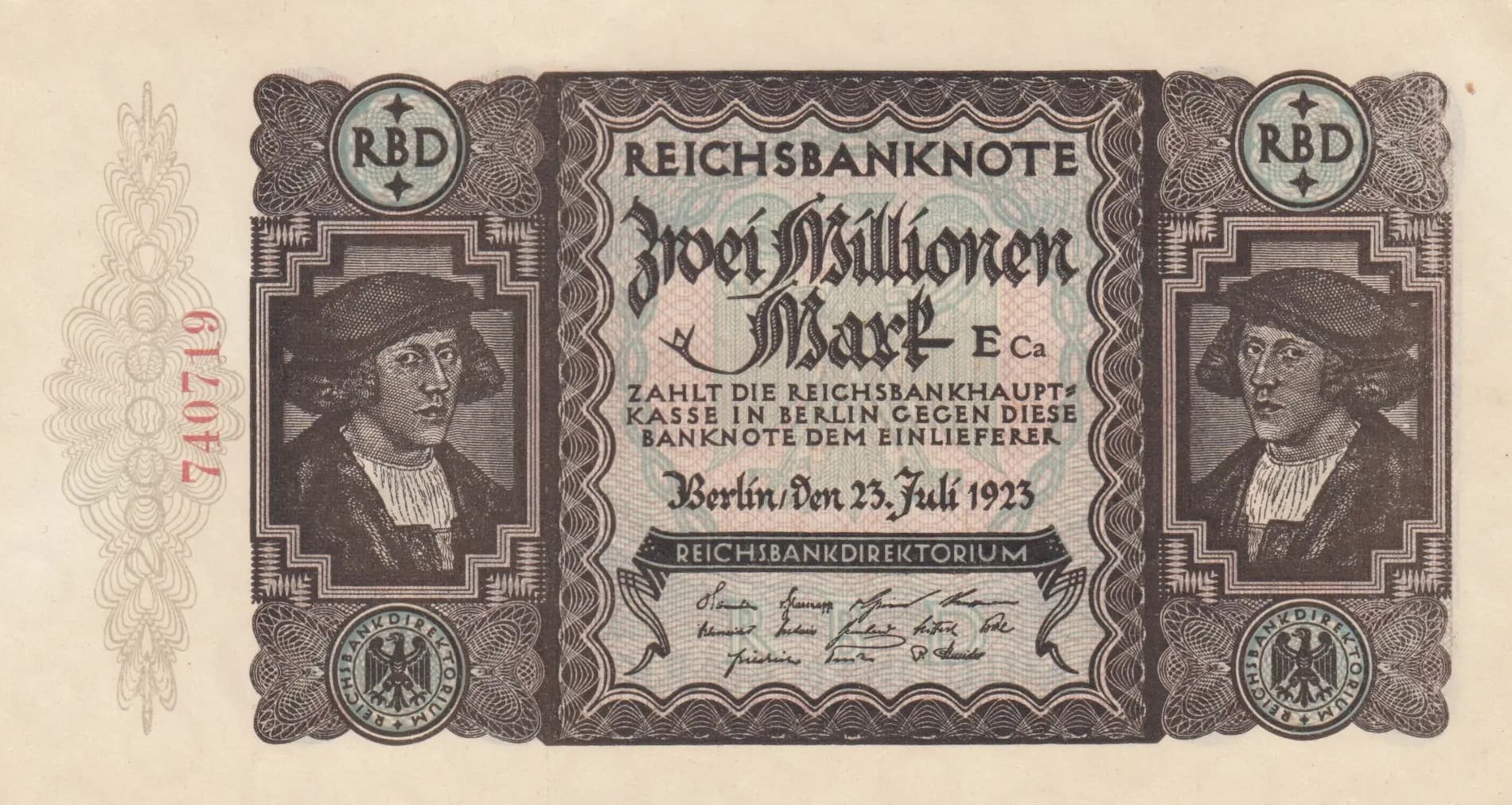
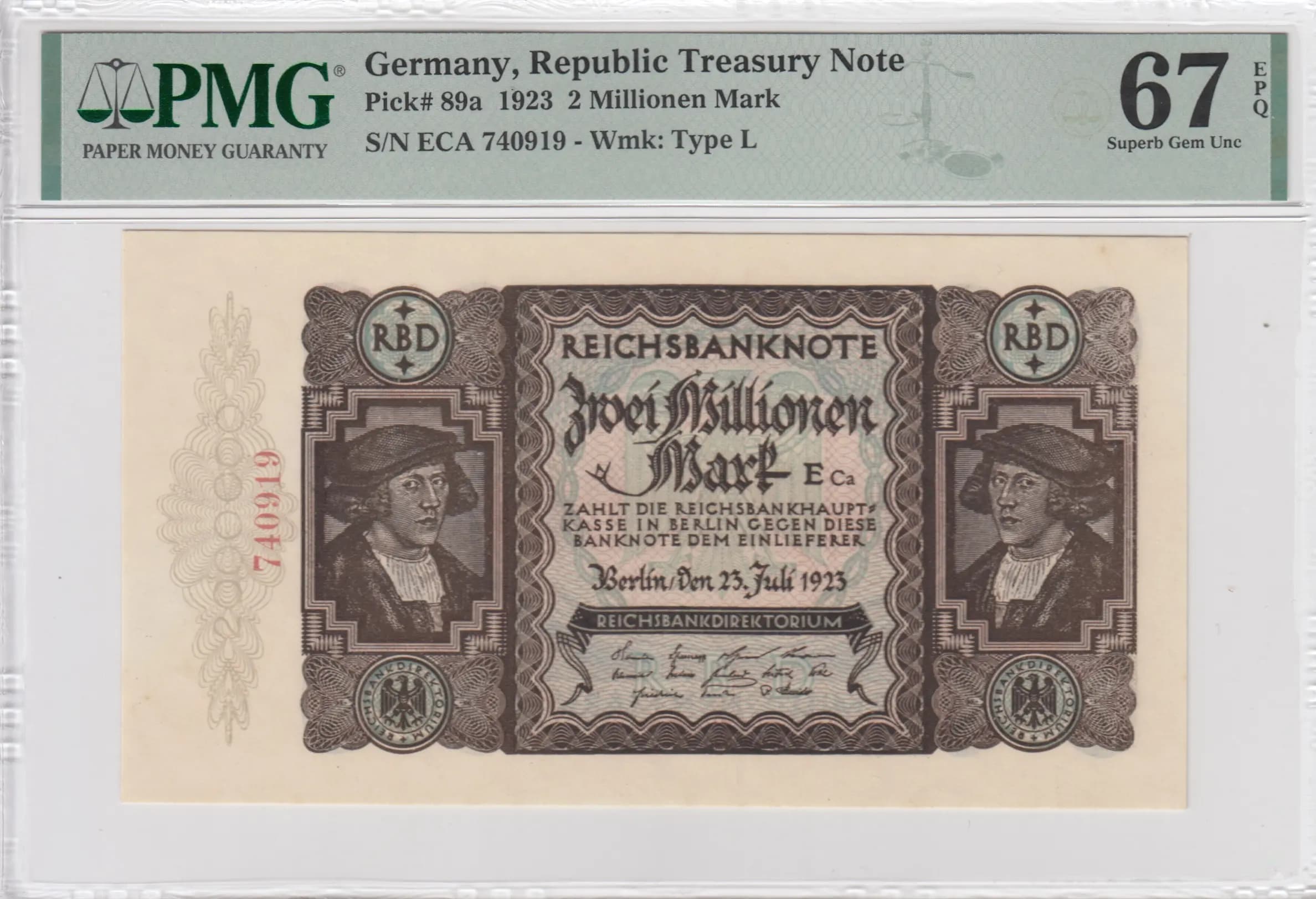
This is an exceptional example of the German Reichsbank's 2 Millionen Mark note issued during the height of the Weimar hyperinflation crisis on July 23, 1923. Graded PMG 67 Superb Gem Uncirculated with Exceptional Paper Quality, the note displays pristine condition with no visible wear, creases, or stains—a remarkable survivor from this tumultuous period. The striking design features dual portraits of the merchant Georg Gisze after Hans Holbein the Younger, rendered in brown and black on cream underprint, making it both a numismatic and artistic artifact of historical significance.
Common. While this specific note is graded PMG 67 (a high grade), the Pick-89a series was produced in substantial quantities during the 1923 hyperinflation period. eBay market data confirms abundant supply: even PMG 67 examples have sold for $120 (December 2020), while lower grades consistently sell for $25-$50 range, and raw VF/AUNC notes trade for $2-$10. The denomination was one of many denominations issued during hyperinflation, ensuring large print runs. The 2016 catalogue values (VG: $10, VF: $25, UNC: $50) further indicate this is a widely available note despite its historical interest.
This note represents the final stages of the Weimar Republic's catastrophic hyperinflation, issued just months before the introduction of the Rentenmark in November 1923 would stabilize the currency. The Reichsbank's choice to depict Georg Gisze—a prosperous merchant from Holbein's 16th-century portrait—reflects an ironic commentary on the era's economic collapse, as the denomination of 2 million marks had become nearly worthless despite its astronomical face value. The formal imagery of the RBD (Reichsbank Direktion) seals and imperial eagles underscore the government's attempt to maintain confidence in a currency system in free fall.
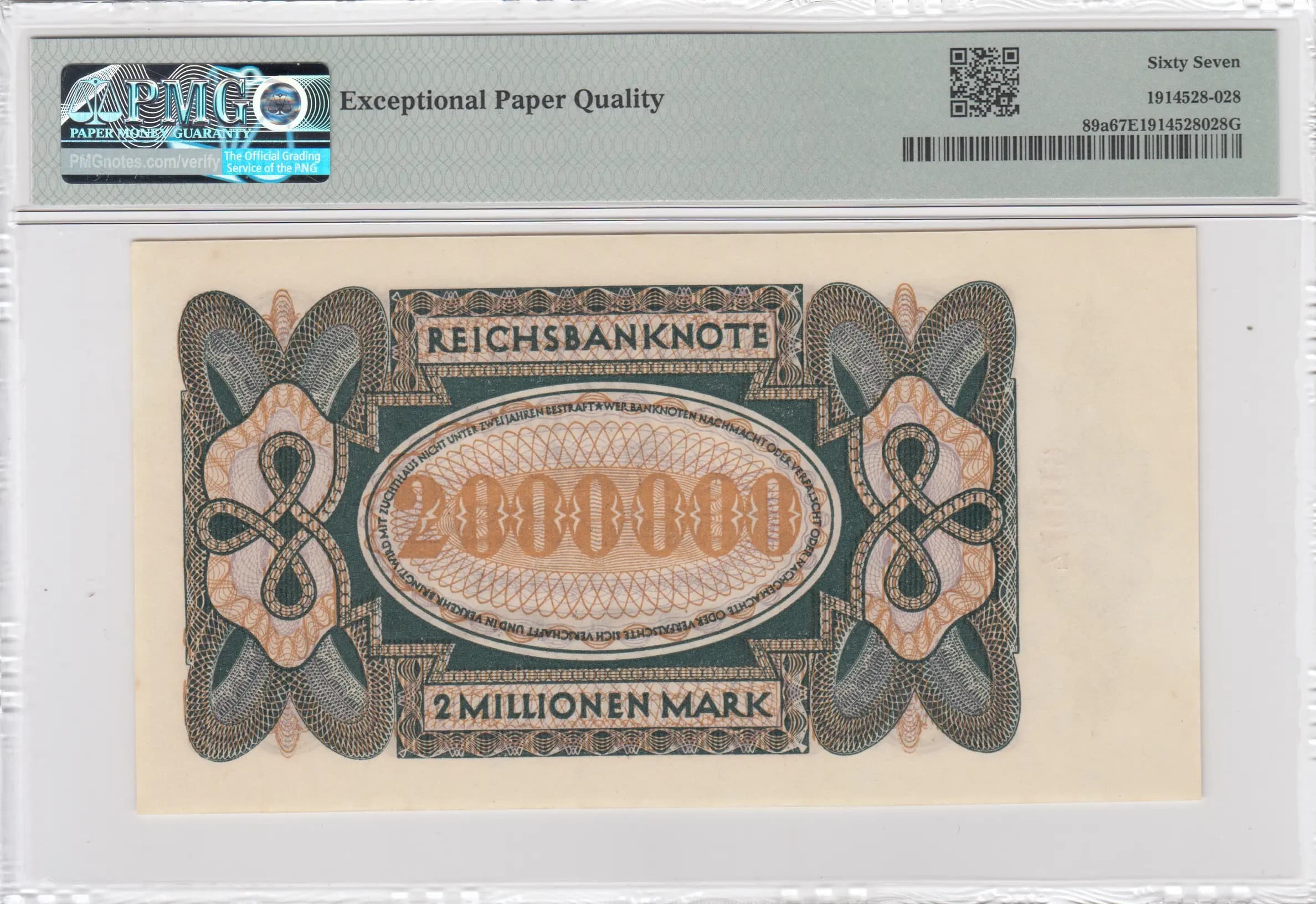
The obverse features two identical profile portraits of Georg Gisze facing left, positioned symmetrically on either side of the central ornamental frame—each rendering captures the merchant in period dress with distinctive headwear, derived from Hans Holbein the Younger's famous 1532 portrait now in Berlin. The central design incorporates elaborate decorative framing with text and signature panels, executed in brown and black engraving on a cream/beige background. Four corner positions display RBD (Reichsbank Direktion) circular seals incorporating the German Imperial Eagle emblem and cross symbols. The reverse presents a grand central oval vignette containing the denomination text '2 MILLIONEN MARK' and numerical '2000000,' flanked by ornate quatrefoil or leaf-shaped decorative ornaments in green and orange/tan tones. Both sides employ complex geometric rosette patterns, fine-line crosshatching, and multi-layered borders characteristic of high-security banknote engraving. The serial number 'ECA 740919' appears in red ink on the left margin, with watermark area visible.
FRONT SIDE: 'REICHSBANKNOTE' (Reichsbank Note); 'Zwei Millionen Mark' (Two Million Mark); 'E Ca' (designation marking); 'ZAHLT DIE REICHSBANKHAUPTCASSE IN BERLIN GEGEN DIESE BANKNOTE DEM EINLIEFERER' (The Reichsbank Main Office in Berlin pays the bearer of this banknote); 'Berlin, den 23. Juli 1923' (Berlin, July 23, 1923); 'REICHSBANKDIREKTORIUM' (Reichsbank Directorate); 'ECA 740919' (serial number). BACK SIDE: 'REICHSBANKNOTE' (Reichsbank Note); '2 MILLIONEN MARK' (2 Million Mark); '2000000' (numerical denomination); additional fine-print text regarding Reichsbank authority and legal tender (partially legible in vignette).
This note was produced using intaglio (engraved) printing, the standard security printing method for Reichsbank currency. The fine-line engraving visible throughout—particularly in the portrait work, decorative borders, geometric patterns, and ornamental frames—is characteristic of the Bureau of Engraving and Printing's (Reichsbank's security printer) techniques. The multi-color design required separate passes for brown/black (portraits and frames), green (back ornaments), and orange/tan tones, with hand-applied red ink for serial numbers. The exceptional clarity and precision of the security features, including the complex rosette patterns and crosshatching, confirms professional intaglio production.
This example is identified as Pick-89a with serial number designation 'ECA 740919' and date 23.07.1923. The 'ECA' series prefix and the specific printing batch are notable markers. Varieties of this denomination are primarily distinguished by series letter prefixes (E, F, etc.) and signature variations of the Reichsbankdirektorium officials. The EPQ (Exceptional Paper Quality) designation from PMG indicates this particular note exhibits superior paper preservation, which is noteworthy given the 100+ year age and the general fragility of Weimar-era currency stock.