2 000 000 mark 1923
Market Prices
24 salesAbout This Note
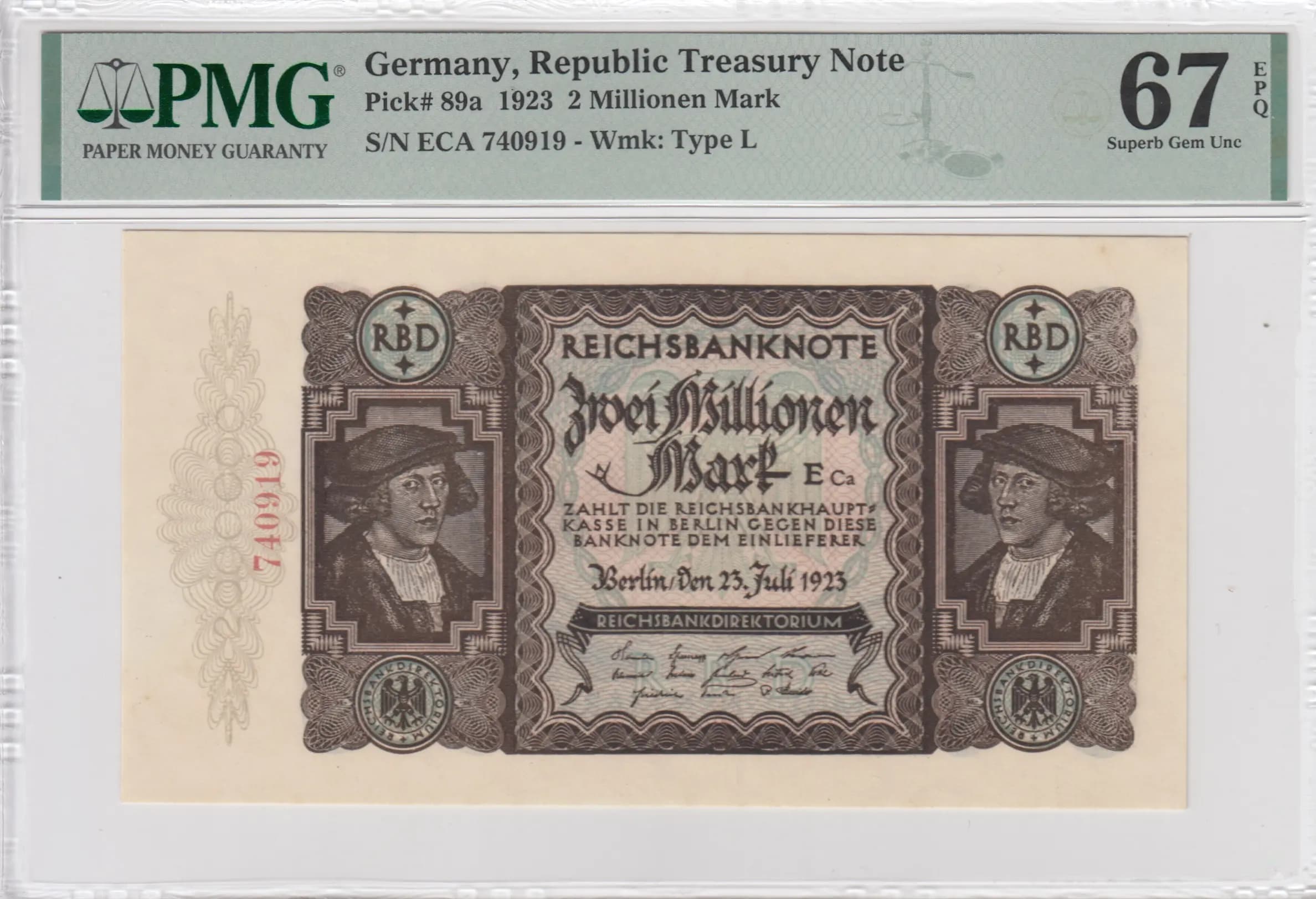
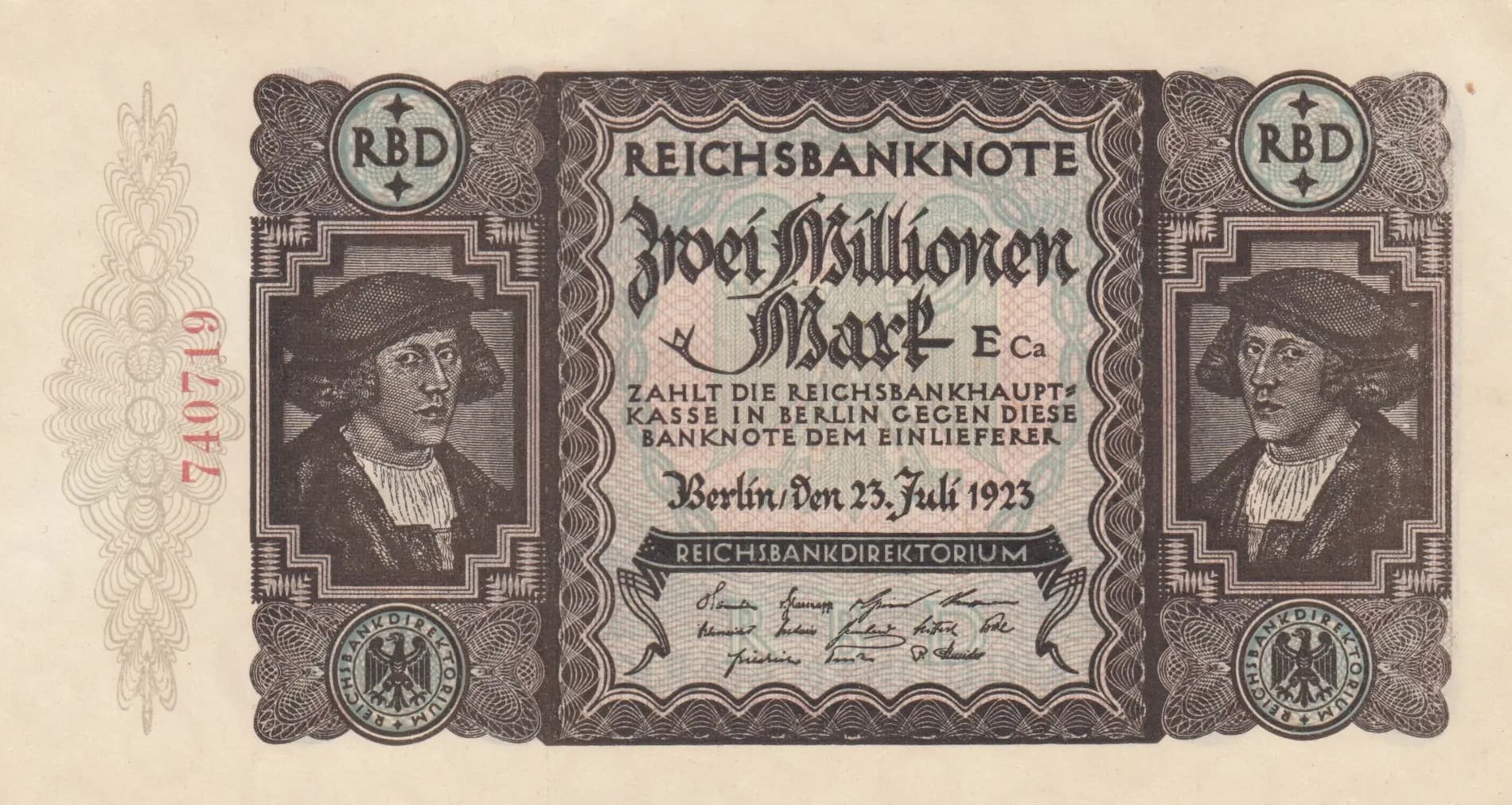
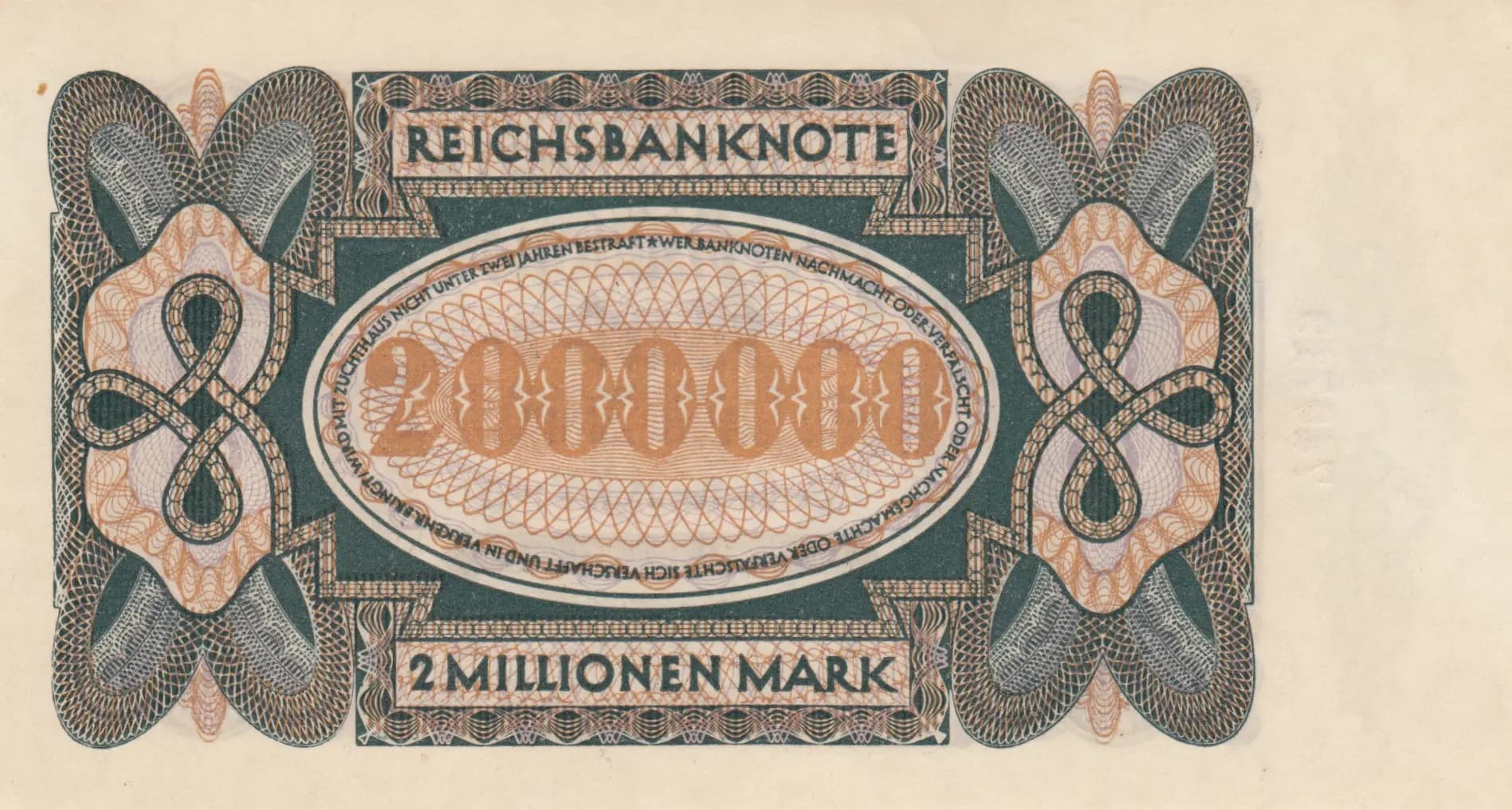
This German 2 Million Mark note from July 23, 1923, represents a masterwork of Art Deco banknote design during the height of the Weimar hyperinflation period. The note displays exceptional uncirculated condition with sharp, crisp printing, intact margins, and no visible wear, creases, or damage. The elaborate geometric guilloche patterns, dual portrait medallions, and vibrant color palette (featuring black, gray, cream, teal, and orange) demonstrate the sophisticated security printing techniques employed by the Reichsbank during this turbulent economic era.
Common. This note, while historically significant, was produced in substantial quantities as a regular issue during the hyperinflation period. The eBay price history provided demonstrates consistent market availability with prices ranging from $2.25 to $305, with most raw examples selling in the $3–$51 range and graded specimens (PMG 65–67) commanding $30–$300. The AU-graded example observed here aligns with historical eBay sales data showing AUNC/AU notes selling for $9–$25 in recent years. The 2016 catalog value of $50 for UNC reflects stable, available supply.
Issued on July 23, 1923, this note represents a critical moment in German economic history when hyperinflation required the Reichsbank to issue increasingly high denominations. The central portraits depicting a merchant (Kaufmann) in period costume reference the Renaissance-era painting by Hans Holbein the Younger, symbolizing German cultural heritage and economic tradition even as the currency's value collapsed. The elaborate security features—complex guilloche work, fine line engraving, and ornamental shields—reflect the Reichsbank's desperate attempts to prevent counterfeiting as denominations spiraled into the millions and billions within months.
This banknote features Georg Gisze (Kaufmann/Merchant), a figure from Hans Holbein the Younger's Renaissance painting, depicted in portrait medallions on both the left and right sides of the obverse, rendered in period costume with hat. The design employs a sophisticated Art Deco aesthetic with elaborate symmetrical compositions on both sides. The obverse features RBD (Reichsbank) circular emblems with crosses in the top corners, German Imperial Eagle seals in the bottom corners, and extensive decorative wreath patterns and ornamental scrollwork. The reverse showcases a dominant central oval denomination cartouche containing geometric pattern work, surrounded by four shield-shaped ornamental emblems with serpentine curves positioned in the corners and sides. The entire note is dominated by intricate guilloche patterns, fine line engraving with complex interlocking designs, and multiple decorative borders. The color scheme shifts between the obverse (black, gray, cream, with red accent text) and reverse (teal, dark green-blue, cream, orange/peach, and black), creating visual distinction between sides while maintaining design cohesion.
FRONT SIDE: 'RBD' = Reichsbank (German Central Bank); 'REICHSBANKNOTE' = Reichsbank Note; 'Zwei Millionen Mark' = Two Million Mark; 'E Ca' = Series designation; 'ZAHLT DIE REICHSBANKHAUPTCASSE IN BERLIN GEGEN DIESE BANKNOTE DEM EINLIEFERER' = The Reichsbank main office in Berlin pays against this banknote to the bearer; 'Berlin, Den 23. Juli 1923' = Berlin, July 23, 1923; 'REICHSBANKDIREKTORIUM' = Reichsbank Directorate; 'GÜLTIG' = Valid. REVERSE SIDE: 'REICHSBANKNOTE' = Reichsbank Note; '2 MILLIONEN MARK' = 2 Million Mark; 'GÜLTIG AB DEM TAGE DER AUSGABE FÜR ZWEI JAHRE GEGEN WÄHRUNG ODER EINLÖSUNG DES GELDES ALLE NICHT UNTER ZWEI JAHREN BESTRAFTER WERBANKNOTEN NACHZUMACHEN ODER TÄUSCHLICH ÄHNLICH HERZUSTELLEN IST EINE REICHSBANK-FÄLSCHUNG UND WIRD NACH WÄHRUNG BESTRAFT' = Valid from the date of issue for two years for exchange or redemption of money. Counterfeiting of banknotes in any way or creating deceptively similar ones constitutes a Reichsbank forgery and is punished according to regulations.
This note was produced using intaglio engraving (copperplate/steel plate printing), the security standard for Reichsbank notes of this period. The intricate guilloche patterns, fine line engraving, complex interlocking designs, ornamental rosette designs, and the ornamental shield designs with detailed serpentine curves are all hallmarks of intaglio printing. The multi-color printing technique visible on both obverse and reverse (particularly the shift from black/gray/cream on front to teal/orange on reverse) indicates multiple passes or multi-block intaglio printing. While specific printer attribution is not definitively established in the catalog data, Reichsbank notes of 1923 were produced by the Reichsdruckerei (German State Printing Office) in Berlin.
Identified as Pick P-89a, issued July 23, 1923. The serial designation 'E Ca' is visible on the obverse, indicating a specific series variety within the 2 Million Mark emission. No additional overprints, date variations, or signature variations are evident from the visual analysis. The Pick-89a designation distinguishes this from related 2 Million Mark notes that may have variations in serial prefixes or printing dates during the July–August 1923 issuance window.