100 mark 1920
Market Prices
49 salesAbout This Note
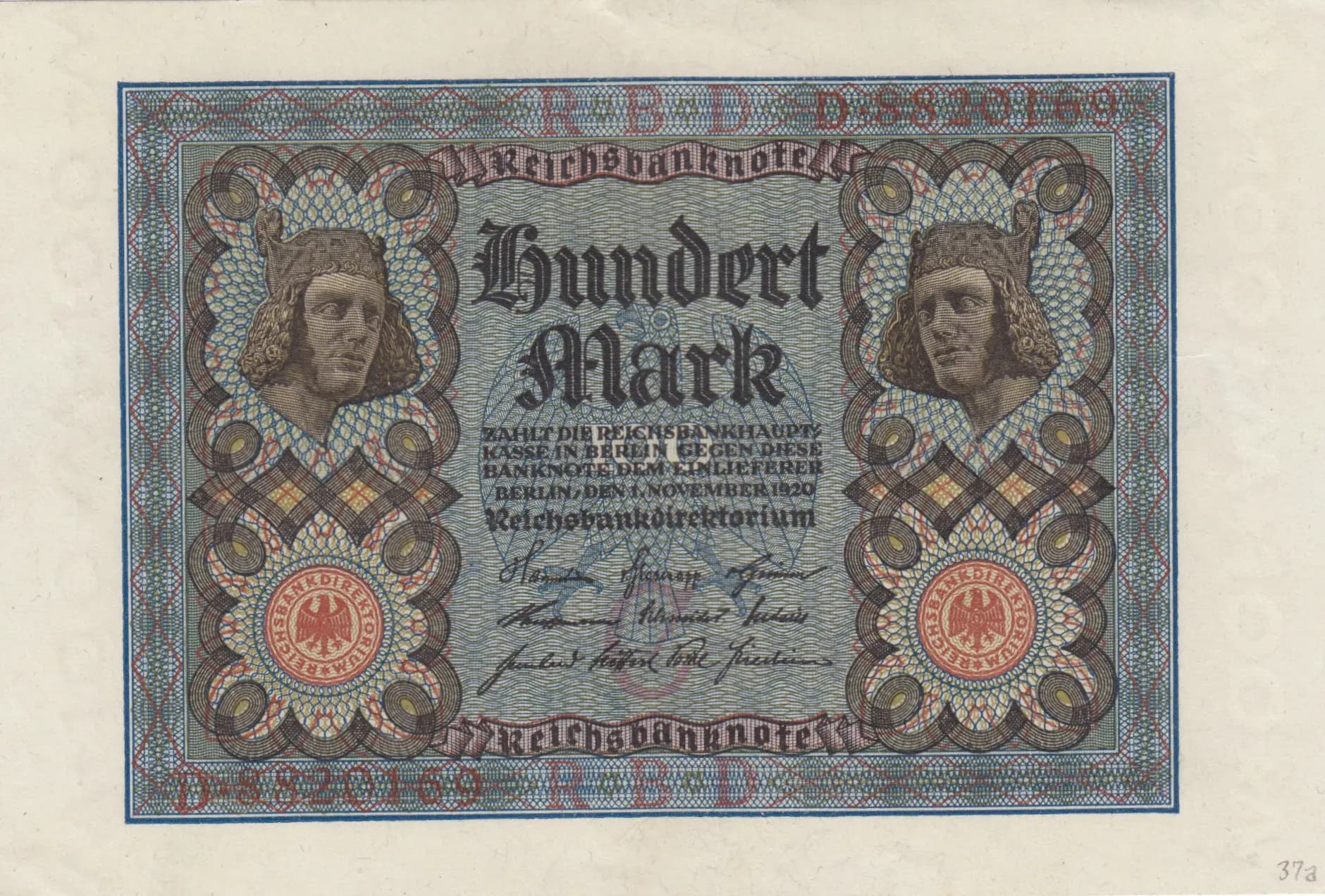
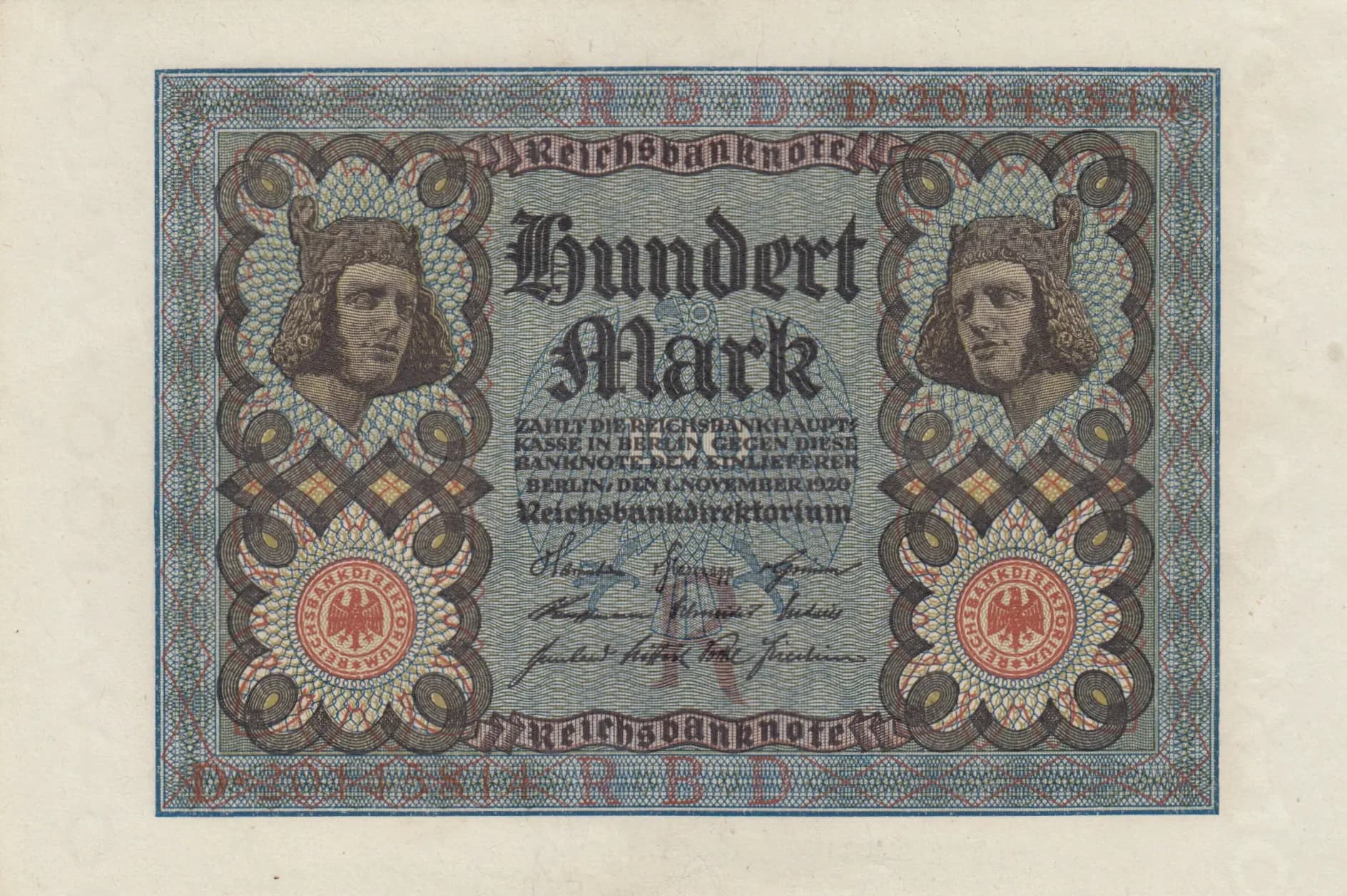
This is a 100 Mark banknote issued by the Reichsbank on November 1, 1920, during the early Weimar Republic period. The note displays the characteristic ornate design of the era with dual classical male portrait medallions, imperial eagle seals, and intricate rococo-style ornamentation in blue, brown, and red. The AU condition grade indicates this example has seen minimal circulation, preserving the fine engraving details and color layering that define this issue, making it an attractive specimen for collectors of early German inflation-period currency.
Common. This Pick 69b denomination was issued in substantial quantities during November 1920 as a standard regular-issue Reichsbank note. The extensive eBay transaction history provided shows consistent sales across multiple condition grades from 2011–2025, with typical prices ranging from under $1 for lower grades to $20–$30 for PMG 65 and $50–$90 for PMG 66–67 examples. AU-condition examples appear periodically on the market at modest premiums ($30–$50 range based on recent comparable sales), indicating stable but not restricted supply. The PMG population report shows only one cataloged variant for this Pick number, with no indication of print run restrictions or recall that would elevate rarity status.
Issued just after Germany's post-WWI hyperinflation began, this 100 Mark note represents a transitional moment in Weimar monetary history when such denominations still held real purchasing power before the currency's catastrophic collapse. The imperial German eagle symbols and formal Reichsbank language reflect the continuity of institutional authority despite the recent political upheaval following the abdication of Kaiser Wilhelm II. The dual classical male portraits and rococo ornamentation exemplify the refined artistic tradition that characterized pre-inflationary German banknote design.
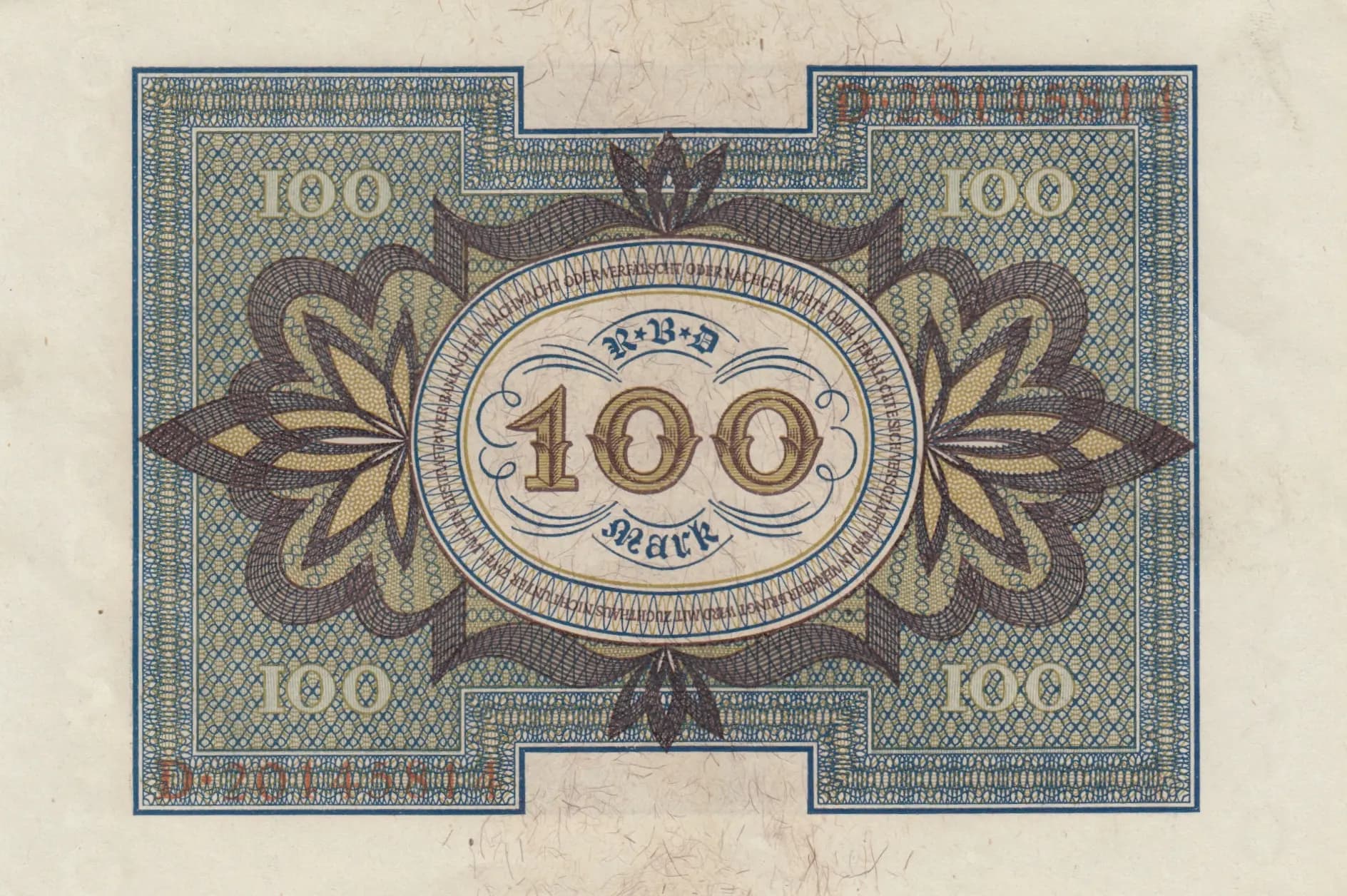
The obverse features a symmetrical composition with two classical male portrait medallions positioned left and right, each depicting a bearded male figure with long, curled hair in the style of historical German nobility or cultural figures — likely representing figures from German cultural or political tradition rather than specific historical persons. The portraits are framed by elaborate rococo-style decorative borders with intricate geometric and floral patterns. Red circular seals bearing the imperial German eagle flank the portrait medallions, serving as both security features and symbols of official authority. The reverse displays a more geometric composition centered on a large oval denomination medallion reading '100 Mark,' with the numeral '100' repeated in all four corners in tan/beige. An imperial German eagle in dark brown crowns the composition at top center. The entire design employs fine line engraving with crosshatch background patterning throughout, creating a sophisticated security texture typical of Reichsbank production standards.
FRONT: 'Hundert Mark' (One Hundred Mark) — the primary denomination text in gothic script. 'ZAHLBAR DEM REICHSBANKHAUPT ODER BEI EINEM DER REICHSBANKNEBENSTELLEN ODER BANKNOTE DEM GÜLTIGERER BERLIN DEN 1 NOVEMBER 1920' (Payable to the Reichsbank headquarters or at one of the Reichsbank branch offices or valid banknote from Berlin, 1 November 1920) — the issuance and payment terms. 'Reichsbankdirektor' (Reichsbank Director) — signature authority line. BACK: '100' and 'Mark' — denomination indicators in the central oval medallion. 'R.B.D' (Reichsbank Director abbreviation) — appears with signature authorities.
Intaglio engraving (recess/relief printing) with multiple color registration and layering. The fine detailed line work, intricate border patterns, crosshatch security background, and the visible depth of color layering (blue, brown, tan, red, black) are characteristic of high-quality intaglio banknote production. The Reichsbank's notes from this period were typically produced by the Reichsdruckerei (Reich Printing Office) in Berlin, with security engraving by specialized banknote printing firms meeting strict government standards.
This example is catalogued as Pick 69b. The visual analysis shows the standard obverse design with dual portrait medallions and imperial seals, matching the canonical P-69b specification. An 8-digit serial number is present (specific digits not legible from images provided). Multiple handwritten signatures are visible on the obverse, which is consistent with period Reichsbank practice of requiring director signatures for validation. No overprints, date variations, or other distinctive marking varieties are evident from the visual inspection. The November 1, 1920 date is consistent with the established issue date for this Pick number. The AU condition grade reflects the minimal circulation wear and preservation of fine engraving details typical of high-grade examples of this note.