100 000 mark 1923
Market Prices
76 salesAbout This Note
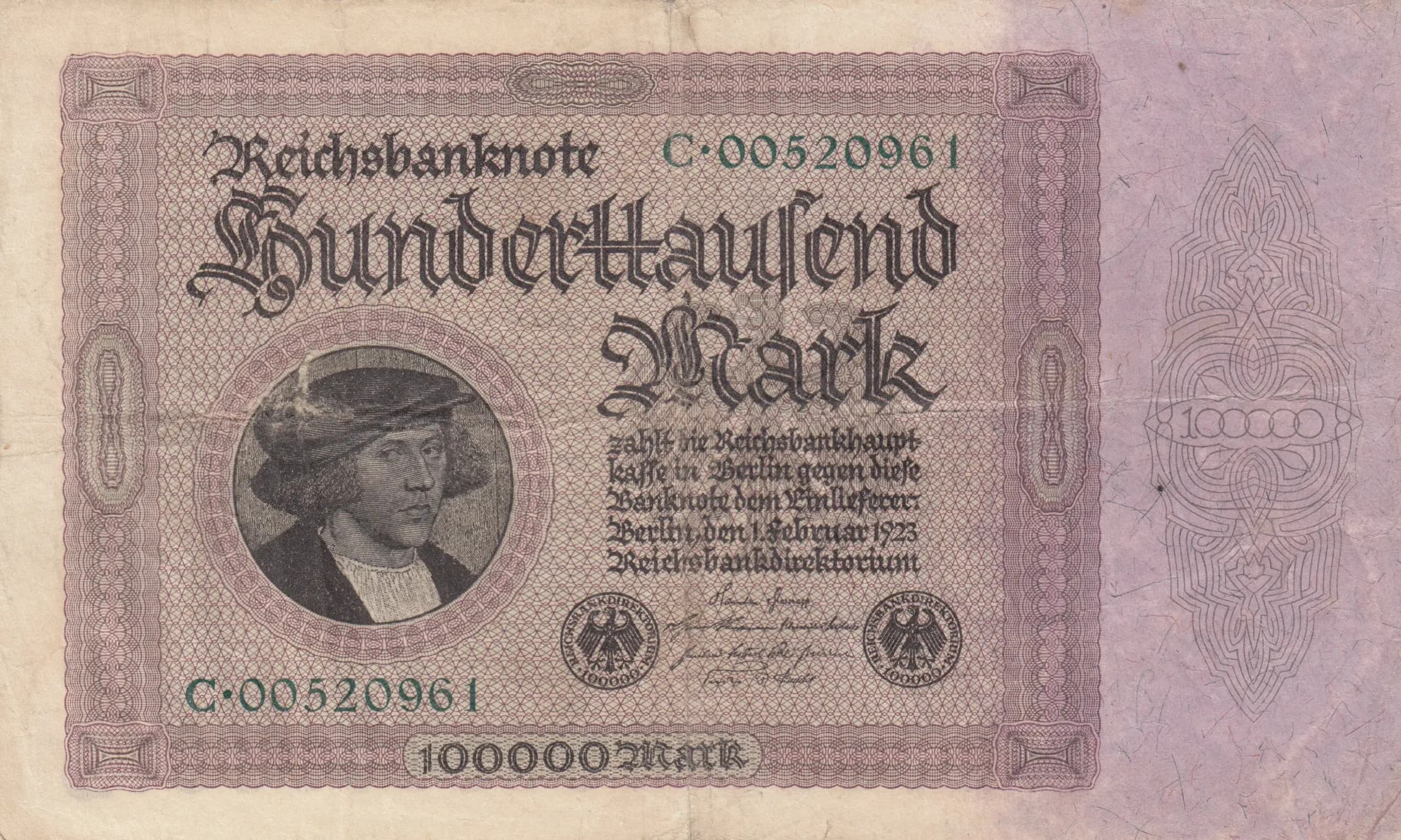
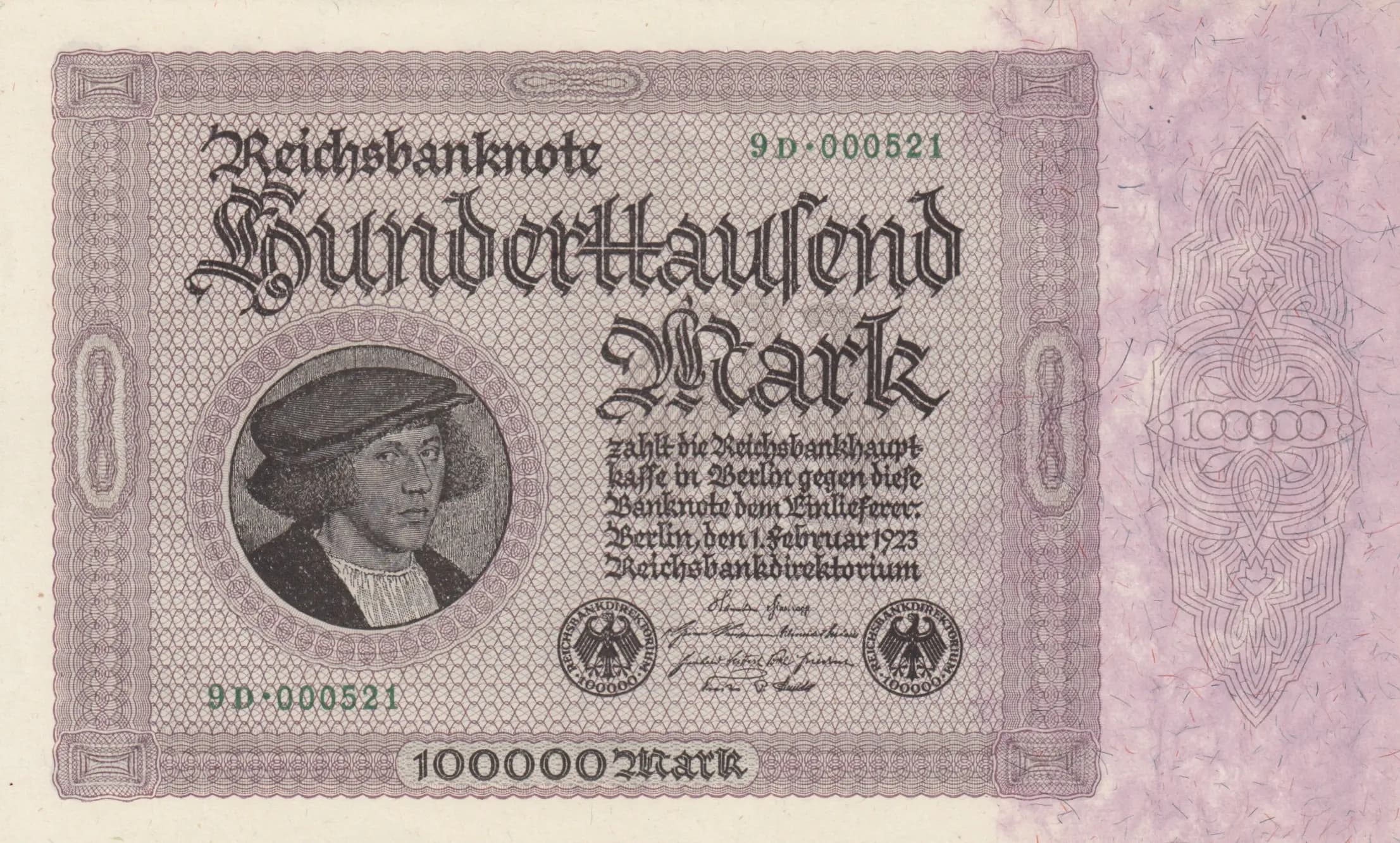
This is a German 100,000 Mark banknote issued by the Reichsbank on February 1, 1923, during the peak of the Weimar hyperinflation crisis. The note features a portrait of merchant Georg Gisze based on Hans Holbein the Younger's famous painting, rendered in dark brown and lilac tones with intricate guilloche security patterns throughout. In UNC condition as graded, this example displays the characteristic purple-mauve aging patina typical of these notes, with crisp, well-defined ornamental designs and no major damage, making it a fine representative specimen of this iconic hyperinflation-era currency.
Common. The eBay market data shows consistent sales activity across a wide range of grades and conditions, with UNC examples selling regularly between $8.50 and $26 in recent years, and most other grades trading well below $20. This denomination was issued in large quantities during the hyperinflation period and survives in significant numbers. The widespread availability and low market prices for even premium grades indicate this is a common banknote in the collector market despite its historical significance.
Issued during the catastrophic German hyperinflation of 1923, this 100,000 Mark note represents the desperate monetary situation of the Weimar Republic in its final months before the introduction of the Rentenmark stabilization currency in November 1923. The denomination itself is a striking artifact of hyperinflation—what would have been an astronomical sum just years earlier. The choice of Georg Gisze, a Renaissance merchant from Holbein's era, symbolizes the connection to German cultural heritage and the historical continuity the Reichsbank sought to project during economic chaos.
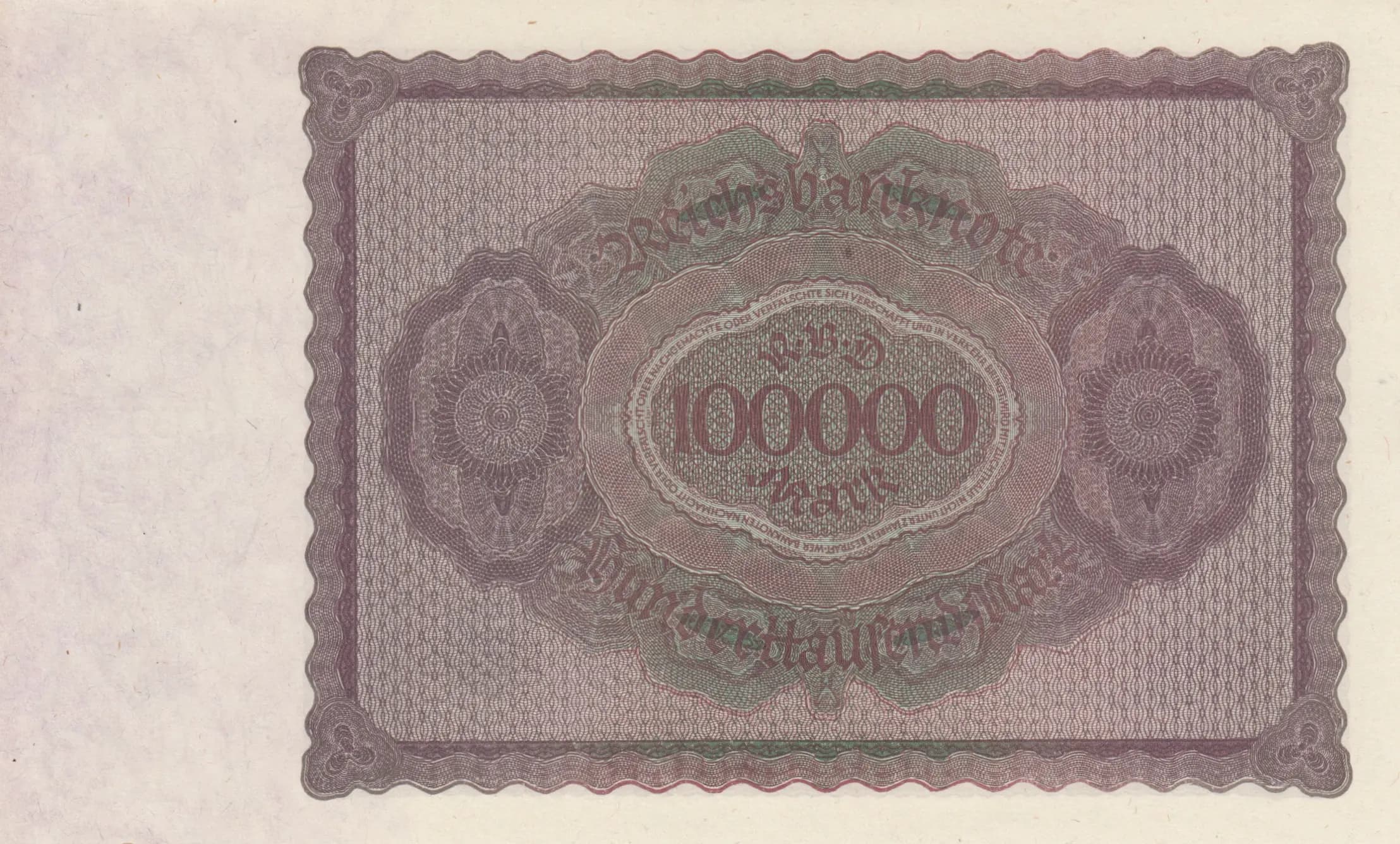
The obverse features a left-facing profile portrait of Georg Gisze, the wealthy Hanseatic merchant immortalized in Hans Holbein the Younger's 1532 painting 'The Merchant Georg Gisze,' positioned in a circular medallion on the left side of the note. The portrait is surrounded by elaborate ornamental borders with geometric and floral rosette patterns. The denomination 'Hundertttausend Mark' (100,000 Mark) is prominently displayed in Gothic Fraktur script across the center. Two circular seals or imperial insignia appear at the bottom center. The entire background is filled with fine line engraving and intricate guilloche patterns in purple-mauve and brown tones. The reverse presents a more purely decorative design, with a large central oval cartouche containing the numeral '100000' surrounded by symmetrically arranged ornamental rosettes and elaborate filigree work. Serial numbers appear in green on both the obverse (top right and bottom left) in the prefix format observed (9p and 9D variants).
Front: 'Reichsbanknote' (Imperial Bank Note); 'Hundertttausend Mark' (One Hundred Thousand Mark); 'zahlbar die Reichsbankhauptkasse in Berlin gegen diese Banknote dem Uberbringer. Berlin, den 1. Februar 1923 Reichsbankdirektorium' (Payable by the Reichsbank main cash office in Berlin against this banknote to the bearer. Berlin, February 1, 1923 Reichsbank Directorate); Serial numbers '9p 000521' (top right) and '9D 000521' (bottom left). Back: 'Reichsbanknote' (Imperial Bank Note, top); '100000' (central oval cartouche); 'Eintausenddmark' (One Thousand Mark, bottom in decorative script). Note: The inscription on the reverse showing 'Eintausenddmark' appears to be part of the security design standard for these high-denomination notes of the series.
This note was produced using intaglio engraving and fine line guilloche printing, the standard security printing method for Reichsbank notes of the period. The intricate geometric patterns, fine line work, and detailed ornamental designs visible throughout the note are characteristic of high-security intaglio processes. The note was printed by the Reichsbank's authorized security printer; for German banknotes of this era, this was typically the Reichsdruckerei (Reich Printing Office) or affiliated security printers contracted by the Reichsbank.
This example appears to be Pick-83d based on the catalog data provided. The visual analysis shows serial number prefixes '9p' and '9D', which may indicate specific variety characteristics within the P-83 series. The catalog reference notes variants P-83a and P-83b exist for this base Pick number, suggesting this note may represent a distinct printing or issue variant, though the exact variety designation (whether this is 83a, 83b, 83c, or 83d) would require comparison with detailed Pick catalog specifications regarding serial number prefixes, plate numbers, or other distinguishing features not fully discernible from the image alone.