100 000 mark 1923
Market Prices
76 salesAbout This Note
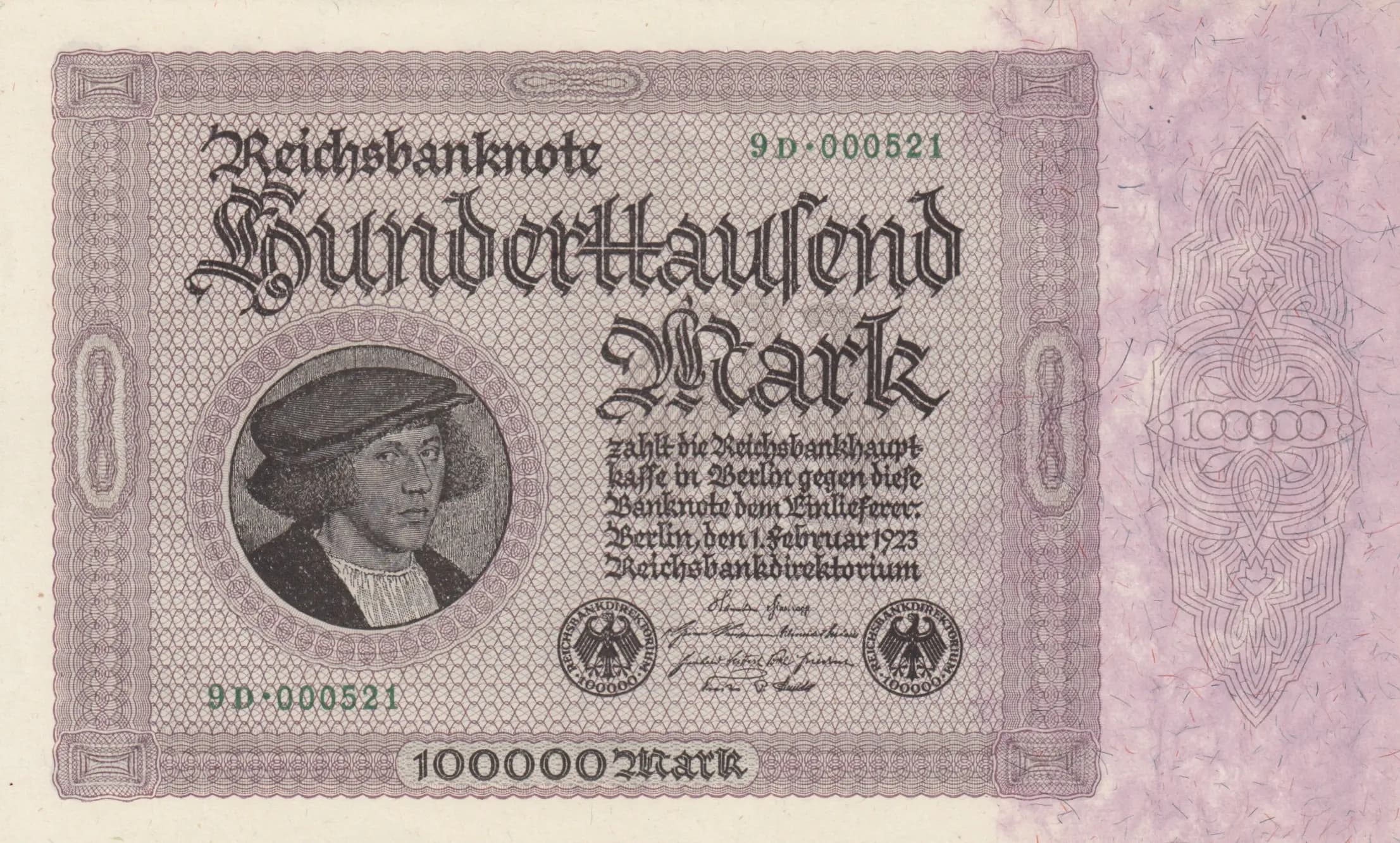
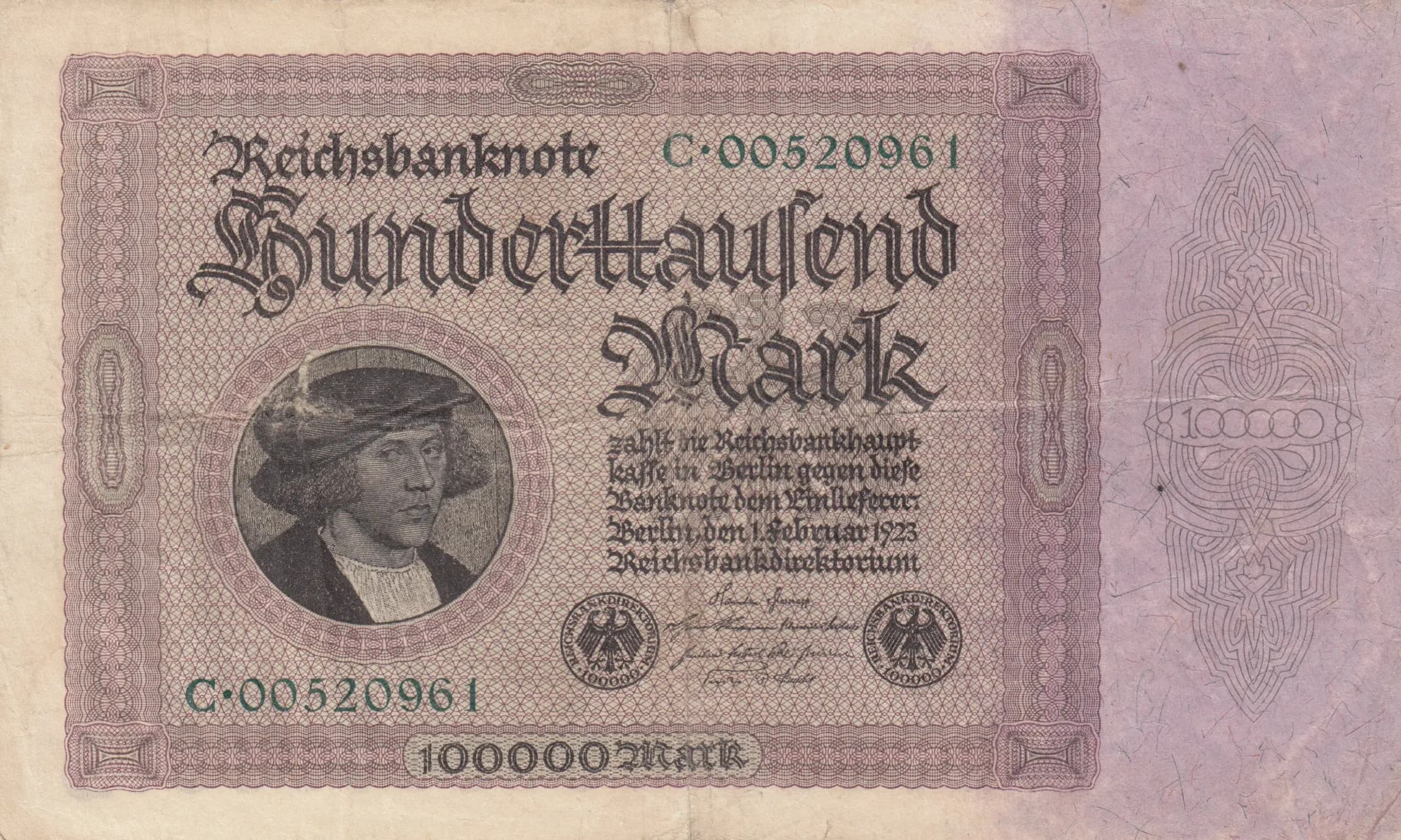
This 100,000 Mark note from February 1923 represents a fascinating artifact of Germany's hyperinflation crisis, featuring an Art Nouveau-style portrait medallion of merchant Georg Gisze after Hans Holbein the Younger on the obverse. The note displays characteristic period wear with visible foxing, creasing, and tonal discoloration consistent with its Fair grade, yet the intricate ornamental borders and dual eagle seals remain clearly defined. As a P-83a variant without the left portrait 'T' marking, this note exemplifies the emergency currency issued during the peak of Weimar's monetary collapse.
Common. The 100,000 Mark P-83a was issued in substantial quantities during February-August 1923 as part of the emergency hyperinflation currency series. eBay market data confirms common status: examples in Fair condition have sold for under $1-5 consistently since 2010, with UNC examples typically reaching only $8-20 and even professionally graded PMG 66 specimens selling in the $30-70 range. These notes were produced in the millions and remain abundant in the collector market. The denomination, while dramatic, is not scarce.
Issued on February 1, 1923, during the acute phase of German hyperinflation that would culminate in the currency reform of November 1923, this banknote reflects the Reichsbank's desperate attempt to maintain circulation as denominations spiraled exponentially upward. The selection of Georg Gisze—a 16th-century Hanseatic merchant depicted by Renaissance master Hans Holbein—may have been intended to evoke historical German mercantile strength during a period of economic catastrophe. The ornate Art Nouveau decorative scheme and dual imperial eagle seals represent the last vestiges of formal Reichsbank design before the complete collapse of the mark's purchasing power.
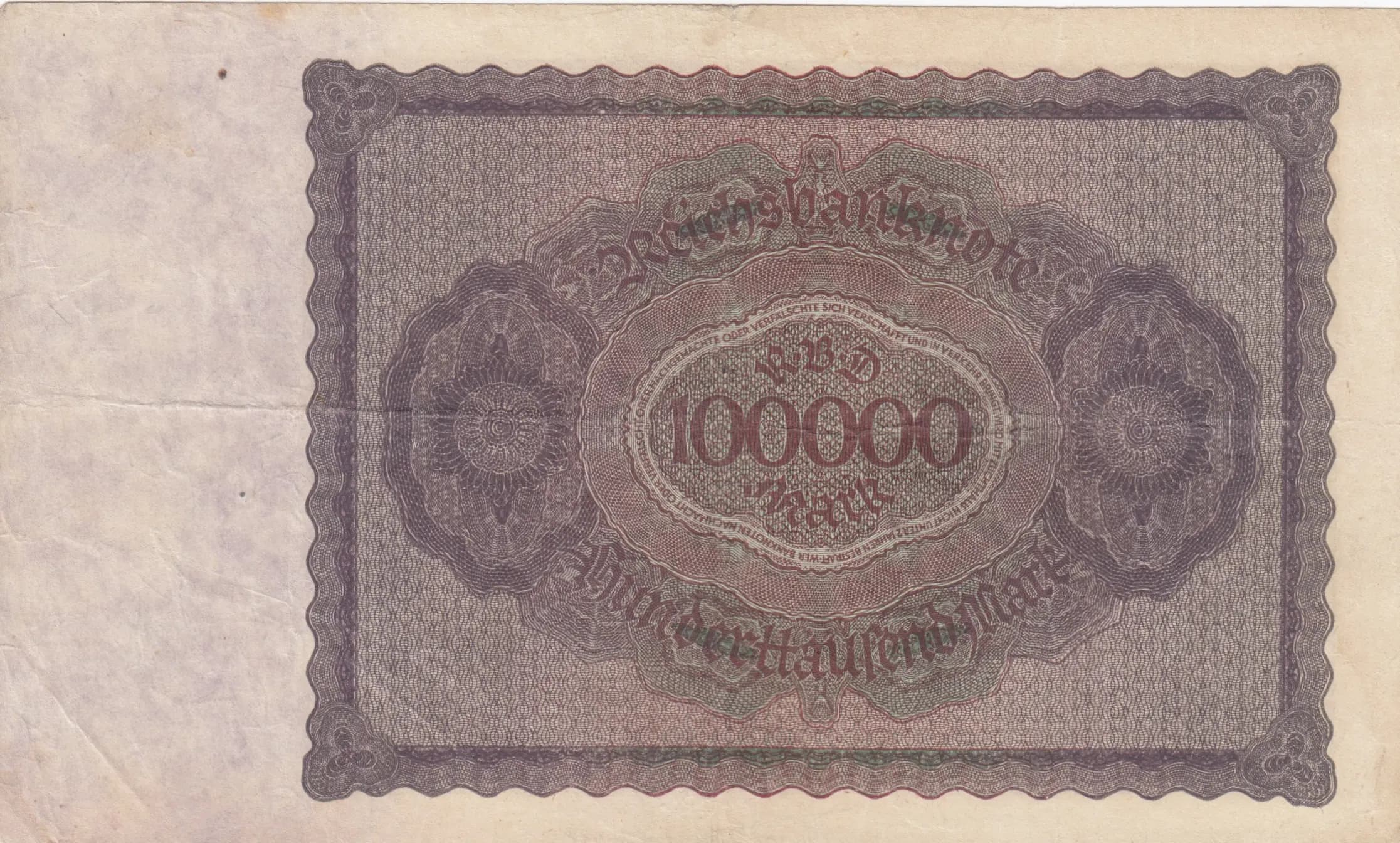
The obverse features a circular portrait medallion on the left containing the profile of Georg Gisze, the 16th-century Hanseatic merchant, facing right and wearing period clothing with a distinctive cap—after the renowned painting by Hans Holbein the Younger. The central design displays 'Hundertlauſend Mark' in large ornamental typography with 'Reichsbanknote' positioned above. Two circular seals containing imperial German eagles are positioned symmetrically at the bottom center, representing official Reichsbank authority. The entire composition is framed by intricate Art Nouveau-style geometric and ornamental borders in purple and mauve tones. The reverse features a predominantly symmetrical design with a large central oval cartouche displaying '100000,' flanked by two substantial circular ornamental medallions with geometric patterns on left and right sides. The back maintains the same purple-mauve color scheme with fine geometric mesh patterns throughout, and ornamental German text in stylized script positioned above and below the central denomination.
Front: 'Reichsbanknote' (Reichsbank Note) — issuing authority designation; 'Hundertlauſend Mark' (One Hundred Thousand Mark) — denomination in words; '100000 Mark' — denomination in numerals; 'C 00520961' — serial number (appears twice, top right and bottom left). Back: 'Reichsbanknote' (Reichsbank Note); '100000' — denomination numeral within central oval cartouche; ornamental German text in stylized script flanking the central design (specific text not legible in analysis but consistent with official Reichsbank formatting).
Intaglio engraving (line engraving/recess printing), the standard security printing method for Reichsbank notes of this period. The fine line work visible in the ornamental borders, the detailed circular portrait medallion, the geometric mesh patterns, and the intricate eagle seals all demonstrate characteristics of intaglio production. The color application (purple-mauve with brown tones) appears to be multi-plate printing typical of German banknote production in the early Weimar period, likely produced by one of the authorized German banknote printers (Giesecke+Devrient or similar contemporary security printer).
This note is identified as P-83a, one of two catalogued variants for the 100,000 Mark denomination (P-83a and P-83b per PMG population data). The distinguishing characteristic of P-83a is the absence of a 'T' marking at the left of the portrait, as confirmed by the realbanknotes.com reference noting 'Without T at left of portrait.' The serial number visible on this example (C 00520961) indicates a mid-range serial from the production run. No additional overprints or signature variants are apparent from the visual analysis.