1 rupee 1915
About This Note
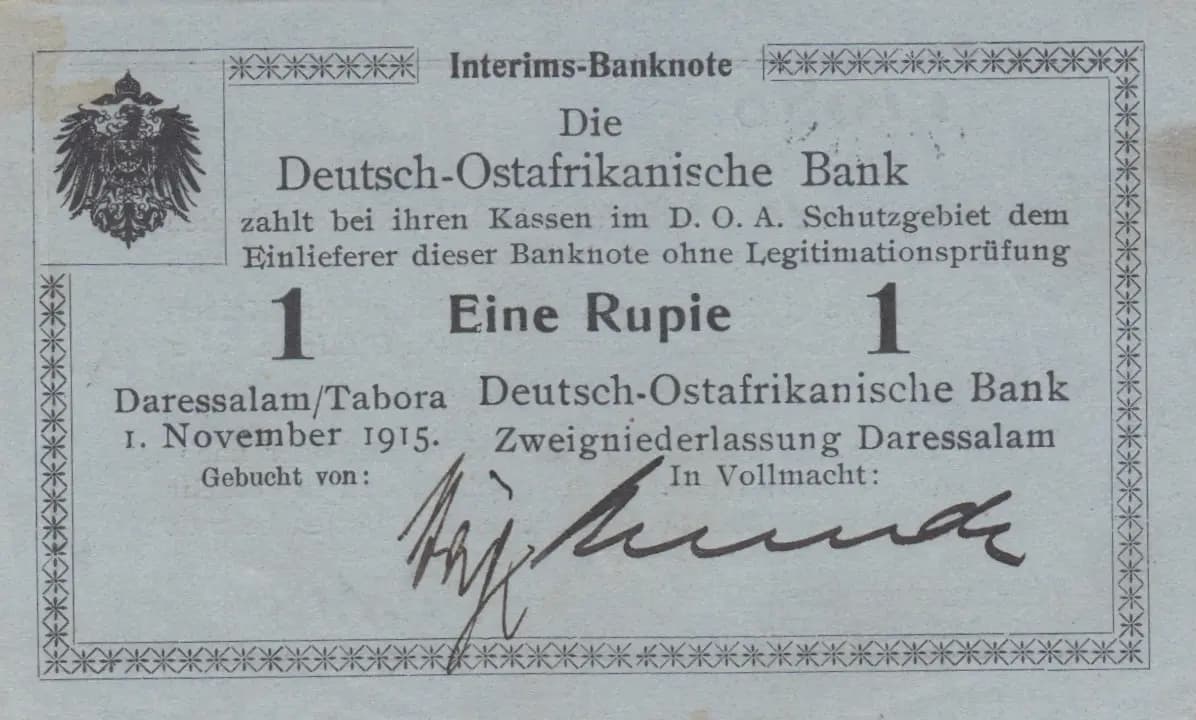
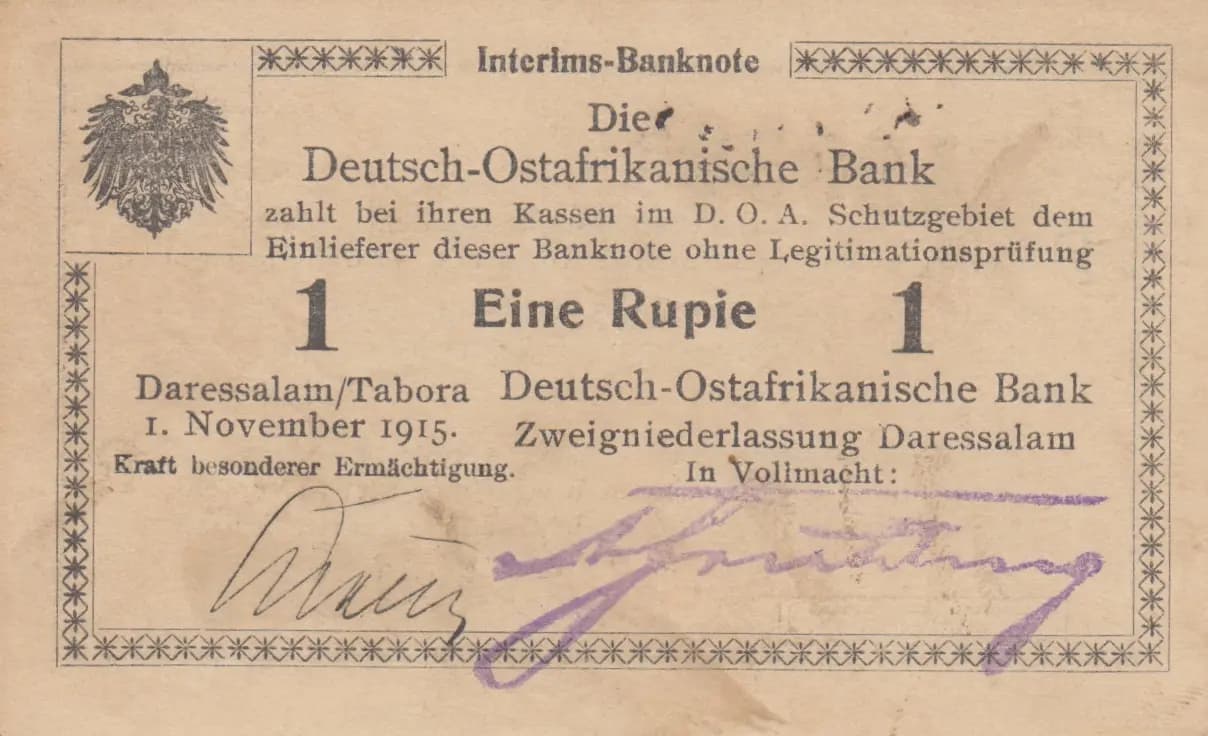
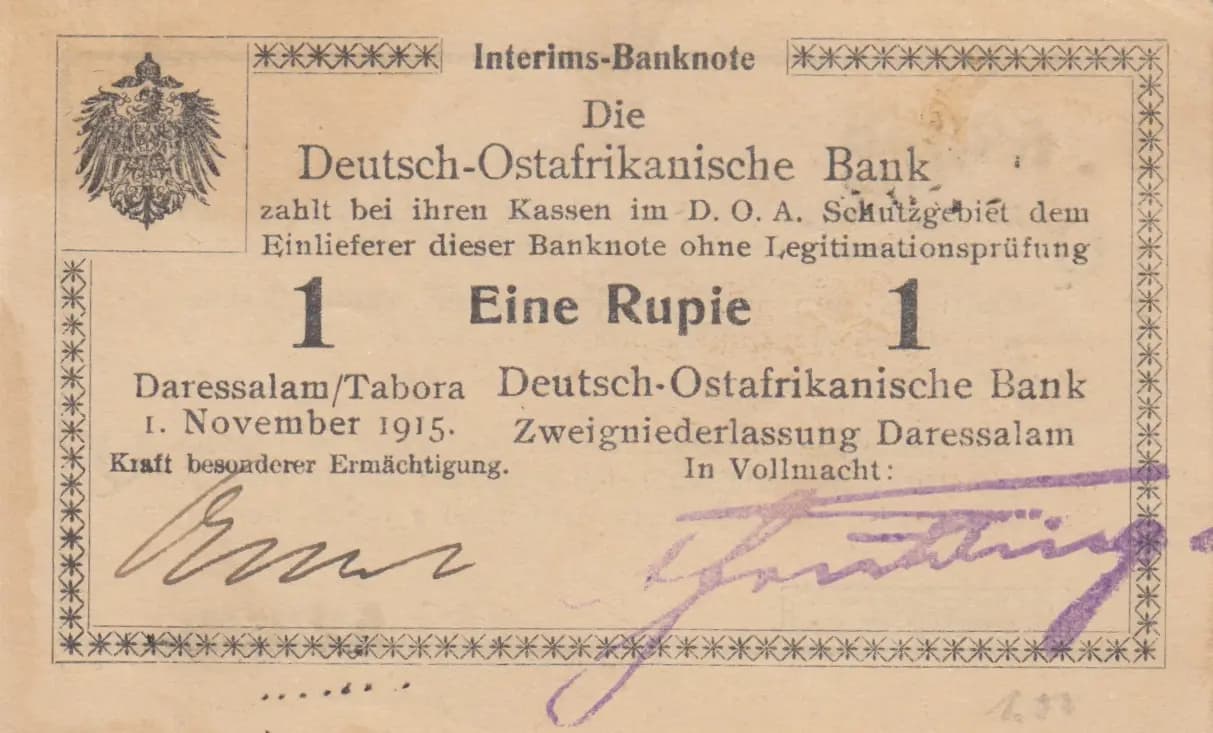
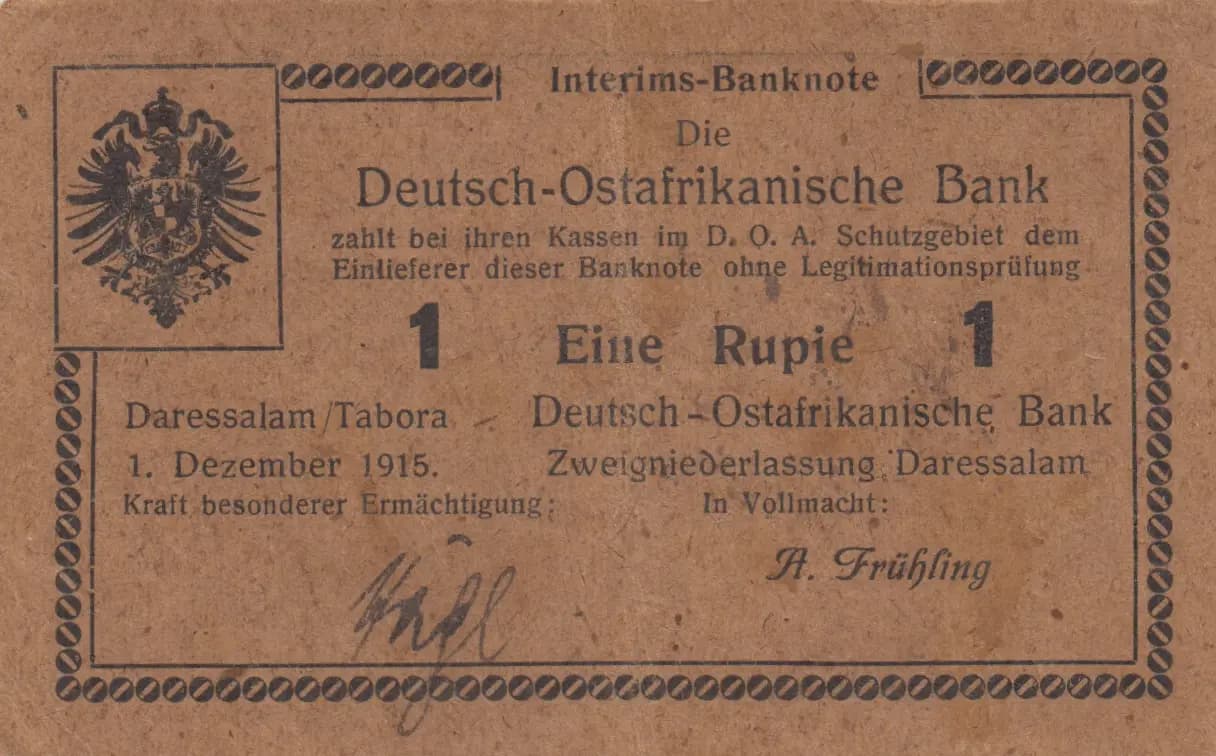
This is a 1 Rupee interim banknote (Interims-Banknote) issued by the Deutsch-Ostafrikanische Bank on December 1, 1915, during Germany's control of East Africa. The note features the German imperial eagle (Reichsadler) within a rectangular frame on the front and displays tan/brown paper coloration with black printing characteristic of WWI-era emergency currency. In EF condition, the note shows expected age-related browning and foxing but maintains excellent structural integrity with clear, legible text and imagery—a desirable example of this scarce interim issue from a collapsing colonial administration.
Uncommon. This Pick-15 interim note from the final years of German East African colonial rule was issued in limited quantities during an economically stressed period of WWI. The emergency nature of the issuance and the subsequent collapse of German colonial authority in 1916-1917 likely resulted in significant attrition and destruction of surviving examples. EF-graded specimens are particularly scarce, as the fragile paper stock and extended age have rendered most surviving examples in lower grades. While not extremely rare, this note represents a genuinely scarce piece of colonial numismatics that commands attention from specialized collectors.
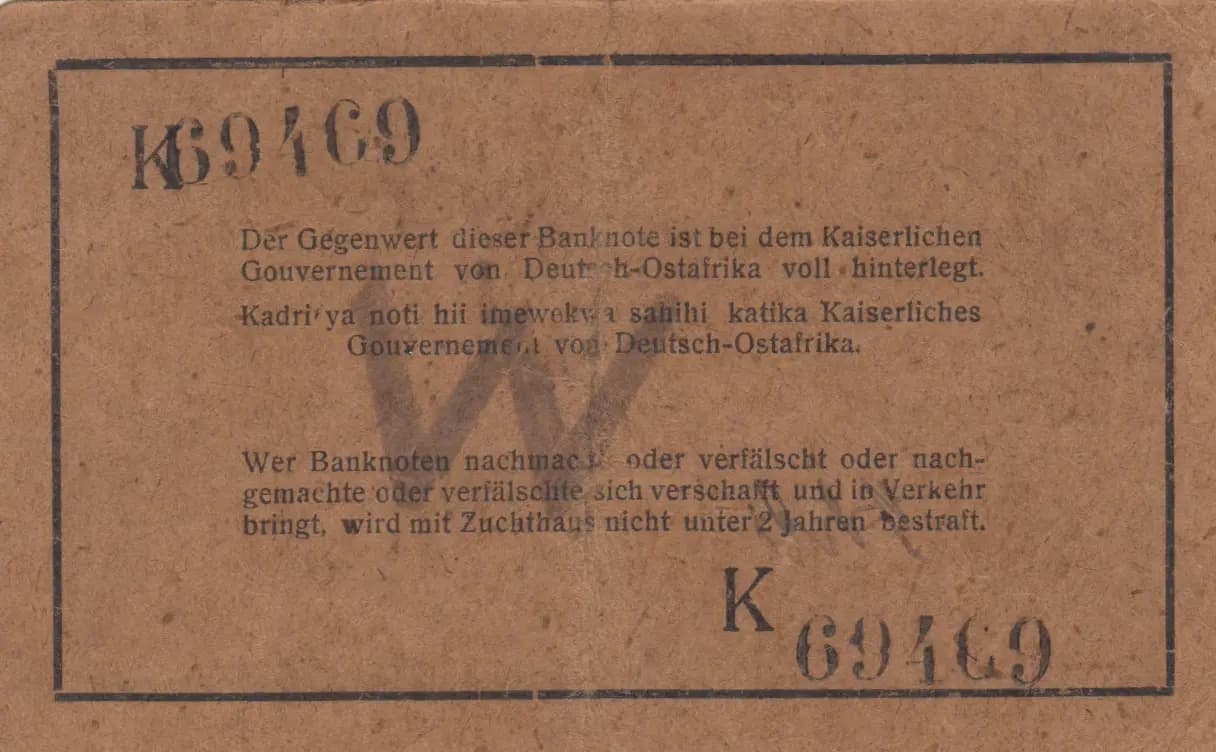
This interim banknote was issued during the final years of German East Africa (Deutsch-Ostafrika), when Germany's overseas colonies faced economic isolation due to World War I. The Deutsch-Ostafrikanische Bank issued these emergency notes to maintain liquidity in the colony, with the front featuring the German imperial eagle as a symbol of imperial authority. The bilingual German-Swahili inscriptions on the reverse reflect the colonial administration's need to communicate with both German settlers and the local African population under German rule.
The front of this interim banknote prominently displays the German imperial eagle (Reichsadler) with crown and shield positioned within a rectangular decorative frame on the left side, serving as the primary heraldic symbol of German imperial authority in the colony. The denomination '1 Rupie' is displayed centrally in large numerals. The note is framed by decorative scalloped borders running the entire perimeter, a typical design element of early 20th-century colonial currency. The reverse side contains no pictorial elements, instead featuring exclusively typographic content in two languages—German and Swahili—printed in black ink on the tan/brown paper stock. The legal guarantees and counterfeiting penalties are prominently displayed, with the serial number K(63)469 appearing in opposite corners.
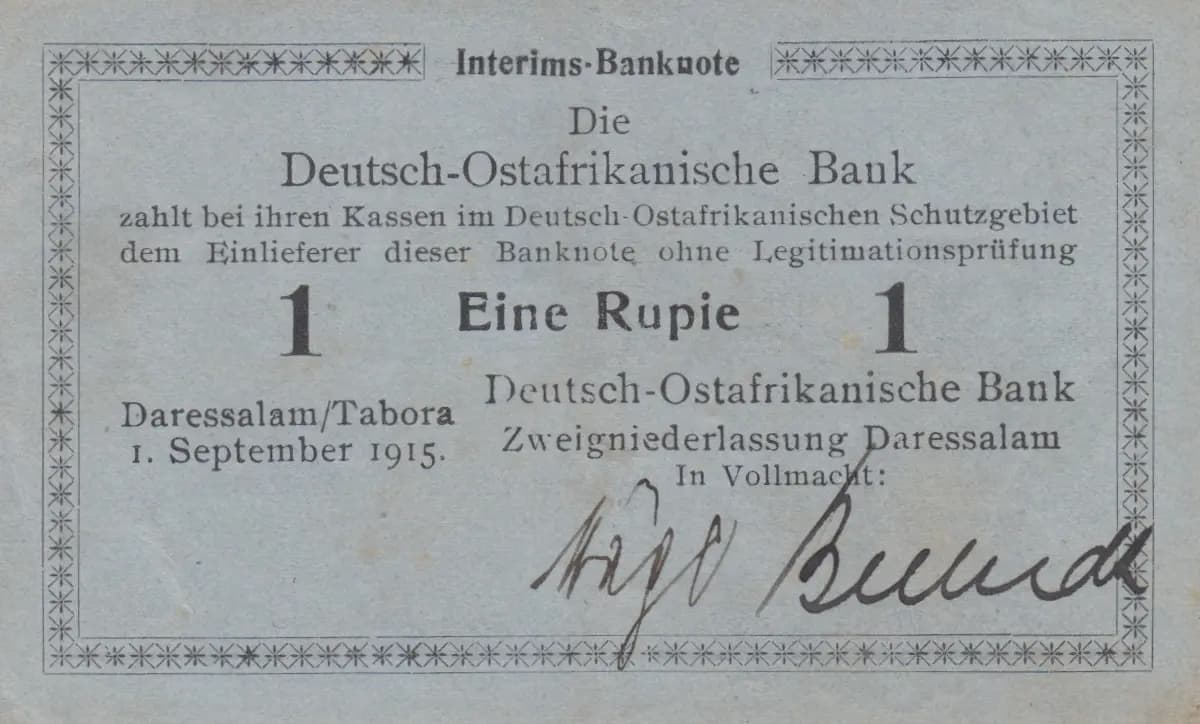
FRONT: 'Interims-Banknote' (Interim Banknote) — 'Die Deutsch-Ostafrikanische Bank' (The German East African Bank) — 'zahlt bei ihren Kassen im D. O. A. Schutzgebiet dem Einlieferer dieser Banknote ohne Legitimationsprüfung' (pays at its cashiers in the D.O.A. protected territory to the depositor of this banknote without legitimation examination) — '1 Eine Rupie 1' (1 One Rupee 1) — 'Deutsch-Ostafrikanische Bank' (German East African Bank) — 'Zweigniederlassung Daressalam' (Branch Dar es Salaam) — 'Daressalam/Tabora' (Dar es Salaam/Tabora) — '1. Dezember 1915' (1st December 1915) — 'Kraft besonderer Ermächtigung' (By special authority) — 'In Vollmacht' (In full power) — Signed by 'R. Fräßling' (signature). BACK: 'K(63)469' (Serial/reference number) — 'Der Gegenwert dieser Banknote ist bei dem Kaiserlichen Gouvernement von Deutsch-Ostafrika voll hinterlegt' (The equivalent of this banknote is fully deposited with the Imperial Government of German East Africa) — Swahili version: 'Kadri'ya noti hit imewekw a sahithi katika Kaiserliches Gouvernement vod Deutsch-Ostafrika' (The equivalent value of this note has been deposited with the Imperial Government of German East Africa) — 'Wer Banknoten nachmacht oder verfälscht oder nachgemachte oder verfälschte sich verschafft und in Verkehr bringt, wird mit Zuchthaus nicht unter 2 Jahren bestraft' (Whoever counterfeits or forges banknotes or acquires counterfeit or forged ones and puts them into circulation will be punished with at least 2 years imprisonment).
This note was produced using letterpress printing technology, the standard method for banknote production in 1915. The black ink impressions are clean and uniform across both sides, with crisp definition of the eagle emblem and text. The paper stock shows characteristics consistent with security printing practices of the era, though the aging and foxing observed in the EF example reflects natural deterioration over more than a century rather than printing defects. The dual-language composition on the reverse required multiple typographic setting and printing passes to achieve alignment.
This example bears the signature of R. Fräßling and is dated 1. Dezember 1915 (1st December 1915). The serial number K(63)469 is noted in both upper left and lower right corners of the reverse. Varieties of this interim issue may be identified by different signatory officials or date variations within the 1915 issuance window, though Pick-15 is primarily documented from the December 1915 authorization period. No major overprint varieties or date variations are noted for this Pick number.