1 rupee 1915
About This Note
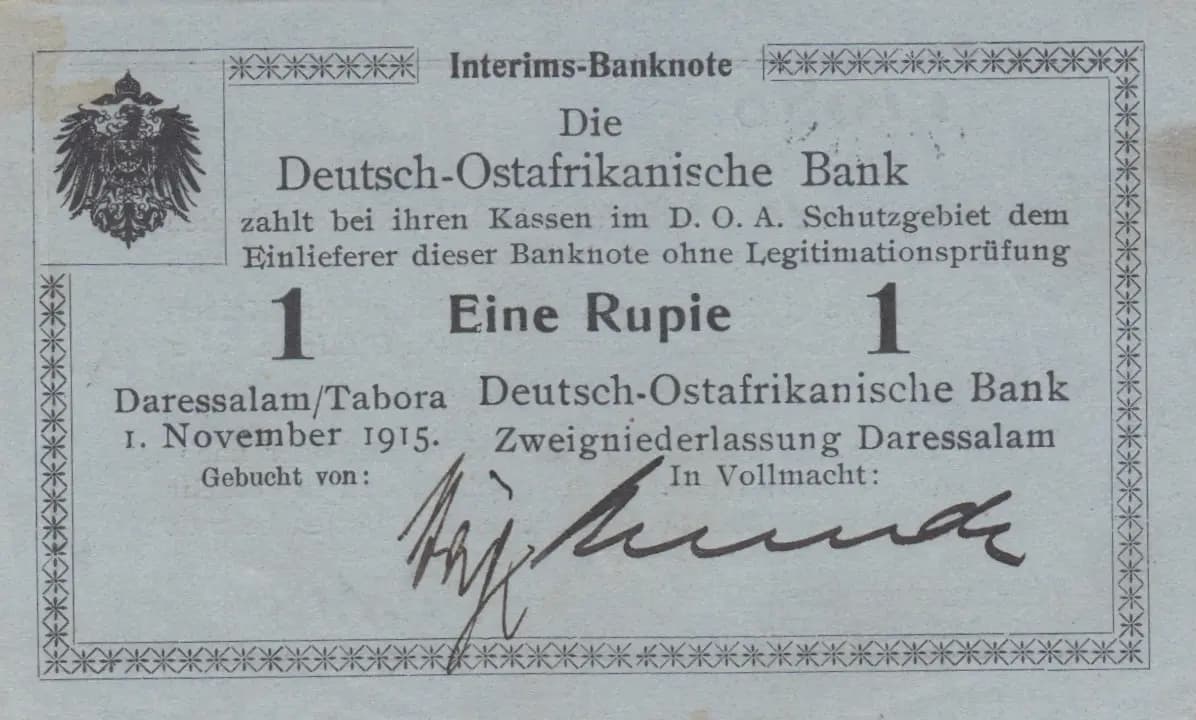
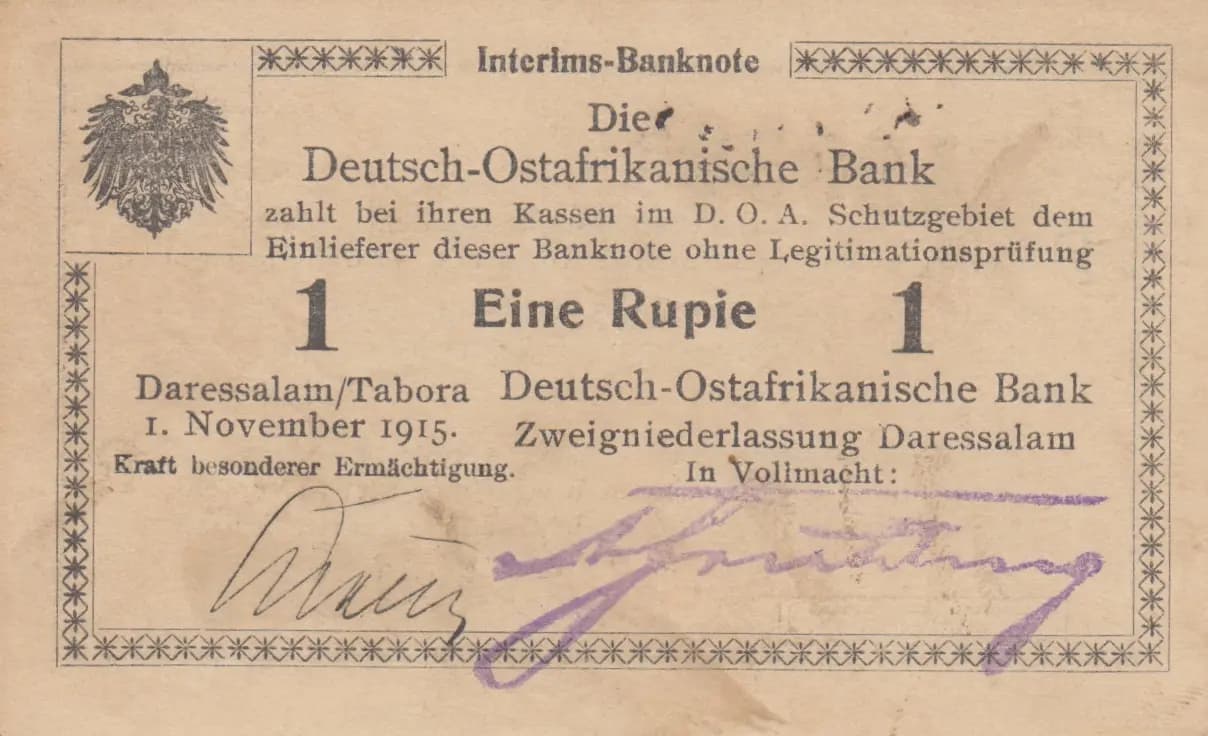
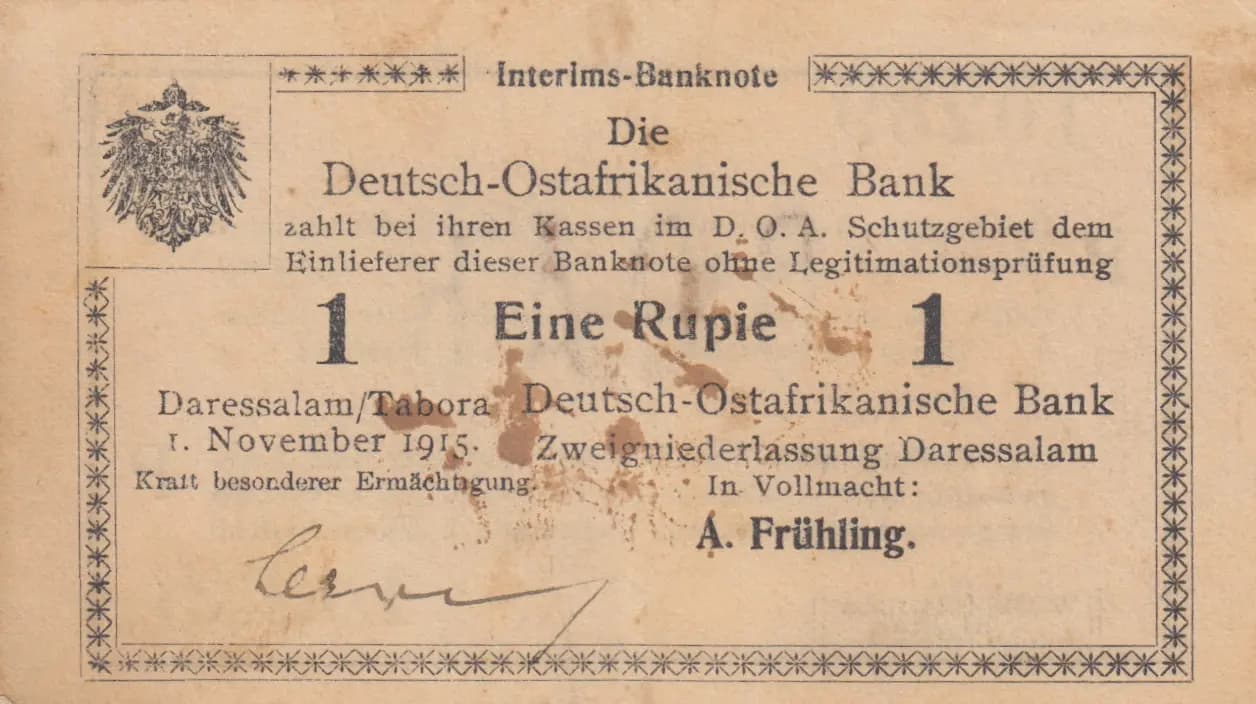
This is a German East African 1 Rupee interim banknote from November 1, 1915, issued by the Deutsch-Ostafrikanische Bank during World War I. The note features an ornate decorative border with the German Imperial double-headed eagle coat of arms prominently displayed, and includes bilingual text in German and Swahili reflecting the colonial administration of German East Africa. In VF condition with heavy foxing, age discoloration, and brown staining typical of early 20th-century tropical currency, this interim note represents a fascinating monetary artifact from the final years of German colonial rule in East Africa.
Common. The Deutsch-Ostafrikanische Bank 1 Rupee 1915 (Pick 12c) was issued as an interim emergency note with a substantial print run typical of wartime currency necessities. No evidence exists of limited mintage, recall, or extreme scarcity. These notes circulated relatively freely in German East Africa until the German colonial administration's collapse in 1918. While the note is historically significant and interesting to collectors of colonial African currency and World War I-era emergency money, it is not rare in numismatic terms and commonly appears in dealer stock and collections focused on this region and period.
This interim banknote was issued during World War I when German East Africa faced economic disruption and the need for emergency currency solutions. The Imperial Government of German East Africa authorized these temporary notes to maintain liquidity in the protectorate's economy, with the German imperial eagle symbolizing official authority and the bilingual German-Swahili text reflecting the colonial administration's attempt to govern the diverse East African territory. The note's explicit statement that its value was 'fully deposited with the Imperial Government' was meant to assure holders of its backed status, though Germany's military fortunes were declining by late 1915.
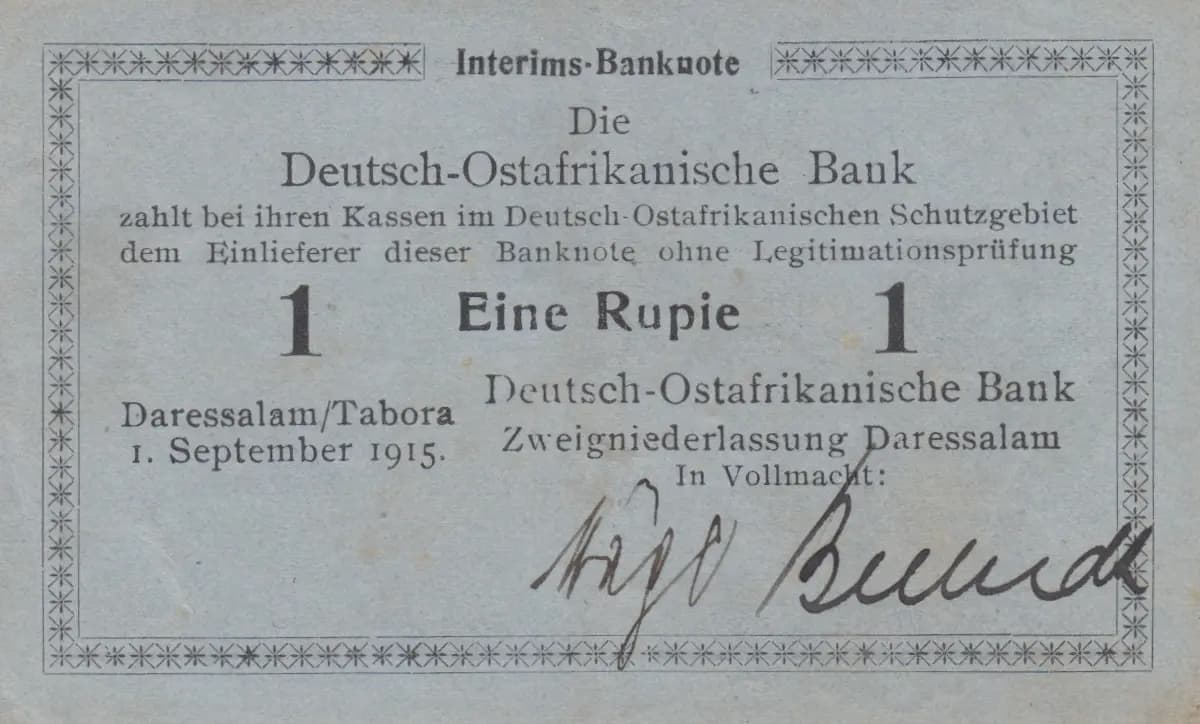
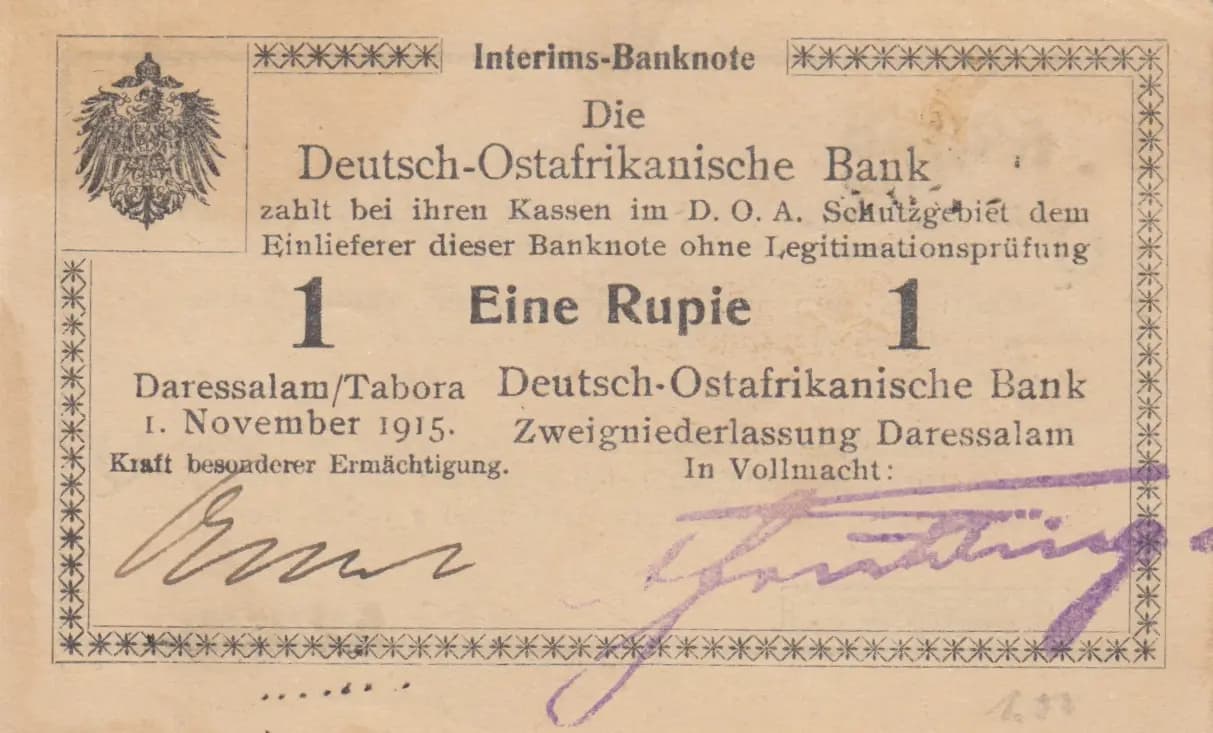
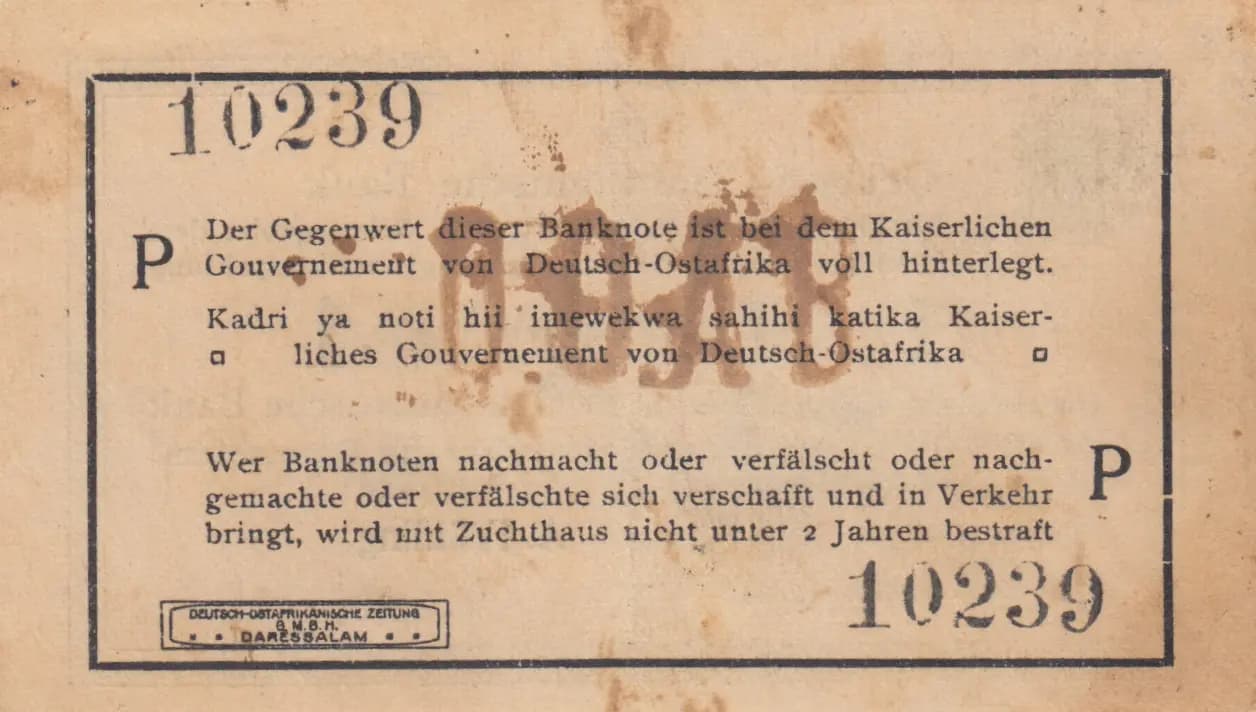
The 1 Rupee interim banknote features a formal, austere design typical of Imperial German emergency currency. The obverse displays an ornate decorative border composed of geometric cross-hatch patterns framing the entire note. Dominating the left side is the German Imperial coat of arms—a double-headed eagle wearing a crown with heraldic shield details—symbolizing official state authority. The denomination appears twice in large numerals ('1') on both left and right margins, with the text 'Eine Rupie' (One Rupee) centered. Bank information is arranged around the design, including references to the Daressalam and Tabora branches. The reverse contains security and legal text, including the serial number 10239 with 'P' prefix/suffix visible in upper left and lower right corners, counterfeiting warnings in German, a deposit guarantee statement in both German and Swahili, and a small printer's mark attributable to the Deutsch-Ostafrikanische Zeitung in Daressalam. The color scheme consists of sepia, brown, and cream tones on what was originally a lighter base.
FRONT SIDE: 'Interims-Banknote' (Interim Banknote) / 'Die Deutsch-Ostafrikanische Bank' (The German East African Bank) / 'zahlt bei ihren Kassen im D.O.A. Schutzgebiet dem Einlieferer dieser Banknote ohne Legitiationsprüfung' (pays at its counters in the D.O.A. protectorate to the depositor of this banknote without legitimation examination) / '1' and 'Eine Rupie' (One Rupee) / 'Deutsch-Ostafrikanische Bank' (German East African Bank) / 'Zweigniederlassung Daressalam' (Branch Daressalam) / 'Daressalam/Tabora' (Daressalam/Tabora) / '1. November 1915' (1 November 1915) / 'Kraft besonderer Ermächtigung' (By special authorization) / 'In Vollmacht: A. Frühling' (By power of attorney: A. Frühling) / BACK SIDE: '10239' (serial number) with 'P' prefix and suffix / 'Der Gegenwert dieser Banknote ist bei dem Kaiserlichen Gouvernement von Deutsch-Ostafrika voll hinterlegt' (The equivalent value of this banknote is fully deposited with the Imperial Government of German East Africa) / 'Kadri ya noti hii imewekwa sahihi katika Kaiserliches Gouvernement von Deutsch-Ostafrika' (The value of this note is properly certified with the Imperial Government of German East Africa - bilingual German-Swahili) / 'Wer Banknoten nachmacht oder verfälscht oder nachgemachte oder verfälschte sich verschafft und in Verkehr bringt, wird mit Zuchthaus nicht unter 2 Jahren bestraft' (Whoever counterfeits or forges banknotes or procures counterfeit or forged notes and puts them into circulation will be punished with hard labor for not less than 2 years) / 'DEUTSCH-OSTAFRIKANISCHE ZEITUNG . . . DARESSALAM' (German East African Newspaper . . . Daressalam - printer's mark).
This interim banknote was produced using letterpress printing, a standard technique for emergency currency of the World War I era. The ornate geometric borders, clear text, and heraldic imagery are characteristic of early 20th-century letterpress production. The printer's mark visible on the reverse ('DEUTSCH-OSTAFRIKANISCHE ZEITUNG . . . DARESSALAM') indicates printing by the German East African Newspaper press in Daressalam, rather than by a specialized security printer, reflecting the emergency nature of this interim issue. Security features were minimal and relied on the printed warning text against counterfeiting rather than sophisticated anti-counterfeiting technology.
This specific example is identified as Pick 12c, with serial number P10239P. The 'P' prefix and suffix on the serial number represents one identifiable variety for this issue. The note is dated '1. November 1915' and is signed by A. Frühling ('In Vollmacht'), which represents the authorized signatory for this batch. Different signatures and serial number patterns exist across the print run, creating minor collecting varieties, though no major overprint varieties or distinct sub-types have been cataloged for this denomination by Pick. Condition and signature variations are the primary points of differentiation among surviving examples.