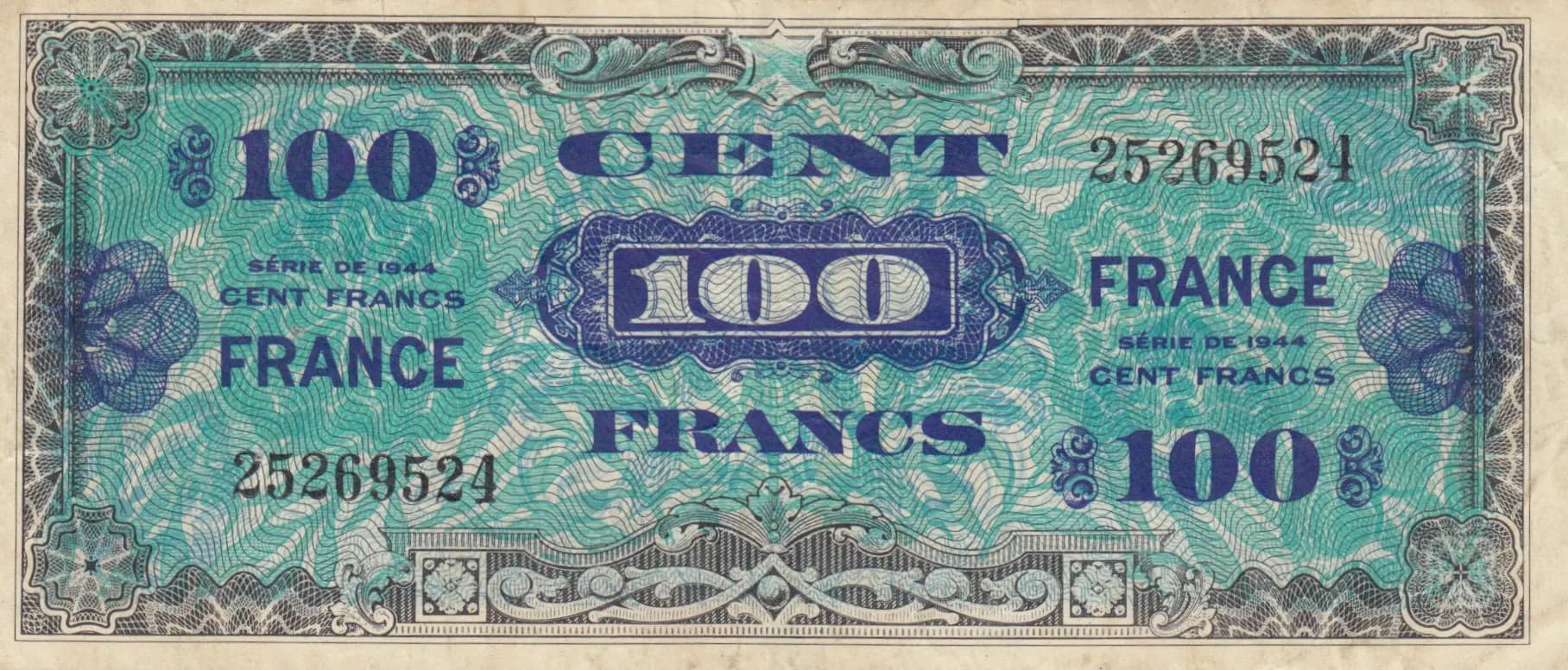
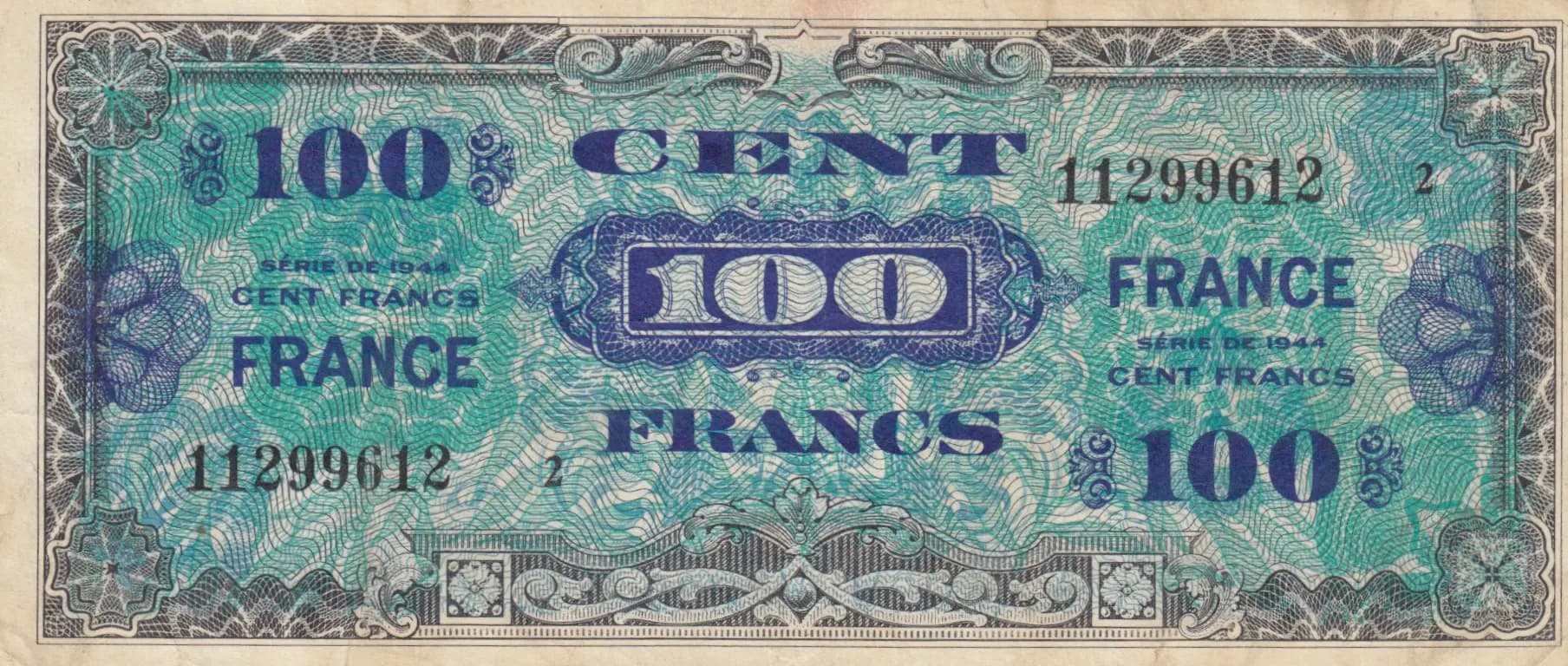
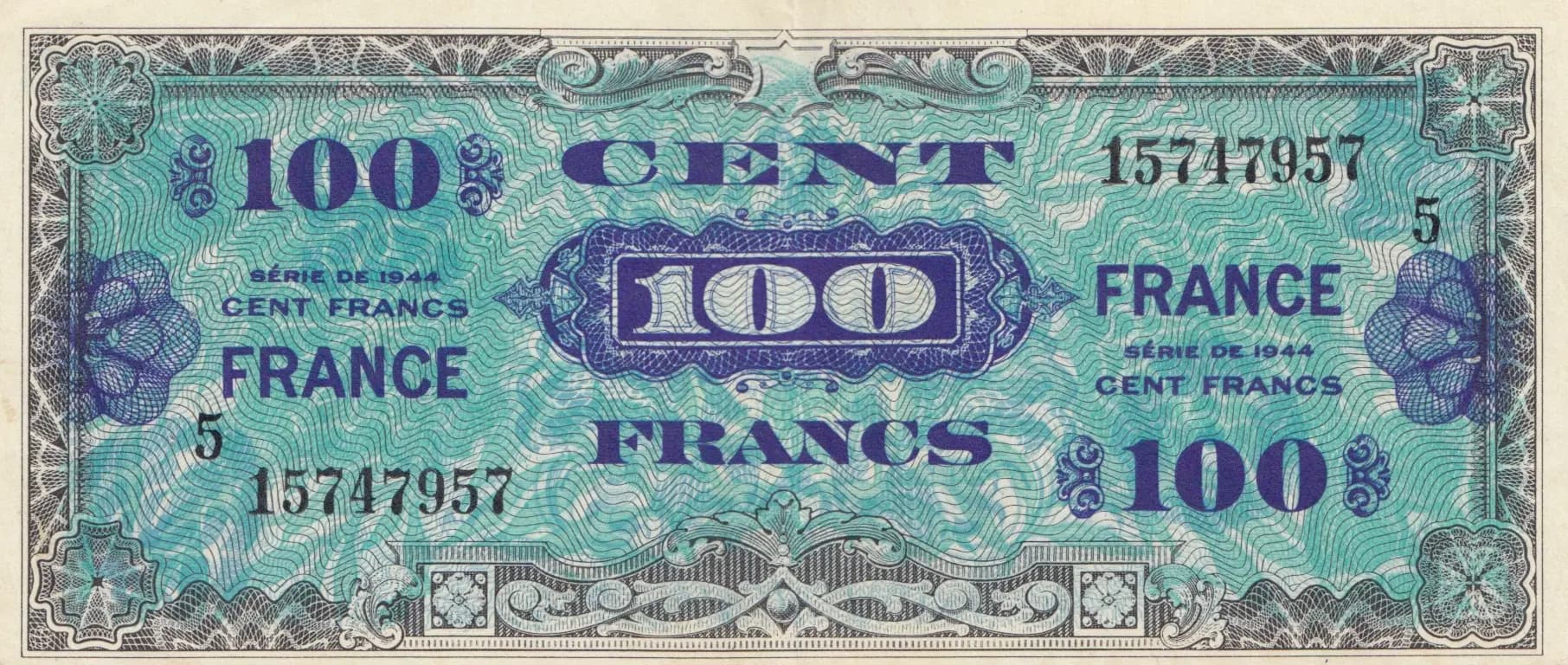
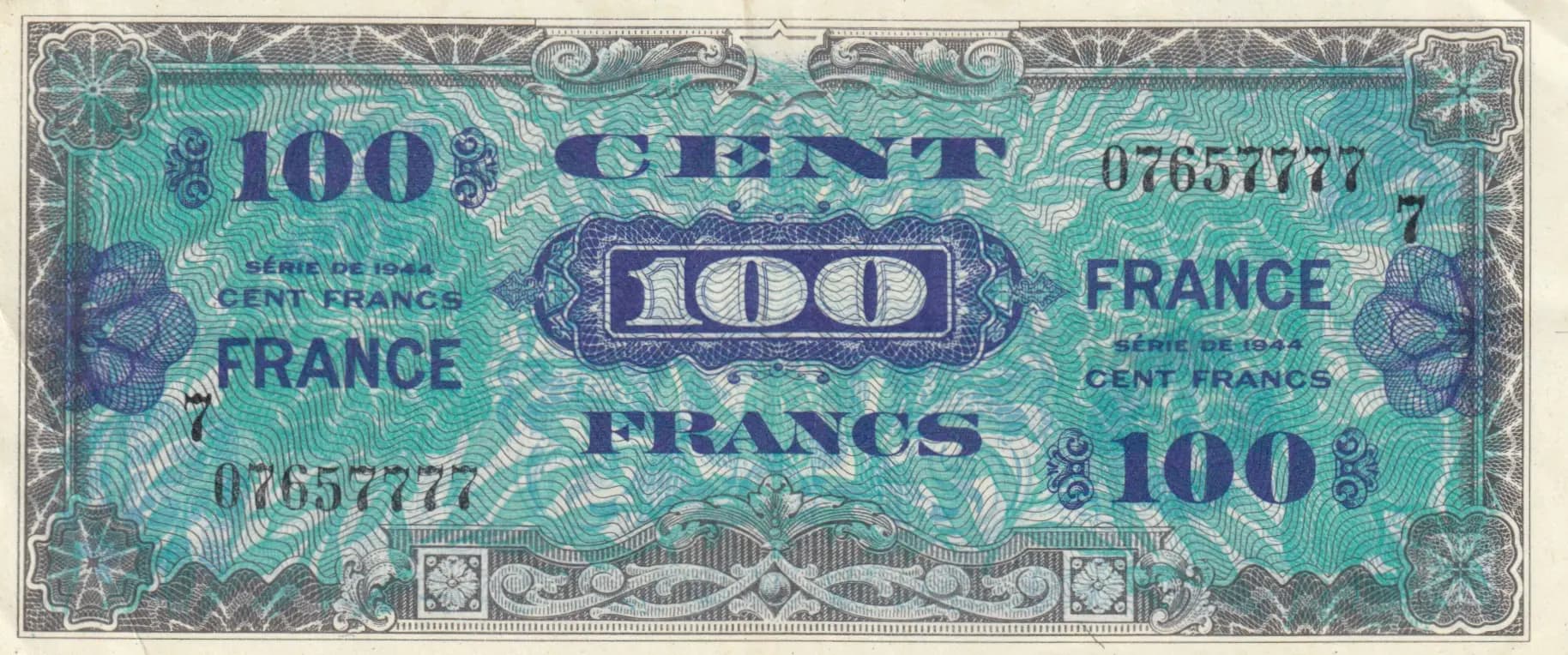
100 francs 1944
Market Prices
28 salesAbout This Note
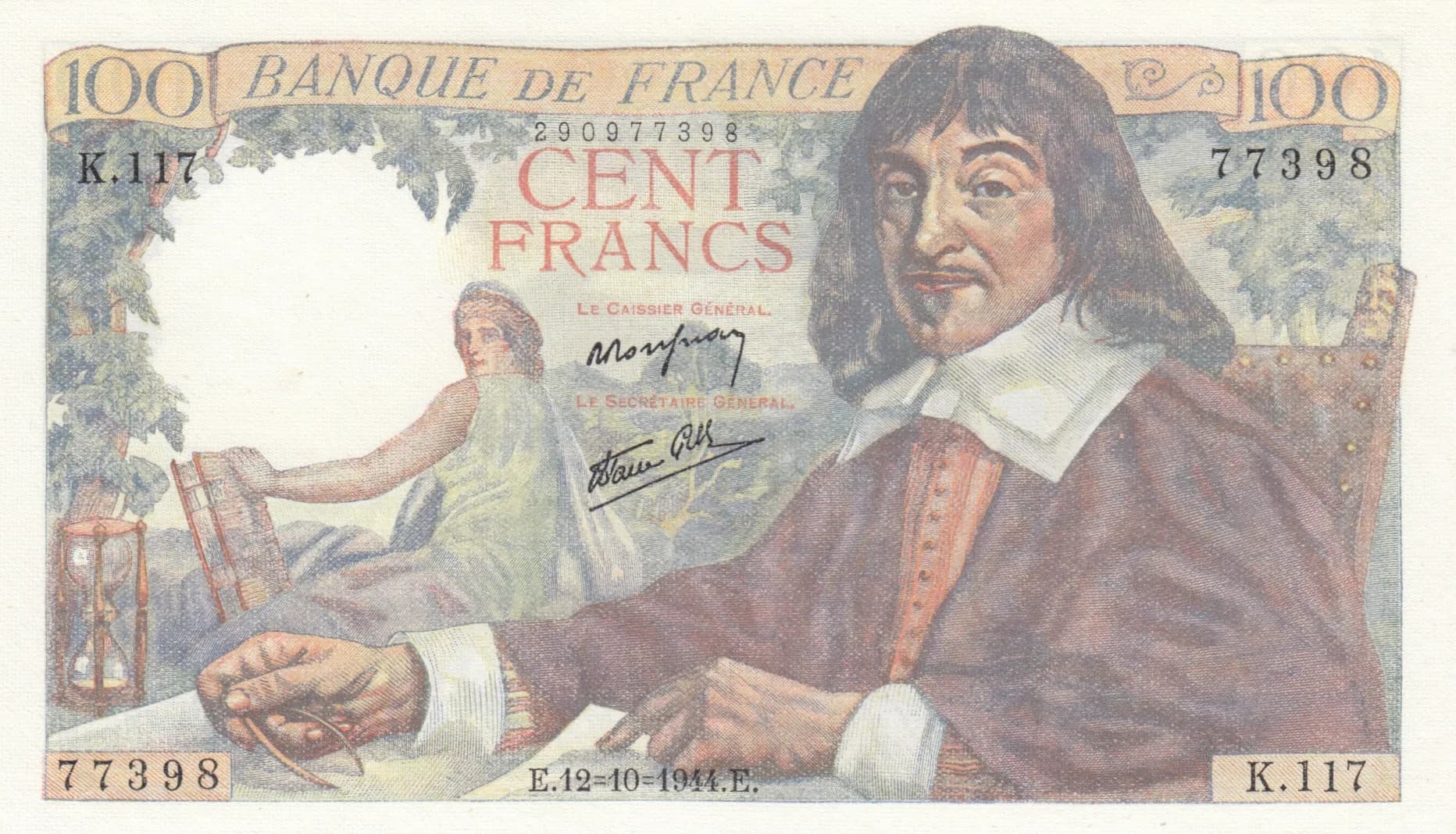
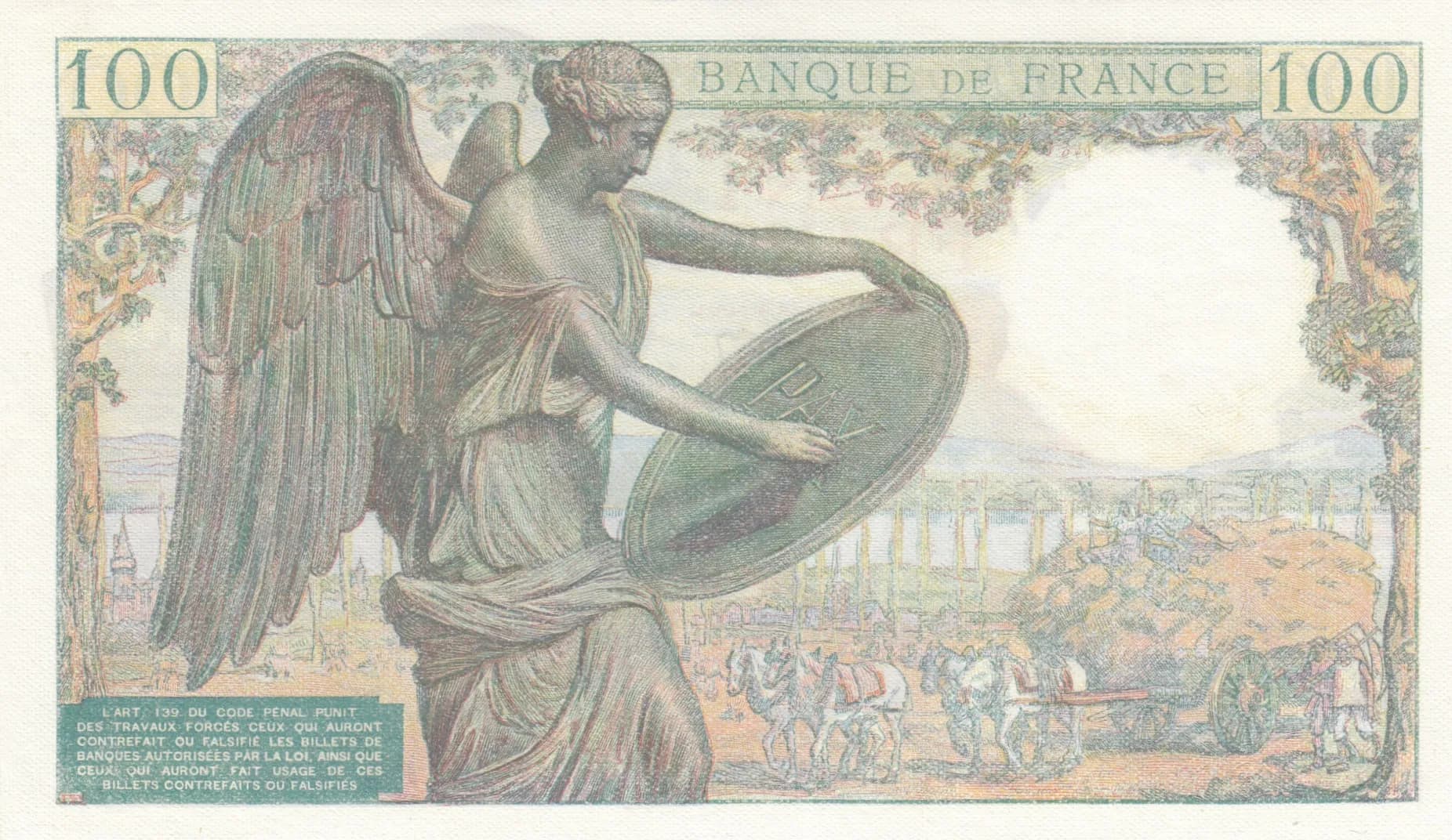
This is a 1944 100 Francs banknote from the Banque de France, commonly known as the 'Descartes' note among collectors, featuring René Descartes in 17th-century dress on the obverse. The note exhibits UNC condition with a cream/beige background and rich color palette including burgundy, green, and blue tones, showing only minor age-related foxing consistent with preservation since the 1940s. The reverse presents an allegorical winged female figure (representing Liberty or France) against an expansive cityscape, making this a significant example of French Liberation-era currency design.
Common. This banknote was issued during the immediate post-war period (1942-1944) by the Banque de France in substantial quantities. eBay market data shows numerous examples selling for $15-60 in circulated to VF condition, with UNC examples historically reaching $100-280 depending on grade specificity. The high volume of sales recorded across multiple decades and price tiers indicates widespread availability in the collector market. No significant print run restrictions or recall status apply to this Pick number.
Issued in October 1944, this banknote represents the early post-Liberation currency of France following the Nazi occupation. The selection of René Descartes—the 17th-century French philosopher and mathematician—reflects the nation's cultural pride and intellectual heritage during the period of national reconstruction. The allegorical angel figure on the reverse symbolizes France's liberation and renewed hope, embodying the spirit of the Fourth Republic's founding principles during this pivotal moment in French history.
The obverse features a three-quarter portrait of René Descartes positioned on the right side, depicted with long dark hair, pale complexion, and wearing a burgundy-brown 17th-century coat with white collar—authentic to the philosopher's historical period. Behind Descartes sits an allegorical female figure in classical dress representing France or learning, positioned against a seascape or harbor landscape. The reverse displays a monumental winged female allegorical figure (Liberty or France) in classical Greco-Roman style, semi-nude with exposed breast, holding a large shield or badge, positioned before an expansive cityscape with fortifications, buildings, and crowds of people, suggesting liberation and national renewal. Both sides feature ornamental vine and leaf motifs framing the design, with decorative scroll elements in the corners. The color scheme employs sage green, blue-gray, cream, brown, and gold tones characteristic of French engraving work of this period.
FRONT: 'BANQUE DE FRANCE' (Bank of France), 'CENT FRANCS' (One Hundred Francs), 'LE CAISSIER GÉNÉRAL' (The General Cashier), 'LE SECRÉTAIRE GÉNÉRAL' (The General Secretary), serial number K.117 77398 290977398, date marking 'E.12-10-1944.E.' (October 12, 1944), signatures of Morphy and Blaise Glis. BACK: '100 FRANCS', 'BANQUE DE FRANCE', and the legal warning: 'Article 139 of the Penal Code punishes with forced labor those who would have counterfeited or falsified banknotes authorized by law, as well as those who would have made use of these counterfeit or falsified banknotes.'
Intaglio engraving (line engraving) on steel plates, the standard method employed by the Banque de France for high-security banknote production. The detailed portraiture, fine line work in the background landscapes, and ornamental borders are characteristic of classical French engraving techniques. The printer is the Banque de France's in-house security printing facility.
Pick catalog number P-101a represents the primary variety of the 1944 100 Francs Descartes issue. The observed specimen carries the date marking 'E.12-10-1944.E.' (October 12, 1944) and serial number prefix K.117, with signatures of Morphy and Blaise Glis. Variations exist in serial number prefixes and signature combinations across the issue period. The visual analysis confirms this is a standard emission of the Liberation-era issue with no overprints or special markings indicating a rare sub-variety.