10 francs 1968
Market Prices
64 salesAbout This Note
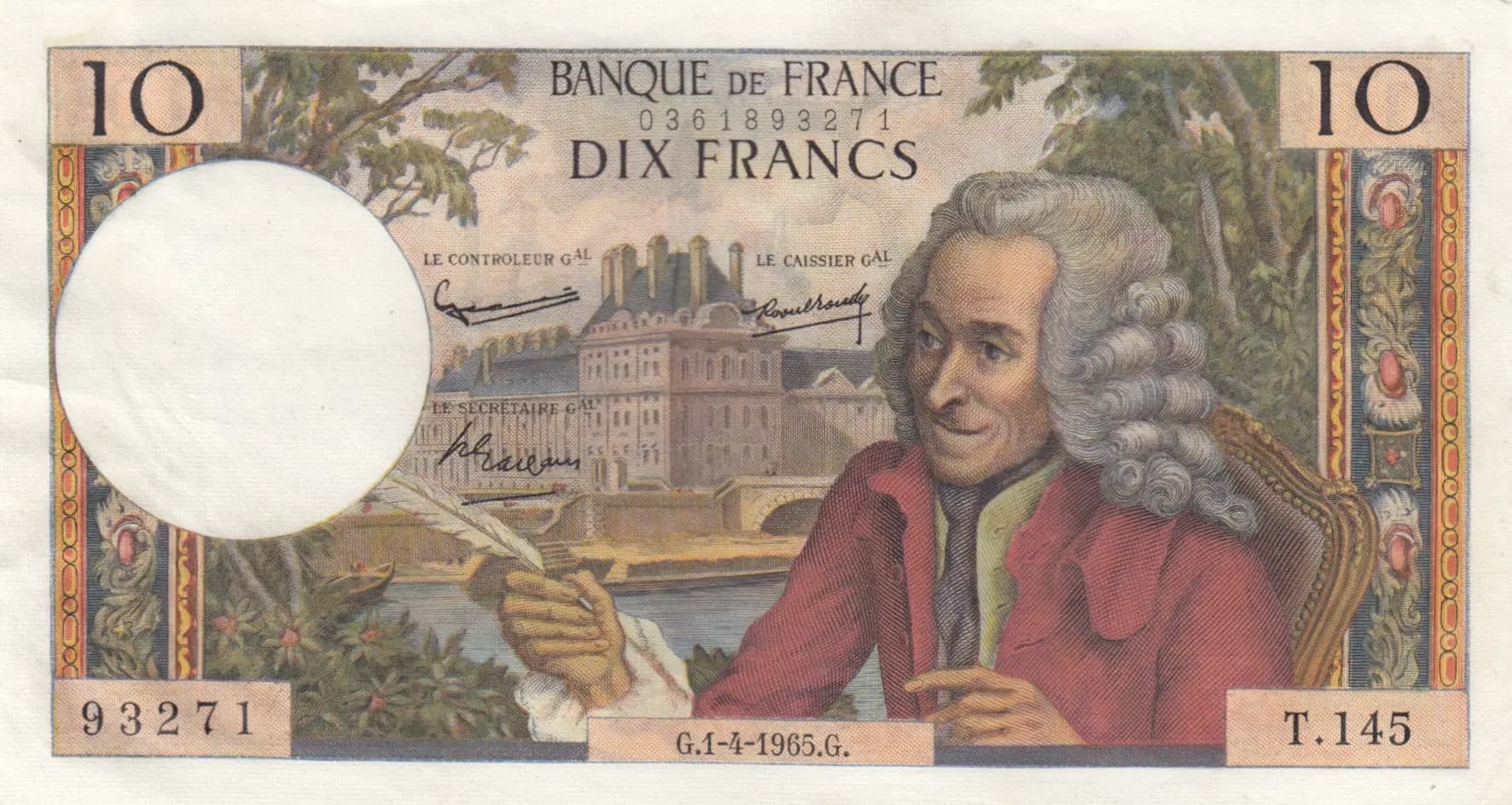
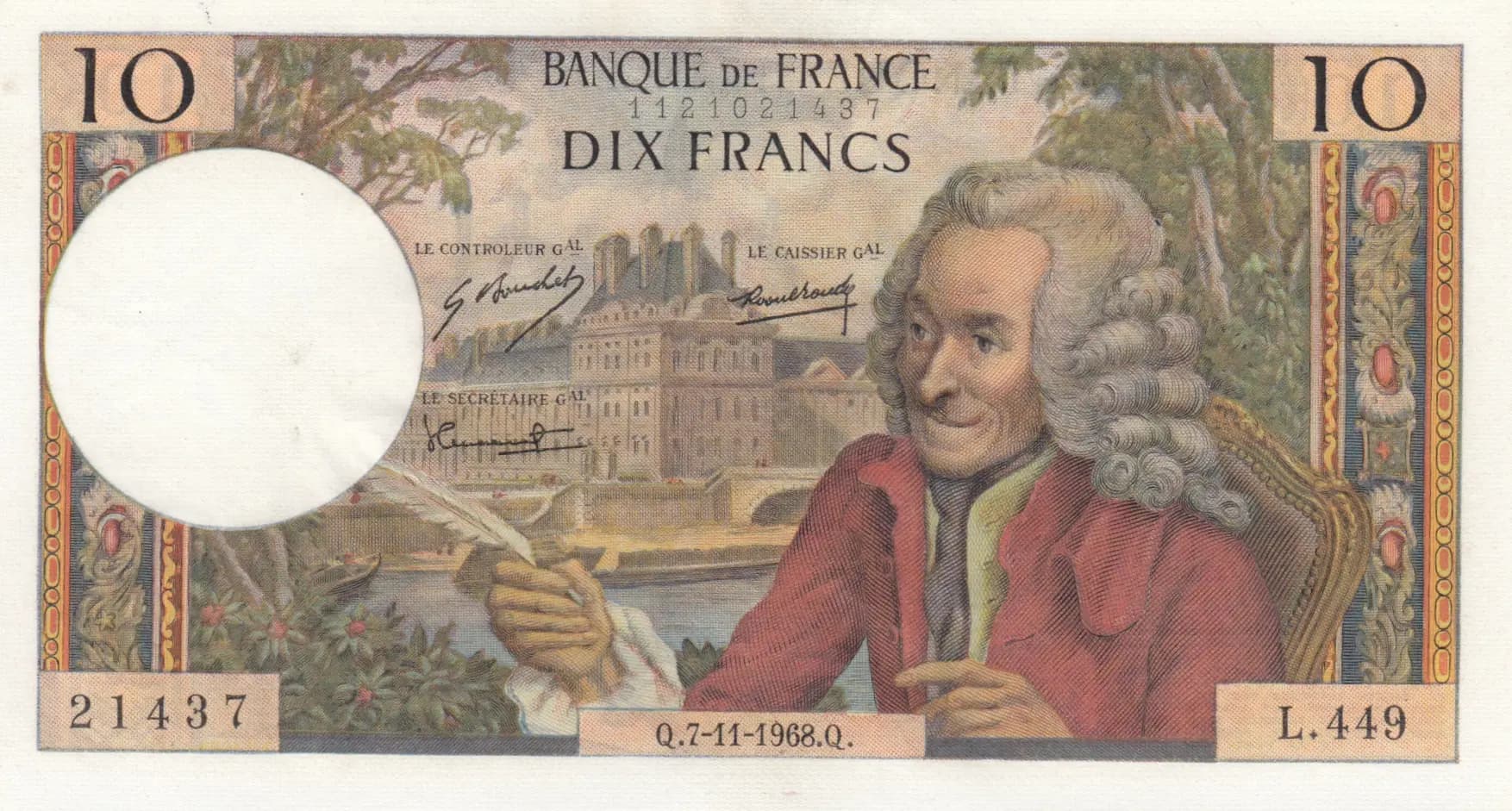
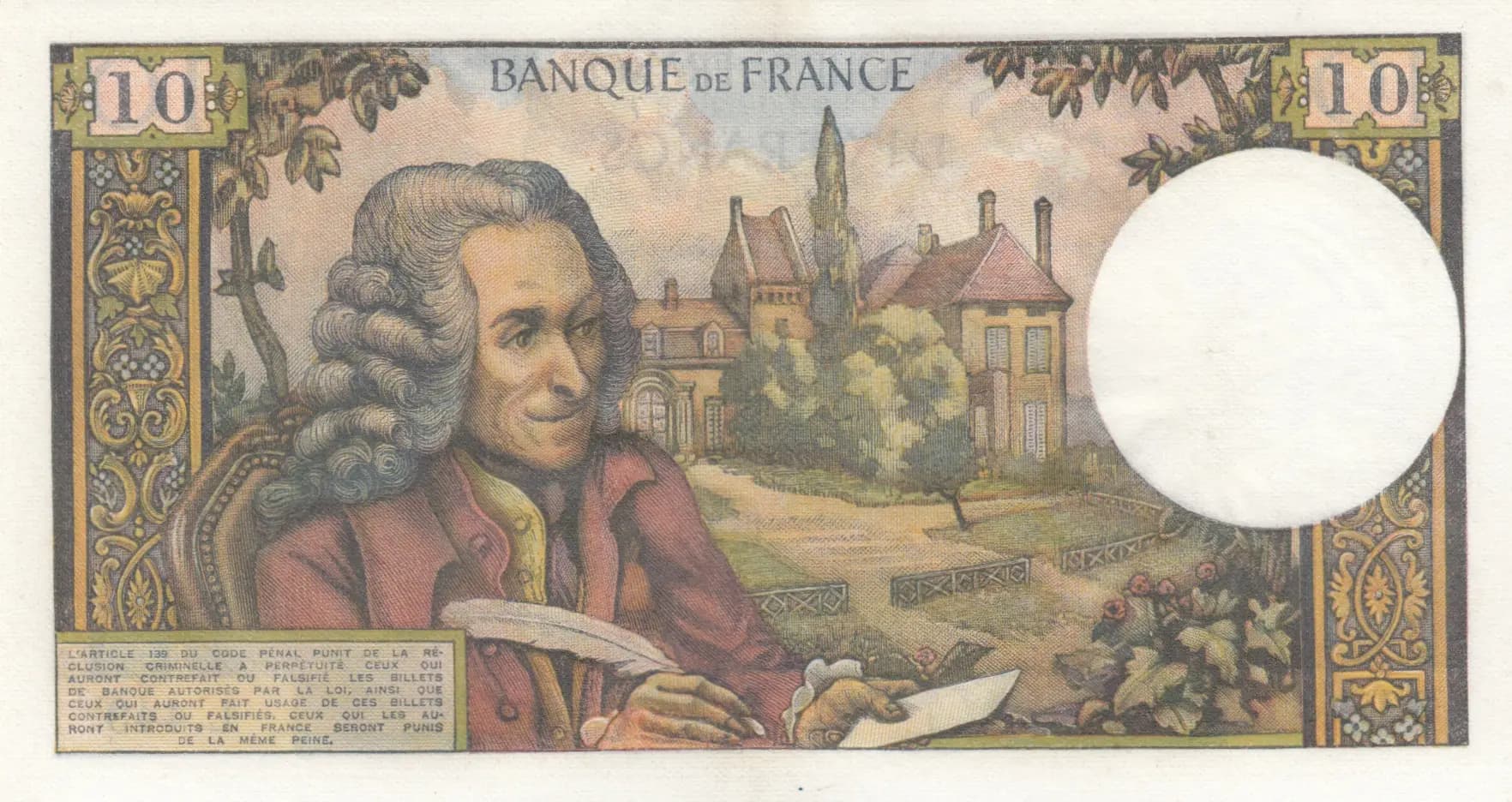
This is a 1968 French 10 Francs note (Pick P-147c) in Extremely Fine condition, featuring the famous Enlightenment philosopher François Voltaire in 18th-century dress with his characteristic curled white hair and burgundy jacket. The obverse displays the Palais des Tuileries in Paris, while the reverse showcases the Château de Cirey with formal gardens and cypress trees—Voltaire's actual residence. The note exhibits pristine condition with vibrant multicolored printing, ornate decorative borders, and excellent preservation throughout.
Common. This note from the regular 1967-1971 issue series shows typical market behavior for French 10 Francs notes from this period. eBay sales data demonstrates consistent availability across all condition grades, with ungraded EF examples selling for $3-15, and PMG-graded specimens in higher grades (65-67) commanding $30-80. The large number of sales spanning 2009-2025 indicates robust supply in the market. No print run restrictions, recalls, or production anomalies are known for this Pick number. The denomination and era make this a commonly traded French banknote among collectors.
Issued during the late 1960s by the Banque de France, this note commemorates François Voltaire, the influential 18th-century French philosopher and writer whose legacy shaped European thought during the Age of Enlightenment. The juxtaposition of Paris's iconic Palais des Tuileries on the obverse with Voltaire's own Château de Cirey on the reverse reflects the note's dual celebration of French cultural heritage and intellectual achievement. This series, spanning 1967-1971, represented a modernization of French currency design during the period preceding France's transition toward the Euro.
This note features a masterful two-sided portrayal of François Voltaire (1694-1778), the celebrated French Enlightenment philosopher. On the obverse, Voltaire appears in right profile wearing an ornate burgundy coat with golden details and his signature white curled hair, positioned against the architectural backdrop of the Palais des Tuileries in Paris—the royal palace representing French grandeur and culture. A large circular watermark featuring Voltaire's portrait serves as a primary security feature on the left side. The reverse presents Voltaire again in three-quarter profile on the left, this time set against the Château de Cirey, his actual estate in northeastern France, complete with classical architecture, formal gardens, cypress trees, and manicured grounds—reflecting his intellectual retreat and personal legacy. Both sides are framed by ornate decorative borders featuring floral and geometric patterns in gold and other colors, with corner ornaments of repeating motifs. The multicolored palette includes cream, green, burgundy, brown, gold, and white throughout.
FRONT SIDE: 'BANQUE de FRANCE' (Bank of France), 'DIX FRANCS' (Ten Francs), '10' (denomination), 'LE CONTROLEUR GAL' (The General Controller), 'LE CAISSIER GAL' (The General Cashier), 'LE SECRÉTAIRE GAL' (The General Secretary), Serial number '21437', Series designation 'L.449', Date designation 'Q.7-11-1968.Q', Reference number '112102143'. BACK SIDE: 'BANQUE de FRANCE' (Bank of France), '10' (denomination), Legal warning: 'L'ARTICLE 139 DU CODE PÉNAL PUNIT DE LA RÉCLUSION CRIMINELLE À PERPÉTUITÉ CEUX QUI AUROINT CONTREFAIT OU FALSIFIÉ LES BILLETS DE BANQUE AUTORISÉS PAR LA LOI. L'ARTICLE... CEUX QUI AUROINT FAIT USAGE DE CES BILLETS CONTREFAITS OU FALSIFIÉS CEUX QUI AUROINT INTRODUIT EN FRANCE DESHORT PUNIS DE LA MÊME PEINE' (Article 139 of the Penal Code punishes with life imprisonment those who have counterfeited or forged banknotes authorized by law. Those who have made use of such counterfeit or forged banknotes and those who have introduced them into France are punished with the same penalty).
This note was produced using advanced multi-color intaglio printing combined with lithography, typical of 1960s Banque de France security standards. The detailed portraiture, fine line work in borders, and security features suggest production by Banque de France's approved security printers of the period, likely utilizing copper plate engraving for the primary design elements and overprinting for color variations. The precision of the ornamental borders and the rendering of architectural elements indicate professional-grade intaglio work characteristic of French banknote production during this era.
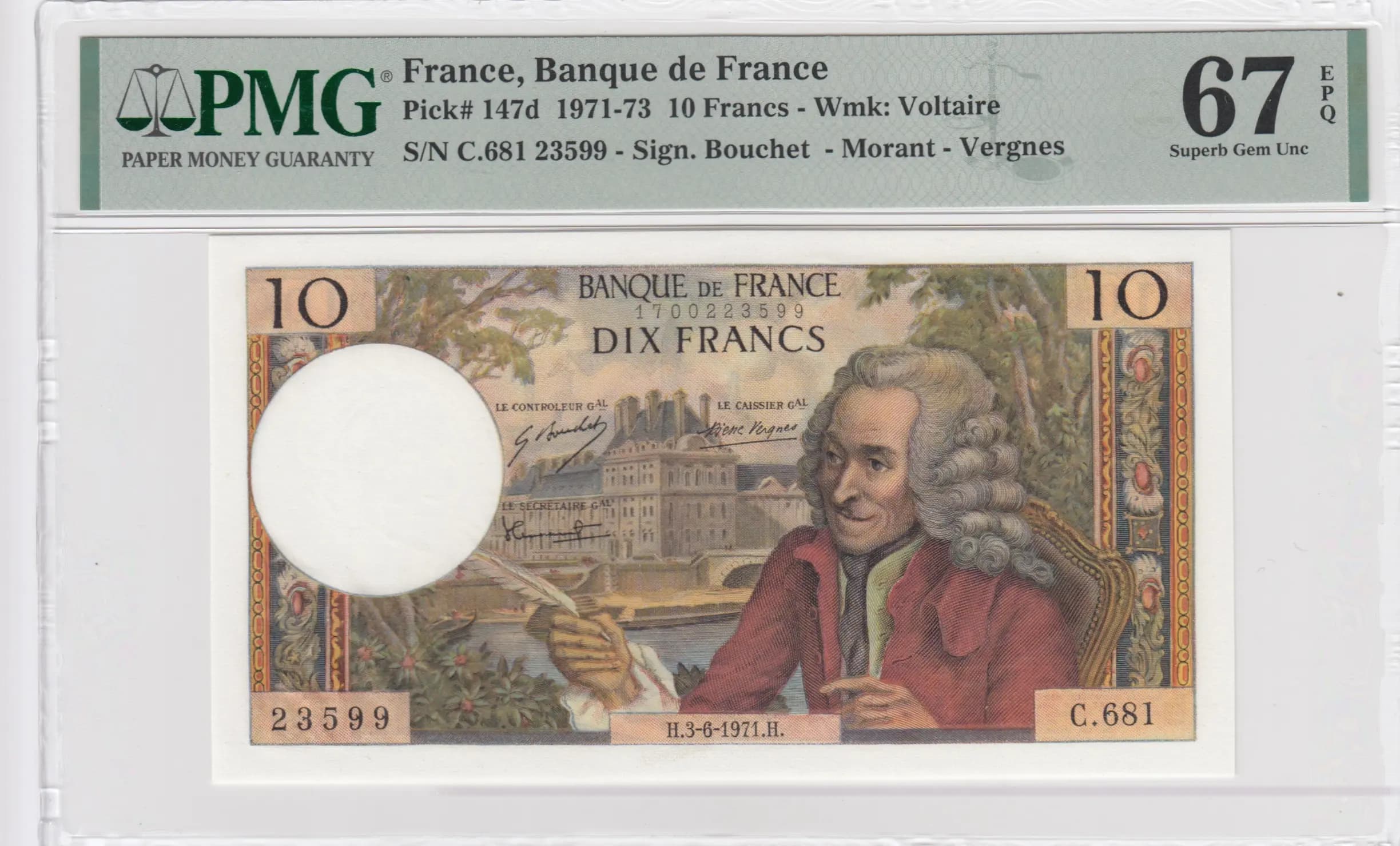
This specimen is identified as Pick P-147c, one of four known variants (P-147a through P-147d) for this base Voltaire 10 Francs issue. All variants share the Voltaire watermark but differ in minor printing or signature variations across the 1967-1971 production run. The date designation 'Q.7-11-1968.Q' confirms this note's November 7, 1968 issue date. The series letter 'L.449' and serial number '21437' are unique identifiers for this individual note. The specific variant classification (P-147c) is maintained according to PMG population records, though detailed distinguishing characteristics between variants are not universally standardized in all catalogs.