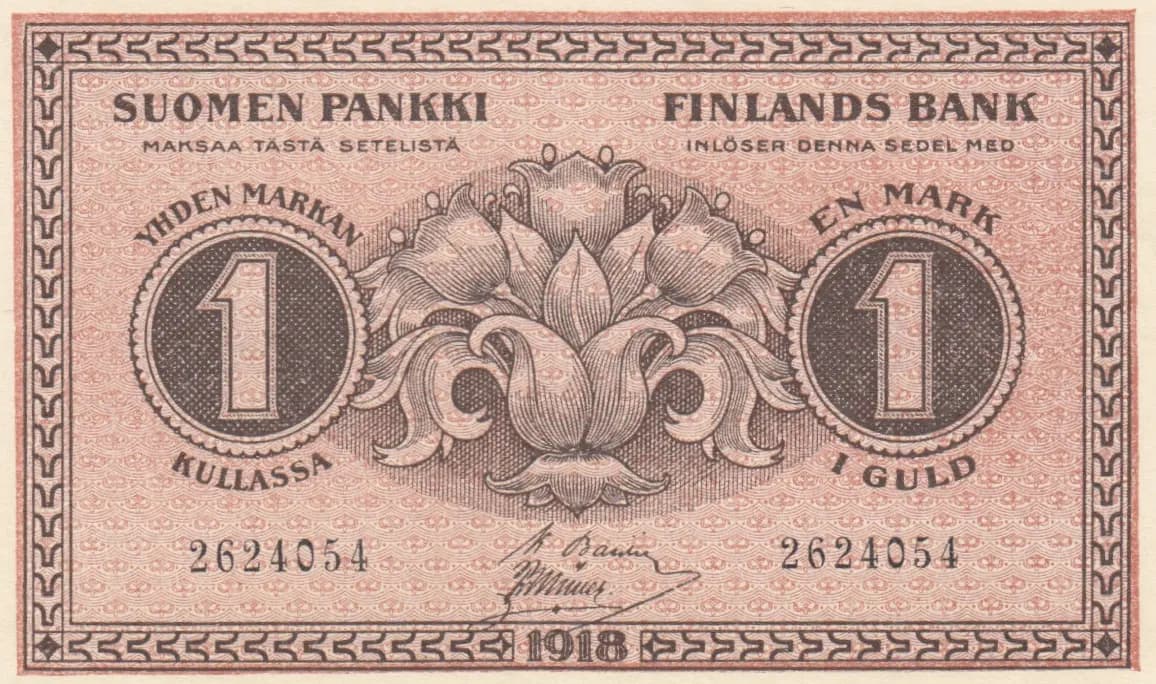
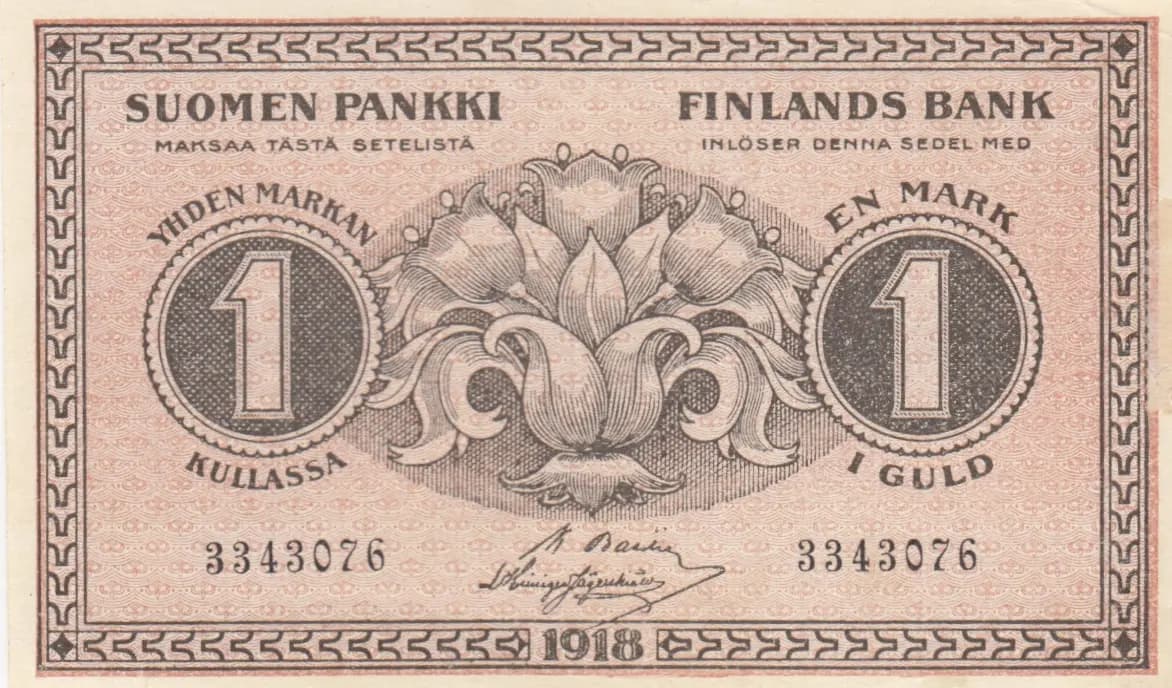
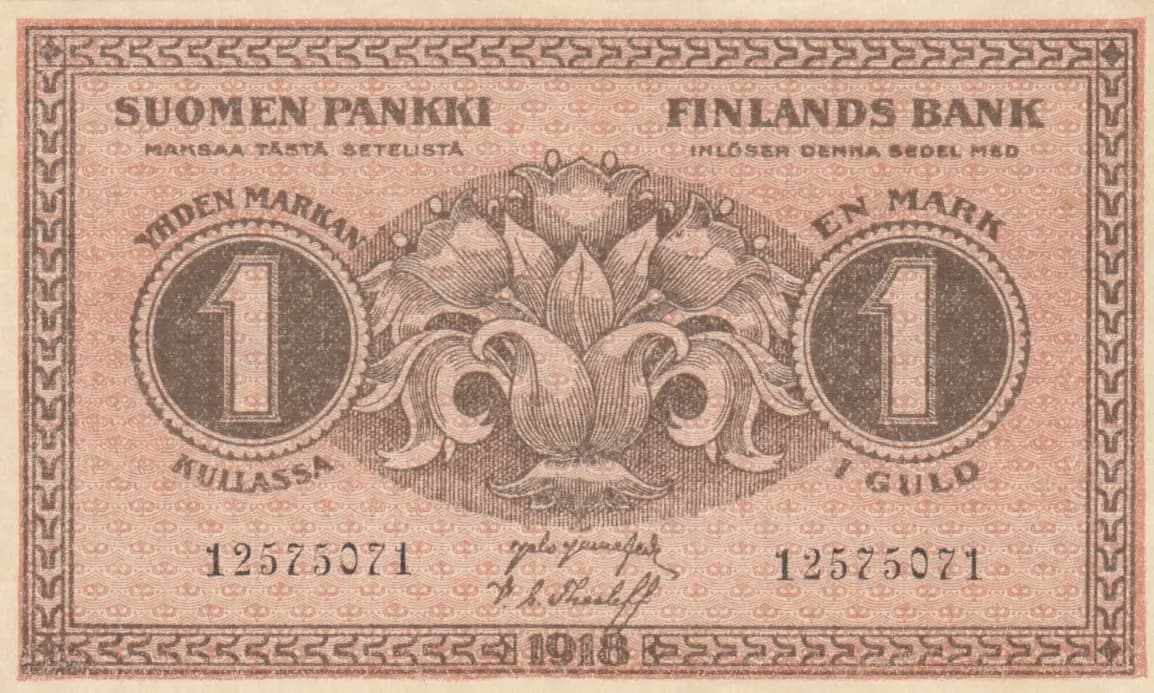
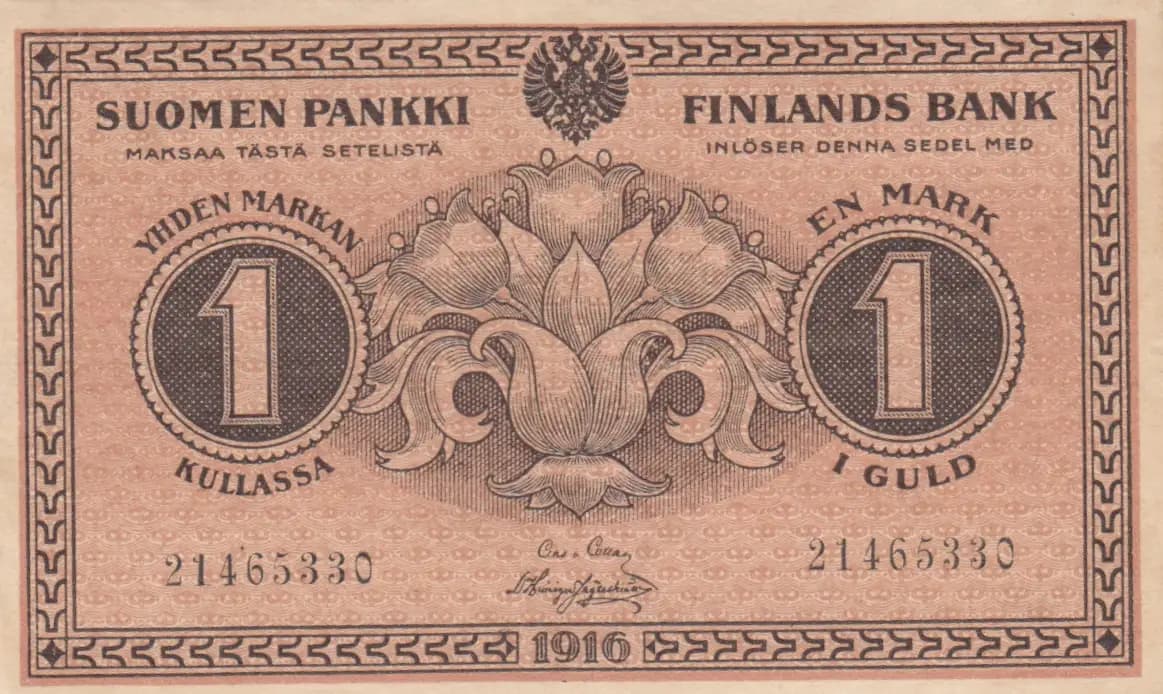
1 markkaa 1918
Market Prices
10 salesAbout This Note
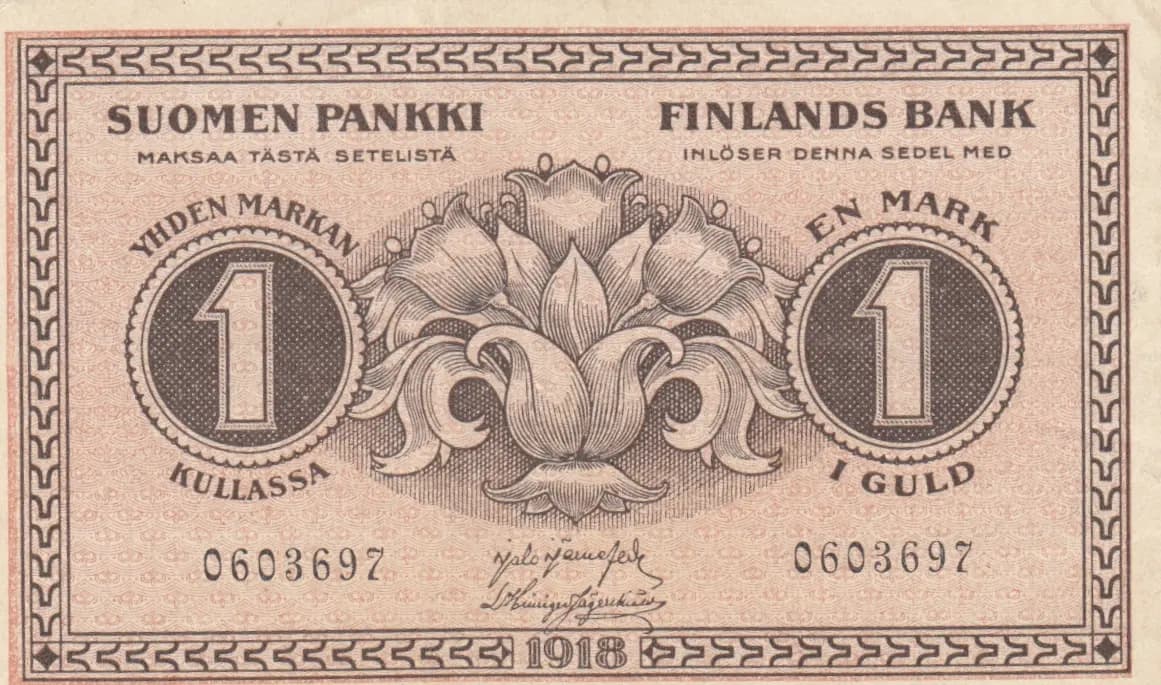
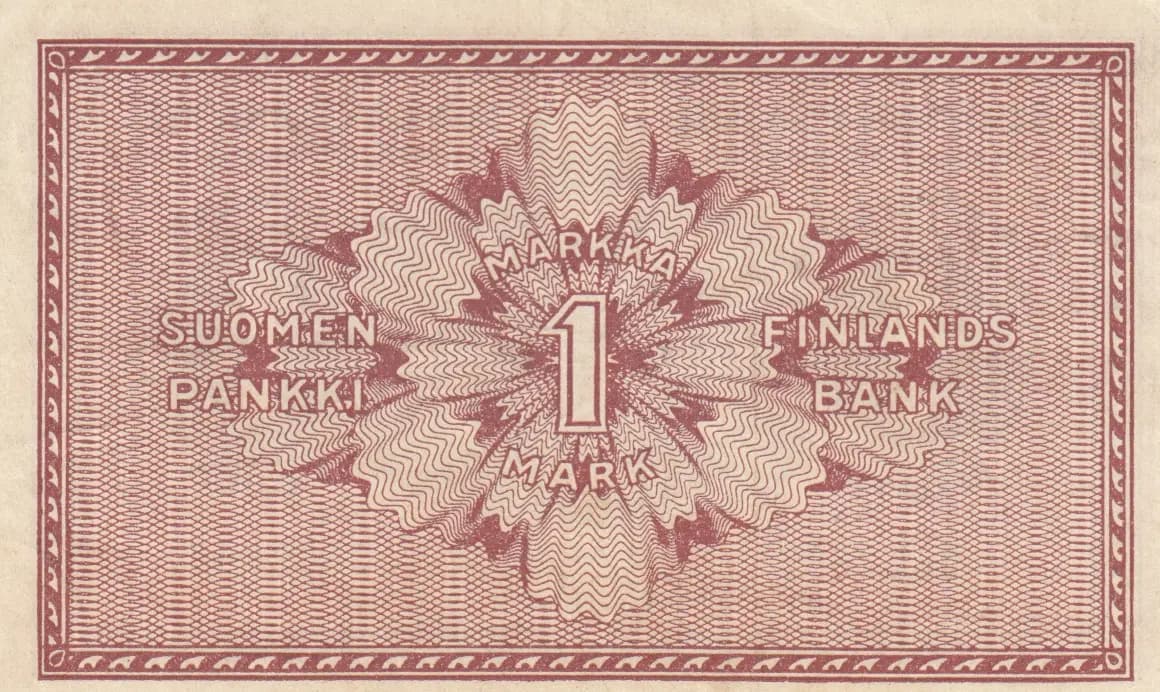
This is a Finland 1 markka note from 1918, issued by Suomen Pankki in the early period following Finnish independence. The note features attractive Art Nouveau-inspired ornamental designs on both sides—a symmetrical floral/botanical composition on the front with circular medallions bearing the denomination, and an intricate sunburst pattern on the back rendered in mauve and burgundy tones. In VF condition, this example shows excellent preservation with uniform coloring, crisp printing, and no significant wear, making it a desirable example of early Finnish currency for collectors.
Common. This is a standard regular-issue banknote from Finland's early period with a substantial print run. The eBay market data confirms common status: VF examples have sold for $3.44–$3.65, and even AUNC specimens typically bring $13–$17, which is modest for early currency. The catalog 2016 valuation of $1.50 in VF also indicates common circulation. No evidence of short print runs, recalls, or rarity factors exists in the historical record.
This 1 markka note was issued in 1918, the pivotal year of Finnish independence from Russian rule, and notably lacks the czarist eagle that appeared on earlier Russian-backed Finnish currency. The dual bilingual inscriptions in Finnish and Swedish reflect Finland's linguistic heritage and the formative period of establishing a sovereign national identity. The note's promise to redeem "in gold" (kullassa/i guld) reflects the gold standard monetary system of the early 20th century, before currency became fiat-based.
The front features a classical symmetrical Art Nouveau ornamental composition centered on the note, with a decorative floral/botanical motif as the dominant design element. Two large circular medallions flank the central design, each containing the numeral '1' rendered in fine detail. The entire note is framed by an ornate geometric border featuring a meander (Greek key) pattern characteristic of the Art Nouveau period. The back displays a spectacular sunburst or radiating star design with intricate wavy parallel lines emanating from a central circular focal point, creating a mesmerizing optical effect typical of security printing techniques of the era. The color scheme comprises tan, beige, and dark brown on the front, with mauve, rose, and burgundy tones on the back.
FRONT SIDE: 'SUOMEN PANKKI' (Bank of Finland - Finnish); 'FINLANDS BANK' (Bank of Finland - Swedish); 'MAKSAA TÄSTÄ SETELISTÄ YHDEN MARKAN KULLASSA' (Pays from this note one markka in gold - Finnish); 'INLÖSER DENNA SEDEL MED EN MARK I GULD' (Redeems this note with one mark in gold - Swedish); '1918' (year); '0603697' (serial number, repeated). BACK SIDE: 'SUOMEN PANKKI' (Finland's Bank - Finnish); 'FINLANDS BANK' (Finland's Bank - Swedish); '1 MARKKA' (one markka - Finnish); '1 MARK' (one mark - Swedish).
This note was produced using intaglio (engraved) printing, evidenced by the fine, precise line work visible in both the circular medallions and the complex wavy radiating patterns on the reverse. The intricate meander borders, parallel line security features, and sharp detail of the ornamental elements are characteristic of high-quality intaglio engraving used by central banks of this period. The security printer for Finnish Bank notes of this era was typically European-based; the level of craftsmanship suggests work by an established security printing house, though specific printer attribution would require archival research.
This example bears the serial number 0603697, repeated on both sides as was standard practice. No specific signature varieties, date variations, or overprints are noted. The absence of a czarist eagle distinguishes this 1918 issue from earlier Finnish markka notes under Russian control (such as Pick-19), which is a design characteristic of the 1918 series rather than a variety within this Pick number. Serial number prefixes and signatures may exist as minor varieties within the Pick-35 type, but visual analysis of this single note does not reveal distinguishing variety characteristics beyond the serial number.