10 shillings 1950
Market Prices
1 saleAbout This Note
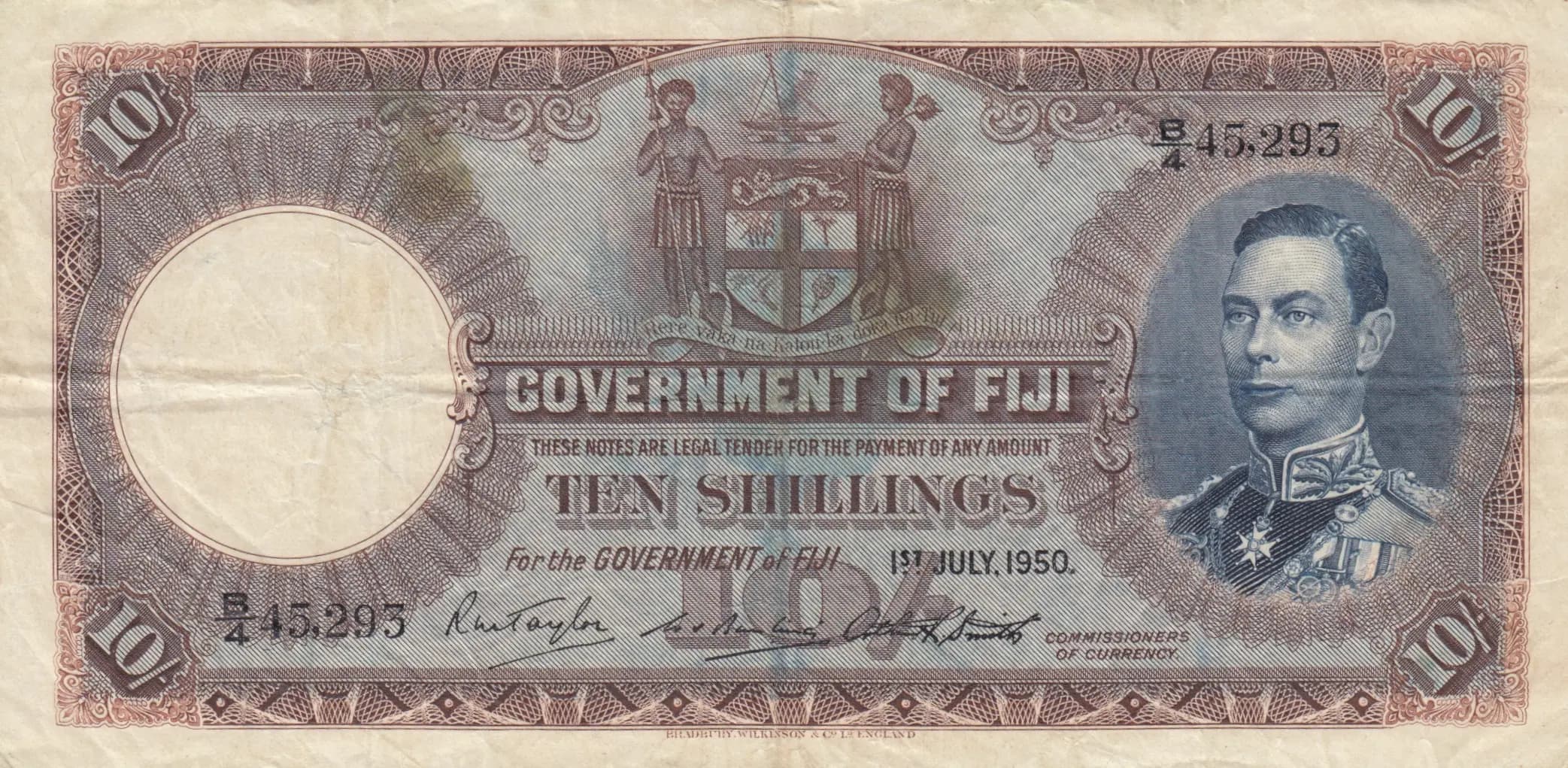
This is a Government of Fiji 10 Shillings note dated 1st July 1950, printed by Bradbury Wilkinson & Co Ltd. The note features a formal portrait of King George VI in military dress uniform on the obverse, with characteristic brown and blue coloring. The note exhibits moderate age-related wear consistent with a 70+ year old banknote, including visible creases, foxing, and patina, placing it in Fair (F) condition grade as cataloged.
Common. The catalog references indicate this was part of a regular issue series (1937-1951) with standard print runs typical of colonial currency production. The eBay market data showing a PMG 35 (marginally better condition) sold for $100 suggests moderate pricing at the lower end of collector interest. The estimated catalogue value for this Fair condition note would be approximately $20-30 USD, which places it firmly in the common category. No evidence of limited print runs, recalls, or short production periods supports any rarity designation.
This banknote was issued during the final years of the British colonial period in Fiji, with the note dated 1950 during the reign of King George VI. The portrait of the monarch in military dress and the formal 'Government of Fiji' inscriptions reflect Fiji's status as a British colony, with the note serving as legal tender under the authority of the Commissioners of Currency. The Bradbury Wilkinson printing house, located in New Malden, England, was one of the premier security printers of the era, underscoring the formal nature of the colonial currency system.
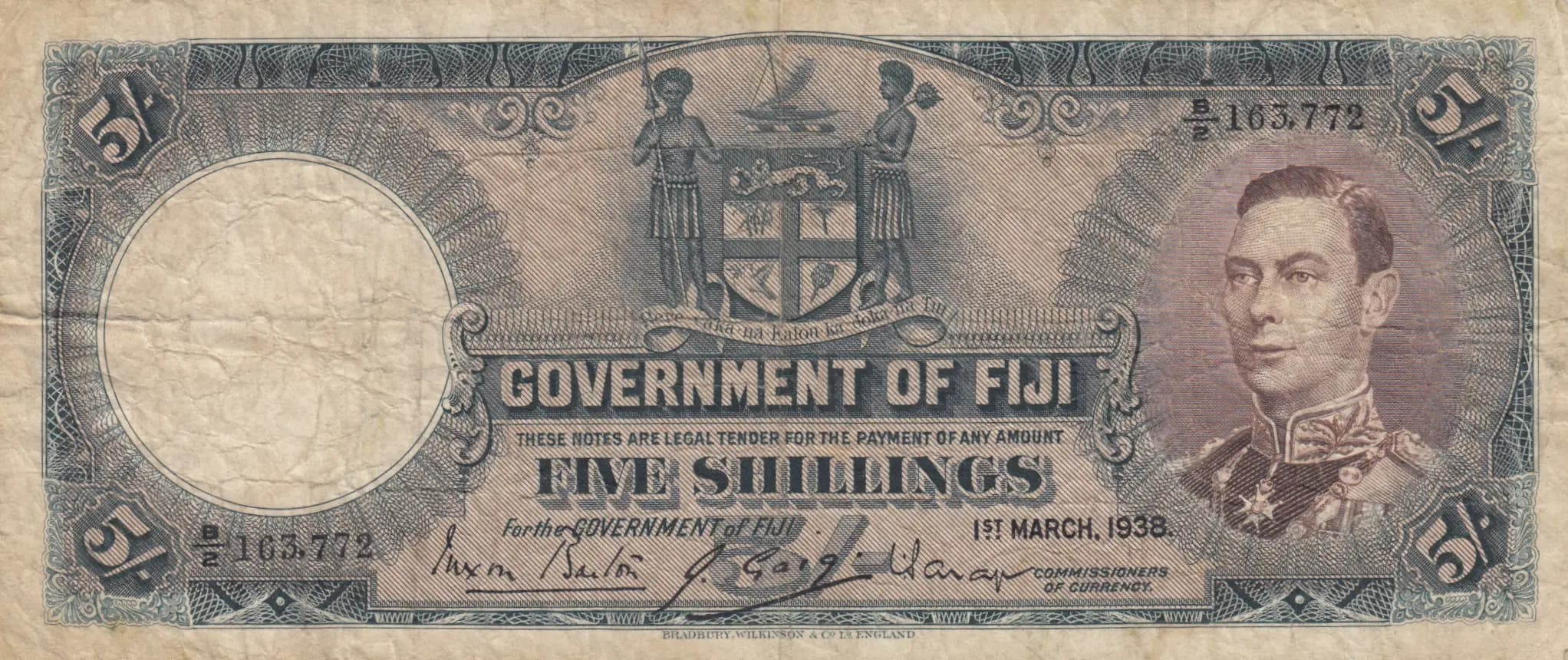
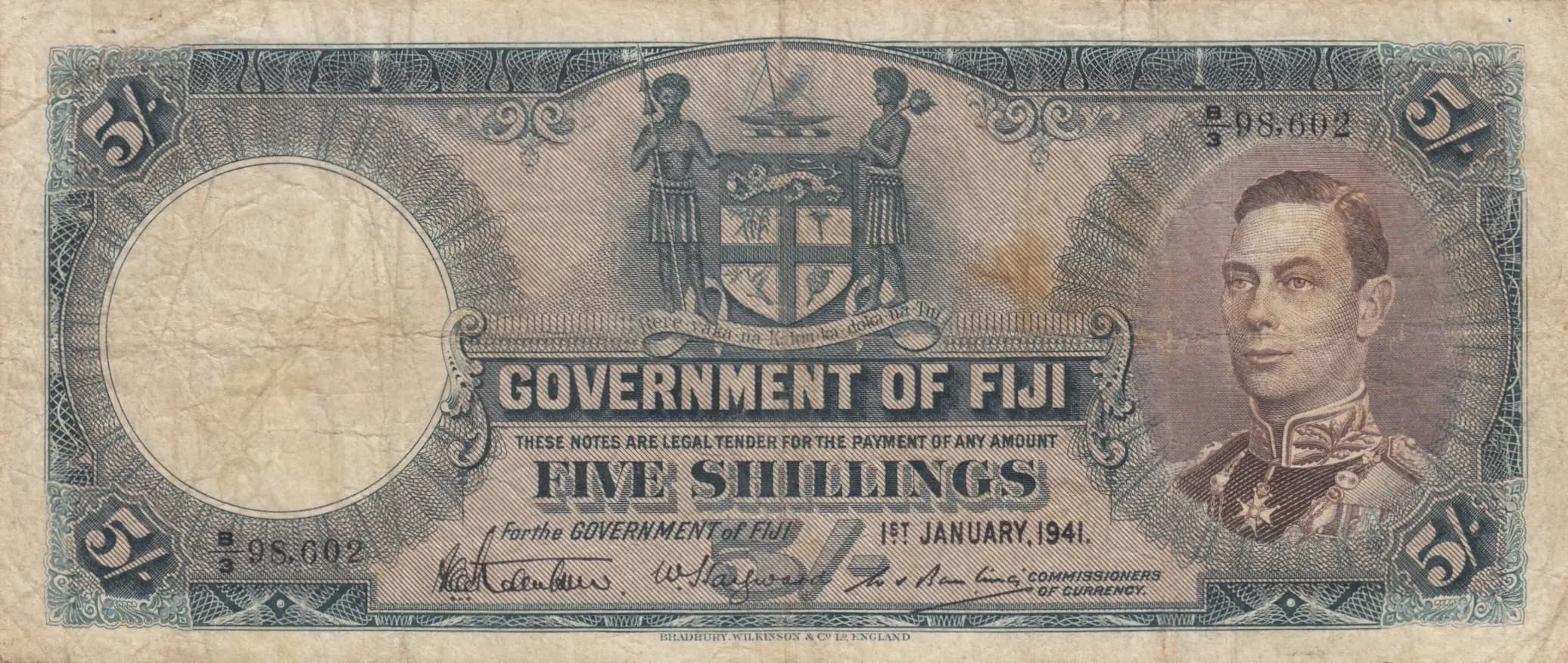
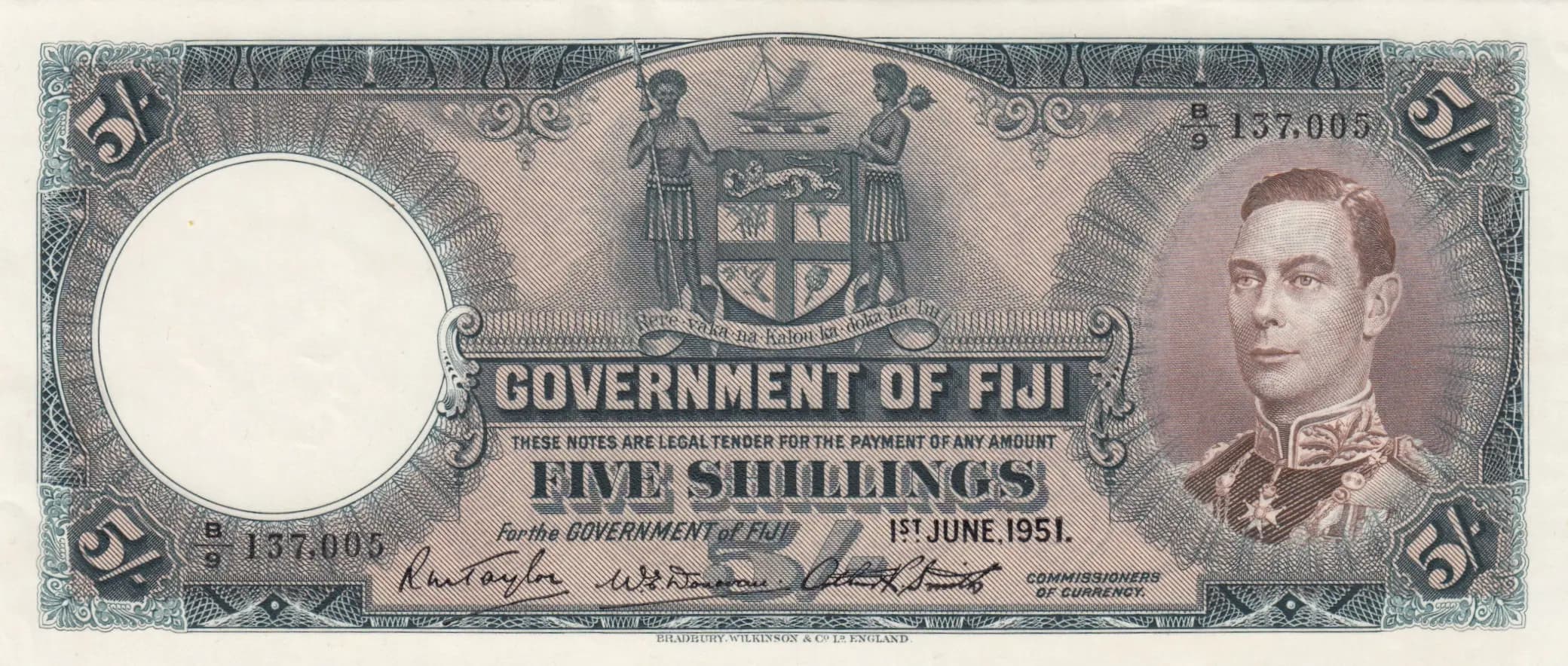
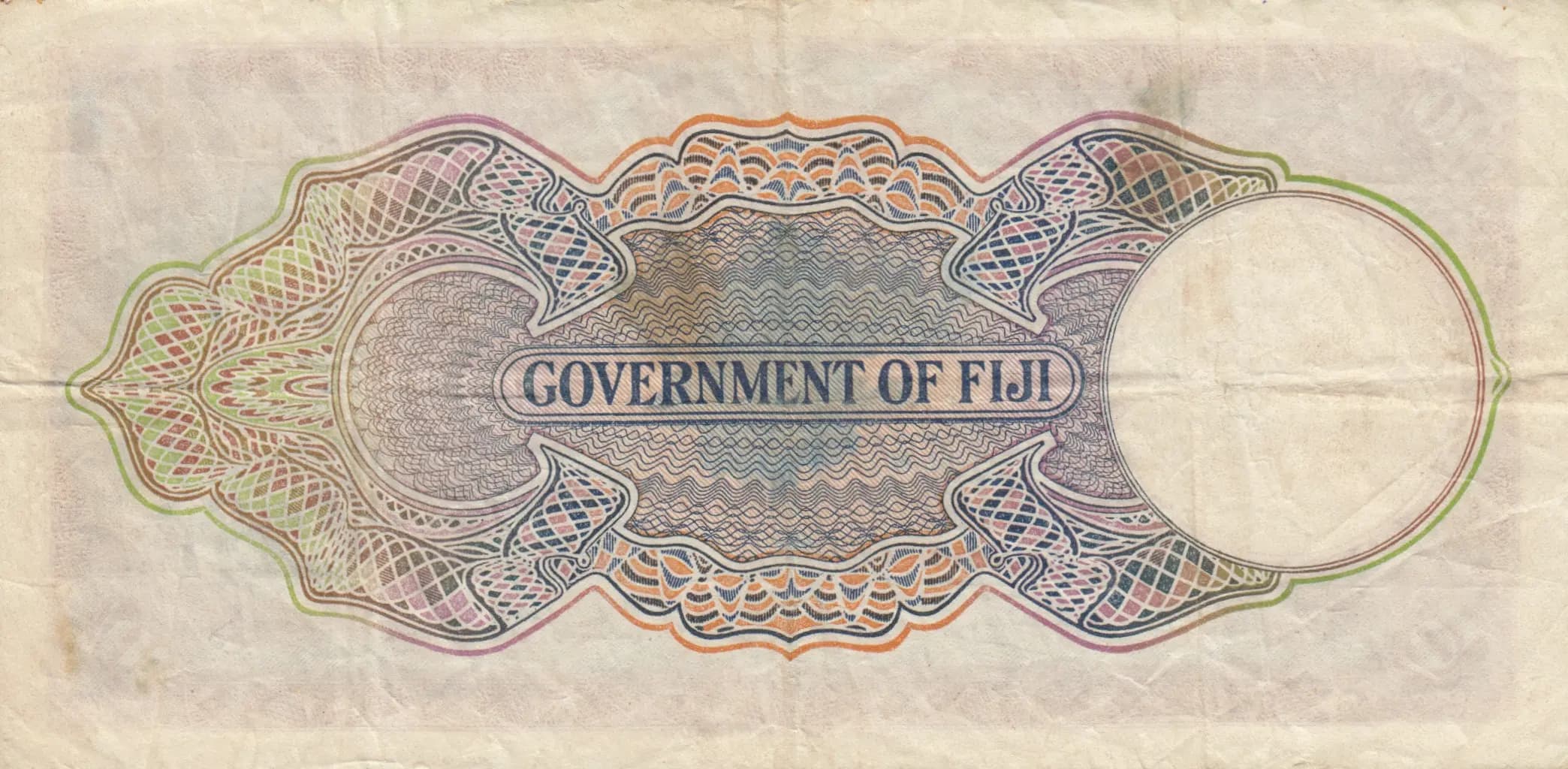
The obverse features a formal three-quarter profile portrait of King George VI facing left, depicted in full military dress uniform with medals and insignia, positioned on the right side of the note. The left side contains a large circular watermark area. The design incorporates the Government of Fiji coat of arms/crest at the top center, with ornate decorative border patterns featuring geometric and floral designs in fine line engraving work throughout. The reverse features an elaborate cartouche-style design with the 'GOVERNMENT OF FIJI' inscription at center, flanked by two large circular watermark areas, and decorated with scalloped edges and intricate geometric and floral ornamental patterns. The color palette on the obverse is predominantly brown and rust tones with blue accents, while the reverse utilizes purple, orange, green, blue, and black inks on a cream background.
FRONT: 'GOVERNMENT OF FIJI' (issuing authority); 'TEN SHILLINGS' (denomination in words); '10' (denomination in numerals); 'THESE NOTES ARE LEGAL TENDER FOR THE PAYMENT OF ANY AMOUNT' (legal tender declaration); 'For the GOVERNMENT of FIJI' (issuing authority); '1ST JULY, 1950.' (issue date); 'COMMISSIONERS OF CURRENCY' (approving authority); 'E 46.295' (serial number, appears twice); 'BRADBURY WILKINSON & CO LTD ENGLAND' (printer attribution). BACK: 'GOVERNMENT OF FIJI' (central cartouche inscription).
Intaglio (engraved) banknote printing produced by Bradbury Wilkinson & Co Ltd, a leading British security printer. The fine line work, complex geometric patterns, and multi-color intaglio separation visible in both the obverse and reverse designs are characteristic of high-security banknote production of the 1950s era. The elaborate decorative borders and portrait engraving showcase the technical sophistication of mid-20th century banknote security printing.
This note is identified as Pick P-38j, with PMG records indicating a P-38k variant also exists for the same base Pick number. Both variants were printed by Bradbury Wilkinson & Co Ltd (BWC). The specific variety designation (j vs. k) likely reflects differences in signature combinations, date variations, or serial number series within the 1950 issue. The observed serial number E 46.295 and the specific date of 1st July 1950 are consistent with the cataloged P-38j variety.