1 dollar 1969
Market Prices
9 salesAbout This Note
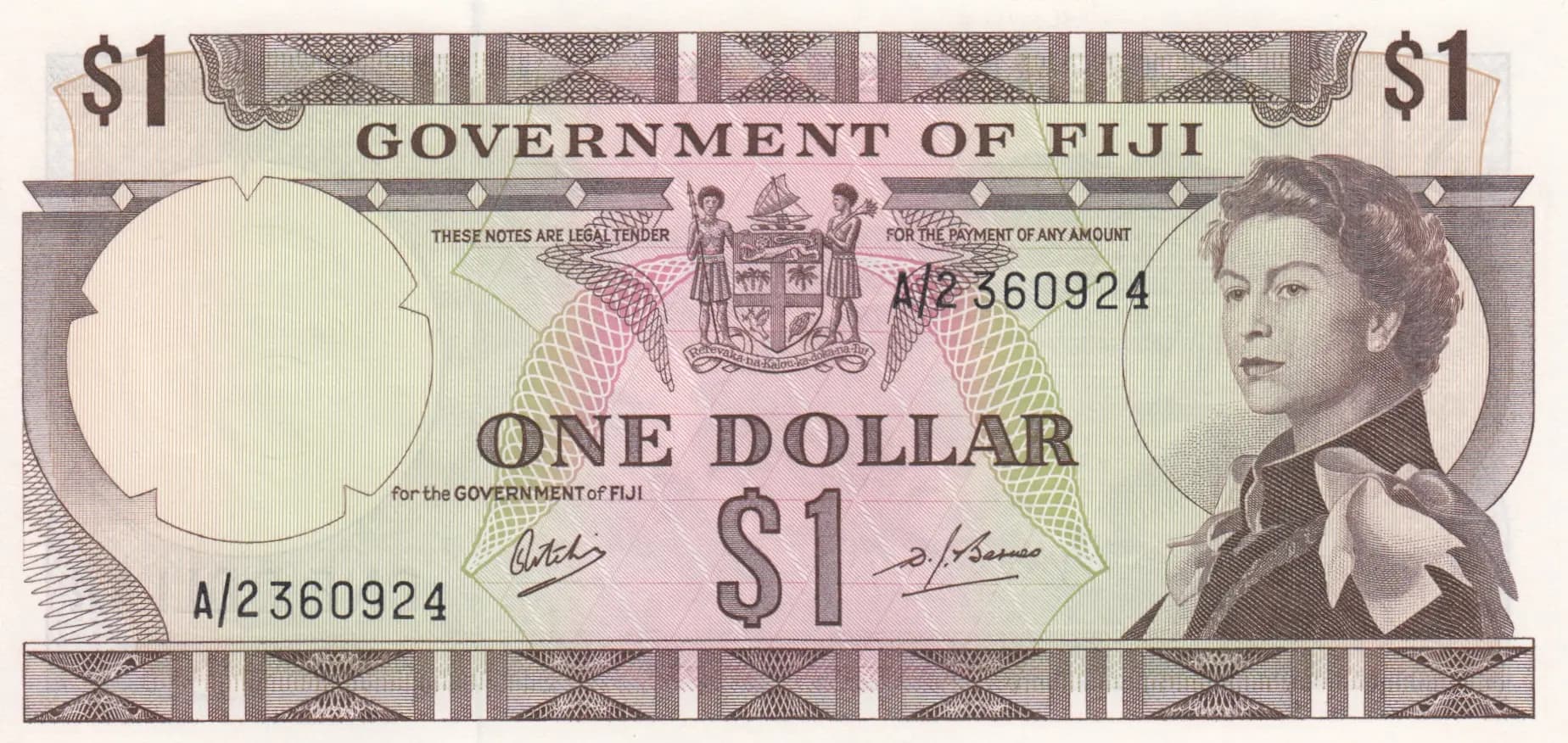
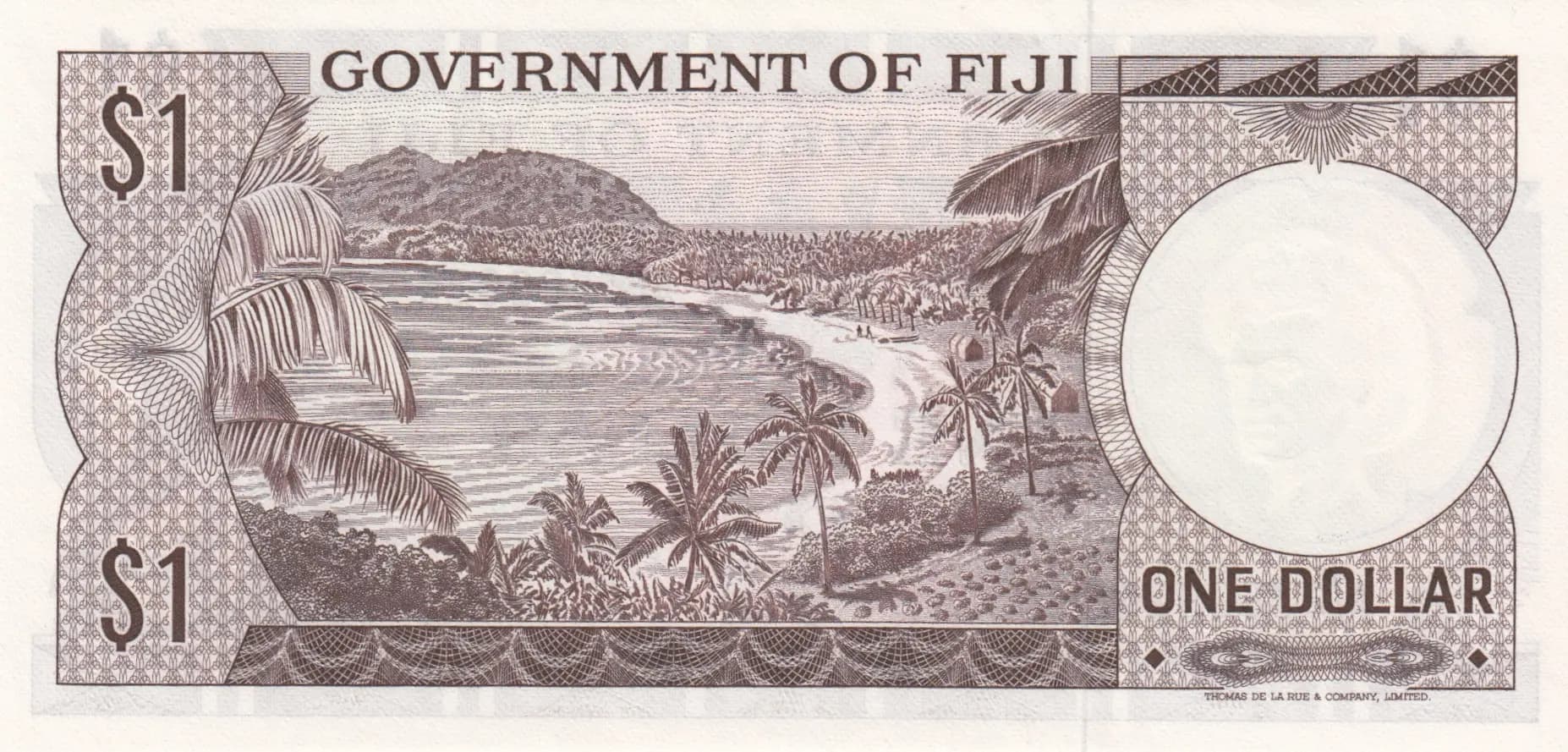
This is a pristine, uncirculated example of the Fiji 1 Dollar from 1969 (Pick-59), printed by Thomas de la Rue in London. The note features a striking portrait of Queen Elizabeth II on the obverse in profile, set against a light green and pink color scheme with intricate security patterns, while the reverse showcases a detailed engraving of Yanuca Beach in the Yasewas region. The exceptional condition, sharp printing quality, and vibrant colors make this an attractive example for collectors of Commonwealth currency and early Fijian banknotes.
Common. The 1969 Fiji 1 Dollar (Pick-59) was part of a standard circulation issue and remains commonly available in the collector market. Market data from realbanknotes.com shows multiple UNC examples selling for $35-$111 in recent years, with numerous lower-grade examples selling for under $10. The print run was substantial for a standard denomination note, and no evidence of scarcity, recall, or limited issue exists. This Pick number was replaced by later issues (P-65 and P-71) as Fiji's monetary authorities changed, but sufficient quantities survived to maintain common status even in high grades.
This note was issued during Fiji's early period of monetary independence following the establishment of the Government of Fiji as the currency-issuing authority in 1969, predating the later Currency Board (1974) and Central Monetary Authority (1987). The portraiture of Queen Elizabeth II reflects Fiji's status as a Commonwealth nation during this era, while the reverse's depiction of Yanuca Beach serves as a representation of Fiji's natural tropical beauty and island identity. The Thomas de la Rue printing indicates the British security printing standards applied to this colonial and early post-colonial currency.
The obverse features a right-facing portrait of Queen Elizabeth II in profile, positioned on the right side of the note, rendered in formal style with upswept hair arrangement. The coat of arms of Fiji dominates the upper center, displaying a heraldic shield with two figures (representing male and female), a sailing vessel symbolizing maritime heritage, a palm tree indicating tropical location, and other traditional elements. The left and right sides feature ornamental vignettes with geometric patterns. The reverse presents a detailed engraved landscape of Yanuca Beach in the Yasawas, depicting a tropical coastal scene with palm trees, forested hillsides, mountains in the background, sandy beaches, and water, rendered entirely in fine-line engraving technique in brown and sepia tones. Corner ornaments on the reverse feature geometric security patterns and guilloche designs.
FRONT SIDE: '$1' and 'ONE DOLLAR' - denomination markers; 'GOVERNMENT OF FIJI' - issuing authority; 'THESE NOTES ARE LEGAL TENDER FOR THE PAYMENT OF ANY AMOUNT' - legal tender declaration; 'for the GOVERNMENT of FIJI' - issuer attribution; Serial number 'A/2360924' appears twice; Signatures present (identified as 'Arks' and 'Bonnée'). BACK SIDE: '$1' - denomination markers in corners; 'ONE DOLLAR' - denomination text; 'GOVERNMENT OF FIJI' - issuing authority; 'THOMAS DE LA RUE & COMPANY, LIMITED' - printer identification.
Intaglio (line engraving) combined with letterpress for text elements. Thomas de la Rue & Company employed their characteristic fine-line engraving and guilloche security patterns throughout both sides of the note. The color scheme utilizes multiple passes of colored inks—green, pink, brown, and cream—layered to create the final design. Security features include intricate geometric line patterns, diagonal color-shifting designs, and fine micro-printing patterns typical of De la Rue's 1960s-era currency production.
This example appears to be the standard P-59a variety as catalogued by PMG, printed by TDLR (Thomas de la Rue). The serial number prefix 'A/2360924' is consistent with the 1969 issue. The signatures visible on this note ('Arks' and 'Bonnée') represent the authorized signatories for this issue period. No overprints, color variations, or printing errors are evident that would constitute a distinct sub-variety.