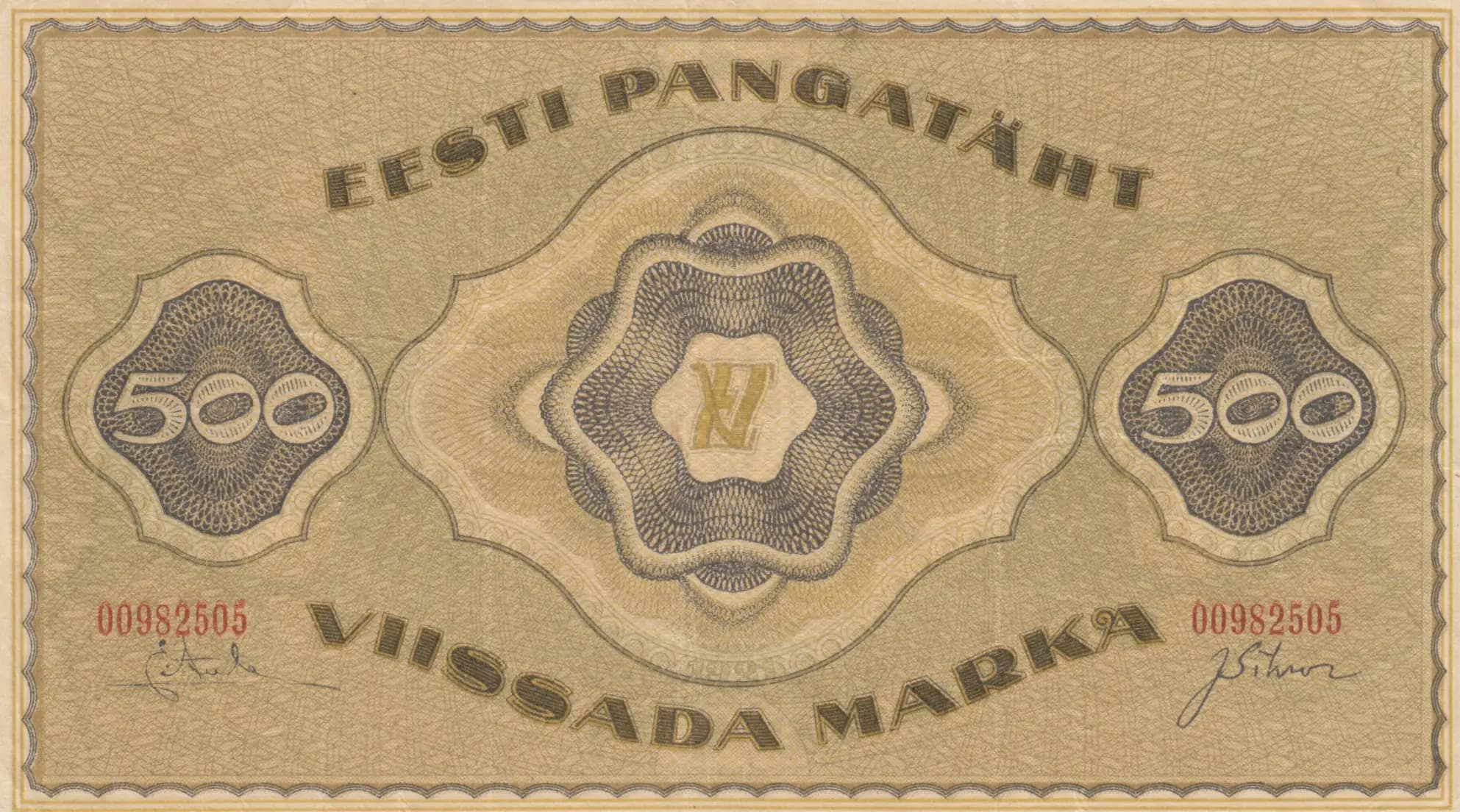
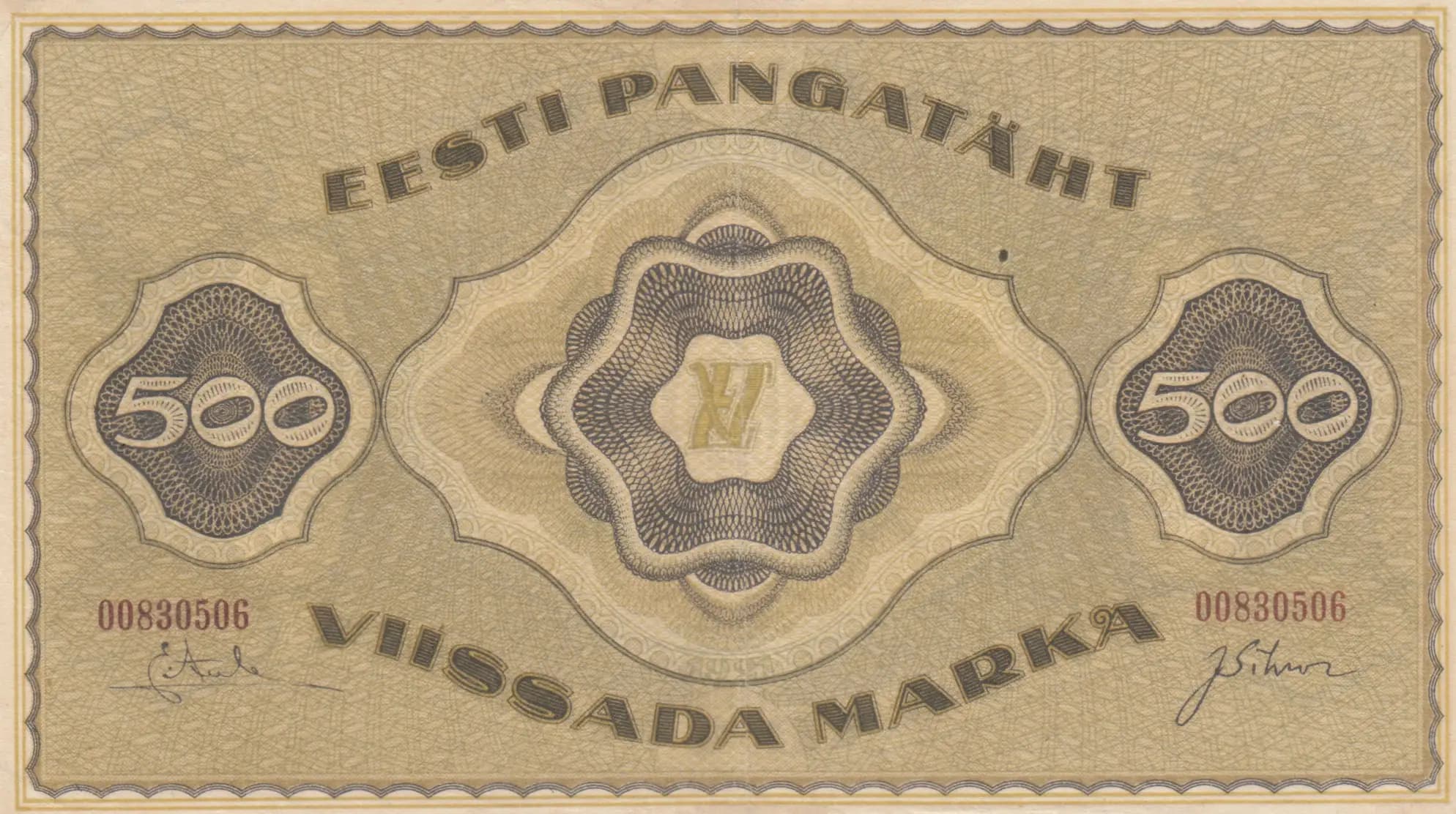
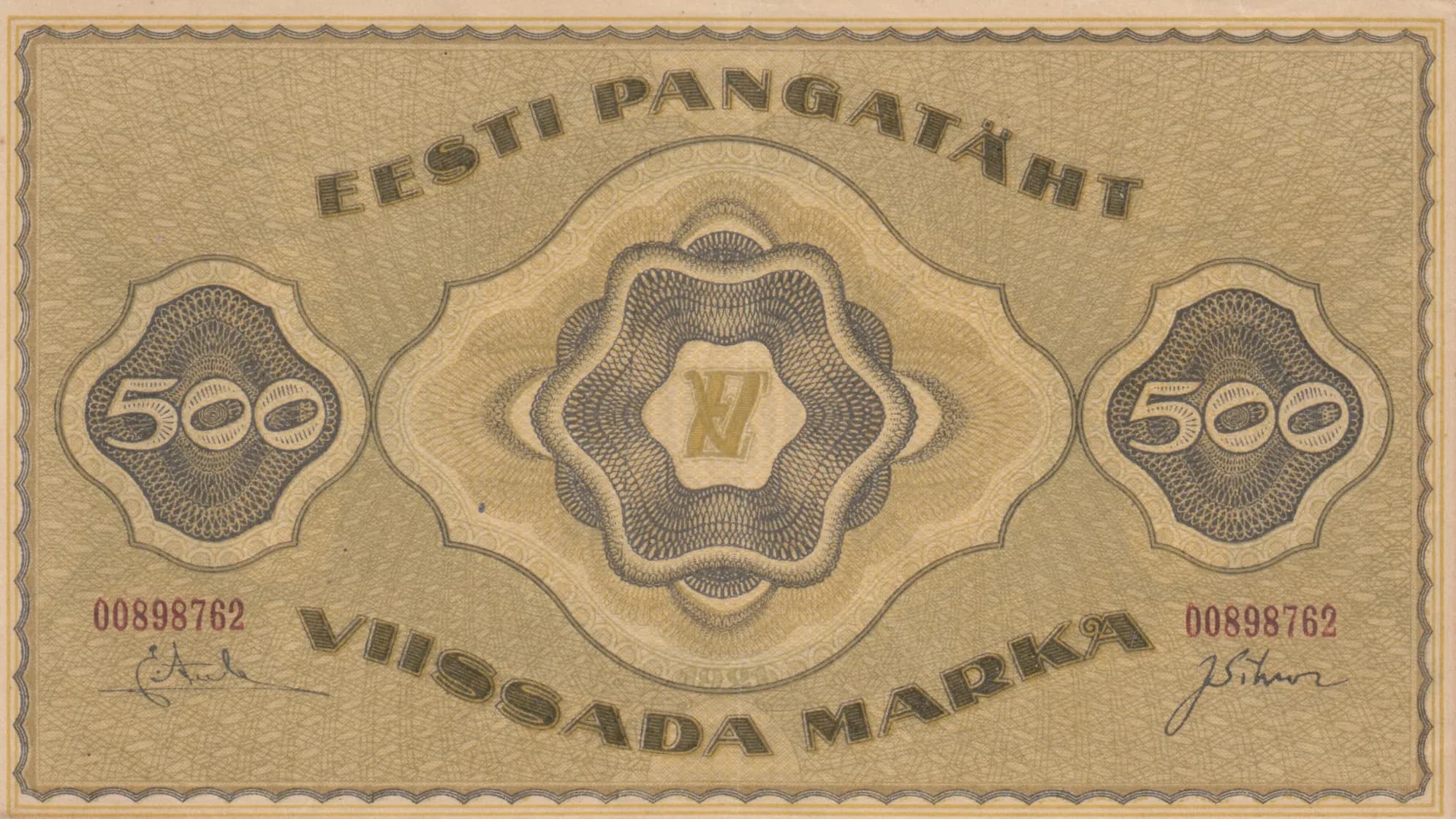
500 marka 1921 specimen
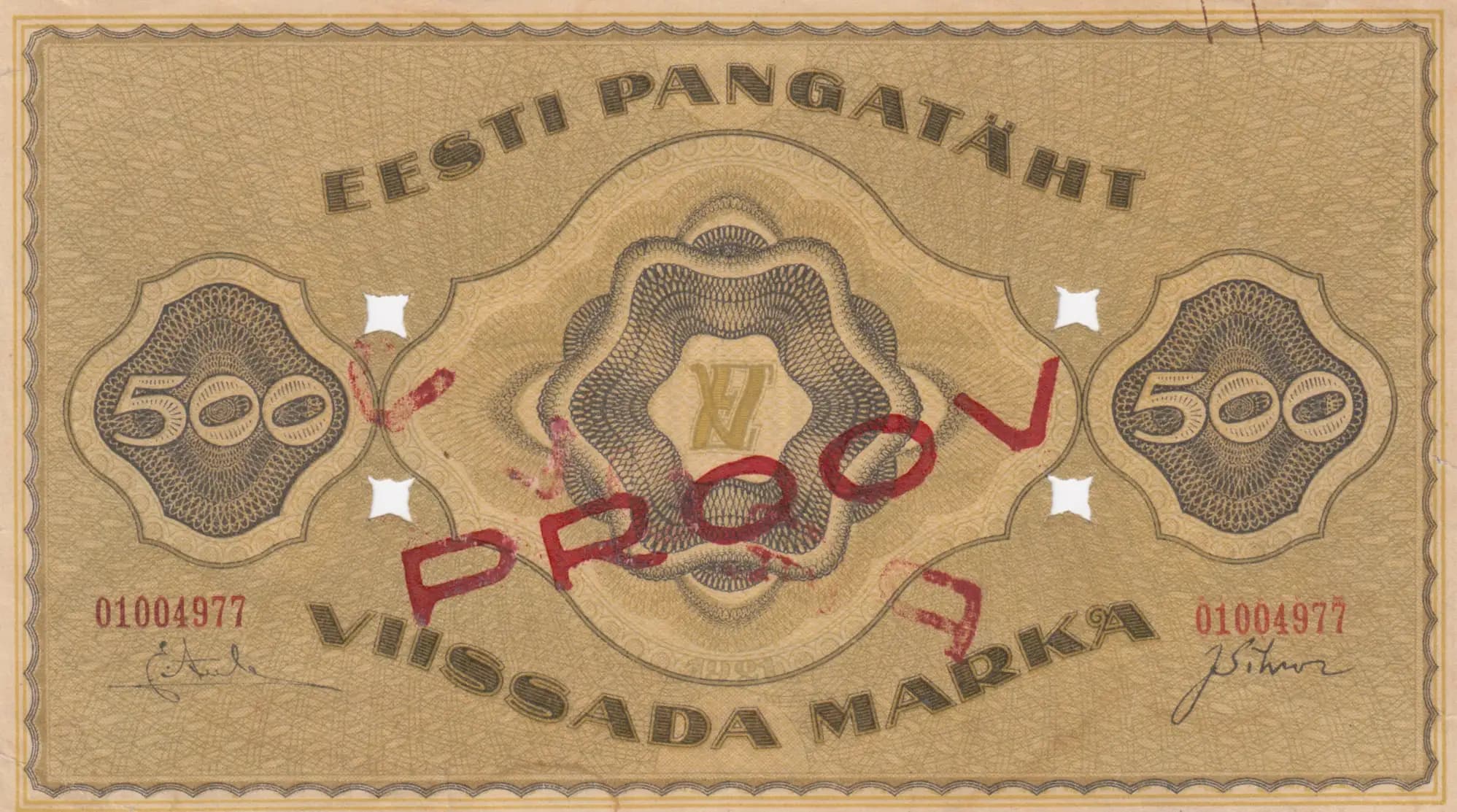
“red serial #”
Market Prices
About This Note
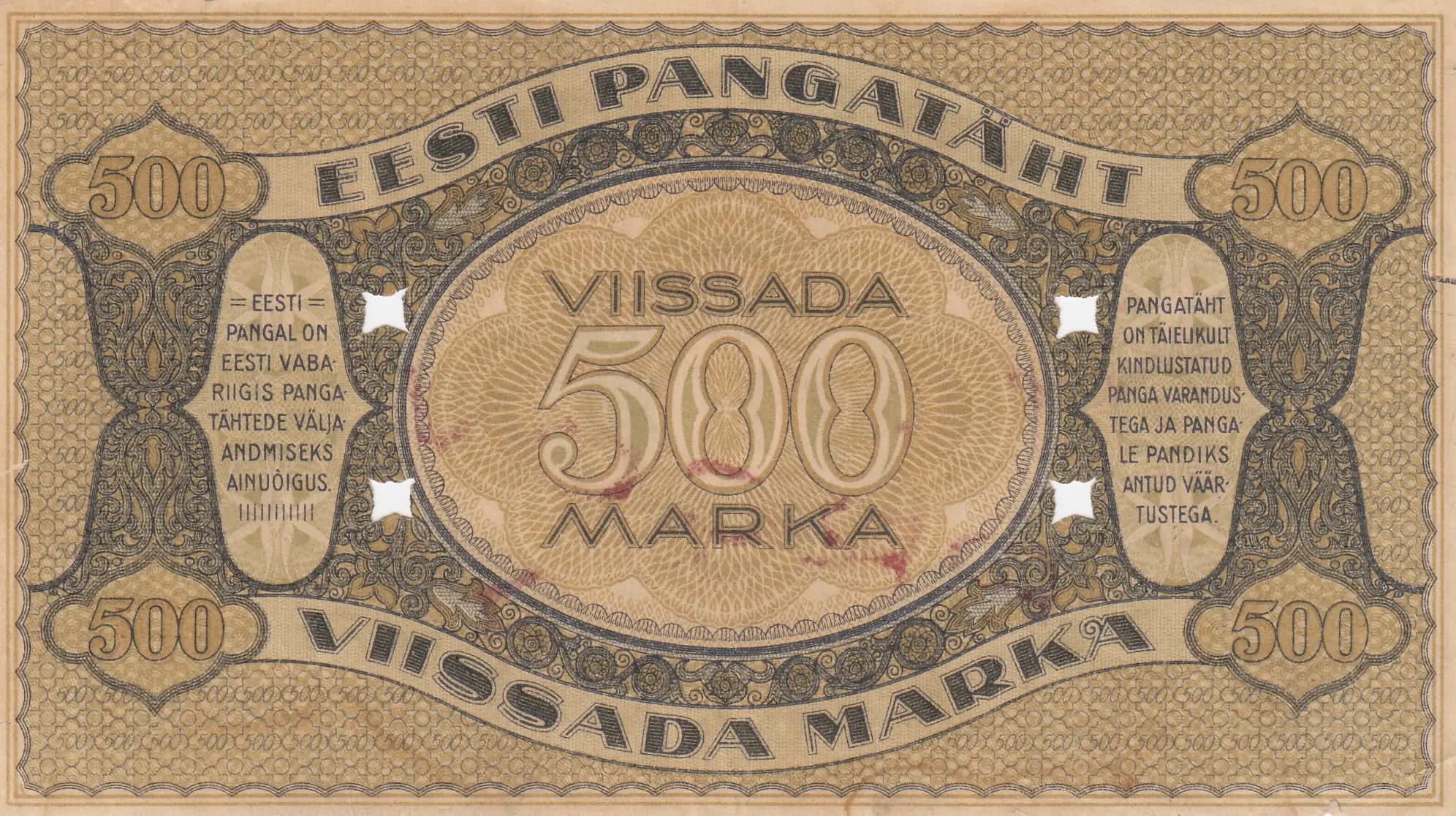
This is a VF-grade 1921 Estonian 500 Marka specimen note featuring a distinctive beige and tan ornamental design centered on a rosette medallion with the denomination prominently displayed. The note bears a red specimen marking across its face and displays characteristic period foxing and discoloration consistent with a preserved historical specimen. As one of Estonia's earliest banknotes issued during the Treasury period, this specimen represents a significant artifact from the newly independent Estonian republic.
Common. Despite being a specimen note from 1921, eBay market data shows consistent availability with VF-grade examples trading in the $45-$82 USD range, and even UNC examples occasionally selling under $120 USD. The catalogue value of $1,500 for VF grade represents a significant premium over secondary market pricing, suggesting limited collector demand relative to supply. Early Estonian banknotes, while historically important, were produced in reasonable quantities and specimen notes were routinely preserved by financial institutions, resulting in adequate survivor populations. The note is collectible and historically significant but not scarce.
The 500 Marka denomination was issued by the Treasury of Estonia in 1921, during the formative years of the Estonian Free State following independence from Russia in 1918. The inscriptions on the reverse explicitly declare 'The Estonian Bank has the sole right to issue bank notes in the Estonian free state,' reflecting the nation's establishment of monetary sovereignty. The ornamental design with the EV monogram (Eesti Vabariigi) emphasizes Estonian national identity during this transitional period of state-building.
The 500 Marka features a classical ornamental design without portraits or landmarks, emphasizing geometric and floral motifs typical of early 20th-century European banknote design. The obverse is dominated by a central rosette medallion containing the denomination, flanked by circular decorative emblems on either side, with the numeral 500 repeated in these cartouches. The reverse presents an oval medallion in the center with the denomination, complemented by ornamental cartouches in all four corners and decorative text panels containing the bank's statutory declaration of monetary rights. Fine scrollwork, diamond shapes, and repeating circular dot patterns fill the background, demonstrating sophisticated engraving technique. The light green and gray color scheme on the obverse, with beige and tan tones predominating overall, creates visual distinction from contemporary issues.
Front side: 'EESTI PANGATÄHT' (Estonian banknote), 'VIISSADA MARKA' (Five hundred marks), denomination '500', serial number '01004977', and 'SPECIMEN' marking. Back side: 'EESTI PANGATÄHT' (Estonian banknote), 'VIISSADA MARKA' (Five hundred marks), denomination '500', 'EESTI PANGAL ON EESTI VABA RIIGIS PANGA TÄHTEDE VÄLJA ANDMISEKS AINUÕIGUS' (The Estonian Bank has the sole right to issue bank notes in the Estonian free state), and 'PANGATÄHT ON TÄIELIKULT KINDLISTATATUD PANGA VARANDUSE TEGA JA PANGALE PANDIKS ANTUD VÄÄRTUSTEGA' (The banknote is fully secured by the bank's assets and values pledged to the bank).
Intaglio (engraved) printing on banknote paper, utilizing fine line engraving and microprint patterns characteristic of security printing from the period. The intricate geometric patterns, rosette and oval medallions, and decorative borders demonstrate the high-quality craftsmanship expected of official state currency. The paper contains an EV watermark visible in the specimen note, consistent with Treasury issue standards of 1921.
This is a Pick P-57s specimen variant, as indicated by the red specimen marking and SPECIMEN text visible on the note. The Pick catalog lists only P-57a as a known variant in the PMG population report, suggesting this specimen issue (P-57s) may not have been formally differentiated in comprehensive grading databases. The red serial number (01004977) is noted in the collector notes and is visible in the image analysis. Specimen notes typically represent non-circulating trial or presentation pieces and may exist with or without overprints; the presence of red SPECIMEN marking is the defining characteristic of this variant.